


















Apas. Organic Coffee
Brazil is the world's largest coffee producer. Yet less than 0.5% of total production is grown organically. The Brazilian approach to producing coffee is geared toward high yield on little land. The soil is often understood as a substrate rather than a living organism. Those who switch to organic in Brazil must change not only their methods, but above all their understanding of agriculture. Apas did that, and we accompanied them on the journey.

Show that it works
What is this project about?
Fast 80% of emissions in the coffee chain come from coffee production. So if we want to reduce emissions in the coffee chain, we as a roastery must start at the origin. The switch from conventional to organic production is the biggest lever because it eliminates the emissions-intensive production and application of synthetic fertilizer. Our Apas coffee has been organic since 2022, but that's not a final state. It's the beginning of a process to produce coffee in a way that conserves resources and regenerates them even better, in a region that is already heavily affected by rising temperatures and increasingly unstable weather patterns. The efforts required to produce coffee sustainably in the long term go beyond the organic seal. APAS knows this too and continues to educate itself to equip farms in the future to be more resilient to external influences and to shape coffee production increasingly as a circular process.
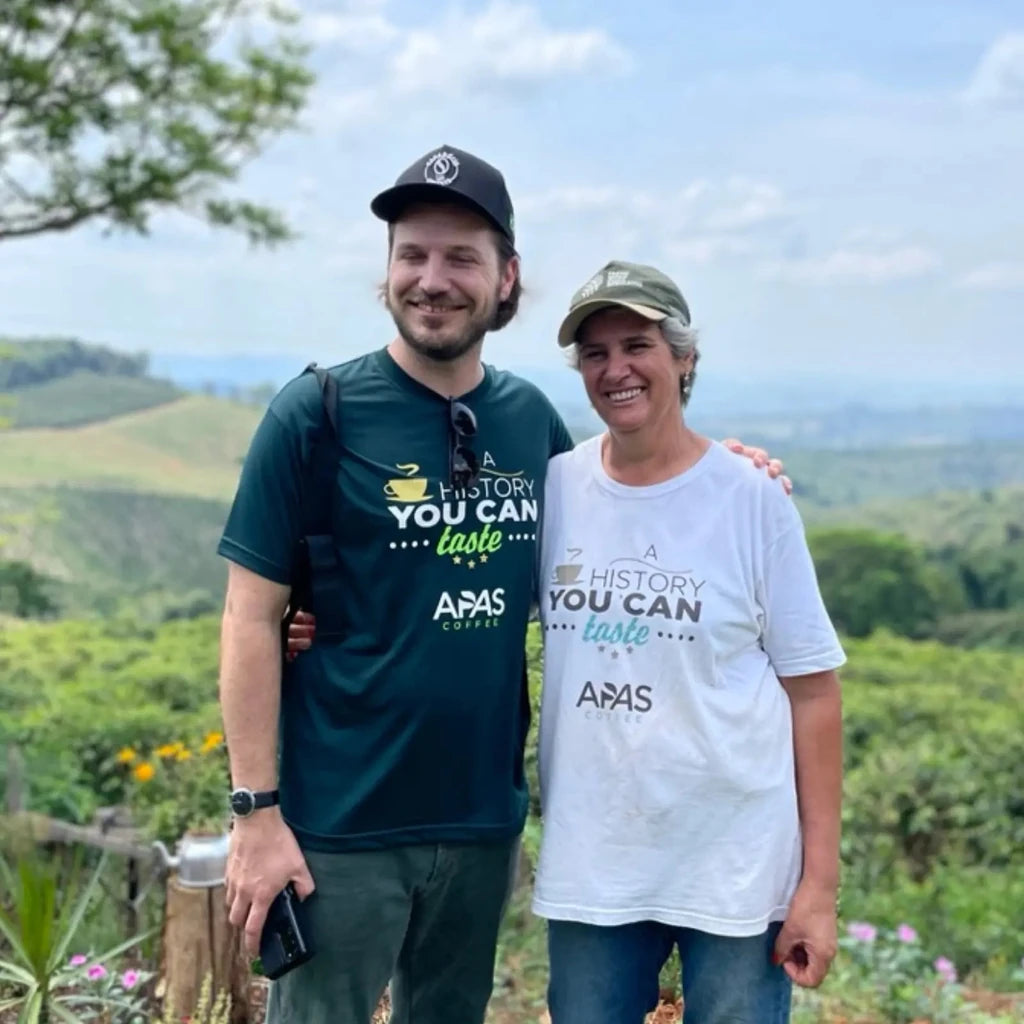
Alessandro Hervaz, co-founder of APAS, was at various coffee trade shows in Europe in 2016 and realized that the European markets offered great potential for organically produced food. Back in Brazil, he wanted to try growing his coffee organically himself.
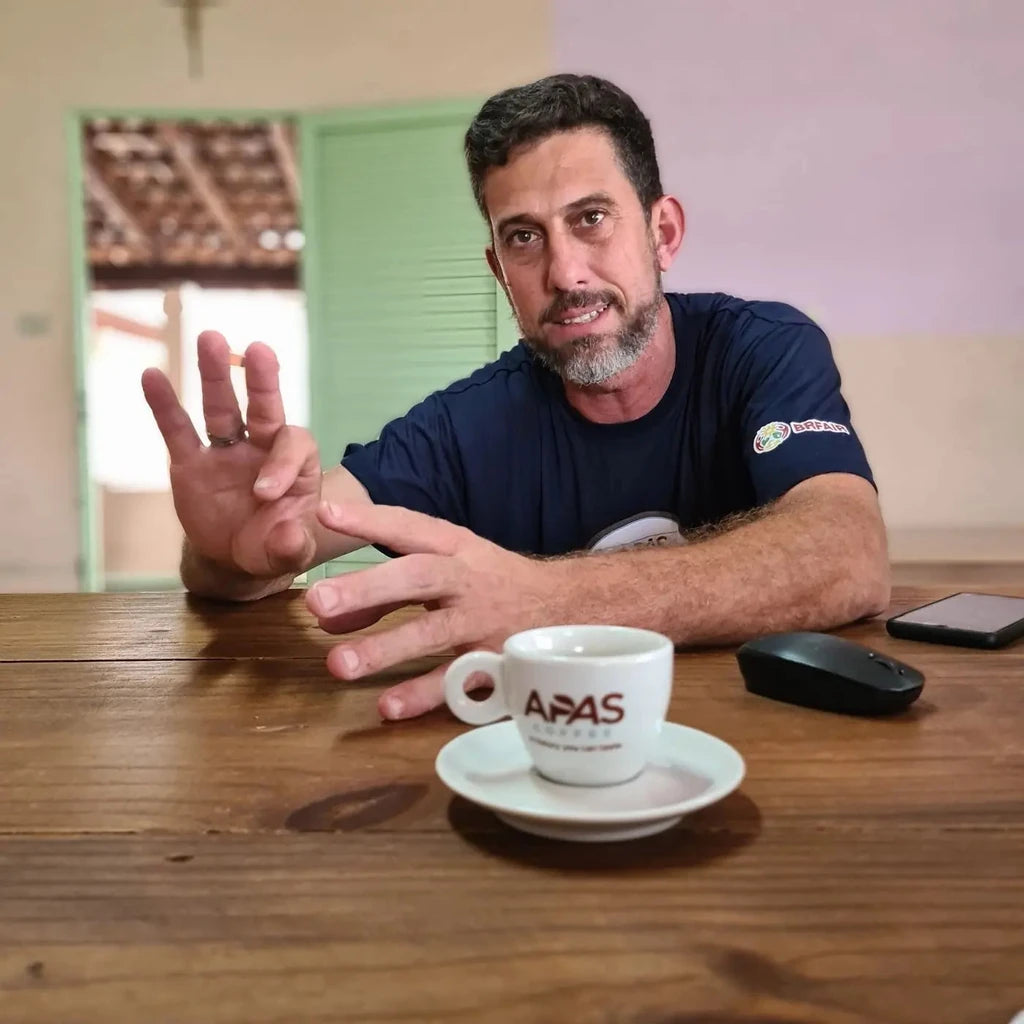
"But there were no products, no technology, no know-how in our region, so we gathered all the information together and invited experts to workshops."
Several APAS members also saw potential in their way of coffee production for a more natural approach to farming. They decided to start producing organically on certain parts of their farms.
"At first, everyone doubted. Now new producers come to us and want to do organic with us."

Apas and us
Milestones
Since 2017, we have imported coffee from Apas. Today the cooperative is a strategic partner.
First visit 2019
In 2019, Felix visited the Apas cooperative. It was the foundation for a personal relationship. Since then we see each other every year.
Apas goes organic 2022
We paid 75% of the organic price during the transition, which at the time motivated 13 producers to make organic coffee for us.
Apas Decaf 2025
So that all Apas fans can also drink decaffeinated coffee, we had our own batch decaffeinated in Bremen for the first time.
"Together we can achieve a lot. Apas is open and motivated, and their coffee is loved by our community. The leverage is there and we will change even more together."

Facts & Figures
What does organic mean for coffee in Brazil?
The transition from non-organic to organic production takes three years if conventional farming was used before. Such a transition requires a lot of botanical and agronomic understanding, as well as a reversal in thinking – especially in Brazil, where organic is barely present.
Basically, the nutrients a plant needs can be divided into macro and micronutrients. If the macronutrients nitrogen (N), phosphorus (P), and potassium (K) are well covered, that's already half the battle - but plants that are supposed to yield also need other nutrients like magnesium, zinc, or boron, which are co-responsible for flower or cherry development.
Previously, the NPK macronutrients were applied with a ready-made mixture. For organic farming, however, an alternative is needed, which Apas replaces as follows:
N: Nitrogen-based mineral fertilizer is replaced by bone meal
P: Phosphorus is replaced by various, naturally occurring minerals
K: Potassium is replaced by cascara, the dried pulp of the coffee cherry
By now we know that up to 75% of the emissions from a cup of coffee are emitted in the country of origin.
More than half of our purchased raw coffee comes from Apas. Durch the transition to organic has reduced our Scope 3 emissions.
As a coffee roastery, we understand our position in the coffee chain. We are among the actors who determine through their purchasing decisions what actually lands on a roasted coffee market.Since we have significantly more selection of coffees that we could potentially buy, we also see ourselves as having greater responsibility as consumers to decide what good coffee is. Consumers can only choose from a small assortment of roasteries and have significantly less decision-making power than roasteries.
Apas now produces its own fungicides and pesticides on an organic basis in its own bio-factory. The next visit is scheduled for 2026. A main topic will be shade. The region was deforested until the mid-20th century, and today there is almost no primary forest left. But coffee needs shade from other trees. That's where we're now starting conversations with Apas.






Pickup available at Kaffeemacher:innen
Usually ready in 24 hours
Apas, Organic Espresso from Brazil
250 g
Kaffeemacher:innen
Otto-Lilienthal-Straße 13
46539 Dinslaken
Germany


Apas Decaf - Kaffeemacher Info
|
Flavor |
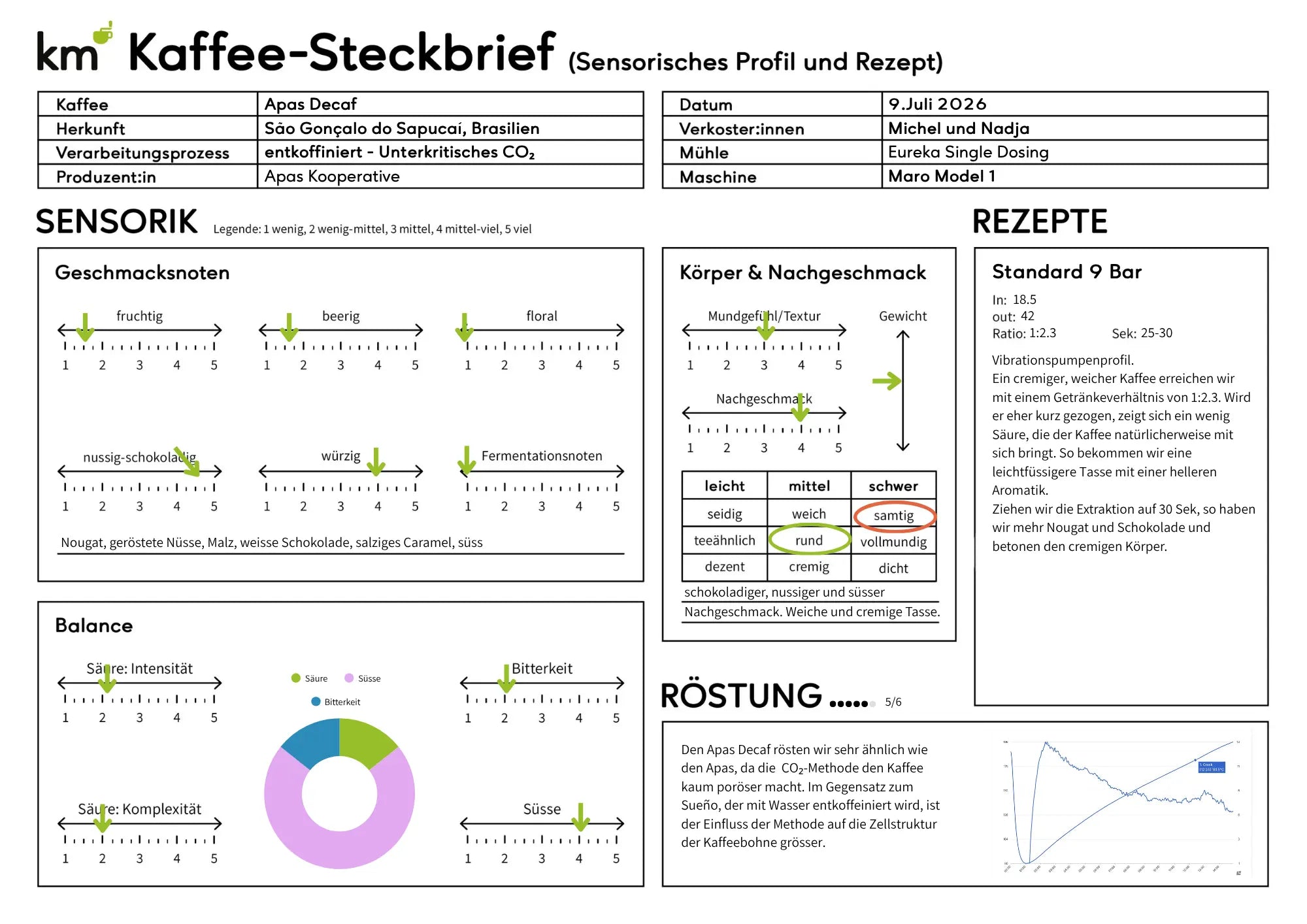
Nougat, roasted nuts, chocolatey |
|
Origin of Beans |
Brazil, São Gonçalo do Sapucaí |
|
Producer |
Apas Cooperative |
|
Varieties |
Local varieties such as Mondo Novo (Arabica) and Catuai (Arabica) |
|
Post-Harvest Process |
Natural |
|
Decaffeination |
Sub-critical CO₂ (natural sparkling carbonic acid) |
|
Decaffeinator |
CR3 in Bremen |
|
All of our coffees are sold as whole beans. |
|
How We Would Prepare Apas Decaf

Why Does Apas Decaf Taste the Way It Does?
The APAS blend is a mixture of coffees from 71 members of the cooperative who market their coffee under the APAS name. They are among Fairtrade pioneers in Brazil and manage their farms in the region around São Gonçalo do Sapucaí. Time and again, they also achieve success as individual producers in renowned competitions such as the Cup of Excellence. The coffee cherries for the APAS blend are selectively harvested by members on their own farms, dried in the cherry, and then mechanically depulped. This dry processing underscores the nutty and chocolatey character of the coffee.
Tell Me More About Apas Decaf
For years, APAS has been our bestseller because it delights many tastes. We now import several containers per year. The coffee and our collaboration with the cooperative are strategically important to us. In winter 2024, we asked ourselves: What if APAS also existed in decaffeinated form? We contacted decaffeinator CR3 in Bremen and reserved a slot for spring 2025. The APAS blend was shipped to Bremen, decaffeinated there, and we subsequently took the approximately three tons of coffee together with friendly roasteries.
The Decaffeination Process
This coffee was decaffeinated by CR3 in Bremen using sub-critical CO₂, known as sparkling carbonic acid. What all processes have in common is that at the start of treatment, the green coffee is placed in a closed vessel with water or steamed so that the pores of the green coffee open. A solvent is then added to extract the caffeine. In this case, it is the sparkling carbonic acid. In the sub-critical CO₂ method, the CO₂ is converted to a liquid state at high pressure and low temperature conditions, which in combination with water can absorb the caffeine. This process takes several days.
How Do We Roast This Coffee?
Very similarly to the Apas, since the CO₂ method makes the coffee hardly more porous. In contrast to the Sueño, which is decaffeinated with water, the influence of the method on the cell structure of the coffee bean is greater.
Read Coffee Details in Beanconqueror:

Pickup available at Kaffeemacher:innen
Usually ready in 24 hours
Apas Decaf, decaffeinated espresso from Brazil
250g
Kaffeemacher:innen
Otto-Lilienthal-Straße 13
46539 Dinslaken
Germany