






















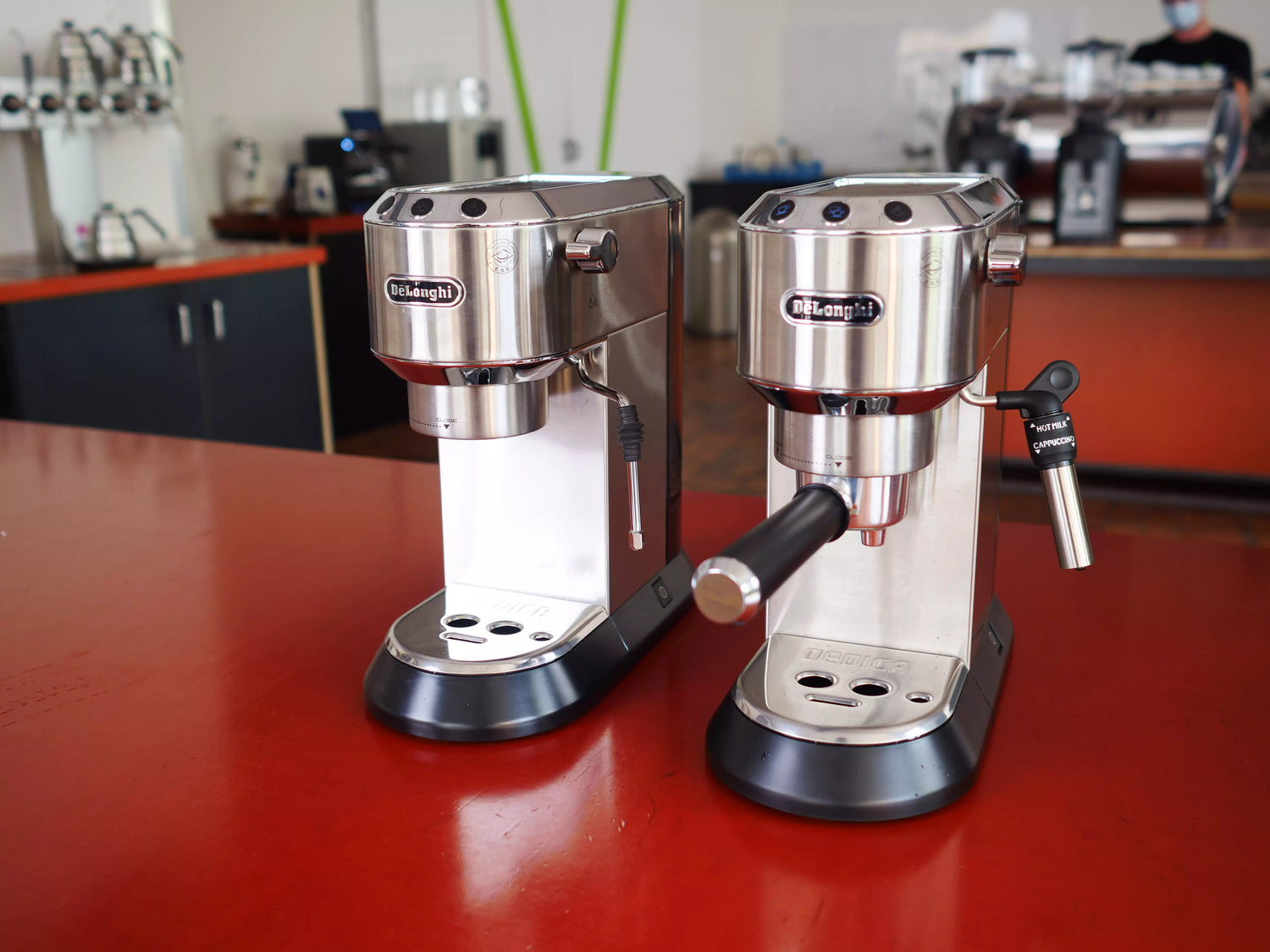

The DeLonghi Dedica EC685 is the machine we get asked about most. We have tested it three times, most recently in our thermoblock series with the measuring portafilter, and by now we know every one of its quirks: how it overshoots on the first shot, why the supplied portafilter drips as soon as you convert it, and how you still get 93 °C out of it, shot after shot. This article is the manual DeLonghi does not include: setting the temperature, temperature surfing, programming the volumetrics, the typical mistakes and what to do about them. If you still need to decide between the 685, the Arte 885 and the Duo 890, read our review of the whole Dedica range first.
We bought every Dedica in our tests; DeLonghi neither supplied machines nor saw this text. We do not sell espresso machines, but we do sell accessories for the Dedica that we developed because nothing usable existed. Wherever we link to them, we say so.
The essentials on the EC685 in 30 seconds
The EC685 costs 119 to 160 euros, is ready in 20 seconds and uses 0.017 kWh per double shot. It has three temperature levels, volumetrics with 1.5 grams of deviation and a plastic Pannarello nozzle. With the right warm-up routine it holds 93 °C; without it, it shoots up to 105 °C.
The box contains only double-wall (pressurised) baskets and a plastic scoop with a stamp. You replace both, otherwise the EC685 remains a machine for pre-ground coffee. With a single-wall basket, a real tamper and a grinder, it is the cheapest espresso machine we recommend.
What's in the box and build quality: steel outside, plastic on top
The side panels are brushed stainless steel, the top is plastic. For the price, it feels good. The machine is 15 centimetres narrow and so light that it moves when you unlock the portafilter; one-handed, nothing works, the second hand always holds the machine. We found no sharp edges anywhere.
The water tank sits at the back, lifts out upwards and is almost too big for home use. If you only top it up instead of emptying and cleaning it, you will eventually get a mossy off-taste in the cup. Empty and rinse it once a week, don't just refill it; that is our recommendation.

The drip tray is a closed plate with three holes instead of a grate. The flush water misses the holes, so a cloth lives next to the machine permanently. Well done, on the other hand, is the float that rises when the tray is full. Beneath it sits a second plate that catches drips when the tray is out. If the plate bothers you: we made a drip tray grate that fits the tray and gives two cups room side by side.
Supplied are three double-wall baskets, also called pressurised baskets (one portion, two portions, pods), and a plastic scoop whose back is meant to serve as a tamper. This “tamper” does not deserve the name. The cheap plastic is regularly warped and does not sit flush in the baskets, which makes straight, even tamping impossible. The original basket would need a tamper of just under 50 millimetres; our single-wall baskets take 51 millimetres. More on that below.
Setting the temperature: three levels, level 2 for most coffees
The EC685 has three brew temperatures. From the factory it is set to level 1. We measured all three with the measuring portafilter, each after the warm-up routine from the next section:
| Level | Temperature during the shot | Suits |
|---|---|---|
| Level 1 (factory setting) | 90 to 91 °C | very dark roasts, classic Italian |
| Level 2 | 92 to 93 °C | most espressos, including our Apas |
| Level 3 | 95 to 97 °C | almost never, at most very light roasts |
Our recommendation is level 2. In our first test in 2019 we had advised the lowest level, because the machine overshoots without a routine. With the routine, level 2 is the right starting point for everything from medium to light roasted. Level 1 remains the choice for dark supermarket roasts.
Here is how to change the level; you only need to do it once:
Temperature surfing: why the first shot overshoots and what helps
The thermoblock is hot in 20 seconds; the stainless steel portafilter is not. If you brew straight after warming up, the first water out of the block is too hot. We measured 105 °C on the first shot, once 108 °C on level 3. Then the cold portafilter cools the water down so far that the extraction ends around 88 °C. 93 °C becomes a lottery.
There are two ways to deal with it. The first: lock in the cold portafilter with coffee and brew straight away. The overshoot partly compensates for the heat loss, but the espresso is still erratic, in most cases less soft and less balanced. The second way takes one minute and delivers a reproducible 93 °C:
For the second and third espresso in a row, step 1 is not needed; the portafilter is already hot. The two pre-infusions stay.
“The fixed pre-infusion of four to five seconds cannot be switched off. I'm relaxed about it: it's a constant you can work with, and it forgives sloppy puck preparation. You can't control it, but you can plan for it.”
Programming the volumetrics and the auto-off
The two brew buttons each store one volume. Programming works like this: scale under the cup, hold the button, let go at the target weight. The machine remembers it for the next shot. Felix weighed the output over 10 to 15 shots, first with water, then with coffee: 1.5 grams of deviation. That is better than some heat-exchanger machines at four times the price that have no volumetrics at all.
The volumetrics measure water, not resistance. If you change the grind setting or the dose, the amount in the cup shifts. So the scale stays for weighing the coffee; under the cup you can leave it out once grinder and machine are dialled in.
From the factory, the EC685 switches itself off after 9 minutes. That can be changed to 30 minutes or 3 hours; we see no reason to: after 20 seconds it is ready again, and a thermoblock that is not running uses nothing.
The original portafilter: convert or replace
The biggest problem of the EC685 is not in the machine but in the portafilter. The double-wall (pressurised) baskets have a single exit hole at the bottom, build up pressure artificially and produce crema no matter how the coffee is ground. For fresh coffee from your own grinder they are a brake: the machine does not react to the grind setting, so there is nothing to dial in. On top of that comes the rubber tab for lifting out the basket, behind which coffee grounds get stuck after every shot, out of reach of any cloth. Old grounds make the next espresso bitter. How double-wall baskets work exactly is explained in our article on the double-wall basket.

In the test we pulled the same Apas espresso once with the original basket, 14 grams to 28 grams: unbalanced, sharp acidity, a dry, papery off-note, the crema gone after 30 seconds. Then with a single-wall basket, 18 grams to 48 grams: round, sweet, nutty. Same machine, same level, same coffee.
Converting works, but it is a compromise. Inside the original portafilter sits a plastic insert with a valve. Remove the spring, undo the Phillips screw at the bottom, pull out the insert. Now a single-wall basket fits, but the portafilter has three holes at the bottom instead of one spout, and the espresso comes out in three places. For one cup that works, for two it does not, and it drips from every corner.
Replacing is the clean way. Because for a long time there was no usable portafilter for the Dedica, we made our own: the double-spout portafilter for two cups or one, with a 12.5-gram or a 16-gram basket, and the bottomless portafilter, which makes channelling visible immediately. If you want to keep and convert the original portafilter, you can get the 51 mm baskets on their own. They go with a 51 mm tamper that sits flush in the basket. The plastic stamp from the box belongs in the bin.

Everything we offer for the Dedica is collected in the accessories overview. Which three upgrades are really worth it, and in which order, is described in the review of the range.
Milk foam with the Pannarello: it works, even without a conversion
The Pannarello nozzle draws in a lot of air and creates little rotation. Still, you can make cappuccino foam with it if you adapt your technique: nozzle flat against the jug wall, stay there until the milk rolls, and don't go deeper than necessary. A conversion is not compulsory. If you want it cleaner, pull off the Pannarello and secure the silicone tube underneath with two cable ties, or fit a stainless steel steam wand, now available to fit the Dedica.
More important than the nozzle is the order: espresso first, then milk. For steam the thermoblock heats up, and cooling down afterwards takes one to three minutes. If the buttons flash twice after steaming, the machine is too hot for espresso. Then open the steam knob over an empty jug and release steam and water until the flashing stops. Whether you are in hot milk or cappuccino mode makes hardly any difference when drawing in air. The thermoblock does not have much power; a small jug takes around 30 seconds; for two cups, steam twice.
After every steaming, pull off the Pannarello and rinse it together with the inner tube under the tap. Whatever milk builds up in there, you will taste in the next cappuccino.
Typical EC685 problems and what helps
The espresso drips after the stop. The EC685 has no expansion valve; the residual pressure escapes through the portafilter into the cup. 14 grams on the scale quickly become 18. Stop earlier or allow for two to four grams of run-on.
It splatters when you unlock. Same cause. If you grind too fine, you have a pressurised portafilter after the shot. Wait a few seconds before unlocking, and set the grind one step coarser.
The first espresso tastes burnt, the second sour. The first was too hot (overshoot), the second too cold (cold portafilter). Run the warm-up routine, see above.
The buttons flash twice. The machine is too hot after steaming. Open the steam knob over a jug until the flashing stops.
The steam button flashes orange. Descale, now. How it works, step by step, is in Descaling the Dedica.
The espresso tastes bitter and stale although the coffee is fresh. Grounds behind the rubber tab of the original basket. Take the basket out completely and wash it, or switch to a single-wall basket straight away.
A mossy off-taste. Water has been sitting in the tank too long. Empty and rinse the tank instead of just topping it up.
The crema is gone after 30 seconds. Double-wall basket. The crema was never real. Change the basket, dial in the grinder, and it will hold.
Backflushing with a blind basket? No. The Dedica has no relief valve; the path into the drip tray does not exist. Daily, rinse the portafilter and wipe the shower screen; weekly, take the basket out and wipe the gasket. Everything else is in Cleaning the Dedica.
EC685 or Arte EC885?

Technically the two machines are identical: same thermoblock, same pump, same group, same volumetrics, same temperature levels. Felix laid the drawings side by side and compared the temperature curves for two days. The difference is in the box: the 885 comes with a metal steam wand, a tamper with a metal base and a small milk jug. If you only drink espresso, take the 685 and put the 50 euros you save into a single-wall basket. If you want cappuccino, take the 885 while it lasts; DeLonghi no longer lists it. The full comparison, including the Dedica Duo EC890, is in the review of the range.
The EC685 is an entry-level machine; the grinder does not have to be. Whoever changes machines at some point keeps the grinder. A hand grinder that grinds fine enough for espresso is enough to start with. Whether the most-bought Dedica grinder is good enough is answered in our short review of the DeLonghi KG521. The complete path from grinder to cup is described in Perfect espresso with the Dedica.
If you want to be guided through the EC685 from the first start to a dialled-in recipe: in our online course for the Dedica, Felix and Andrea show you in six modules and more than 20 videos how to match grinder, temperature and volumetrics. Permanent access, 35 euros.
Frequently asked questions about the DeLonghi Dedica EC685
Which temperature should I set on the EC685?
Level 2, which corresponds to 92 to 93 °C during the shot. Level 1 (factory setting, 90 to 91 °C) only for very dark roasts, level 3 (95 to 97 °C) almost never.
How do I set the temperature on the Dedica?
Hold the steam button until the three buttons flash. Press the espresso button once, then the button for level 1, 2 or 3 from the left. A flash confirms it.
Why is the first espresso from the Dedica too hot?
The thermoblock is hot in 20 seconds; the portafilter is not. Without preparation, up to 105 °C comes out of the block. Blank shot with the portafilter, pre-infusion twice, wait one minute, then brew.
Does a single-wall basket fit the original portafilter?
Yes, if you remove the plastic insert (spring, Phillips screw). The portafilter then has three holes at the bottom and drips. Cleaner is a dedicated portafilter with a 51 mm single-wall basket.
Which tamper fits the Dedica EC685?
For the single-wall 51 mm baskets, a 51 mm tamper. The original basket is slightly smaller; just under 50 mm fits there. The plastic stamp from the box tamps at an angle.
Can I steam milk with the EC685's Pannarello?
Yes, with a little practice. Espresso first, then steam, nozzle flat against the jug wall. It gets better with the cable-tie trick or a stainless steel steam wand, but the conversion is not compulsory.
How often does the EC685 need descaling?
At the latest when the steam button flashes orange. With hard water every three months, light or no light.
Verdict
The DeLonghi Dedica EC685 has been the cheapest espresso machine we can recommend since our first test, and after the third test it still is. It is ready in 20 seconds, uses next to nothing, has volumetrics that put some expensive heat-exchanger machines to shame, and with the warm-up routine holds a reasonably stable 93 °C. For 120 euros, that is a lot.
It has the weaknesses of its class: no expansion valve, a fixed pre-infusion, a drip tray with three holes, a body that moves when you unlock the portafilter. And it has one fault that has nothing to do with the price: the double-wall basket with the rubber tab and the plastic stamp. Both prevent exactly what you buy an espresso machine for.
With a single-wall basket, a real tamper and a decent grinder, the EC685 becomes a machine you can learn espresso on, in the camper van, in the workshop or in the kitchen. Consistency remains work, but it can be learned. If you are looking for the heavy, hands-on feel of a traditional espresso machine, you will not find it here. If you want to know whether espresso at home is for you, there is no cheaper way to find out.
As always, we bought all the Dedicas ourselves. This test was not requested by DeLonghi.
More Dedica videos (in German): 685 vs. 885 (series 1/5), Making good espresso (series 3/5), Descaling (series 4/5), Cleaning (series 5/5).

Die Maschine tut was sie soll und ist zuverlässig seit 3 Jahren bei mir im täglichen Betrieb. Mit euren Tipps konnte ich den Espresso Geschmack optimieren.
Nach dem Umstieg auf euren passenden Siebträger mit 2-fach Auslass und dem einwandigen Sieb, dreht sich der Siebträger allerdings beim Brühen heraus. Es folgt ein riesige Sauerei. Es scheint, als würde der Siebträger zu wenig Widerstand haben. Das passiert auch beim gröbsten Espresso-Mahlgrad und 14 Gramm im großen Sieb.
Der originale Siebträger mit gleichem Sieb und Kaffeemehl bleibt drin.
Habt ihr damit Erfahrung und was sind Fehlerquellen? Die Maschine ist gereinigt.
Vielen Dank für euren Content.
Ich freue mich auf eine Antwort.


1. Wow was für toller Content!
2. Ich wohne gerade neben dem OzL (orte zum leben) wo ihr geholfen habt kaffee zu rösten.
Den daraus entstandenen Kaffee bin ich gerade mit eurem dedica setting und niche am testen.
Mit dem Lungo habe ich Mühe. Der wird mir zu wässrig. Was könnte ein gutes Verhältnis sein?
Gwnerell habe ich das Gefühl ich bringe nur eine halbe Tasse Lungo hin. Sobald ich gröber werde wird er wässrig.
vielen Dank

ich wollte euch mal fragen, wie eure Erfahrungen mit der Dedica 685 in Bezug auf Konstanz und Reproduzierbarkeit der Ergebnisse sind.
Ich benutze den Siebträger der Kaffeemacher:innen, wiege immer dieselbe Menge Bohnen ab, mahle mit der DF64v immer auf derselben Stufe, benutze immer ein Levelling Tool und das Ergebnis in der Tasse ist stets eine Überraschung. Mal bricht die Maschine von selbst ab; mal habe ich exakt 1:2 mit 28 Sekunden raus; mal 1:2 in 24 Sekunden; dann eher ein Ristretto etc.
Ich bin auf der Suche nach der Fehlerquelle und würde sie gerne eliminieren ;)
Liegt es an meiner Maschine?
Liegt es an der Mühle, weil die Mahlscheiben vielleicht nicht exakt parallel ausgerichtet sind?
Oder liegt es an mir? :-D
Ich freue mich über eure Erfahrungen.
Viele Grüße aus dem Allgäu
Nadine

Kaffee ist ein Frischeprodukt und beim Kauf von Kaffee empfehlen wir immer, aufs Röstdatum zu achten. Bei Espresso gilt: Zwei Wochen ab Röstdatum ist der Kaffee "brühbar" und ich schaue immer, das ich den Kaffee in den nächsten 2 Wochen dann trinke. Wenn du immer mit dem gleichem Mahlgrad mahlst, verändern sich deine Ergebnisse immer aufgrund der Alterung von Kaffee. Schau dir mal hier unser Video dazu an:
https://youtu.be/P59nGgSsso4?si=w5Yq4k9eE0z7peG7
Schau beim Brühen immer aufs Getränkeverhältnis und stoppe nach Gewicht. Danach den Mahlgrad so korrigieren, das du auf deine gewünschte Extraktionszeit kommst.
Grüsse
Andrea
Beim Lungo würde ich ein Verhältnis von rund 1:7 empfehlen. Wenn der Lungo einfach nicht gut kommen will, dann empfehle ich dir, einen Americano zu brühen. Zuerst einen Doppio ziehen, und danach mit heissem Wasser strecken auf dein gewünschtes Verhältnis.
Grüsse
Andrea

Mir stellt sich gerade folgende Frage: Wenn ich das Duschsieb abmontiere, ist darunter ein schwarzes Gummi zu sehen. Aus diesem Teil kommt wahrscheinlich das Wasser. Ist es vorgesehen das dieser abmontiert und ebenfalls gereinigt werden kann? Lässt dieser sich einfach abziehen oder Ähnliches oder ist das doch mit mehr Arbeit verbunden?
Grüße
Otis

habt ihr euch schon mal die EC950 im Vergleich angesehen? Auf der Homepage von Delonghi schreiben sie, daß es sich um einen "Advanced Thermoblock" handelt. Gibt es tatsächlich einen Unterschied?
BIn auf der Suche nach einer Alternative zur meiner erst kürzlich erstandenen Sage Bambini, mit der ich keinen guten Esspresso hin bekomme. Hab leider zu spät euren Test gelesen...
LG Michael

Ich würde dir einmal eine Entkalkung empfehlen. Das kann sicherlich helfen um wieder heisser brühen zu können. Ich würde eher auf die Sensorik gehen. Solange die Sensorik stimmt, würde ich mir über die Brühtemperatur keine Sorgen machen.
Grüsse
Andrea


De'Longhi Dedica Style EC 685.R – Espresso Siebträgermaschine
Bei mir ist folgendes Problem aufgetreten:
Ich habe einen neuen "feinen" Kaffee gekauft. Beim Brühen bleibt extrem viel Wasser im Siebträger bzw. kommt unten nur tropfenweise der Kaffee heraus...
Ich habe die Maschine seit Jänner. Das Sieb ist auch nicht verlegt und die Öffnung unten im Einsatz habe ich auch noch zusätzlich erweitert.
Kann es sein, dass der Kaffee zu fein ist? Mahlgrad 1,7 - beim gröberen habe ich kein Problem - der ist allerdings sehr wässrig...
Bitte um Hilfe! :)

Ihr empfehlt in dem Artikel Temperaturstufe 1 für das Temperatursurfing, im Video ist es Stufe 2. Was ist nun die richtige Stufe, um die 92 bis 94 Grad gut zu erreichen? Danke und viele Grüße!

ich wollte mal fragen, ob ihr wisst ob die Dedica 685 einer besonderen Reinigung bedarf. Die Klassische Reinigung mit Reinigungspulver und Blindsieb funktioniert ja nicht, da es ja kein Rückventil gibt? Im Handbuch finde ich unter Reinigung und Entkalkung auch nur wie die Maschine entkalkt wird. Zur Reingung steht dort allerdings nichts. Wäre super, wenn ihr da Tipps habt, danke schonmal

Beim Spülen natürlich auch nochmal machen, damit der Entkalker raus ist.
Habe vor kurzem noch Reinigungstabletten von meinem alten Vollautomaten gefunden. Hab mal eine gemörstert und vor der Entkalkung durchgeschickt (auch mit Siebspülung) Das Wasser sah so aus als würde es was helfen ;-)
Bei Benutzung mit weichem Wasser reicht eine Entkalkung für den inneren Teil der Maschine. Ich empfehle dir, das Duschsieb einmal pro Woche abzuschrauben, und dieses sowie die Brühgruppe mit einem Lappen zu reinigen.
Grüsse
Andrea

wir sind auch seit neustem im Besitz einer Dedica und haben auch gleich die tollen Siebträger nachgerüstet. Die erste Maschine haben wir zurückgegeben, da sie sehr laut war, auch nach entlüften. Die zweite ist wesentlich besser aber sie ist trotzdem noch lauter als in euren Videos. Kann ich da was dran ändern? Vllt hat uns ja jemand ein Tipp!
Ganz liebe Grüße Lisa


Wenn es sehr günstig sein soll kann man es mit einer Handmühle probieren, z. B. eine Kingrinder oder die X PRO von 1ZPresso. Soll es eine elektrische Mühle sein, ist für Neulinge die Sage Smart Grinder Pro ein guter Einstieg.
Teurer geht immer, ich weiß nur nicht ob eine teurere Mühle bei der Dedica signifikant bessere Ergebnisse erzielt.

habe meine Delonghi Dedica nun seit knapp 2 Wochen, hab auch nur positives von gehört.
Da ich mir neben dem Espresso mal auch ein Cappuccino gönnen möchte vor allem Sonntags , ist mir auf gefallen wenn ich den Milchaufschäumer benutze und danach die Kaffeetaste betätigen will, um mir einen Cappuccino zu machen, blinken beide Kaffeetasten für circa 5-8 Minuten vor sich hin.
Ist das normal ,das die Maschine solange für den Abkühlzyklus braucht??
Bin auch ein Anfänger by the way
Beste Grüsse!

ich habe seit etwa einer Woche auch eine Dedica und bin (eigentlich) sehr zufrieden. Das doppelwandige Sieb werde ich zeitnah durch das von euch empfohlene Sieb austauschen. Mithilfe der kleinen Tricks und Kniffe aus euren Videos (Temperatursurfing & Co) konnte ich bereits ziemlich guten Espresso aus der Maschine quetschen. Nun hat seit zwei Tagen der Espresso einen merkwürdigen Geschmack, irgendwas zwischen bitter und wässrig. Die Kaffeemenge, Mahlgrad, Durchlaufzeit und Bohnen sind aber identisch wie zuvor, als der Espresso noch geschmeckt hat. Ich habe auch schon zwei andere Bohnensorten (frisch geöffnet und innerhalb der letzten 1-6 Tage gekauft) sowie einen anderen Mahlgrad ausprobiert, aber das hat auch nichts gebracht. Welche Ursachen könnte das noch haben?
Viele Grüße,
Jack

Das ist unheimlich schwierig zu beantworten. Ich denke aber, dass du sowieso mit dem "richtigen" Sieb nochmals eine krasse Veränderung haben wirst. Vielleicht liegt es einfach an dem aktuellen Sieb und deiner wachsenden Wahrnehmung für leckeren Espresso:)
Das ist mein aktuell verwendetes Setup:
1. Bodenloser Siebträger (inzwischen 2 Stück, davon einer mit Doppelauslauf)
2. Tamper mit eingebauter Feder von Normcore (das war für mich einer der Gamechanger, die Pucks werden zu 98% perfekt)
3. Feinwaage (habe ich 2 Stück, eine davon wiegt nicht nur sondern es läuft auch noch ein Timer mit)
Diese 3 Dinge sind für mich alternativlos, ohne das wird es - gerade für Anfänger - sehr schwer, sehr gute reproduzierbare Ergebnisse zu erzielen.
Außerdem nutze ich folgendes Zubehör:
4. Abklopfbehälter
5. WDT Tool
6. Distributor
6. Aufsatzring für Siebträger
7. Silikonmatte
8. Microfasertücher
Das sind für mich alles sinnvolle Sachen, die ich auch täglich nutze.
Bei der Dedica habe ich noch ein IMS Duschsieb installiert.
Außerdem habe ich die Milchlanze abgenommen und den Gummirüssel mit Kabelbinder fixiert, damit bekommt man sehr brauchbaren Milchschaum hin.
Die Tropfschale nutze ich auch nicht mehr, da tropft sowieso alles daneben. Dafür stelle ich ein passendes Schälchen hin.
Bei der Mühle habe ich das Mahlwerk verstellt, so dass ich nicht mehr bei Mahlgrad 2 oder 3 mahle, sondern zwischen 10 und 14. Das gibt mir wesentlich mehr Flexibilität.
Außerdem nutze ich den SGP nur noch im Single Dose Modus. Zu etwa 80% kommen nach 20 Sekunden von 18 gr zwischen 17,9 und 18,1 gr raus. Ist es weniger, mahle ich nochmal 10 Sekunden und klopfe ein paar Mal mit der flachen Hand auf den Deckel. Das funktioniert ziemlich zuverlässig und hat mich bisher davon abgehalten 600-700€ in eine neue Mühle zu stecken aber ich befürchte irgendwann kommt dann doch die DF-83.
Zum Bezug
Da wir hier sehr hartes Leitungswasser haben, nutze ich seit etwa 2 Jahren nur noch Wasser aus Flaschen. Beim Geschmack stelle ich keinen so großen Unterschied fest aber statt 4 x im Jahr muss ich nur noch alle 9 Monate entkalken.
Und dann natürlich der Kaffee - ohne vernünftige Bohnen wird das nix. Glücklicherweise gibt es in DE über 1.000 Röstereien, wo man permanent ausprobieren kann. Das ist natürlich alles Geschmacksache aber ich habe inzwischen "meine" Rösterei in Berlin gefunden. Nightingale, Hummingbird und Black Cap sind meine Favoriten. Aber auch der Apas von den Kaffeemachern schmeckt mir richtig gut.

Gamechanger bei mir war allerdings die Anschaffung eines Pucksiebs. Damit habe ich das Channeling stark reduzieren können.

gibt es bei euch auch einen Video zu der De Longhi 685 wie man einen Kaffee mit dem Pad zubereitet?
Oder die Einstellung für eine normale Tasse Kaffee?
Bei uns in der Familie möchte jeder was anderes.🙈
Wir haben einen richtig guten Siebträger, aber meinem Mann ist dies zu kompliziert. Deshalb sind wir auf eure Videos gestoßen, weil die De Longhi 685 recht gut abgeschnitten hat. Das wäre unkomplizierter für meinen Mann.
Auch wegen den Pads.
Es wäre schön, eine Rückmeldung zu bekommen, vor allem in Videoform.
Vielen herzlichen Dank.
Liebe Grüße
E. Schmitt
Über Pad's werden wir kein Video machen. Mit etwas Geduld gibt es aber bald eine Hilfestellung:) Wir halten euch auf dem Laufenden

ich habe schon länger die Delongi 685 und mir passend dazu eine vernünftige Mühle mit Kegelmahlwerk gekauft. Nun habe ich das Problem, dass bei einer feinen (Espresso-) Mahlung die Kaffeemaschine nicht schafft das Wasser durchzupressen. Könnt ihr mir einen Tipp geben wie ich das Problem lösen?
Gruß Sven
Dann bist du definitiv zu fein oder verwendest noch das doppelwandige Original-Sieb. Da empfehle ich dir auf jeden Fall ein Update.
Michel

Ich nutze die Dedica 685 schon ein halbes Jahr. Täglich trinken wir mit meiner Frau ca. 4 Tassen Esspresso. Zwei zum Frühstück, zwei am Nachmittag.
Die Einstellungen der Maschine sind nun nicht kontrolierbar. Man sieht nicht, was man einstellt. Man muss es einfach wissen und glauben...Ich habe die heißeste Stufe eingestellt (zumindest glaube ich es), weil ich den sizilianischen Kaffee Tonaca di Monaco zubereite. Die Temperatur wurde mir so empfohlen. Ich wiege die Kaffeemenge vorher einzeln und mahle natürlich separat. Die Wassermenge ist auch einstellbar, jedoch im Laufe der Zeit habe ich es mir angewöhnt, die Kaffeemenge in der Tasse visuell zu kontrollieren. Da ich sehr reines Wasser nutze, pH Wert 7,4, schmeckt der Kaffee wie in Palermo. Einfach lecker!
Ich mache zwei leere Spülvorgänge nach jeder Extraktion: zwei Tassen ohne Kaffee, nur sauberes heißes Wasser. Und trotzdem kommen Kaffeepartikel vom altgebrühten Kaffee raus. Für Familienfeier ist die Maschine nicht geeignet, weil es ca 3 Minuten je eine Kaffeetasse dauert. Wenn wir zu 6 sind, es dauert ca 20 Minuten, ehr ich mich hinsetzen kann und mein Kaffee trinken kann. Da sind die ersten Gäste schon mit ihrem Kaffee fertig. Aber alle haben meinen Esspresso sehr gut bewertet. Man kann natürlich einen doppelten Esspresso zubereiten. Jedoch reicht der Druck nicht aus, um danach einen normalen Esspresso zu zubereiten. Da habe ich zwei unterschiedlichen Malgradeinstellungen für einfachen und für den Doppelten Esspresso, da die Höhe vom gepressten Kaffee bei dem doppelten den Wasserfluss blockiert. Da kommt die Maschine an ihren Grenzen. Deswegen male ich den doppelten etwas grober...was auch nicht so sinnvoll ist.
Mit den gleichen Enstellungen schmeckt der Kaffee aus einer deutschen Rösterei nicht, es schmeckt eben sauer!
Ich bilde mich nun weiter, probiere wietere Einstellungen und gehe davon aus, dass nach einer gewissen Zeit genug Erfahrungen gesammelt haben werde, um den Prozess besser und schneller zu beherrschen.
Danke dir vielmals für deine Erfahrungen!

Ich habe neuerdings das Problem, dass viel zu wenig Druck auf der Milchdrüse ist. Habe den Aufsatz mit der Amazon-Düse aus eurem Link getauscht. Das hat alles super funktioniert, doch seit kurzem kommt kaum bis kein Dampf mehr raus. Anfangs hat sich das Problem nach dem entkalken gelöst doch seit dem letzten Entkalken hat sich nichts verändert.
Komischerwesie, wenn die Maschine nicht auf milchaufschäumen steht und ich den Regler nach hinten drehe kommt normaler Druck. Sobald ich den Knopf für Milch drücke fällt der Druck direkt und es kommt wieder kaum Dampf raus.
Habt ihr Idee an was das liegen könnte?
Das könnte auch ein Maschinen-Defekt sein. Grundsätzlich sollte sich der nicht verändern.

falls es die Edelstahl-Düse ist die man einfach nur aufsteckt statt der originalen Pannarello, dann wirds an der Düse liegen.
Hatte das gleiche Problem vor einiger Zeit.
Wenn du wieder die originale Düse einsetzt wirst du merken, dass die Dampffunktion nicht defekt ist.
Die Amazon China Düsen verstopfen irgendwie nach einer gewissen Zeit. Das Material verzieht sich bestimmt.
Ich habe letzten Endes die Rancilio Silvia Düse eingebaut. Es lohnt sich auf jeden Fall. Die Düse einzubauen ist relativ einfach. Es gibt viele Videos dazu auf YouTube.
Ein Tipp falls der Umbau durchgeführt wird:
Beim Einbau muss man unter anderem ein weißes Plastikteil an der originalen Lanze abziehen und dann auf die neue Lanze aufsetzen. Dieses Plastik Teil ist schwer zu bewegen, vorallem um die Kurve.
Wenn man das Plastikteil jedoch leicht erwärmt z.B. mit einem Föhn, dann geht's viel einfacher.

Ich glaub schon, dass sowas kaputt gehen kann. Leider kann ich dir aber nicht genauer weiterhelfen.
Michel

schau mal, ob an deinem Dampfrohr (https://www.juraprofi.de/DeLonghi-Ersatzteile/Milchaufschaeumer/Dampfrohr-fuer-DeLonghi-EC-680::16547.html)noch der kleine "Nupsi" existiert.
Wenn ja, dann achte darauf, dass beim Aufsetzen der Milchschaumdüse die entsprechende Aussparung übereinstimmt.
Falls dieser "Nupsi" fehlt, kannst du dir schnell helfen, indem du den Gummieinsatz der Milchschaumdüse mit drei Kabelbindern an der Düse befestigst. Sieht nicht schön aus, feiner Milchschaum lässt sich aber herstellen.
Aufwendiger ist es, die gesamte Dampflanze zu wechseln.
Bei Youtube habe ich ein Video gefunden (https://youtu.be/4e-VBhN8-ic?si=6ICAiA2qxHoLni37).
Die netten Kaffeemacher haben, glaube ich, auch einen entsprechenden Tipp.
Viel Erfolg bei der "Reparatur" und einem leckeren Capuccino zur Belohnung.
:-)

Lt. Beschreibung meiner Dedica 685 soll ich 2 Messlöffel Kaffeepulver in dem 2er Sieb füllen um 2Esspressi zu erhalten. Da passen nie und nimmer 2 Löffel Pulver rein, oder denke ich da verkehrt? Lieben Dank euch schon mal vorab und Grüße aus Lüneburg
grundsätzlich kommt es natürlich auf die Größe des Löffels an. :-)
Probiere es einfach aus.
Ich benutze nicht einmal eine Waage.
Ich habe erst Mal so viel wie möglich reingemacht. Also nicht randvoll, sonst kannst du das Sieb nicht mehr einspannen.
Bezug ziehen, probieren. Dann bei nächster Gelegenheit halb voll und wieder testen. Dann kannst du dich rantasten.
Wie oben schon erwähnt, habe ich die Kafffeemeneg "Pi mal daumen" ausgemittelt, dann habe ich die Temperaturen durchgespielt und die Extraktionszeit korreliert mit der gewünschten Ausgabemenge.
Mit guten Bohnen komme ich wirklich auf ein für mich gutes Ergebnis.
Wenig Aufwand, kleine Maschine guter Geschmack.
Arbeite lieber mit einer Waage und sicher mit frisch gemahlenem Kaffee. Damit veränderst du deine Kaffeewelt um 180°. Du kannst auch mit einer guten Handmühle anfangen um die neue Welt langsam kennen zu lernen.
Liebe Grüsse
Michel


ich habe vor einiger Zeit euren Siebträger zur Dedica in eurem Shop bestellt, allerdings feststellen müssen, dass der Siebträger nicht in die neuere Dedica 950 passt. Ich habe dss Internet durchforstet um einen für das neuere Modell zu finden, leider vergebens. Habt ihr vor einen ins Sortiment aufzunehmen? Vielen Dank!


die Delonghi-Dedica ist wirklich eine tolle Maschine - und nun seit fast 2 Jahren bei mir. Auch das Erzeugen Latte-Art-geeigneten feinporigen Milchschaums habe ich lange Zeit gut hinbekommen - bis es seit einigen Wochen es plötzlich nicht mehr funktionieren will: Obgleich der Schieber der Dampflanze immer auf "Milch" und nie auf "Cappuchino" steht (KEIN zusätzliches Ansaugen von Luft zur Erzeugung von "Bauschaum"), fängt es nach einigen Sekunden Eintauchen in die Milch stark zu rauschen an und es entstehen ganz viele grobporige Blasen (Bauschaum), die ich dann auch nicht mehr durch Rollen zerkleinern kann. Ich habe schon darauf geachtet, dass nicht versehentlich der Schieber während des Aufschäumens nach unten rutscht und zusätzlich Luft angesaugt wird. Auch habe ich mir schon die innere Silikontülle angeschaut und nach Rissen untersucht - sie scheint unbeschädigt zu sein. Der rote Dichtring scheint auch unbeschädigt zu sein.
Ich bin also jetzt etwas ratlos und hoffe, dass Ihr, da Ihr die Maschine schon so lange kennt und möglicherweise auch in Eurer Kaffeeschule nutzt (?), vielleicht eine Idee habt, was hier schieflaufen könnte.
Herzlichen Dank vorab!
Martin


Ich weiss dass der Kommentar etwas älter ist, aber du kannst den Panerello (Das Teil wo die Luft reinziehen kann) abnehmen wodurch du dann nur noch diese Gummi-Düse hast. Die fällt zwar gerne durch den Druck raus, kann aber gut mit einem Einweg-Kabelbinder fixiert werden.
Die kann dann so gehandhabt werden wie eine normale Dampflanze bei den höherpreisigen Maschinen. ^^

ich habe seit geraumer Zeit das Vorgängermodell die EC680. Leider ist mir vor ein paar Wochen der Dichtungsring an der Brühgruppe rausgesprungen. Da die Maschine ca 8 Jahre auf dem Buckel hat, habe ich ihr einen neuen Dichtungssatz "gegönnt", leider hat das auch nur 1-2 Wochen gehalten, nach mehrmaligem neu Einsetzen und leichtem "Knick" im Dichtungsring, neuen Ring bestellt und wieder eingesetzt - leider nach 1-2 Wochen erneut rausgeflogen - habt ihr eine Ide?

Sobald ich in die nähe von 15 sekunden Exteaktionszeit komme beginnt der siebträger undicht zu sein. Dichtung überprüft, kaffemenge reduziere haben nichts gebracht.
Gibt es sonst noch tipps wie es funktionieren könnte?
Gruss Thomas

Ja, doppelwandig, Fake Crema...
Ich habe anfangs auch gedacht, ich müsste die Puristenschiene mit bodenlosem Siebträger, etc fahren.
Das war mir am Ende zu viel Sauerei, zu viel Gefrickel.
Ich fahre mit dem Originalzubehör sehr gut. Ist natürlich Geschmacksache.
Ich komme vom Nespresso und finde die Ergebnisse der Dedica können es damit aufnehmen.
Mit einem Espresso im Urlaub in Italien nicht ganz, aber da ist auch viel "Placeboeffekt" dabei.
@ Thomas Jöbstl, ich habe die Temperatur im Siebträger mit einem Bratenthermometer gemessen (den schwarzen Einsatz ausgebaut und dann in das Schraubenloch des original Siebträgers eingesteckt). Hier komme ich auf 93 bis 97 Grad, sollte eigentlich passen (genauer bekomme ich es wahrscheinlich nicht hin). Ich gebe jetzt langsam auf - ich verstehe nur nicht warum so viele keinerlei Probleme haben mit der Dedica einen einigermaßen vernünftigen Esspresso hinzubekommen. Schade eigentlich. Trotzdem vielen Dank
Gruss, Thomas
Ggf. unterschiedliche Mineralwasser durchprobieren.
Viel Erfolg.

Hat jemand einen Link zu einer guten Nachrüstdüse?

Erstmal vielen Dank für eure umfangreiche Arbeit zur Dedica! Eine schicke, kompakte Maschine - gut für die kleine Küche zuhause. Deswegen habe ich sie mir auch gern geholt und mit eurem Zubehör aufgemotzt.
Nun habe ich folgendes Problem, ich bin noch in der Einstell-Phase: Wenn ich den Brühvorgang starte (ich halte den Knopf gedrückt, um die Brühzeit zu programmieren) bricht die Maschine den Brühvorgang ab, alle drei Tasten blinken kurz auf. Wo liegt das Problem? Ist das Pulver zu fein oder zu stark getampered?
Danke für eure Hilfe und schöne Grüße!

Bei mir hat das Wasser 20Grad dH. Oder brauche ich dafür einen besseren Filter?
Viele Grüße
Für die Dedica ec885 diw ihr so cool getestet habt suche ich doe richtige Mühle.
G iota od Niche? (mein Ziel eher auf ital. Kaffee, also lang und Mocca).
Was denkt ihr passt besser?
Viel wichtiger aber das Wasser. Was empfiehlt ihr? Gibt einen Steckfilter oder lieber Britakanne?
Vielen Dank

Manuelle Silberthal Mühle. Stufe 1 (1 von 6) ist Pulverfein
Mit dem bei euch erhältlichen Siebträger:
12 Gramm Stufe 1, es läuft gar nicht durch und Maschine schaltet ab. 9 Gramm Stufe 1, es läuft sehr langsam und schmeckt eklig.
12 Gramm Stufe 2, es läuft und schmeckt dünn und sauer.
Mit dem original mitgeliefertem Siebträger
8 Gramm Stufe 1, es läuft nicht und Maschine schaltet ab.
8 Gramm Stufe 2, läuft, schmeckt dünn, sauer und alles andere eklige.
Wird wohl an der Mühle liegen?
Ich hab schon wieder gar keinen Bock mehr und bleib bei meiner Jura
Falls jemand helfen kann und Lust dazu hat, Vielen Dank!

Mein Tipp. Versuche es doch erst mal mit dem mitgelieferten Siebträger und Sieb. Fang mit Mahlstufe 1 an.
Nimm so viel Pulver, dass du noch Tampern kannst. Die mitgelieferten Siebe laufen schräg zu, so dass du eine Mindestmenge brauchst damit der Stempel nicht an der Schräge anstößt.
Wenn es nicht schmeckt/nicht geht: Gleicher Vorgang Mahlstufe 2 usw.
Merke dir das beste Ergebnis.
Mit dem besten Ergebnis kannst du dann mal die Mengen (Wasser/Kaffee) variieren.
Und dann natürlich die Kaffeesorten. Da wird es halt schwierig, weil man vorab nicht weiß ob einem die Bohne schmeckt.
Ich habe bei mir in der Nähe einen Röster, bei dem kann man jeden Kaffee testen. wenn man anschließend kauft, meist kostenlos.
Ich hab mir auch ein bodenloses Sieb gekauft und versucht zu experimentieren, aber da fehlt mir die Leidenschaft.
So gut wie in Italien schmeckt der Espresso eh nie. Dazu fehlt das Flair ;-)
Mir schmeckt er wirklich gut. Der ein oder andere Nerd hier (Nerd ist nicht negativ gemeint) hätte vielleicht was auszusetzen. Aber so what. Geschmack ist individuell.
Ich kam vom Nespresso und wollte ähnlichen Geschmack mit weniger Müll.
Den habe ich jetzt. Die Siebträgerei hat etwas Sinnliches, das den Aufwand rechtfertigt.
Und wenn ich ehrlich bin, glaube ich fast, dass ich mit einem guten Vollautomaten und den Bohnen die ich jetzt habe eine ähnliche Qualität hinbekäme. Dann hätte ich aber nichts Sinnliches mehr :-) und wieder eine Brüheinheit, die ich regelmäßig umständlich reinigen muss (nicht sinnlich).
So long.

wenn ich allerdings mehrere espressi hintereinander beziehe, krieg ich nicht wirklich eine konstanz zusammen - macht ihr zw.jedem bezug nochmal 2* preinfusion bzw. habt ihr weitere messungen gemacht nach mehreren bezügen?
wenn ich mehrere espressi hintereinander beziehe, krieg ich nicht wirklich eine konstanz zusammen - macht ihr zw.jedem bezug nochmal 2* preinfusion bzw. habt ihr weitere messungen gemacht nach mehreren bezügen?
Ich bin eigentlich sehr zufrieden mit dem Teil. Hätte aber mal eine Frage zur Extraktionszeit.
Was ist denn genau die Extraktionszeit?
Die Zeit in der Kaffee rausläuft?
Die Zeit von Knopf bis Stopp der Pumpe?
Die Zeit in der die Pumpe zum weiten Mal läuft (also nach der Preinfusion)?

Ich habe gerade den bei Euch gekauften bodenlosen Siebträger ausprobiert. Ganz schön viel Spritzerei. Ok hab gelernt, das nennt sich Channeling. Da werde ich Eure Tipps umsetzen. Wasnivh aber auch gemerkt habe: es hat nach der Extraktion länger nachgetropft. Das kenne ich so nicht von dem Dedica Siebträger. Hab ich auch da einen Fehler gemacht? Oder ist das normal bei den bodenlosen Siebträger? Vielen Dank!!

vielleicht kann mir jemand helfen.
Ich verwende die Maschine mit dem Siebträger von Kaffeemacher mit zweifachen Auslauf und dem dazugehörigen Sieb.
ich mahle meinen Kaffee per Hand mit einer 1zpresso jx pro (70 Klicks) und fülle das Sieb mit 16g Kaffeemehl.
Leider stoppt die Maschine den Brühvorgang nach der Pre-Infusion und wenn ich nochmal auf die Bezugtaste drücke läuft der Kaffee ganz normal... was mache ich hier falsch?
Teilweise wird der Brühvorgang, wie oben beschrieben gestoppt und manchmal nicht. Liegt das u.U. an zu starken tampen?
Vielen Dank für jegliches Feedback!
Egal welcher Mahlgrad ich einstelle, stoppt es nach 15 Sekunden.
Danke!
https://www.kaffeemacher.ch/blog/espresso-crema/

Ich habe folgenden Arbeitsablauf (Mahlen + Brühzeit), der mir etwa 32g Output bei 16g Input in etwa 25-30 Sekunden liefert und wirklich gut schmeckt. Aber alle 3 oder 4 Mal stoppt die Maschine nach der pre-Infusion einfach. Ich denke, dass der Druck aufgrund dem feinen Mahlgrad zu hoch ist und die Maschine deshalb den Prozess blockiert.
Welche Möglichkeiten gibt es jetzt? Ein gröberer Mahlgrad führt zu einem säuerlichen Geschmack...ich glaube nicht, dass viel mehr Kaffee in den 16g Portafilter passt oder?
Ich bin für jede Hilfe dankbar!!

Hallo Martin,
dein Problem ist bekannt, insbesondere bei eher helleren Röstungen.
Bei der Dedica geht ein großer Teil des Druckes über das Brühgruppenventil verloren. Die Pumpe schaltet aber schon bei 13-14 bar ab. Um einen Brühdruck von ca. 9 Bar zu erhalten, bist du daher immer am oberen Limit. Sobald es etwas mehr Widerstand gibt, stoppt die Maschine.
Es gibt also zwei Möglichkeiten:
1. Finde dich damit ab und nehme weniger Pulver, um die Säure zu reduzieren.
2. Manipuliere das BG-Ventil, um den Druckabfall zu reduzieren und mehr Spielraum zu haben (nur für Bastler empfehlenswert)

Die Pumpe macht nach datenblatt 300ml/min bei 8 bar.
Da der Puck ja ein widerstand ist vermindert sich Durchfluss.
Gemessen habe ich ohne Kaffee
60ml/15s 52ml+8ml pre in 5s pre+10s ohne einsatz
163ml/35s 155ml+8ml pre in 5pre+30s ohne einsatz
ca. 5,2ml/s

Vielleicht hab ich es in der riesigen Kommentarspalte oder euren zahlreichen tollen Vidoes übersehen: kann die Delonghi Dedica auch langen Kaffee bzw. schafft sie einen Durchlauf von 100g in 20s ? Da ich immer wieder gerne mal eine lange Tasse trinke (ca. 13g im Doppelsieb für 18g, etwas gröberer Mahlgrad) ist diese technische Beschaffenheit der Maschine ein zentrales Kaufentscheidungskriterium für mich. Vielleicht hat auch jemand aus der Dedica Comunity Erfahrungen damit gemacht?
Besten Dank für Eure Rückmeldung!

Ich hätte eine kurze Frage zum Bezug von mehreren Espressi hintereinander. Wie funktioniert dann der „Hack“ zum erreichen der optimalen Temperatur? Muss ich nach jedem Bezug wieder 2 mal die Präinfusion durchführen und dann 1 Minute warten? Oder ist es dann anders? Falls ihr es schon irgendwo geschrieben habt, tut es mir leid. Ich habe es aber bisher nicht gefunden. Würde mich über eine Antwort freuen. Viele Grüße. Holger

ich habe Delonghi Dedica 685 quasi als Ersatzmaschine während unsere Rocket in der Reparatur ist. Ich würde mal sagen mit den komischen zugestopften Sieben und dem Original Siebträger praktisch nicht nutzbar. Aber mit dem hier angebotenen Siebträger mit offenem 17g Sieb ist das ja ein Unterschied wie Tag und nacht. Ich bin wirklich begeistert. Natürlich ist das Handling der Maschine immer noch ein bisschen kitzelig, aber wenn man sich Mühe gibt kann man damit richtig guten Espresso beziehen. Ganz ganz vielen Dank für den Tipp und den passenden Siebträger. So ist das eine richtige Kaffeemaschine :-)

Es kommt eindeutig zu viel Wasser.
Wenn ich z.b. die zeit nach der preinfusion ohne kaffe ablaufen stoppe komme ich auf 125ml Wasser in 25sec, was fast 5ml/s entspricht.
Bei 14g im doppelsieb und feinem mahlgrad bekomme ich 34ml in 15 sec ab drücken des startknopfes.
Wenn ich nun die preinfusion von 5 sec abziehe bekomme ich 34ml Kaffee in 10sec.
Da ist doch irgendwas falsch.
Beim öffnen des Siebtragers steht auch noch ein wenig Wasser auf dem Puck.

ich habe mir vor kurzem die Dedica EC 885 (baugleich zur EC 665, bis auf die Dampflanze) gegönnt. Allerdings komme ich mit der Maschine noch nicht so ganz zurecht. Ich versuche bei 16g Kaffeepulver auf eine Menge von ca 40 g Kaffee (Ratio 1:2,5) und 25 Sekunden Brühzeit zu kommen.
Wenn ich allerdings den Bezug an der Maschine bei 25 Sekunden und 40g Kaffee stoppe läuft es leider noch weiter und am Ende habe ich ganz 50g Kaffee in der Tasse. Ist das normal bei der Maschine oder mache ich etwas falsch. Muss ich den Bezug früher stoppen?
Ich beutze den Siebträger mit einwandigen, bodenlosen Sieb von den "Kaffeemachern".
Gruß
Florian

in diesem Artikel gebt ihr an, dass man fuer die optimal Temperatur bei der Dedica die niedrigste Temperatur waehlen soll. Ich hab vor wenigen Tagen dieses Video zur 685 von euch gesehen:
https://www.youtube.com/watch?v=dNPw6oUHh4I&ab_channel=Kaffeemacher
Dort sagt ihr jedoch, dass man die mittlere Temperatureinstellung fuer die meisten Espressoroestungen als gute Allroundtemperatur nehmen soll.
Da das Video deutlich neuer ist, gehe ich mal davon aus, dass die dortige Angabe von euch aktuell vertreten wird, oder?
Viele Gruesse und bitte weiter so! :)
Theresa

Ich bin absoluter Einsteiger in der ganzen Espresso-Thematik.
Maschine ist die Dedica EC685, soweit klar.
Erste Anschaffung dazu waren frische Bohnen von einem anderen Händler im www ;-) sowie die Silberthal Handmühle. Ja - sicher nicht die Beste und mir war von vorneherein klar dass ich nur Stufe 1 und wenn überhaupt 2 nutzen kann, aber ich wollte einfach anfangen um bisschen ein Gefühl zu bekommen.
Nun hatte ich folgendes Problem:
15g Stufe 2 ins Dedica Sieb (noch doppelwandig) - läuft zu schnell durch, schmeckt nicht
15g Stufe 1 ins Dedica Sieb (doppelwandig) - kein durchfluss
Belesen, okay, zu fein gemahlene Espresso funktionieren mit dem doppelwandigen Sieb nicht
Direkt euren Bodenlosen siebträger bestellt
Kaum angekommen, damit rumprobiert
1. Bezug Stufe 2, 15g wieder viel zu schnell durch, ich nehme an zu grob
2. Bezug Stufe 1, 15g wieder keine Extraktion
Kann das sein?
Kann man bei dem bodenlosen siebträger zu fein mahlen? Mit dieser handmühle?
Liebe Grüße
Wenn ich den Siebträger abnehme, spritzt das gestaute Wasser in alle Richtungen und der Kaffee ist leicht aufgequollen im Sieb.
Vielen Dank für die Tipps. Ich habe bereits mit dem Gedanken gespielt die Mühle zu retournieren aber ganz wollte ich mich nicht geschlagen geben:
Nach etwas Rumprobieren habe ich vorerst die Lösung:
17,5g Bohnen, circa 2/3 auf Stufe 1, circa 1/3 auf Stufe 2 mahlen, im Messbecher dann nochmal gut umrühren, komme ich auf 40g in der Tasse nach circa 28 Sekunden - mit Crema!
Ich werde noch weiter tüfteln, Aber für den Anfang bin ich doch zufrieden dass das noch etwas geworden ist :-)

Damit hast du auch die Ursache gefunden.
Ich nutze die Graef Mühle mit ca 40 Mahlgrad-Stufen und bin erstaunt, wieviel 1-2 klicks ausmachen.
Von daher wird die Handmühle immer ein großer Kompromiß bleiben.
Weiterhin gutes Gelingen .....
könnt ihr bitte erzählen, wie und wo ihr die Temperatur für dasTemperatur-Surf-Profil gemessen habt?
Hintergrund meiner Frage:
Ich habe das Wasser direkt beim Bezug in einer vorgewärmten Tasse gemessen,
nachdem ich zweimal ohne Sienträger Wasser bezogen habe.
Die Temperaturen lagen bei 75, 78 und 81 °C, je nach Einstellung.
Danke
Enrico

Man kann den schwarzen Kunstoffeinsatz auch einfach mit einer Säge 1cm einkürzen. Dann passt auch ein anderes Sieb rein und man hat unten nach wie vor die beiden Ausläufe.


Würde damit gerne ausprobieren, ob die Crema ggf. früher kommt, wenn der Puck besser durchnässt ist…

Ich hatte am Anfang auch den Eindruck, dass der Siebträger viel schwerer einzuspannen war. Kann es sein, dass da etwas ausgeleiert/locker ist?
Vielen Dank schon mal vorab für jegliche Tipps.

da bei mir nur extrem hartes Wasser aus der Leitung kommt, bin ich am überlegen mir den passenden Wasserfilter von Delonghi (DLSC002) in den Wassertank einzubauen (Auf der Website steht er sei kompatibel mit der EC685). Allerdings hat die Maschine ja zwei Ventile im Boden des Wassertanks. Heißt das ich müsste zwei Filter einbauen oder wird nur aus einem hauptsächlich das Wasser gezogen?
Wäre über eine Antwort sehr dankbar :)
Lg

sauber gemacht. Vielen Dank dafür.
Kann ich Eueren Siebträger auch mit E.S.E verwenden oder habt ihr einen tauglichen Einsatz?
Ich nutze die Maschine im Büro. Eine Mühle kommt da leider nicht in Frage und mit E.S.E. habe ich bessere Erfahrungen gemacht als mit losem, vorgemahlenem Kaffee. Warum auch immer. :-D
Danke und Viele Grüße

So wie viele habe auch ich die dedica gekauft mit allen notwendigen zubehör von euch (bodenloser siebträger mit doppelsieb, tamper).
Als mühle benutze ich die mhw 3bomber race m1.
Kaffeebohnen habe ich die kimbo extra cream 50% arabica 50% robusta, mittlere röstung.
Benutze alle eure tipps und tricks.
Kaffeemenge die raus kommt stimmt auch, 26s ratio 1:2-1:2.5.
Die crema ist auch da und schön braun aber der kaffee ist mir zu bitter.
Viele sprechen von nussig und schokoladig aber das gibt es bei mir nicht.
Ist es die kaffeebohne? Ist es zu fein gemahlen? Bin zu schwach? Ist kaffee immer bitter?
Ich danke im voraus für eure hilfe

Gruss Thomas


Danke für euren 1A Content.
Ich hab seit einiger Zeit den bodenlosen Siebträger für meine Dedica (und nun endlich auch die Rancilio Dampflanze dran, juhu). Beim Versuch, mit meiner Graef Mühle auf feinster Einstellung das Sieb mit ca 17,5 g zu befüllen und einen Kaffee zu beziehen habe ich oft das Problem gehabt, dass er zu schnell durchläuft und sauer bleibt. Habe daher fester getampt. Nun, nach dem ich vor kurzem die Dichtungen in der brühgruppe gewechselt habe, springt mir der Siebträger beim Bezug aus der Einspannung. Habe Mal geschaut, der Vorsprung, in den eingehängt wird sieht ganz schön runter aus und die Maschine hat auch bald acht Jahre aufm Buckel. Wisst ihr ob sich die Teile, die den Siebträger halten, tauschen lassen?
LG Alex
suche mal nach "Brühkopf Delonghi EC685" . Dann wirst du fündig.
LG
Maik

ich frage mich ob man in die älteren Dedica Modelle (EC 685, 785) die Dampflanze der Dedica 885 (Arte) einbauen könnte. Also das Upgrade das von vielen mit der Rancilio Silvia Lanze gemacht wird, aber eben mit der Dampflanze der 885. Oder gibt es sonst noch Alternativen zur Rancilio Silvia Lanze?
Wieso ich das machen möchte? a) die 885 gibts leider nicht in weiß, die 685 schon, b) die Rancilio Lanze find ich optisch nicht so den Hit... :D
Wie ist eure Abschätzung zu dem Upgrade vom Nutzen her? Ich habe nämlich etwas Angst da dran rumzumurksen und am Ende hab ich dann gar keine Dampflanze oder eine undichte. Dann nimm ich lieber direkt die 885 Arte und hab sie halt dann nicht in weis. Oder ist das Upgrade echt easy und wenn man hier sorgfältig arbeitet kann auch nichts kaputt gehen?
Ich habe in einem Kommentar oben gelesen das es noch ein Video zu den Dedica Modellen geben soll. Habt ihr da schon einen Termin für mich wann das ungefähr kommt?
Danke für die ganzen nützlichen Tipps! Vor allem die Kommentare hier haben mir schon sehr geholfen.
Unsere Testreihe hat nun begonnen und das erste Video davon ist nun Online:
https://www.youtube.com/watch?v=TlpR01SuGQI
Der Test mit dem Umbau ist bisher nicht komplett fertig, daher kann ich aktuell nicht genaueres mitteilen. Ich hoffe, ihr habt noch bisschen Geduld
Gruss Pascal


https://www.amazon.de/dp/B0BF96GS42/ref=pe_27091401_487027711_TE_SCE_dp_1
Der Milchschaum wird damit um Längen besser, und man spart sich den komplizierten Einbau einer Ersatzlanze.

Bei mir gehen die ESE Pads mit der Delonghi Dedica nicht. Resp es kommt zum Teil nur Tropfenweise Kaffee raus. Ich möchte die Pads vorallem dann nutzen wenn ich viele Besucher habe die Lungo trinken.
Ich habe sowohl die von Adrianos probiert, wie auch herkömmliche vom Supermarkt. Benutze jeweils das ESE Sieb aber auch mit dem normalen Einersieb ist es nicht besser.
Könnt ihr mir da helfen?
Gruss Pascal

Ich habe eine frage zu der Maschine: Ich bin Espressoanfänger und mein Espresso hat keine Crema. Mir ist klar, woran das liegt und dass ich noch etwas beim Mahlgrad rumjustieren muss. Mein eigentliches Probelm: obwohl ich offensichttlich zu wenig Druck für eine gute Crema habe bleiben schon jetzt viel Wasser im Portafilter zurück, sodass es spritzt, wenn ich ihn abnehme. Was kann ich tun?
LG
https://www.youtube.com/watch?v=iFulYPweyLo
Grüsse Pascal
Ich meinte eher, dass das Wasser quasi gar nicht durch den Filter bzw das Espressopulver durchläuft. Und trotzdem müsste ich fester tampern oder feineres Pulver verwenden, um eine Crema zu bekommen. Das ist mein Problem. Wie bleibt der Puck trocken?
LG
So, wie ich es ausführlicher in der ursprünglichen Frage beschrieben hatte.
Auch wenn das stimmt und du solltest keine Crema haben, dann verwendest du wahrscheinlich alten Kaffee, welcher kein CO2 mehr gespeichert hat und sich somit keine Crema bilden kann. Hoffe das hilft dir weiter. Gruss Thomas


Ich habe die Maschine mE korrekt entkalkt (nicht zum ersten mal), aber jetzt geht nichts mehr. Sie brummt, pumpt aber kein Wasser. Weder dirch die Dampfdüse, die ich nie brauche, noch durch den Kaffeeausgang

VG Stefanie


leider hat ein Reset nichts gebracht - hatte ich davor aber auch schon ausprobiert. Verkalkt ist da auch nichts (benutze nur entkalktes Wasser und entkalke die Maschine trotzdem regelmäßig).
Ich kann auch ganz normal Espresso/Kaffee damit machen, nur die Dampfdüse (habe diese jetzt sogar ausgetauscht gegen eine ordentliche Dampflanze) hat absolut 0 Druck... Die Milch bewegt sich kein Stück und es dauert auch viel zu lange, bis sie warm wird... Googeln bringt leider auch nichts weiter... Scheinbar ist das Problem verbreitet, aber eine Lösung gibt es nicht. Ich werde jetzt nochmal Ersatzteile für die Pumpe bestellen und schauen, ob es mit einer neuen besser wird :(

Bei meiner Maschine kommen bei doppeltem Bezug (voreingestellt) nach ca. 22 sek. etwa 100g Wasser heraus, wenn ich einfach nur das Wasser durchlaufen lasse und dabei den Siebträger nicht eingespannt habe.
Mit Siebträger und relativ fein gemahlenem Kaffee (17g) kommt bei doppeltem Bezug dann nach ca. 28 sek. etwa 84g Espresso heraus.
Das ist ja viel mehr als die eigentlich richtigen 34g Espresso, was mache ich falsch? Sagt man nicht auch, dass die Standard-Wassermenge bei einem doppelten Espresso eher 50g und nicht 100g sein sollten?
Danke schon einmal!
dir scheinen noch die Basics zur Espressobrühung zu fehlen. Schau dir mal die Videos auf dem Kaffeemacher-YouTube-Kanal oder von KakaduCoffee an, da ist alles sehr gut erklärt.
Dein Kaffeemehl ist auf jeden Fall noch zu grob oder du hast ein geundsätzliches Problem bei der Puckvorbereitung (Distribution, Tampern).

Ich nutze das originale Sieb (2 Tassen) zwar weiter, habe aber das winzige Loch im Boden etwas aufgebohrt. Jetzt wird kein „künstlicher“ Druck im Siebträger aufgebaut und ich kann richtig fest tampen, ohne das die Dedica abstellt. Nach einigem Probieren bekomme ich nun auch einen leckeren Espresso bzw Milchkaffee hin, Ziel erreicht.
Ich habe beim Ausklopfen des Siebträgers aber manchmal den Eindruck, daß das Kaffeepulver relativ trocken ist. Nun lese ich etwas über die Preinfusion. Ich glaube die Dedica macht das automatisch, allerdings mit einer sehr kurzen Pause.
Macht es Sinn in diesen Vorgang einzugreifen, damit das Kaffeepulver länger einweichen kann. Oder ist es sogar richtig, daß das Pulver beim Ausklopfen nicht sehr naß ist?
Vielen Dank und Grüße, Guido
Ich schau mir immer an, wie der Kaffee in die Tasse läuft. Danach bekommt man ein gutes Gefühl für Mahlgrad und tampen.
In der Einsteigerklasse (Dedica 685 / Graef CM800) muß man eh kleine Kompromisse eingehen.
Mir schmeckt´s schon richtig gut !
Danke nochmal und viele Grüße,
Guido
ich habe vor Kurzem den 12g Sieb und Messbecher bei euch bestellt (beides top!), und habe mir dann noch dazu zwei Kaffees bestellt. Der erste, den ich probieren wollte, ist der Henrique. Der Geruch der Bohnen ist der Wahnsinn und die Beschreibung würde genau dem entsprechen, was ich mir unter einem perfekten Espresso für meinen Cappuccino vorstelle. Leider klappt es so gar nicht. Ich bekomme zwar eine gute Extraktionszeit von 25s bei einem Verhältnis von 1:2,5 hin. Aber der Espresso hat recht wenig Crema (was mich jetzt nicht so stören würde), schmeckt aber auch gar nicht nussig und voll. Sondern eher spitz und fruchtig/sauer.
Ich wende auch all eure Tipps an, mache zwei Vorbezüge und warte danach eine Minute ab. Channeling kann ich auch keines beobachten.
Habt ihr eine Idee, was ich falsch mache? Mit den Lavazza Espresso Barista 7/10 Bohnen bekomme ich mit dem gleichen Vorgehen ein für mich deutlich besseres Ergebnis.
Da die Dedica mit Vorbrühung arbeitet, würde ich die Extraktionszeit mal etwas verlängern (Mahlgrad feiner stellen) und Richtung 30 sec gehen. Eventuell ist er dann nicht mehr so spitz und ist dann auch etwas voller. Gruss Thomas
Viele Grüße

Was ich nicht ganz aus den Videos und in der Beschreibung hier verstehe ist, wie ich die Durchlaufmenge (ml Menge, die eingestellt wird um mit der Menge von 17 g Kaffeemehl entsprechend… Milliliter Espresso=?Anzahl Sek zu bekommen). Ich kann natürlich auch jedes Mal nen Timer auf 20Sek(?) einstellen. Ich habe bisher das (mitgelieferte) Doppelsieb random gefüllt, mit dem mitgelieferten Plastik“Temper“ festgedrückt & den Doppelknopf gedrückt und gewartet bis die Maschine aufhört (keine Ahnung was voreingestellt ist), da ich die Menge Espresso im Verhältnis zu meiner Milchmenge so bisher ok fand 🫣 Um das Ergebnis zu verbessern ändere ich jetzt:
- Euren Siebträger nutzen
- Kaffemenge wiegen
- Leerdurchlauf & preinfusion
- wie stelle ich ein wie lange Espresso durchläuft, damit ich auf eine gute Menge komme? —> ich mag keinen wässrigen Espresso
Ich trinke normalerweise eher so was zwischen Cappu und Latte. Weniger Milch als im Latte, aber mehr als im Cappu…
Mein Fokus lag bisher immer so drauf wohl-temperierten, stabilen Milchschaum zu schäumen, das klappt inzwischen super, daher ist mein nächster Schritt die Qualität des Espresso zu verbessern. Danke :)

Wir sind 2 Personen und ich habe jetzt versucht eure Tipps so gut es geht für uns umzusetzen. Mir bleibt dabei eine Frage. Wie mache ich den 2. Espresso? Ist die Maschine zu heiß nachdem ich den 1. Espresso (mit 2x starten u. Abbrechen aufheize) dann den milchschaum für 2 zubereite?
Welche Reihenfolge ist die bessere?
Wir nutzen das Einer Sieb mit 7g auf ca 25sek. So schmeckt es uns am Besten.
Besten Dank! 🤗
Bettina

ich nehme meine Maschine immer vom Netz. Meine Maschine hat dabei noch nie ihre Einstellungen vergessen. Wenn du dir ganz sicher bist, dass die Einstellungen zurückgesetzt werden und du nicht versehentlich neu programmierst o.ä., würde ich das an deiner Stelle reklamieren. Mehr als nein sagen können sie ja nicht:-)

Ich besitze nun auch seit einigen Wochen die Dedica und freue mich, dass man so viele gute Videos von den Kaffeemachern findet! Klasse!
Ich bin von der Maschine begeistert. Brauche aber für die optimale Einstellung noch ein bisschen Hilfe.
Extraktionszeit:
Mein größtes Problem ist eigentlich, dass ich nicht weiß wann ich die Zeitmessung starte und wann stoppe.
Beginne ich mit dem drücken des Knopfes oder erst wenn der Kaffee in die Tasse läuft.
Stoppe ich erst wenn der letzte Tropfen in die Tasse tropft oder sobald die Dedica aufhört zu pumpen. Aus den Videos konnte ich das nie richtig erkennen.
Bodenloses Sieb:
Ich habe den siebträger aus eurem Shop. Allerdings habe ich das Problem, dass er unkontrolliert spritzt. Nicht oben an der Dichtung sondern unten am Kaffeesieb. Ich muss sehr große Tassen verwenden und diese direkt unters Sieb halten.
Gerade bei längeren Bezügen wird es schlimmer.
Das nimmt mir leider die Freude an diesem Siebträger. Das kontrollierte ausströmen aus dem original Siebträger ist hier leider im Moment besser. Was mache ich falsch?
Kaffee Menge:
Meine Frau trinkt selten Espresso sondern eher einen Americano. Zusätzlich nutzt sie sehr wenig Kaffee. Ab wann sollte das einfache Sieb genutzt werden? Oder kann ich in dem doppelten Sieb auch mit wenig Kaffee arbeiten?
Vielen Dank für eure Antworten!
Grüße, Torsten
Die Dedica neigt durch ihre 15 Bar Druck etwas zu channeln und beim bodenlosen Siebträger wird dies gut ersichtlich. Dem Vorbeugen kannst du indem du den Kaffee im Sieb vorm Tampen gut und gleichmässig verteilst.
Das Sieb für einen doppelten Espresso braucht schon eine gewisse Kaffeemenge, wenn es unterfüllt ist gibt es zu viele Turbulenzen und schaffst meist den Widerstand nicht mehr her. Wir hätten in unserem Shop ein kleines doppel Sieb vielleicht wäre das eine Lösung für euch. Gruss Thomas

seit kurzem bin ich auch stolze Besitzerin einer Dedica und stoße leider auf ein zwei Probleme...
Mein Kaffee hat eine eher kurze Durchlaufzeit, bei der der Espresso auch eher tropfenhaft als fließend aus der Maschine kommt... Auch wenn ich im Mahlgrad variiere, alles sehr gründlich putze ändert sich nicht viel. Geschmacklich hingegen ist er okay.
Leider hab ich auch eine Mühle, per der man den Mahlgrad nicht sehr präzise einstellen kann, ist das das Problem?
Temperatur ist in der Mitte eingestellt und ich habe dunkle Bohnen benutzt. Hat jemand vielleicht noch ein paar Tipps?
Gerne alles her damit, bin noch eine ziemliche Anfängerin um ehrlich zu sein :)
kurze Durchlaufzeit aber der Kaffee kommt nur tröpfchenweise? Klingt ja komisch. Hast du denn die Wassermenge richtig eingestellt?
Nutzt du noch den Original-Siebträger mit Fake-Crema-Loch? Der Siebträger hat mir auch jedes sinnvolle Einstellen von Mahlgrad und Extraktionszeit unmöglich gemacht. Hier wäre mein Tipp auf den bodenlosen Siebträger umzusteigen. Auch, weil du erst dann wirklich siehst ob die Extraktion gut läuft oder ob es beispielsweise zu Channeling kommt. Das siehst du dann, wenn der Kaffee in alle mögliche Richtungen spritzt und der Rand der Kaffeetasse eher wie ein Schlachtfeld aussieht. Bei der Dedica muss man schon recht stark tampen, damit das nicht passiert. Aber wenn man den Dreh mal raus hat freut man sich bei jedem Bezug. Über Geschmack, aber auch wie schön der Espresso in die Tasse läuft ;-)
Plus was heisst für dich schnelle Extraktion? Wird die Extraktion von der Maschine schnell beendet oder hast du deine Kaffeemenge in der Tasse schnell erreicht?
Mühle kann natürlich entscheidend sein, würde aber zuerst mal an anderen Stellschrauben drehen. Gruss Thomas
Tröpfchenweise kommt er raus und die Maschine macht nach 10 Sekunden Stopp und die Menge ist auch noch nicht ganz erreicht… habe bis jetzt auch nur alles was mitgeliefert worden ist verwendet . Kann es sein dass der Kaffee zu fein gemahlen ist und somit das Wasser nicht durch kommen kann?
Vielen Dank an alle!

Ich bin nun bereits etwas länger mit der Delonghi Dedica beschäftigt und leider kommt bei mir einfach immer nur ein extram saurer Espresso raus. Ich habe das einwandige Sieb mit dem bodenlosen Siebträger von euch, Kaffeemaschine auf richtige Temperatur gebracht (Leerbezug+2x Preinfusion) Temperatur habe ich schon mit allen 3 Temparaturstufen der Maschine versucht, frischer Kaffee dunkle Röstung (immer max. 1 Monat seit Röstung), feiner Mahlgrad (7 Clicks Timemore slim 3), 17g in - 41g out, um die 25sek Bezugszeit.
Habt ihr oder jemand eine Vermutung was ich falsch mache? Ich weiss wirklich nicht mehr was ich noch versuchen kann.
Vielen Dank im Voraus für eure Hilfe :)
Liebe Grüsse Lars
Ja ich habe bereits mehrere Kaffeesorten versucht, welche allesamt dunkle Röstungen sind.
Ich hatte auch die Vermutung das die Maschine zu kalt brüht, jedoch habe ich die Temperatureinstellung auf die höchste Stufe gestellt und auch mit dieser war der Espresso extrem sauer.
Was kann ich sonst noch versuchen?
Probier vielleicht mal noch die Kaffeemenge etwas zu erhöhen.
Versuche mal länger zu beziehen.
Ich habe bei der Dedica gute Erfahrungen mit t
Kaffee kann ich nicht mehr erhöhen da ich mit 17g bereits am Limit bin für den bodenlosen Siebträger von euch. Hast du noch eine andere Idee?
Hallo Maik, danke für den Hinweis. Mit länger Beziehen meinst du die Bezugszeit erhöhen aber bei gleicher Menge Kaffee in der Tasse, sprich feiner Mahlen? (bei 17g habe ich jeweils 41g) oder die Menge Kaffee in der Tasse erhöhen bei gleichen Mahlgrad?
Versuch es mal mit einer Bezugszeit t>=30s. Bei helleren Kaffees erziele ich damit bei der Dedica bessere Ergebnisse. Natürlich vorher einen Leerbezug mit Siebträger inkl. Sieb zur Aufheizung durchführen.Ein feinerer Mahlgrad ist dabei natürlich sinvoll, um das Brühverhältnis von 1:2 bis 1:2,5 zu erhalten.
Viele Grüße und viel Erfolg
Maik

Dann empfehle ich einen Kaffee mit wenig Säure. Die sind meistens die aus Äthiopien.
Du kannst Dein Wasser auch Filtern um den Kalk zu reduzieren. Das verändert stark den Geschmack.
Die Temperatur habe ich mal ganz am Anfang im Siebtträger gemessen, war konstant bei 94 Grad.
Ich verstehe es nicht mehr und bin kurz davor, das Hobby wieder aufzugeben 🙄
Letzter Verdacht: Das mittelharte Wasser mit 10ner Härte. Aber das kann es doch nicht sein.
Hat noch jemand einen Tipp für uns?

Liebe Grüße, Verena
@Kaffeemacher: Welche Sorte von euch ist denn am dunkelsten geröstet?

Was ich allerdings jetzt schon merke, beim reinen Espresso wäre geschmacklich noch mehr drin, allerdings ist das mit dem mitgelieferten Fakesieb nicht zu machen. Allein ein feinerer Mahlgrad führt sofort zum Verstopfen des Siebes und das war‘s dann mit der Kaffeeportion. Auch passen bei mir 14g Kaffeemehl gerade so rein. Viel optimieren und experimentieren kann man da nicht. Vielleicht werde ich noch auf ein ordentliches Sieb upgraden. Für den Hausgebrauch und meinen laienhaften Cappuccino sind Preis-Leistung der Maschine soweit top. Ich bin sehr zufrieden.

ich habe bei meinem Fake-Doppelsieb das Cremaloch auf 7mm Durchmesser aufgebohrt... das ist groß genug, damit der Druck weg ist, und klein genug, dass sich der Kaffee gleichmäßig auf beide Auslässe verteilt, wenn du mal keinen doppelten Espresso trinkst, sondern zwei Tassen drunter stellst. Die kleine schwarze Lasche habe ich abgeschnitten, da dort meiner Erfahrung nach sehr leicht Channeling entsteht.. zum Reinigen kann man den doppelten Boden sehr leicht mit einem Holzstäbchen (z.B. aus dem Chinarestaurant) rausdrücken. Mein Eindruck ist, dass sich der Geschmack der Kaffeegetränke im Vergleich zum unbearbeiteten Fake-Sieb sehr verbessert hat.
Kleiner Hinweis noch: ohne Cremaloch bist du auf eine gute Mühle angewiesen, denn dann musst du die Sache mit dem Widerstand im Kaffeekuchen über den passenden Mahlgrad lösen.
Liebe Grüße, Anita

JoeFrex bietet seit neuestem ebenfalls Siebträger für die DeLonghi an, falls der von den Kaffeemachern vergriffen sein sollte

Vorweg ein großes Dankeschön an die Kaffeemacher für die vielen Tests und Videos. Für den Einstieg habe ich auch die Dedica (mit den ein Sieb- & Siebträgerupdates) mit einer Timemore C3 pro gewählt. Nach einer etwas frustrierenden Anfangsphase (das bezieht sich jetzt auf fehlendes KnowHow – nicht auf die Maschine) bin ich jetzt bei Espressi angekommen die allesamt „ganz OK“ sind, aber auch sehr unterschiedlich. Ich bin nun auf der Suche nach einer „Referenz“, von der aus ich experimentieren kann. Darum habe ich jetzt eine Verständisfrage zur Durchlaufzeit:
Bei euren Videos sprecht ihr von einer Durchlaufzeit zw. 20-30 Sek. Das sind aber immer Doppelbezüge. Bei einem Einzelbezug schaffe ich diese Zeit nicht. Da sind es 10 -18 Sek. (je nach Menge & Mahlgrad). Jetzt wäre es logisch, wenn weniger Wasser durch den Kaffee muss, ist es auch schneller fertig. Oder soll das auch in Richtung 20-30 Sek? Falls ja, was kann ich noch versuchen?
Ein noch feinerer Mahlgrad geht in eine Richtung, die mir nicht schmeckt und auch der Hersteller der Mühle nicht empfiehlt (kleiner7 Clicks). Mehr Kaffeepulver geht auch nicht, weil dann bekomme ich den Siebträger nicht mehr (gewaltfrei) zu. Channeling habe ich keines entdeckt. Noch fester Tampen hält der Siebträger wsl auf Dauer nicht aus. Die getesteten Kaffees waren dunkle ital. Röstungen.
Ich freue mich auf eure Tipps,
Beste Grüße, Oliver
Ich hoffe, ich konnte dir helfen!
vielen Dank für Deine Infos. Das schwarzen Plastikteils werde ich auf jeden Fall abschneiden. Bodenlosen Siebträger habe allerdings auch schon.
Das Grundproblem bleibt aber die Durchlaufzeit mit den Gräf-Sieb. Bei 7g bleiben es 12-15 Sek. Ich werde den Kaffee mal woanders mahlen (lassen) vielleicht hat ja wirklich die Mühle ein Problem.
Habe jetzt mal den Abas bestellt. Mit der Timemore C3 und 8,5 Klicks sollte das ja das richtige Setup sein.
Beste Grüße
Oliver
Zuerst hat es mit eurem Apas auch nicht geklappt. Dann ist mir die Timemore aus versehen auf den Boden gefallen. Seit dem mahlt sie scheinbar so fein, wie sie soll.
Apas mit 8,5 Klicks bei der C3 --> So hab ich mir den Espresso vorgestellt :)
Vielen Dank für all eure Tipps.
Oliver
Vorweg ein großes Dankeschön an die Kaffeemacher für die vielen Tests und Videos. Für den Einstieg habe ich auch die Dedica (mit den ein Sieb- & Siebträgerupdates) mit einer Timemore C3 pro gewählt. Nach einer etwas frustrierenden Anfangsphase (das bezieht sich jetzt auf fehlendes KnowHow – nicht auf die Maschine) bin ich jetzt bei Espressi angekommen die allesamt „ganz OK“ sind, aber auch sehr unterschiedlich. Ich bin nun auf der Suche nach einer „Referenz“, von der aus ich experimentieren kann. Darum habe ich jetzt eine Verständisfrage zur Durchlaufzeit:
Bei euren Videos sprecht ihr von einer Durchlaufzeit zw. 20-30 Sek. Das sind aber immer Doppelbezüge. Bei einem Einzelbezug schaffe ich diese Zeit nicht. Da sind es 10 -18 Sek. (je nach Menge & Mahlgrad). Jetzt wäre es logisch, wenn weniger Wasser durch den Kaffee muss, ist es auch schneller fertig. Oder soll das auch in Richtung 20-30 Sek? Falls ja, was kann ich noch versuchen?
Ein noch feinerer Mahlgrad geht in eine Richtung, die mir nicht schmeckt und auch der Hersteller der Mühle nicht empfiehlt (

ich bin ganz neu in der Welt der Siebträger und habe mir vor kurzem die Dedica und direkt ein einwandiges 2er Sieb dazu gekauft. Espresso funktioniert inzwischen ganz gut (wobei das sicher noch ausbaufähig ist :D), aber das Schäumen klappt überhaupt nicht. Mein Problem ist dass sich der Dampf gar nicht erst aufbaut. Ich nutze die "Hot Milk" Einstellung an der Dampflanze und beziehe erst den Espresso bevor ich auf "Dampf" umschalte. Ich warte dann - gemäß Anleitung - bis der Knopf aufhört zu blinken und permanent brennt. Anschließend drehe ich das Ventil auf und es passiert... einfach nichts. Ich kann kann das Teil 5 Minuten offen lassen und es kommt einfach kein Dampf. Die Maschine ist natürlich dann total überhitzt und ich kann ewig warten bis sie soweit runtergekühlt ist dass ich den nächsten Espresso beziehen kann. Habt ihr eine Idee woran das liegen könnte und wie ich es schaffe Dampf zu erzeugen?
VG, Jule

Du musst den schwarzen Ring am oberen Ende der Dampflanze auf Cappucciono stellen, sprich einfach nach unten ziehen. Dann sollte es klappen.
Liebe Grüsse
Nadia

Vielen Dank für die tollen Analysen, haben mir sehr geholfen.
Ich hätte da auch noch einen Tuning Tipp zur Dedica 685 für euch bez. der Dampflanze. Hier hat man ja diesen Panarello, den man abmachen kann (hält dann aber nicht gut und springt gern runter, riesen Sauerei) oder man verbaut die Lanze von der Rancilio Silvia.
Ich habe einfach den Panarello an der Stelle wo das Blech beginnt abgesägt. Damit habe ich die Gummilanze und der Panarellostutzen funktioniert als Sicherungsring. So kann man gut schäumen und auch noch alles demontieren zum Reinigen.
Viele Grüße Jan

vielen Dank für den coolen Tipp, das hat bei mir wunderbar funktioniert. Im Endeffekt habe ich jetzt nur noch das Plastikteil, wo man Hot Milk und Cappuccino einstellen kann als Stulpen drauf und klappt wunderbar.
Auch ich habe mir nach euren hervorragenden Videos eine Delonghi Dedica 685 gekauft.
Ich habe nun die Kommentare zu diesem Blogbeitrag durchgelesen und festgestellt das viele das gleiche "Problem" haben (wenn man dies Problem darf) wie ich.
Ich zittiere Martin:
">>Welche Kaffees schmecken Dir mit der Dedica am besten?
Dunkle Röstungen. Momentan ein Kaffee aus Kamerun von nem kleinen Röster gleich um die Ecke. Eigentlich alle Versuche mit helleren Röstungen waren geschmacklich am Ende nicht überzeugend.
Von Euch habe ich bisher den Dreispitz und den Apas probiert. Das, was nach vielen Versuchen am Ende raus kam, war leider nur saure Brühe."
Auch ich habe den Dreispitz Kaffee von euch verwendet und der Espresso schmeckt sehr sauer und ist wirklich nicht annähernd trinkbar.
Mich würde eure Ansicht dazu sehr interessieren, da ich eigentlich keine Antworten darauf in den Kommentaren gefunden habe. Ihr habt die Delonghi mit dem bodenlosen Siebträger auch mit dem hauseigenen Kaffee getestet und der scheint sehr geschmeckt zu haben.
Ist es wirklich so das nur dunkle Röstungen funktionieren oder was gibt es hier für Möglichkeiten, was ist das Problem das der Kaffee so sauer schmeckt?
Ich würde mich über eure Antwort sehr freuen.
Herzliche Grüsse
Lars

Ich habe das gleiche Problem habe auch alles probiert aber die beiden Sorten sind echt sauer. Temp. Passt. Wasserpärke passt Sec- ml passt 16g ~>40ml in 25sec.
Aber immer wieder sauer 😠
Hätte auch gerne mal gewusst woran es liegt
Habe sage Smart pro. Mühle. Dedica Maschine und bodenlosen siebträger
Mit freundlichen Grüßen Mark
Probiert es gerne mal mit einer längeren Extraktionszeit. Durch längere Extraktionen ist die Säure nicht mehr zu stark. Unsere Kaffees sind verhältnismässig zu anderen Röstereien immer noch eher hell. Gruss Pascal


Auch ich habe mir nach euren hervorragenden Videos eine Delonghi Dedica 685 gekauft.
Ich habe nun die Kommentare zu diesem Blogbeitrag durchgelesen und festgestellt das viele das gleiche "Problem" haben (wenn man dies Problem darf) wie ich.
Ich zittiere Martin:
">>Welche Kaffees schmecken Dir mit der Dedica am besten?
Dunkle Röstungen. Momentan ein Kaffee aus Kamerun von nem kleinen Röster gleich um die Ecke. Eigentlich alle Versuche mit helleren Röstungen waren geschmacklich am Ende nicht überzeugend.
Von Euch habe ich bisher den Dreispitz und den Apas probiert. Das, was nach vielen Versuchen am Ende raus kam, war leider nur saure Brühe."
Auch ich habe den Dreispitz Kaffee von euch verwendet und der Espresso schmeckt sehr sauer und ist wirklich nicht annähernd trinkbar.
Mich würde eure Ansicht dazu sehr interessieren, da ich eigentlich keine Antworten darauf in den Kommentaren gefunden habe. Ihr habt die Delonghi mit dem bodenlosen Siebträger auch mit dem hauseigenen Kaffee getestet und der scheint sehr geschmeckt zu haben.
Ist es wirklich so das nur dunkle Röstungen funktionieren oder was gibt es hier für Möglichkeiten, was ist das Problem das der Kaffee so sauer schmeckt?
Ich würde mich über eure Antwort sehr freuen.
Herzliche Grüsse
Lars

Gibt es eigentlich einen Unterschied zwischen der Dedica 685 und der nun häufiger im Handel gesehenen 685.m (Dedica Style)? Danke!
nein, der Buchstabe hinter dem Punkt ist nur der Farbcode. Ich habe die 685.s, also die Schwarze.
LiGrü, Anita
herzlichen Dank für Eure tollen Videos und Tipps, insbesondere auch zur "Delonghi Dedica EC685", ich ich mir zugelegt habe. Ich freue mich, dass der "Bodenloser Siebträger Delonghi Dedica" im März wieder verfügbar sein wird. Wird dieser dann mit Sieb ausgeliefert? Ich habe mir aufgrund Eures Tipps das entsprechende Sieb im Internet bestellt, welches aber nicht in den Träger von Delonghi passt bzw. nur unter der Anwendung von Gewalt. :-)
Könnt Ihr mir eine Bezugsquelle für das passen Sieb (53 mm) nennen?
Lieben Dank und viele Grüße in die Schweiz aus Deutschland, nähe Frankfurt am Main,
Tobias

Ich hab die Maschine erst seit heute und hab einige Bezüge gemacht. War mir unsicher, ob ich jedes Mal das Procedere machen muss oder die Maschine dann schon warm genug ist. Falls zweiteres zutrifft: nach wie vielen Minuten "Pause" sollte es wieder gemacht werden?
Bin Anfänger...ich glaube, ich krieg das innerhalb 1 Minute nicht alles unter. Das Sieb muss nach dem Leerbezug ja blöderweise auch getrocknet werden.
Freu mich jedenfalls, wenn es euer Sieb dann ab März gibt...
Antwort: " Wenn der Siebträger heiß ist, machen wir nur noch die zwei Präinfusionen, keinen Leerbezug"

Ich habe die EC685 und eine G-Iota. Zunächst mal: Ganz ohne irgendetwas anderes zu kommentieren bin ich schonmal aufrichtig begeistert wie viel interessanter meine Kaffees schmecken seit ich eine brauchbare Mühle habe. Jetzt bin ich aber ziemlich sicher, dass ich die Ratio nicht richtig hinbekomme. Mir ist nicht klar, wie ich die EC685 richtig einstellen soll. Hier in den Kommentaren fand sich Uneinigkeit darüber, ob man bei dem Gerät das Volumen oder die Zeit einstellt. Und dann gibt es ja eine Interaktion mit dem Mahlgrad. Jetzt bräuchte ich bei Mühle oder EC685 so etwas wie einen Startpunkt den ich nutzen kann, um die jeweils anderen Faktoren zu eichen. Ein Espresso (das ist was ich versuche zu erreichen) fließt viel zu schnell durch, aber das obwohl ich schon einen ziemlich feinen Mahlgrad gewählt habe (glaube ich). Ich kriege nicht die richtige Konsistenz beisammen. Irgendeinen Tip, wie ich die EC685 für den Anfrang richtig einstelle? Auf welche Zeit (bzw. Volumen)?
LG und danke an euch für eure tollen Videos!
danke für die Antwort! Jetzt hätte ich noch ein Problem, das leider in euren Videos gar nicht angesprochen wird. Es passiert leider wirklich oft, dass die Maschine nicht genug Druck zu haben scheint, als dass sie durch das Mahlgut durchpressen könnte. Sie wird immer mal wieder "abgewürgt". Es ist wirklich nicht zu fest getampered, und es passiert auch bei gröberen Mahlgraden (jedenfalls komme ich nicht auf eine zu kurze Extraktionszeit). Was kann ich hiergegen tun?
Danke und LG,
S.
LG
hast du noch den originalen Siebträger mit dem Fake-Crema-Loch? Da hatte ich auch das Problem, dass bevor ich die richtige Extraktionszeit einstellen konnte, der Druck nicht mehr ausgereicht hat.
Wir brühen den Apas (mittlere Röstung) mit 17,5 g in 25sek. Bei einer dunkleren Röstung passen nicht so viel Kaffee rein.
Hoffe dies hilft dir weiter.
Gruss Pascal
hast du dein Problem in den Griff bekommen?
Wie lief es denn bei Mahlgrad 12?
VG
Maik


Beste Grüße
Piet

-Vorauswahl im Setup Temp. niedrig
-1x Leerbezug um den Siebträger auf Temperatur zu bringen
-vor Bezuf 2x Preinfusion +60Sekunden warten
--> Extraktion im Verhältnis 10gr in 20ml out -25sec
--> Temperatur Profil 94°-92°
Korrekt?
Verhältnis 10gr in 20-25 wichtig Gramm nicht Milliliter out - in rund 25 sec... Grüsse Thomas

Mich würden noch ein paar mehr Details dazu interessieren, wie ihr auf die neue Prozedur des Temperatursurfens gekommen seid. Warum muss ich z.B. nach dem Leerbezug noch zwei mal Preinfusion machen und nicht z.b. noch zwei mal Leerbezug? Was passiert in der Maschine? Ihr schreibt nach der Prozedur hat man 1 min Zeit. Heißt das der gesamte Zeitraum von 0-60s danach ist eine optimale Zeitspanne für den Bezug oder soll ich genau bei 1 min triggern? Sorry, dass ich so ein gnadenloser Optimierer bin, aber ich glaube es könnte wichtig sein.

https://www.amazon.de/Delonghi-7313286069-Kaffeefilter-f%C3%BCr-Tassen/dp/B07G16Y8LN/ref=asc_df_B07G16Y8LN/?tag=googshopde-21&linkCode=df0&hvadid=487692867527&hvpos=&hvnetw=g&hvrand=5494789785100571668&hvpone=&hvptwo=&hvqmt=&hvdev=m&hvdvcmdl=&hvlocint=&hvlocphy=1002896&hvtargid=pla-1015457901838&psc=1&th=1&psc=1
vielen Dank für deine Nachricht! Ich glaube nicht, dass das Sieb passt. Es gibt eines bei steht konkret oben, dass es kompatibel mit der EC685 ist. Schöne Grüsse, Thomas
92-94° damit spare ich mir nun den PID Umbau. Ich habe schon eine OPV installiert und den bodenlosen Siebträger mit rinwandigem Sieb
Flow control steht noch an --> dank an Christian für den Link
Damit habe ich eine perfekte und kompakte Reise - espresso Maschine
Falls jemand Interesse am Umbau/Fragen am Umbau hat (-pm)
Wenn ja, hast du einen Link und in welchem Bereich kannst du einstellen?
Danke und viele Grüße
Maik

Eine Frage zur richtigen Temperatur. Wie kann man dies bei der Dedica sinnvoll messen? Ich fange das Wasser ohne Siebträger in einer Tasse auf und messe auf der höchsten Brühstufe 85°C (in der Tasse gemessen). Das ist die höchste Temperatur die ich nach mehreren Durchläufen erreiche. Kann man das sinnvoll in der Tasse messen? Anderes Gerät steht mir nicht zur Verfügung, wie z.B. ein Temperaturfühler oder Siebträger mit Thermometer so wie im anderen Blog von euch beschrieben. Ich wundere mich darüber, dass beim Austreten lediglich 85°C gemessen werden. Kann der Temperaturabfall so groß sein? Habt ihr eventuell einen Vergleich welche Temperatur bei euch in der Tasse gemessen wird? Vielen lieben Dank!
Mit dem Trick vor Bezug 2xSpülen bleibt die Temperatur zwischen 91,5-93,5

Folgendes Problem: ich habe die Sage Smart Pro zusammen mit der De’Longhi 685. Kaffee mahlen mit Wage passt, etc. habe eine Extraktionszeit von 25 - 27 Sekunden .
ABER ich bekomme bei 18 Gramm nur auf ein Brühverhältnis von ca. 2,5 also ca 45 Gramm Getränk, wenn ich an der De’Longhi 60 ! Gramm Output an Wasser voreinstelle. Wenn ich 45 Gramm voreinstelle, lande ich immer bei um die 27 oder 28 Gramm Getränk und der Kaffee schmeckt auch nicht gut. Auch wenn ich gröber male, komme ich nicht auf die 45 Gramm.
Ist dies ein ‚legitimes‘ Vorgehen, oder mache ich was anderes falsch? Mahlgrad, also Widerstrand etc habe ich schon mit 'rumgespielt'.
Ich finde auch der Kuchen ist tendenziell zu feucht, wenn man den Siebhalter nach der Extraktion rausnimmt. Nicht matschig und man kann ihn auch als ganzes rausschlagen, aber an der Oberfläche zu feucht.
Siebhalter ist der von Euch empfohlene Neouza mit 18 gr und Kaffee ist zum Anfang jetzt der Schwiizer Schüümli Espresso.
DANKE ! Chris

Habt ihr hierzu Erfahrungen?

Jetzt zu meiner Frage, da ich wirklich am verzweifeln bin bitte ich um eine Antwort.
Ich habe das Problem egal wie fein/grob ich mahle, der siebträger steht nach der Extraktion noch unter Druck es gibt eine riesige Sauerei. Über dem Kaffeebett ist eine Pfütze Wasser, in all euren Videos ob Über-, Unterextraktion oder Channeling ist das nie der Fall, oder ?
Hat das Team von den Kaffeemacher ein Tipp woran es liegen könnte ? Liegt es vielleicht an der G-iota/Dedica ?
Ich würde mich über eine Antwort sehr freuen! Gruß und danke :)

Auf dem positiven Seite kann man mit dedica blooming espresso machen: den Knopf drücken, 5 Sekunde laüft die Pumpe für Preinfusuion, dann wieder drücken, um die Programm zu stoppen, dann wieder 5 Sekund und wieder Stoppen. Meiner Erfahrung nach reicht das bis zu ersten Tropfen in der Tasse. Dann 30-45 Sekunden warten und danach die Programm wie üblich starten.
Das hat mir bei hellen Bohnen extrem geholfen, jetzt kann ich noch feine mahlen und bekommen (weniger) channeling.
Achtung, das funktioniert nicht bei E61, da 3 Wege-Ventil sich öffntet, und es keine Drück in der System während längere Preinfusion gibt.

Nach Christians Post hab ich kurz überlegt, ob ich die beiden Teile wirklich einbauen soll. Hab von Elektronik keinen Plan, bis auf Plus und Minus… Hab mich dann aber dafür entschieden, weil die Maschine so schön klein ist. Alle nennenswert besseren Maschinen, die ich gefunden hab, sind größer (Ascaso Dream PID) oder ähnlich klein aber viel zu teuer (Zuriga).
Und wenn der Umbau in die Hose geht, hätte ich eben 129 Euro für eine neue Maschine in den Sand gesetzt.
Die Teile habe ich über die Bestell-Links aus den Videos von Toms Coffee Corner (Manometer) und Lance Hedrik (Gaggia Dimmer Mod) geordert.
Ich wollte, dass Manometer und Dimmer-Drehknopf richtig IM Gehäuse eingebaut sind, und nicht wie in den Videos aussen drauf sitzen. Daher hab ich zusätzlich noch eine „Lochsäge“ mit Zentrierbohrer gekauft, um das Loch für das Manometer ins Gehäuse zu bohren. Das ging erstaunlich gut und sauber. Allerdings hatte der Händler ums Eck nur einen in 41mm, was etwas zu groß ist. 40 oder 40,5 mm wären wahrscheinlich perfekt.
Diese kegelförmigen Lochbohrer würde ich nicht verwenden, da sie keine sichere Zentrierung gewährleisten. Das ist aber sehr wichtig, da es für das Loch eigentlich nur eine gute Position im Gehäuse gibt.
Beim Bohren der Löcher auf jeden Fall immer zuerst ein kleines Loch bohren (2-3mm) und dann stufenweise größer werden. Das dauert zwar länger, dafür gibts aber ein sauberes Ergebnis.
Nach einem durchbastelten Abend und ersten Bezügen: Der Druck lässt sich nun genau einstellen, zwischen 4 und 12 bar ist alles drin. Neben dem Spaß-Faktor haben sich auch Optik (schönere Crema) und noch wichtiger, der Geschmack verbessert (weniger bitter).
Schade, dass man hier keine Bilder einstellen kann, sonst könnte ich Bilder von innen und aussen zeigen.

Freut mich riesig, dass alles geklappt hat. Die Maschine macht um so viel mehr Spaß seit dem.
Wünsche allen ein schönes und genussreiches Wochenende

Das 2er Sieb von Graef war eine gute Investition. Allerdings habe ich nicht den schwarzen Einsatz im Siebträger komplett entfernt sondern lediglich um 1,2 cm gekürzt. So passen alle meine Siebe und ich habe kein blöd tropfendes drittes Loch. Einen bodenlosen Siebträger habe ich zwar auch, bin aber wahrscheinlich (hoffentlich noch) nicht gut genug um damit keine Sauerei zu produzieren. Deswegen liegt er meistens in der Schublade.
Die Rancillio Dampflanze war leider ein Fehlkauf für mich. Die Spitze mit den drei Löchern hat zu wenig Power und die mit einem Loch zu viel Power. Viel besser fand ich den Aufsatz der Original-Dampflanze abzunehmen und mit einem Kabelbinder die Gummitülle zu befestigen. Werde ich wahrscheinlich wieder zurückbauen.
Welche Kaffees schmecken Dir mit der Dedica am besten?
Der Illy Espresso (rot). Ich versuche es immer wieder mit anderen Bohnen, komme aber immer wieder darauf zurück.
danke für deinen Kommentar mit Erfahrungsbericht. Herzlich, Benjamin

Danke für euren super Videos. Mein Haushalt wird schrittweise kleiner und damit meine Zielvorgaben. Ein Vorschlag: Thema: kleinste Maschine mit 58 mm Siebträger für sehr guten Espresso. Könnt ihr dazu bitte ein Video machen und verfügbaren "Verdächtigen" vergleichen?
Danke für alle Upgrade-Tipps. Pumpendrehzahl Manometer- und Dimmer-Mods werde ich demnächst ausprobieren. Gibt es Bezugsquellen für einen guten möglichst schweren verchromten Siebträger?
Habe am Wochenende eine Drehzahlregelung in for Dedica verbaut (https://www.amazon.de/dp/B07QBKL3YL/ref=cm_sw_r_apan_i_936ZTSQ8EBH7Y1HF4T7M?_encoding=UTF8&psc=1). Die Platine hat unter der Hauptplatine Platz gehabt. Die Kabel wurden verlängert und nach oben geführt. Den Drehregler habe ich samt Druckmanometer (auf Youtube beschrieben in Tom's Coffee Corner) auf die rechte Seite gepflanzt. Jetzt kann ich den Druck der Dedica lustig rauf und runter drehen. Endergebnis: kein Channeling mehr bei eingestellten 8.5 Bar und die Sage Smart grinder Pro ging runter von Stufe 13 auf Stufe 7-8 bei gleichem Output. Aber der Geschmack ist jetzt eine ganz andere Welt und die Dedica pumpt viel leiser. Eventuell macht ihr mal ein Video über so ein Modding. Die Maschine geb ich jetzt nicht mehr her. ;-)
Gruß
Christian
Vielen Dank und Grüße,
gustav
Schau dir mal das Video an! Da wird genau beschrieben, wie du das Druckmanometer verbaust. https://youtu.be/Scsm9Vw6JrA
In der Beschreibung sind die günstigsten Bestelllinks. Such nicht lange und bestelle genau dort. Hab da echt Zeit verschwendet.
Von der Hauptplatine geht ein Stecker mit der Beschriftung PUMP weg. Das Kabel ist braun und dicker, soweit ich noch weiß. Das ist der Pluspol, den du in die Platine der Drehzahlregelung gehen lässt. Dann hast du ein paar Kabel von der abgehen mit der Bezeichnung Line. Da sollte der Minuspol in die Regelung rein gehen. Von der Regelung gehst du dann mit den Originalkabel zur Pumpe weiter. Die Verbindung zum Drehregler ist zu kurz. Regler ablöten, Klingeldraht kaufen und 3 Stränge mit ca. 20cm als Verlängerung an den Drehregler löten. Jetzt reicht es auch bis in die obere Kammer. 8mm Bohrung an einer dünnen (wichtig, da das Gewinde des Drehreglers kurz ist!) Stelle in der Seite und montieren. Fertig. Viel Glück mit dem Umbau!!!

ich nutze folgende Dichtung von Toom: https://toom.de/p/dichtungen-fuer-flaschensiphons-44-x-55-mm-3-stueck/5485799
p.s: Sorry für die falsche Größenangabe
Ich dichte den Zwischenraum vom Sieb zum Siebträger ab, indem ich die Dichtung an der Unterseite des Siebes befestige. Das Sieb ist für meinen bodenlosen Siebträger ist etwas zu breit, sodass ich die Drahthalterung aus dem Siebträger entnehmen musste. Ohne die Halterung sitzt das Sieb jedoch nicht richtig im Siebträger und das Wasser schließt einem um die Ohren, was durch die Dichtung verhindert wird. Die Dichtung ist zwar etwas dick, was das einspannen des Siebträgers ein wenig erschwert, aber es funktioniert.
Die Siebe von Graef habe ich mir auch gekauft, hat bei mir allerdings auch nicht funktioniert. Meine Theorie bleibt die große Fläche des Siebes. Die doppelten Siebe habe ich nicht ausprobiert, da ich einfache Espressi bevorzuge. Außerdem sind die meisten 1-Tassen Siebe so tief, dass wenn ich nicht grade 11-12gr für einen Singleshot verwende der Kaffeepuck matschig wird und sich die Extraktionszeit trotzdem nicht regulieren lässt. Das ist zumindest meine Erfahrung.
Ich hoffe ich konnte weiterhelfen, einen schönen Tag.
https://www.reddit.com/r/espresso/comments/tbcm2j/delonghi_ecp_dedica_style_opv_mod/
Danach konnte ich eine ganze Stufe feiner gehen (niche zero), sodass Bezugszeit und Ratio wie vorher bleiben. Und das hat besser geschmeckt (hoffentlich ist es kein Placebo :D )
Andere interessante mods: auf jedem Fall dimmer mod. Und nicht nur für Dedica, sondern auch für andere teurere (1000+ eur) Ulka Maschinen — wie sinnvoll und nachhaltig wäre es?
Kannst Du bitte die Links für alle Teilen hier posten?


Ich hab gerade angefangen, bekomme aber keine vernünftigen Espressi hin. Sie sind alle zu sauer, selbst bei feinem Mahlgrad.
Darüber hinaus ist die Extraktionszeit immer viel zu kurz.
Daher meine Frage: Wie wird die Wassermenge korrekt programmiert. Mit Siebträger? Ohne Siebträger? Ich hab es "ohne" auf die BrewRatio 1:2.5 eingestellt (42ml), bekommen dann aber bei der Extraktion nur rund 25-28ml ins Glas. Woran kann das liegen?
Danke euch
bei der dedica kannst Du nur die Zeit, nicht die ml programmieren. Wieviele ml in der programmierten Zeit bezogen werden, hängt dann von Kaffeemenge und Mahlgrad ab. Da musst Du dich langsam rantasten.
Grüße,
gustav

Sorry, wenn ich Dir widerspreche.
Ich bekomme
- mit Siebträger ohne Sieb - 52 gr in 13 sekunden
- mit leeren 2 Tassen Doppelbdensieb - 51 gr in 19 sekunden
- mit gefüllten, getamperten Sieb - 52 gr in 25 sekunden
Das heisst, die Delonghi misst das Volumen, nicht die Zeit.
Grüße
Helmut

Ich habe ebenfalls die Dedica umgebaut. Dampflanze von Ranicilio, was wirklich ein super Update ist.
Den Siebträger habe ich durch einen von A… ersetzt und nutze das 2er Graef Sieb. Als Mühle habe ich die C40. Kaffee Nutze ich gerade den Ganyo von CC. Mein Rezept hierzu ist wie folgt.
15g Kaffee 7Clicks an der C40 bei 1:2,5 Ratio geben ca. 37,5ml in ca. 28sek.
Ich denke hier kann man definitiv viel rumprobieren. Helle Röstungen habe ich noch nicht probiert.
Freue mich aber auch auf einen Austausch mit euch allen. Was Kaffee angeht den man in der Dedica am besten verwenden kann.

Ich nutze eine ROMMELSBACHER EKM 200 Mühle und es scheint so, als wäre Espresso in dieser Kombination unmöglich :(
Auf Stufe 3/9 (1 = ganz fein), war die Extraktion viel zu schnell. Habe sie dann auf 1 gestellt und hatte nach 4 Versuchen immer noch Spritzen und Unregelmäßigkeiten -.- das ganze habe ich mit einem 51mm Tamper und 10kg Druck durchgeführt
Hab das ganze Paket dann wieder zurück geschickt. Sehr schade!
Auch von mir vielen Dank für die tollen und sehr informativen Videos.
hast du vielleicht auch einen Link zu einem passenden O-Ring? Habe nichts mit den Angaben gefunden :(. Und könntest du nochmal erklären, wofür genau der eingesetzt wird?
Einen kleineren Sieb finde ich sehr interessant.
Danke für den Tipp.
Hast du auch das 2 Tassen Sieb ausprobiert?
Ich habe mir die GRAEF Siebe bestellt und bekomme damit keine vernüntige Zeit hin (Sage smart grinder pro).
Helmut

Ich habe mir zusätzlich zur dedica noch einen bodenloser Siebträger 18g und die Mühle Sage pro gekauft. Mit der Dosierung und der extraktionszeit habe ich auch schon 2 Monate experimentiert und bin meistens zwischen 25-28s Brühzeit für einen doppelten Esspresso. Mein Problem ist die Säure im Espresso, die ist einfach immer da meist eher penetrant so das Sie die anderen Geschmäcker verdrängt. Habe auch schon verschiedene Bohnen probiert die Säure bringe ich jedoch nicht weg beziehungsweise kriege ich sie nicht so reduziert wie ich es gerne hätte. Fals jemand noch eine Idee hat würde ich mich freuen meinen nächsten Espresso zu geniessen und nicht das Gesicht zu verziehen.
Mfg Marco
Zunächst möchte ich mich bei euch für die tollen Videos bedanken. Die sind wirklich gut gemacht und sehr lehrreich. Ich habe die Dedica dieses Weihnachten bekommen und nun schon den ein oder anderen Versuch gestartet, und dabei versucht euer Rezept so gut wie möglich umzusetzen. Gelungen ist es mir aber leider noch nicht. Mein Hauptproblem ist, dass ich bei gewünschter Brew-Ratio nicht auf die Extraktionszeit von ca 25 Sek komme, sondern deutlich darunter liege. Ich nutze die Rommelsbacher Kaffeemühle mit integrierter Waage. Ich nutze ca 12 g Pulver. Wenn ich hier nun um die Extraktionszeit zu erhöhen nun den Mahlgrad verfeinere, dann verstopft der Sieb und die Maschine kann nicht genügend Druck aufbauen um Wasser durch den Kaffee zu befördern. Bei nur einer Stufe gröberem Mahlgrad ist dann wie oben beschrieben nach 15-20 Sekunden schon die Brew-Ratio erreicht.
Ich muss dazu sagen, dass ich aktuell nur die Originalteile verwende, also auch den Sieb mit Fake-Crema-Loch und den Plastik-Tamper. Erweiterungen sind bestellt, aber noch nicht da.
Habt ihr eine Idee, was ich tun könnte, um das Verstopfen der Maschine zu verhindern und dennoch die Extraktionszeit erhöhen kann?
Wäre über jeden Tipp extrem dankbar!
Viele Grüße
Moritz

ich denke, dass du diese Siebe einfach nicht verwenden solltest. Deine Mühle kenne ich nicht, daher kann ich auch nichts dazu sagen.
Bei mir passt das Sieb von Graef besser, als das 5 EUR no-name Produkt. Bei letzterem sitzt der Siebträber ziemlich schwergängig in der Maschine. Das Sieb von Graef passt super. Ich benutze es meistens mit 15 g Kaffeepulver.
Mich würde aber auch einmal interessieren, ob bei Euch folgendes Phänomen ebenfalls zu beobachten ist: Wenn ich einfach mal zwei Bezüge nacheinander (Abstand 1 bis 2 Minuten) mache, kommt bei dem zweiten zwischendurch sehr viel Dampf. Zu sehen ist das schön, wenn man die Bezüge mal ohne den Siebträger macht. Ich kann mir nicht vorstellen, dass das so richtig oder gut für den Kaffee ist. Ein Leerbezug durch den ST, um diesen auf Temperatur zu bekommen, ist daher wohl schlussendlich auch nur teilweise hilfreich. Die Temperaturkonstanz ist offenbar wirklich der Schwachpunkt der Maschine.
Zu dem Post von Martin: Ich habe den Workflow so eingerichtet, dass ich die Tropfschale gar nicht benötige und immer die Tasse auf die flache Schale darunter stelle. So habe ich auch Platz für Waage und Tasse unter dem ST.
VG
Ingo
danke für die schnelle Antwort. Ich habe mir den für wenige Euro bestellt, weil ich den Graef nicht mehr finden konnte. Hast du mir dazu einen Link? Ich glaube der Link wurde beim Youtube-Video entfernt.
Die Entwicklung von besonders viel Dampf ist mir bisher nicht aufgefallen. Ich achte mal darauf und melde mich wieder, sollte ich das ebenfalls beobachten.
das hört sich für mich so an, als wäre die Stufung deiner Mühle zu grob. Wie weiter unten geschrieben, nutze ich die Eureka Specialita, die du stufenlos und extrem feinfühlig einstellen kannst. Und die dedica braucht eine ganz präzise Mahlgrad-Einstellung, ist quasi eine Mahlgrad-Zicke.
Gruß, gustav
ich verfolge seit einigen Wochen den Blog und den YT-Kanal der Kaffeemacher:innen. Vielen Dank an das ganze Team für die vielen toll aufbereiteten Informationen! Bei dem Videokanal besteht aber die Gefahr des Binge-Watchings ;-)
Die Dedica habe ich mir vor ein paar Wochen gekauft als Einstieg in das Thema Siebträger. Zum Üben habe ich mir ein Kilo Moreno Caffe Espresso (100 % Arabica) vom Discounter geholt. Dabei handelt es sich um eine recht dunkle Röstung. Die Dedica betreibe ich in Kombination mit einer Eureka Specialita. Die Dedica habe ich auf Temperaturstufe 3/3 eingestellt.
Vorab: Meine Erfahrungen mit der Dedica decken sich weitestgehend mit denen, die Martin geschildert hat.
>>Welche Upgrades waren sinnvoll?
Die originalen Siebe habe ich nicht ausprobiert. Mit dem bekannten 2er Sieb von Graef habe ich gute Erfahrungen gemacht. Die Dampflanze habe ich auch getauscht. Mit der originalen konnte man auch irgendwie Milchschaum machen. Dabei wurde aber bei der Einstellung "Cappuccino" m.E. zuviel Luft zugeführt. Die nachgerüstete klassische Milchlanze ist schon irgendwie präziser, was das Ziehen und Rollen angeht.
Als Zubehör habe ich einen Tamper und einen Leveler. Den Boden vom Siebträger habe ich nicht abgesägt, aber der Kaffeepuck zeigt bei mir inzwischen nach dem Bezug keine Anzeichen von Chanelling an der Oberfläche.
>>Welche Kaffees schmecken Dir mit der Dedica am besten?
Das ist jetzt spannend.
Die Dedica habe ich auf Temperaturstufe 3 eingestellt. Wie oben beschrieben, habe ich mir zum Start dunkel geröstete Bohnen vom Discounter geholt. Mit dem Standardrezept der Kaffeemacher:innen (15 g im 2er Graef-Sieb, Brew Ratio 1:2,5 bei 25-30 Sekunden Bezug) hatte ich zu meiner Überraschung nach weniger als 10 Bezügen einen wirklich leckeren Espresso. Auch als Cappuccino einfach lecker, weder Säure noch Bitterkeit überwiegen, der Espresso oder der Cappuccino (mit einer guten Vollmilch) schmecken nussig schokoladig.
Das Kilo Bohnen ist schon weg, Ausreißer hatte ich geschmacklich bei keinem Bezug. Klasse!
Als nächstes habe ich mir den Apas und den Decafe Sueno von den Kaffeemacher:innen bestellt.
Um es kurz zu machen: Da war nichts zu holen: Feiner gemahlen, gröber gemahlen, Brew Ratio 1:2 bis 1:3, man konnte keinen einzigen Schluck trinken ohne das Gesicht zu verziehen. Meistens war die Säure zu krass, manchmal auch die Bitterkeit. Ich gehe hier NICHT davon aus, dass das ein Problem der Kaffeesorten ist. Die gleiche Erfahrung habe ich auch mit einem Lavazza Espresso gemacht. Alle drei Sorten eint, dass sie (deutlich) heller geröstet sind, als meine ursprünglich verwendeten Espressobohnen.
Meine laienhafte Vermutung ist, dass die Dedica einfach nicht die erforderliche Temperatur liefert, auch nicht auf der höchsten Einstellung. Ob es hier eine Serienstreuung gibt, oder ob die Maschine so gebaut ist, weiß ich natürlich nicht. Aber den Post von Martin kann ich jedenfalls bestätigen.
Ich werde mir daher nochmal ein Kilo der dunklen Bohnen vom Discounter holen (leider).
>>Welche Erfahrungen habt ihr mit der Delonghi Dedica EC685 gemacht? Was funktioniert gut und was macht die Maschine nicht so gut?
Das Wesentliche steht oben. Ich finde toll, wie schnell die Maschine aufheizt. Vor dem ersten Kaffee mache ich aber immer einen Leerbezug durch den Siebträger. Auch das Umschalten auf Dampf geht sehr schnell. Der Abkühlprozess braucht halt ein bisschen Betreuung, aber das ist konstruktionsbedingt nun mal so. Die Dedica ist super kompakt und lässt sich daher gut in der Küche platzieren - ja Michel, in der Küche ;-).
Aus meiner derzeitigen Sicht ein tolles Gerät, sofern man explizit nur dunkle Röstungen verwendet. Müsste ich Punkte vergeben, würde ich für die Zubereitung mit der Dedica bei der dunklen Röstung 9 von 10 Punkten vergeben und bei den hellen Röstungen 2 von 10 Punkten. So krass ist m.E. der Unterschied.
Da ich aber auch kein erfahrener Barista bin, nehme ich Verbesserungsvorschläge und Kritik gerne entgegen :-) Schön wäre es, wenn man noch eine weitere Einstellmöglichkeit der Temperatur hätte...
VG
Ingo
meinen Espresso mache ich derzeit mit der Kombi dedica/Mignon Specialita. Die Mühle ist spitze, schön leise, schnell und das Ergebnis ist jedesmal identisch. Und zwar in Sachen Mahlgrad und auch Menge.
Nun zur Dedica: Ich verwende das Graef 2er-Sieb und einen vernünftigen Tamper.
Deine Beobachtungen kann ich 100% bestätigen. Mit dunklen Röstungen und höchster Temperatur gibts sehr gute Espressi. Aber je heller die Röstung, desto übler wirds. Im Cappuccino gehts noch gut, aber pur echt nicht zu trinken.
In Sachen der Abstimmung von Mahlgrad/Bezugszeit/Menge ist die dedica ne ganz schöne Zicke. Ich kriege die gewünschte Ratio hin, und kann sie auch reproduzieren. Dafür war aber echte Millimeterarbeit an der Mahlgrad-Schraube nötig. Danach sollte man al besten nie wieder die Bohnensorte wechseln …
Außerdem ist das Sieb auch immer noch zu klein. Wenn ich 15g hineinfülle, sehe ich auf dem Puck den Abdruck der Duschschraube. 13-14 g gehen m.E. maximal rein. Etwas wenig für meinen Geschmack.
Denke gerade über eine Ascaso Dream PID nach… das wärs wohl.
Grüße, gustav
Ich habe ähnliche Erfahrungen mit hellen Bohnen gemacht.
Mit dem Pemperstursurfen (oben) bei mtlerer T-Stufe und längeren Durchlaufzeit t>=30s habe ich es gut in den Griff bekommen.
Man darf sich nicht so sehr an den 25s orientieren.
VG
Maik

bin gerade eher zufällig auf den Blogpost gestoßen, als ich was ganz anderes auf Eurer Seite gesucht habe. Wurde der nirgendwo (youtube, insta) angekündigt oder ist das an mir vorbei gelaufen???
Ich habe die EC685 nun seit gut zwei Jahren im täglichen Gebrach und werde mich mal an einer Art kleinem Fazit anhand der Fragen versuchen...
Vorweg: Die Maschine war und ist mein Einstieg in die Espressowelt. Mir fehlen also direkte Vergleiche zu anderen Maschinen. Aktuell wird sie für zwei morgendliche Cappuccini und manchmal noch den ein oder anderen Espresso über den Tag genutzt. Als Mühle steht der Dedica eine Niche Zero zur Seite. Geile Kombo - ich weiß. :D
>>Welche Erfahrungen habt ihr mit der Delonghi Dedica EC685 gemacht? Was funktioniert gut und was macht die Maschine nicht so gut?
Grundsätzlich bin ich nach wie vor sehr angetan von dem, was die Dedica für relativ günstiges Geld (hab sie für ca. 120 Euro geschossen) bietet. Espresso klappt mittlerweile recht zuverlässig, Milchschaum (Hafermilch) klappt auch noch mit einer Doppelportion vertretbar gut. Dauert halt seine Zeit.
Schade finde ich die fehlende Konstanz. Zwar habe ich mich mittlerweile gut eingespielt, aber hin und wieder gibt's bei gleichem Malgrad und gleicher Dosis doch recht unterschiedliche Ergebnisse in Durchlaufzeit, Endmenge und Geschmack.
Die Leistung beim Milchschäumen reicht gerade noch aus, um zwei Tassen Cappuccino gleichzeitig hinzukriegen. Ein bisschen mühsam ist es allerdings schon.
Was gar nicht geht und mich zur Zeit nur noch nervt, ist die mini-Tropfschale, die ich ständig ausleeren muss und vor allem die viel zu kleine Fläche, um Tassen unter den Siebträger zu stellen, sowohl in der Höhe, als auch in der Breite. Zwei Cappuccinotassen nebeneinander (mit oder ohne Waage) sind echt jedes Mal ein fieser Akt. Mir ist schon mehr als einmal eine der Tassen durch die Vibration beim Bezug abgestürzt. Und wenn ich eine Waage benutze, muss ich die eine Tasse jedes mal sehr unschön unter den Siebträgerauslauf drunter basteln. Hier könnte sich gern mal jemand was einfallen lassen, dass man günstig im 3D-Drucker produzieren kann (mehr Breite, dafür flacher).
>>Welche Upgrades waren sinnvoll?
Ganz klar: zunächst ein einwandiges Sieb (Graef) im mitgelieferten Siebträger. Mittlerweile bin ich allerdings noch auf einen neuen Siebträger mit schönem Holzgriff aus China gewechselt, der ein eigenes größeres Sieb im Lieferumfang hatte - möchte ich nicht mehr missen und kostete insgesamt nicht viel mehr, als die Graef-Siebe einzeln.
Darüber hinaus: die ausgetauschte Dampflanze wie in eurem Video gezeigt mit Ein-Loch-Düse...schäumt vertretbar gut und lässt sich viel besser reinigen, als das komische Originalteil.
>>Welche Kaffees schmecken Dir mit der Dedica am besten?
Dunkle Röstungen. Momentan ein Kaffee aus Kamerun von nem kleinen Röster gleich um die Ecke. Eigentlich alle Versuche mit helleren Röstungen waren geschmacklich am Ende nicht überzeugend.
Von Euch habe ich bisher den Dreispitz und den Apas probiert. Das, was nach vielen Versuchen am Ende raus kam, war leider nur saure Brühe. Meine Freundin war sogar einmal der Meinung, ich hätte noch Maschinenreiniger drin gehabt. Keine Ahnung, was da schief gelaufen ist, habe dann auf weitere Experimente verzichtet.
Freuen würde ich mich, wenn Ihr noch mal ein Video zum Temperatursurfing der Dedica machen könntet. Momentan orientiere ich mich an den Tipps, die Ihr für die Smeg gegeben hat, da das ja ein baugleiches Innenleben zu sein scheint. Ob das aber so passt, kann ich leider mangels Technik nicht nachmessen.
Abschließend und als kleines Resümee kann ich sagen, dass ich die Maschine durchaus mag, weil sie mir den Einstieg in die Kaffeewelt ermöglicht hat, vertretbaren Espresso produziert und im Preis-Leistungs-Verhältnis immer noch echt gut ist. Zum Kaufzeitpunkt und ohne jegliche Erfahrungen im Bereich Kaffee oder Espresso fand ich sie unheimlich teuer und hätte unter keinen Umständen mehr für eine Espressomaschine ausgegeben. Dass man durchaus für den Hausgebrauch auch vierstellige Summen anlegen kann und ich das mittlerweile sogar selbst nicht mehr auschließen würde, wäre mir damals völlig absurd vorgekommen - wie sich die Dinge doch ändern. So bot und bietet sie mir die Gelegenheit, mich ein bisschen in die Materie einzuarbeiten, mich überhaupt erst einmal mit Kaffee in seinen vielen Facetten zu beschäftigen und daraus fast schon ein neues Hobby zu entwickeln. Klar hat sie nicht die Konstanz, die Einstellmöglichkeiten oder die Power von großen Maschinen, aber trotzdem kann man mit ihr vertretbar guten Espresso machen, an dem sich eine Vielzahl von teilweise echt teuren Restaurants gern mal ein Beispiel nehmen dürften. ;)
Trotzdem freue ich mich drauf, die Dedica irgendwann in zu ersetzen. Bisher hat mich allerdings noch keine (bezahlbare) Espressomaschine ausreichend überzeugt. So verrichtet die EC685 vorerst weiter ihren täglichen Dienst und ich versuche weiter an ihr zu lernen und warte gespannt auf weitere Testvideos von Euch. :)
In dem Zusammenhang sage ich mal ein großes DANKE für Eure Videos, die mir viel beigebracht haben...tolle Arbeit!

nur kurz: Du kannst die höhere Abstellfläche entfernen und die darunter liegende breitere/flachere verwenden! : ) Oder habe ich Dich falsch verstanden?
Viele Grüße Ava
Lavazza, Segafredo und alles andere vom Supermarkt schmeckt bis auf Tierra for Planet nicht gut. Bin gespannt wie Apas und Mamy schmecken wird.

Mit der Sage Smartgrinder und frischen Espresso Bohnen lecker.
Gibt es eigentlich einen Unterschied zwischen der Dedica 685 und der nun häufiger im Handel gesehenen 685.m (Dedica Style)? Danke!



