






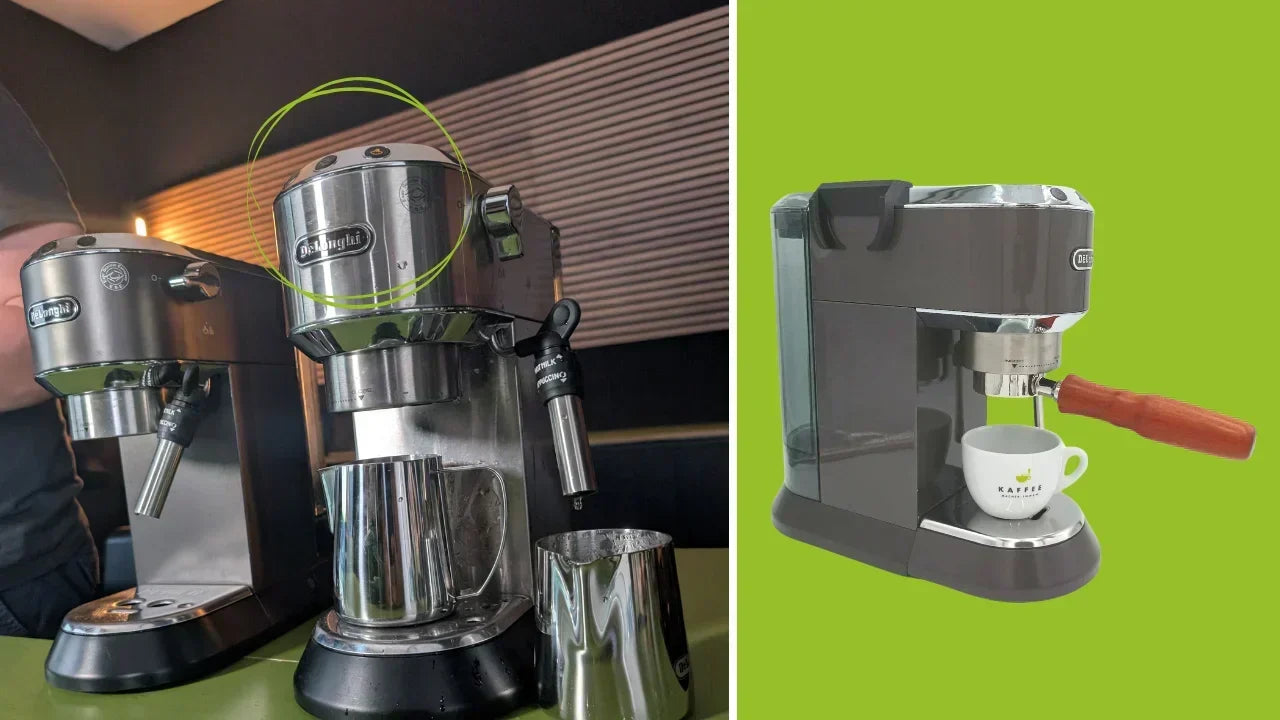

The DeLonghi Dedica is, for good reason, the perfect entry-level espresso machine for many. With the right upgrades and a small grinder by its side, the Dedica can make many a bigger espresso machine look old.
But the Dedica only works well for as long as the tubes inside stay free of limescale and let the water flow. The thermoblock in particular builds up limescale over time, even with relatively soft water (low in magnesium and calcium). That's why regular descaling is essential.
You should descale at the latest once the orange warning light comes on. If your tap water is on the harder side, more frequent descaling makes sense too.
In this article, we'll walk you through exactly how and when to descale, step by step. Our video can help you along the way as well.
Jump straight to the step-by-step guide
Don't want to descale alone? Do it with us on our YouTube stream.
Next descaling party: Wednesday, August 27, 2025, at 6:00 PM. Here's the link to the live stream.
Limescale, the enemy of every machine
What exactly is this limescale, and why is it such a troublemaker? It's simple: your tap water contains dissolved minerals, mainly calcium and magnesium. When heated inside your espresso machine, these minerals precipitate out and settle as a hard, white layer. That's limescale. These deposits act like an insulating layer on the heating elements, meaning your machine has to use more energy to reach temperature. They can also clog the fine tubes and nozzles, which affects both water pressure and temperature. The result? Your coffee often tastes more sour and simply not as good anymore. That's usually because a scaled-up machine no longer brews hot enough — and that leads to sour-tasting espresso.
Orange alert: your Dedica wants descaling
If the right-hand steam button lights up orange, it's time to descale your machine. At the latest, that's your cue. Your machine needs your attention!
Sometimes you'll read in general DeLonghi manuals, or for newer models like the Dedica Arte, about a "red descale light." That can be a bit confusing at first. If you own a Dedica EC685 or a similar model, though, it's very likely the orange light on the steam button that's pointing the way. This small inconsistency in colors shouldn't throw you off. What matters is that you pay attention to your machine's signal. When in doubt, it always helps to check your specific model's manual.
Rules of thumb — when the light stays quiet:
But what if the light is still fast asleep, even though it feels like forever since your last descale? Here are a few rules of thumb:
- Regardless of the warning light, it's good practice to treat your machine to a descale every two to three months. That way, you prevent stubborn buildup before it starts.
- This guideline applies especially if the water coming out of your tap has a hardness above 15 °dH (German degrees of hardness). You can find this out on your local water supplier's website.
- If you're a real coffee lover enjoying around 3 to 4 cups a day, an interval of roughly 2 months is a very good rule of thumb.

The water hardness factor — your local limescale check
A crucial point that's often underestimated is the water hardness where you live. The "harder" the water, the more limescale it contains, and the faster deposits build up inside your machine. That means if you live in a region with very hard water, you may need to descale much more often, even if the warning light hasn't come on yet. Many machines have a water hardness setting that affects when the descale indicator triggers, but if your water is harder than the default setting, limescale will build up faster than the machine "thinks."
How do you find out your water hardness? The easiest way is roughly, via your water supplier's website, or with test strips — or precisely, with our water hardness test kit. With this so-called titration test, you can determine the total hardness.
We've also written in detail about the topic of coffee water on our blog — it's worth a read! The result of your measurement helps you fine-tune your descaling intervals to your local conditions, instead of only acting once a thick layer of limescale has already formed. That way, you avoid the "hidden costs" of not knowing — namely, potential machine damage and, above all, less delicious coffee.
As a rough guideline: above 15 °dH total hardness, descale more often than every three months. At 10–15 °dH total hardness, descaling every 3 months should be sufficient. Below 10 °dH total hardness, you can likely stretch the intervals even further.
Always at your own risk, but that's roughly the direction to go.

The right descaler: our recommendation
DeLonghi's own descaler, called EcoDecalk, works just fine, of course. However, we've also added another compatible descaler to our range and had it specially tested in a lab. This descaler can also be used for other thermoblocks, for example from Ascaso. It was actually developed for the professional descaling of Ascaso espresso machines, but as mentioned, it also works very well for the DeLonghi Dedica.
The descaler we use for our own Dedicas and in the video.
Even if grandma swears by it: stay away from home remedies like pure citric acid for descaling your espresso machine! When heated, citric acid can react with limescale to form a compound called calcium citrate. The problem with that is calcium citrate is insoluble and can clog the fine tubes in your machine even more thoroughly — a real nightmare! Vinegar or vinegar essence aren't a good idea either. The aggressive acid in vinegar can attack the metals and delicate seals in your Dedica and make them porous.
What else you'll need:
- Catch containers: you'll need one, or better two, vessels that together hold at least 1.5 liters of liquid. Better to size them generously so nothing overflows during the process. A large mixing bowl, a measuring cup, or a small pitcher all work well here.
- Water: clear, fresh tap water to mix the descaling solution, and — very important — for thorough rinsing afterward.
- Time: plan for roughly 25–30 minutes for the whole process. During that time, your Dedica can go through its "spa treatment" in peace, while you look forward to your next, especially delicious espresso.
Water filter? Please remove it.
If you use a water filter in your Dedica's tank (a great idea for reducing limescale buildup in general!), make sure to take it out before descaling. The descaler isn't meant for the filter and could damage it or reduce its effectiveness. It goes back in later, after rinsing.
Here's everything at a glance as your personal checklist:

With this preparation, nothing can really go wrong!
Descaling the Dedica — step by step
Got everything ready? Great! Let's roll up our sleeves and give your Dedica the cleaning treatment it deserves. Just follow these steps and it's really a breeze. If you're unsure at any point, check our video again or join our next descaling livestream.
1. Get the machine ready:
- First, switch off your Dedica if it's still on.
- Take the water filter out of the tank, if you haven't already done so during prep.
- Empty the water tank completely and rinse it briefly with fresh water to remove any residue.
- Now mix the descaler with water. Follow the instructions on your descaler's packaging exactly. For DeLonghi's EcoDecalk, that's usually 100 ml of descaling liquid to 1 liter of water. For our own descaler, use a third of the bottle, so around 166 ml per liter. That corresponds to one full tank on the Dedica.
- Pour the finished descaling solution into your Dedica's water tank, but don't go above the MAX marking.
- Put the filled water tank back into the machine correctly.
2. Get into position:
- Very important: the portafilter stays out! It isn't used at any point during the descaling process. This is essential so the solution can flow freely and doesn't get stuck in the portafilter.
- Now place a large enough container (or one of your two, if you're using two) under the steam wand/milk frother (also called the hot water spout). Position a second container under the brew head — exactly where the portafilter would normally go.
- Now switch your Dedica on using the ON/OFF button.
3. Wake up the descaling program:
- Wait a moment until the one-cup and two-cup indicator lights stay on continuously. That tells you your Dedica is heated up and ready to go. The orange indicator light will also come on if the machine wants to signal that it's time to descale.
- Whether the indicator light is on or not, start the descaling process by pressing and holding the steam button firmly for 10 seconds. You'll know it worked once all three buttons (single-cup, double-cup, and the steam button) start blinking one after another. That's the signal: descaling mode activated!
- Note: always double-check your manual to confirm this works the same way on your specific Dedica model.
4. Descaling in progress: operate the steam dial
- Turn the steam dial (the control for the steam/hot water function) all the way to the steam position. This is usually marked with a steam symbol (something like three curved lines).
- Now briefly press the right-hand button again (the steam button, or whichever button you used to activate the mode) to start the actual descaling process.
- The machine will now start pumping the descaling solution through the system in intervals. It will also pause from time to time — that's completely normal and part of the program.
To make sure not just the lines to the steam wand, but also the brew head (i.e. the shower screen, where the water hits your coffee grounds) gets properly descaled, there's an important trick: close the steam dial briefly every so often during the process (turn it to position "0"). This forces the descaling solution through the brew head as well. After a few seconds (around 5–10), open the steam dial again. Feel free to repeat this every few minutes. Some instructions, like DeLonghi's own guide for the Dedica Arte, suggest keeping the steam dial closed for a while after about 10 minutes to achieve this effect. This one simple step makes a huge difference to how thorough the descaling actually is!

5. Tank empty? First round done!
The descaling process runs until the water tank with the descaling solution is completely empty. Throughout the entire process, the orange indicator light on the steam button keeps blinking, signaling that the machine is still in descaling mode.
See, with a bit of patience and the right know-how, it's really not that complicated.
After rinsing comes... more rinsing
The descaler has done its job and taken care of the nasty limescale buildup. But now the descaler itself needs to come back out of the machine! Thorough rinsing is now super important, because nobody wants their next espresso to have a slightly sour aftertaste of descaling agent.
1. Refresh the water tank:
- The orange indicator light on the steam button will still be happily blinking away — that's normal and shows that the descaling cycle (including rinsing) isn't finished yet.
- Take the water tank out of the machine. If there's still a little leftover descaling solution in it, empty it out completely.
- Now rinse the water tank very, very thoroughly with fresh, clear water. Ideally several times, so that no descaler residue is left in the tank.
- Fill the clean water tank up to the MAX marking with fresh water. Ideally, use soft water here too, just like you would for brewing coffee. We simply call this "coffee water" in our detailed article on the topic. If you use this kind of water, you'll need to descale less often.
- Put the tank, now filled with fresh water, back into your Dedica correctly.
2. Start the rinsing cycle:
- Empty the catch containers, which now hold the used descaling solution. Be a bit careful — the solution can still be irritating. Best to pour it straight down the drain. Then place the empty containers back under the steam spout and the brew head.
- Make sure the steam dial is still in the steam position (symbol).
- Now press the right-hand button again (the steam button, or the same button you used to start descaling) to begin the rinsing process.
3. The steam-dial trick again (important during rinsing too!):
- Just like during descaling itself, the same applies to rinsing: close the steam dial briefly every so often. That way you make sure the brew head and its lines also get properly flushed with fresh water, leaving no descaler residue behind.
4. How many rinsing cycles? The golden rule for clean lines:
- The machine now rinses the entire contents of the water tank through the system.
- We recommend, and DeLonghi itself suggests this too, running at least one, but ideally two full tanks of fresh water through the system. This really ensures that all descaler residue is removed. So once the first tank has rinsed through empty, simply repeat the process starting from step 1 ("Refresh the water tank") for a second rinsing round. Better safe than sorry.
5. Putting the water filter back in? Absolutely — but when exactly:
- If you use a water filter for your Dedica (which we highly recommend!), now is the right time to put it back in. Ideally before you fill the tank with fresh water for the second rinsing round. So place the filter in the empty tank, then fill it with fresh water and start the second rinsing cycle. That way, the filter also gets rinsed through with fresh water right away and is ready for your next coffee.
Thorough rinsing might be the most time-consuming part, but it's absolutely essential for the result. Take your time with it — it's worth it!
Finish line: the light goes out
You've almost made it! Your DeLonghi Dedica will soon be as fresh and clean as on day one, ready for your next espresso and more. But how do you know the descaling spa treatment is truly complete?
The clearest sign is this: the rinsing process (or the last rinsing round you ran) is finished once the water tank is empty again AND the orange indicator light on the steam button finally goes out.
Close the steam dial
One very important final step: turn the steam dial back to position "0" (closed). This tells the machine that the special "descale/rinse" mode is over and it can switch back into normal coffee mode.
Machine ready!
Fill the water tank again with fresh water if needed. Your DeLonghi Dedica is now officially descaled, freshly rinsed, and fully ready again to make delicious espresso!
Kaffeemacher's extra tips & tricks
Using soft (softened) water makes a real difference. The intervals between necessary descalings can get noticeably longer. Especially if you live in a region with hard water, that's a real blessing for your machine — and your schedule!
What if something goes wrong? (Quick troubleshooting tips):
- Power outage during descaling? Don't panic! The safest approach is to restart the entire cycle (descaling AND rinsing) completely from the beginning, to make sure everything gets properly cleaned and no descaling solution is left in the machine.
- Machine asks for another rinsing cycle? That can happen if the water tank wasn't quite filled to the MAX marking during a rinsing round. The machine is just being smart here, making sure all descaler residue really gets flushed out. Simply follow the instructions on the display or the light signals.
Don't forget regular cleaning:
Descaling is an important part of machine care, but it's not the only one! Don't forget the Dedica's other regular cleaning tasks too. That includes cleaning coffee residue and oils off the portafilter and baskets, wiping down the shower screen, and cleaning the steam wand after every milk-frothing session. Here's our article on cleaning the DeLonghi Dedica.
Conclusion: descaling ensures longevity
Regular, and above all correct, descaling is really the key to a long-lasting DeLonghi Dedica that brings you pure joy, day after day, espresso after espresso.
Still have questions about descaling your Dedica? Or your own tips and tricks you'd like to share with the community? Feel free to leave them in the comments! We always love hearing from you and are happy to learn something new too.
With that: here's to many more delicious, perfectly extracted espressos with your beautifully maintained DeLonghi Dedica!
Your Ben Kaffeemacher