


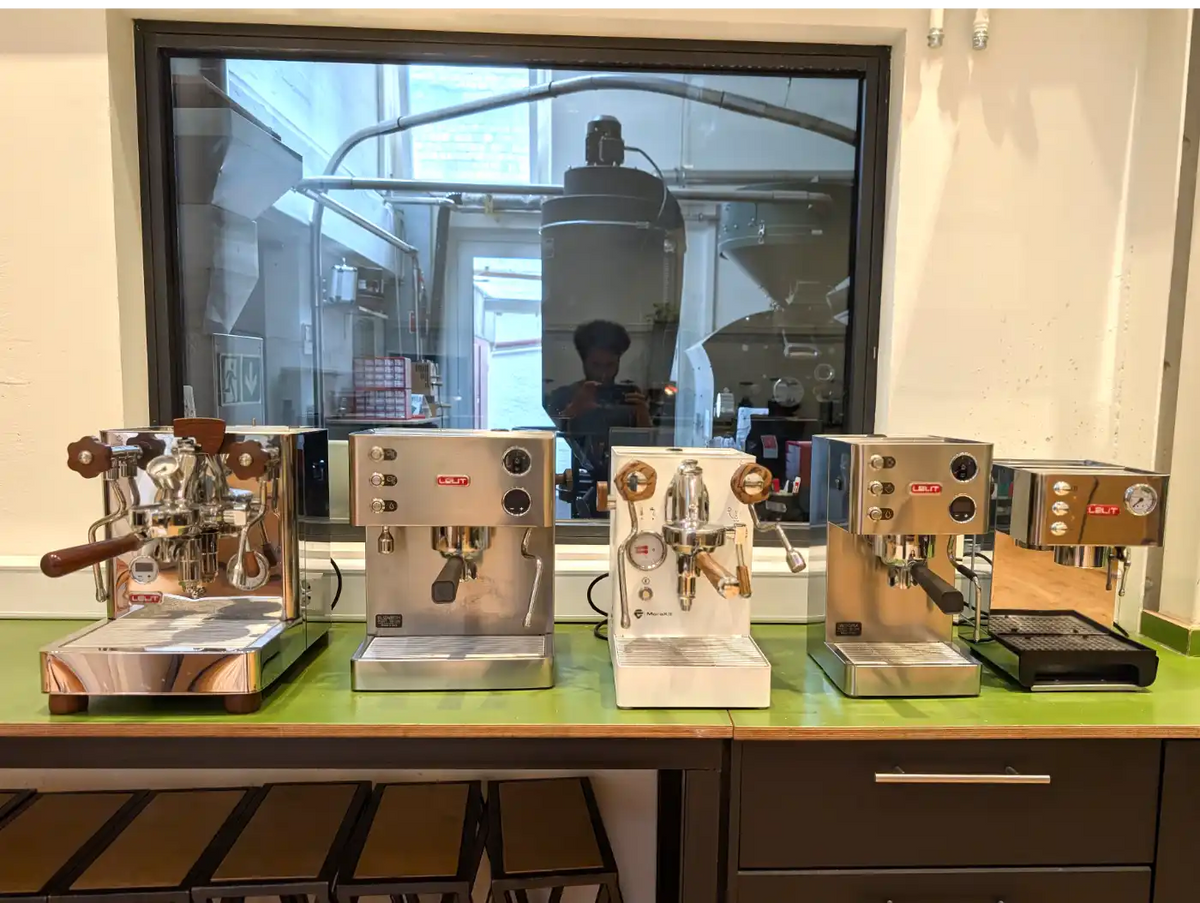

We have tested ten Lelit machines so far: the single-circuit Victoria, the dual-circuit Mara X in three generations, the dual-boiler Elizabeth and Bianca, plus four espresso grinders. We purchased each of these machines ourselves, as independent espresso machine tests are the foundation of our work.
On this page we bring together what we have measured: which Lelit is suitable for which needs, where the brand is strong, and where it fails to deliver on its promises.
We are a coffee school in Basel and the Ruhr Valley, with our own roastery, three cafés, and deeply integrated work with coffee farms on various continents. We measure espresso machines and grinders according to our own protocol: heat-up time, temperature deviation across multiple shots using KM and WBC protocols, power consumption in kWh, and for grinders additionally retention, grinding speed, dosing consistency, and particle distribution in a laser diffractometer. You can find exactly how this works in the test protocol for espresso machines and the test protocol for espresso grinders.
You can find all our equipment tests in comparison under espresso machines tested and best espresso grinders for home. If you're more interested in what ends up in your cup than in the machine itself, then how to make espresso explains recipe, grind, and extraction from the ground up.
Lelit: from steam irons to prosumer portafilters
Lelit is not an old espresso machine dynasty. The company was founded in 1986 in the province of Brescia by Maria Bellini and her husband Edoardo Epis. The name is short for "L'Elettrodomestico Italiano," and they initially produced steam iron systems. Lelit still manufactures irons today, around 30,000 units per year.
The founding date itself is not clearly documented: English-language Wikipedia lists 1986 and Baitella near Brescia, the Brescia daily newspaper Bresciaoggi cites 1986 and San Vigilio di Concesio, and Breville's acquisition announcement states 1985 and Castegnato. Castegnato is the current location.
Coffee machines came as a second business line, developed by the founders' sons. Sources conflict on the exact timing: Bresciaoggi dates the start of espresso machine development and production to 1992, while English-language Wikipedia lists 2002 as the beginning of focus on semi-automatic portafilter machines. Both could be correct if we distinguish between initial products and strategic focus.
What matters to us is a later date. Only in 2017 with the Bianca and 2019 with the Mara X did Lelit enter the prosumer market—the segment between household appliances and commercial machines. These two models alone establish the brand's reputation to this day.
After that, growth was rapid. Revenue increased from 13 million euros in 2019 to 39 million. In 2020, Lelit sold 48,000 espresso machines and expanded its workforce from 80 to 230 people within a month to meet demand. Today the company employs just under 200 people, and the Castegnato factory ships over 50,000 coffee machines annually.
The Breville acquisition
On March 11, 2022, Australian Breville Group announced it was acquiring 100 percent of Lelit. Purchase price: approximately 113 million euros, half in cash and half in Breville shares at 27.64 Australian dollars with a five-year holding period. The transaction was completed in early July 2022, after the previous holding company Gemme Italian Producers srl had transferred the coffee business to a new Lelit srl.
The founding family and parts of management moved to the Breville camp. At the time of acquisition, Emanuele Epis was CEO of Lelit; according to Wikipedia, his brother Mauro Epis now leads the company.
Breville CEO Jim Clayton put it this way, in our translation: "The acquisition of Lelit brings together the two great coffee cultures of the world, Italian and Australian." Marketing speak, certainly. What's practically relevant is something else: Breville also owns Baratza. This means espresso machines and grinders from the specialty segment sit under the same roof, and Lelit gains access to distribution structures outside Europe as well as numerous patents from Breville. This shows up, among other things, in the integration of the Pagaia function, which builds on a Sage patent.
The information on company history comes not from our own on-site research but from secondary sources: Breville's acquisition announcement, reports from Comunicaffè and Bresciaoggi, and English-language Wikipedia. We cannot independently verify revenue and unit figures. All measured values below, however, are our own.
Production continues in Castegnato. Whether that will remain is to be seen. For you as a buyer today, this means: Lelit is Italian manufacturing with Australian ownership, not a relabeled purchased product.

How Lelit organizes its product lines
Lelit's model names are first names, and the type designations are PL numbers. This seems arbitrary but follows a logic based on the brew group. Three lines exist side by side:
The 57-millimeter line with proprietary group includes entry-level models Anna (PL41), Anita (PL042, with built-in conical burr), and discontinued Grace (PL81). Common features are a 250-milliliter brass boiler, a three-way solenoid valve, and an adjustable overpressure valve. We're currently testing these machines. The test is more demanding because we had to develop our own temperature sensor specifically for these devices.
The 58-millimeter line without E61 group includes Victoria (PL91), Kate (PL82), discontinued Glenda (PL41PLUST), and dual-boiler Elizabeth (PL92). The Victoria has a 300-milliliter brass boiler; the Elizabeth has a 300-milliliter brew boiler plus a switchable 600-milliliter steam boiler.
The E61 line with a 58-millimeter group modeled after the Faema E61 consists of the heat exchanger Mara X (PL62X) and dual-boiler Bianca (PL162T). The Bianca runs an 800-milliliter brew boiler and a 1.5-liter steam boiler; the Mara X has a 1.8-liter boiler. What makes this brew group technically special can be found in our article on the Faema E61 brew group.
Model overview: what we tested
| Model | Type | Brew group | Our test |
|---|---|---|---|
| Victoria PL91T | Single-circuit with PID | 58 mm, Lelit | To the test |
| Mara X V2 (PL62X) | Heat exchanger | 58 mm, E61 | To the test |
| Mara X3 (PL62X3) | Heat exchanger with Pagaia | 58 mm, E61 | To the test |
| Elizabeth PL92T | Dual-boiler | 58 mm, Lelit | To the test |
| Bianca V3 (PL162T) | Dual-boiler with flow control | 58 mm, E61 | To the test |
| Steve (PM20) | Espresso grinder, timed dosing | 64 mm burr set | To the test |
| William PL72 | Espresso grinder | Burr set | To the test |
| Fred PL044MMT | Espresso grinder, entry-level | Conical burr | To the test |
| Fred PL043MMI | Espresso grinder, entry-level | Conical burr | To the test |
We have not yet tested the Anna PL41TEM, Anita, and Kate. Anna and Anita are in progress. For Bianca V4 and the Pagaia versions of Elizabeth and Victoria introduced in 2026, further measurements will follow in late 2026 and early 2027.
Which Lelit should you buy?
The question "which Lelit is the best" is misleading. The models differ mainly in which drinking habits they're built for. So we organize by need.
You drink almost exclusively pure espresso, one to three per day
The Victoria PL91T will do. A single-circuit with PID, 10.9 kilograms, 23.5 centimeters wide, for around 800 euros. Using the WBC protocol, we measure a standard deviation of 1.28 degrees across 14 shots, which is acceptable for this type of machine. What you have to accept: 23 minutes heat-up time and a switchover if you want to steam milk afterward. The steam power is weak, but typical for a single-circuit. For one cappuccino on the weekend, that works; for four in a row, it doesn't.
We have documented a routine that cuts the 23-minute wait significantly: heat for 3 minutes until the machine shows espresso temperature, then 7 minutes in steam mode, back to espresso with a flush shot, wait one minute, pull your shot. The machine isn't permanently temperature-stable after this, but it's enough for the first espresso. Energy consumption is the same whether you heat-up quickly or slowly, by the way. Everything about this is in the Victoria test.
You regularly make milk drinks and don't want to wait
Then you need separate circuits. The Elizabeth PL92T is a true dual-boiler with a 300-milliliter brew boiler and switchable 600-milliliter steam boiler, from around 1,050 euros. The steam boiler can be set up to 145 degrees, it delivers strong and heats slowly. After 20 minutes the machine is up to temperature, although it claims to be ready before that. Power consumption is low: 0.13 kWh for five double espressos including heat-up without the steam boiler, 0.24 kWh with it.
For us, it's the best entry-level dual-boiler machine we've tested, with the potential to outperform significantly more expensive machines. The trade-off is thin stainless steel body, plastic handle, plastic steam knob, and a water tank that's awkward to fill.
The alternative is the heat exchanger Mara X. It's up to 10 decibels quieter than comparable dual-circuits and at 22 centimeters is unusually narrow for an E61 machine. In Switzerland the list price was 1,490 francs; in the EU we found numerous offers under 1,000 euros. For that you need to understand the brew priority modes, otherwise the machine brews too hot.
Flush after the shot, not before. The Mara X has a second temperature sensor in the heat exchanger that responds to flowing water and reheats. If you flush before the shot like you do on classic dual-circuits, you push the temperature above target. In our first measurement series we got 93 to 98 degrees; with the right routine the three modes sit at 90 to 95 degrees. Plus a two-minute pause between shots. Both measurement series, the switch logic, and the complete routine are in the Lelit Mara X test.
You want to dial in extraction profiles
The Bianca V3, for over 2,000 euros. It has a mechanical paddle and additionally an electronic low-flow mode, a rotary pump with 8 to 9 bar that we measure at 61 decibels. With the paddle you control flow from around 2.5 grams per second in the 6 o'clock position to just over 6 grams in the open position; the electronic low-flow sits at 1.5 to 1.7 grams per second and 3.1 bar.
The temperature values are the best in the entire Lelit lineup: 93 degrees target temperature with a one-degree deviation, standard deviation of 0.99 degrees in the KM protocol after 17 minutes and 0.69 degrees in the WBC protocol after one hour. And despite the E61 group, it's up to temperature after 17 minutes—8 to 12 minutes faster than the E61 average. On consumption, the large steam boiler takes its toll: 0.133 kWh for five espressos, but 0.43 kWh once the steam boiler is running.
The thing about the Bianca is you can run it two ways: as a solid E61 machine without thinking or as a profiling machine where you control flow on every shot. It grows with you, which is why we recommend it to beginners as well. At 27 kilograms and 50 centimeters deep it does need space, though.

You want flow profiling but cheaper
Then the Mara X3 at 1,699 euros fits the bill. The flow control works well; the lever adjusts from 6 to around 3.5 milliliters per second, and the pump drops below 50 decibels in the process. In the KM protocol, which reflects home use, temperature control is fine.
In the WBC stress test across 14 shots, however, we measure a temperature window of 7 degrees. We clearly rated this as a failure in the test. For a machine in your kitchen this weighs less heavily than for commercial use, but if you regularly pull many drinks in a row, you're better off with a dual-boiler. On KM overall score the machine comes in at 50.2 out of 100 points. So for a 500-euro upcharge from the previous version you get flow control.
You're looking for a Lelit grinder
Here we have to put the brakes on. The two Fred models PL044MMT and PL043MMI had the broadest main peaks at 336 and 349 micrometers in our first test field of 24 directly compared grinders. The best grinder in that field was at 180 micrometers. You taste this: the espresso comes across as frayed, the acidity stands alone. For pure espresso we can't recommend the Freds.
The William PL72 is a different case. Its grounds are good; the coarse peak sits narrow at 227 micrometers. The problem is adjustment: once adjusted, the grind setting can't be reliably reset. In exchange it has a property we haven't seen in any other grinder quite this way. It grinds itself completely empty—18 grams in, 18 grams out. If you already own a PL72 and like to drink different coffees side by side, you should run it exclusively in single-dose mode.
The Lelit Steve has been the successor to the William since 2026 and costs from 469 euros. It does several things better: 30.3 grams in 10 seconds, 81.8 decibels with pleasant grinding noise, a main peak of 243 micrometers and a fine peak of 39.4 percent—lots of body and a distribution that carries well from dark to medium roasts. Two things have gotten worse or stayed the same. Empty grinding no longer works; the grinder retains 5.2 grams of temporary retention, so single dosing is out. And the play in the grind adjustment has persisted: after traveling through Ristretto and Lungo and back to the original grind setting, the same recipe runs through in 14 to 15 instead of 25 seconds. If you stick with one bean and keep topping up, you'll do fine; everyone else won't.
If you have a free choice, check our overview of the best espresso grinders. We've now tested over 100 grinders, so the selection is significantly larger than when we tested Lelits. For milk-based drinks the Freds are certainly usable, because milk buffers flavor imbalance.
Distribution and retail
Lelit doesn't sell direct but through specialty retailers, online shops, and Amazon. According to Bresciaoggi, the Amazon channel was a major driver of rapid growth, which is unusual for a manufacturer in this price segment.
For you as a buyer this primarily means: prices vary widely. For the Elizabeth we saw prices in Switzerland between 1,100 francs at major online platforms and 1,600 francs in local retail, with a German entry price of around 1,050 euros. Price comparison is worthwhile here more than with other manufacturers.
We ourselves don't sell espresso machines. In individual tests we mention specialty shops where we'd recommend buying because they know the machines and can service them themselves. With a purchase through a marketplace you don't have this contact person.
Comparison table: our measured values
All values are our own measurements from the linked individual tests, not manufacturer specifications. A dash means we didn't take that measurement in this test.
| Model | Price* | Weight | Heat-up time | Consumption | Best use |
|---|---|---|---|---|---|
| Victoria PL91T | approx. 800 € | 10.9 kg | 23 min | – | Pure espresso, little milk |
| Mara X V2 | approx. 1,000 € (EU) | 18.0 kg | – | – | Espresso and milk, quiet, narrow |
| Mara X3 | approx. 1,699 € | 18.3 kg | 24 min | 0.266 kWh** | Flow profiling, individual shots |
| Elizabeth PL92T | from approx. 1,050 € | 12.0 kg | 20 min | 0.13 / 0.24 kWh*** | Milk drinks without switching |
| Bianca V3 | over 2,000 € | 27.0 kg | 17 min | 0.133 / 0.43 kWh*** | Profiling, flow control |
| Steve (PM20) | from 469 € | 6.5 kg | not applicable | not applicable | One bean in the hopper, timed dosing |
| William PL72 | approx. 417 € | 6.6 kg | not applicable | not applicable | Single dosing, various coffees |
| Fred PL044MMT | approx. 235 € | – | not applicable | not applicable | Milk-based drinks, entry-level |
| Fred PL043MMI | approx. 185 € | – | not applicable | not applicable | Milk-based drinks, entry-level |
* Prices at time of test and for reference. Lelit prices fluctuate significantly in retail.
** Heat-up plus one espresso in espresso mode.
*** Heat-up plus five double espressos each. First value without, second value with steam boiler engaged.
Temperature measured values in comparison
Temperature control separates the field much more clearly than price does. Here's the breakdown separately:
| Model | Measured temperature | Standard deviation | What you should know |
|---|---|---|---|
| Bianca V3 | 93 °C, +/- 1 °C | 0.99 ° (KM) / 0.69 ° (WBC) | Best value in Lelit lineup, 6 °C offset |
| Victoria PL91T | – | 1.28 ° across 14 shots (WBC) | Significant offset deviation |
| Mara X V2 | 90 to 95 °C depending on setting | – | Flush after the shot, otherwise too hot |
| Elizabeth PL92T | – | – | Set two degrees below target for first 30 min |
| Mara X3 | Settings 88 / 92 / 96 °C | Window of 7 ° in WBC stress test | Stress test rated as failure, KM protocol acceptable |
Which protocol counts depends on use. The KM protocol measures home use: heat up and pull individual shots. The WBC protocol measures sustained load across 14 shots and is therefore mainly meaningful for commercial use. For a dual-circuit in your kitchen, therefore the individual shot is what matters, not the stress test. We explain both methods in the test protocol for espresso machines.
Frequently asked questions about Lelit
Is Lelit still an Italian company?
The brand and manufacturing are Italian; the owner is not. Since July 2022, Lelit has been owned by Australian Breville (Sage) Group. Manufacturing continues at the factory in Castegnato near Brescia; the founding Epis family remained with the company.
Which Lelit is the best espresso machine?
By our measurements, the Bianca V3, if budget and space allow. It has the best temperature control in the entire Lelit lineup and the shortest heat-up time among E61 machines. For about half the money, the Elizabeth PL92T is the more sensible choice if you mainly make milk drinks. For pure espresso on a tight budget, the Victoria will do.
Lelit Mara X or Elizabeth?
The Mara X is quieter, narrower, and works with the E61 group—meaning thermal inertia. The Elizabeth has two true boilers, is up to temperature after 20 minutes, and is more confident with steam, but is less well constructed. If you make many milk drinks in a row, get the Elizabeth. If build quality, noise, and footprint matter more to you, the Mara X.
How long does a Lelit take to heat up?
We measured: Bianca V3 17 minutes, Elizabeth PL92T 20 minutes, Victoria PL91T 23 minutes, Mara X3 24 minutes. The Bianca is fastest despite the E61 group because its brew boiler is insulated. For all machines, expect sustained temperature stability to arrive later than the brewing readiness the display indicates.
What's the difference between Mara X V1, V2, and X3?
V1 and V2 are technically nearly identical; you recognize the V1 by the red logo. Differences lie in control logic, which is why some machines shipped with manuals from the other version. The Mara X3 is a bigger jump; it brings Pagaia, electronic flow control via a lever, and costs 1,699 euros. Temperature-wise it behaves similarly to the V2, but flow control adds another layer that can influence temperature. Details in our tests of the Mara X and the Mara X3.
What does Pagaia cost?
For Elizabeth 3 and Victoria 3, Lelit quoted us 300 euros upcharge over the non-lever version in Brussels. For the Mara X3, Pagaia is built-in; it costs 1,699 euros, roughly 500 euros more than the predecessor. Neither the Elizabeth 3, Victoria 3, nor Mara X3 offers a volumetric or timed option.
Are Lelit grinders recommendable?
For pure espresso, by our measurements, only to a limited extent. The two Fred models have too much spread. The William PL72 grinds well but can't reliably reset to the same grind setting, and makes most sense for existing owners in single-dose mode. The Steve comes closest: its particle distribution carries a good espresso, but grind adjustment remains imprecise and single dosing doesn't work. If you mostly drink cappuccinos, the Freds can work fine.
Is a used Lelit worth it?
Yes for E61 machines, because the technology is well documented and parts are available. Watch for scale buildup, condition of the seals at the brew group, and which generation you're buying. For the Mara X, the version question isn't a minor thing but determines how you control brew priority.
Which Lelit haven't you tested yet?
Anna PL41TEM and Anita are in progress. Kate is still pending. Tests for Bianca V4 and Elizabeth 3 and Victoria 3 with Pagaia are coming.
Conclusion
Lelit is the manufacturer that opened the prosumer segment downward. The Elizabeth delivers a true dual-boiler for around 1,050 euros with low power consumption; the Bianca V3 combines the best temperature values in the Lelit lineup with 17 minutes heat-up time and full flow control. That's the brand's strength.
The weakness is execution in detail: thin sheet metal, plastic where you touch daily, awkward water tanks. And with the Mara X3, it shows that a new feature doesn't automatically make a better machine. In daily home use temperature stays in range; in sustained-load stress testing it fails with a seven-degree window.
For grinders, the verdict is mixed. The two Fred models deliver the broadest particle distribution in our first test field and aren't suitable for espresso. The William PL72 grinds well but stumbles on reproducibility of grind setting. The Steve, five years later, shows where Lelit stands: faster, quieter, good particle distribution, but with the same play in grind adjustment and without the William's ability to grind itself empty. In all three cases you notice that here a machine manufacturer built a grinder: a burr set in self-bent stainless steel, without the precision of the specialists on the adjustment mechanism.
If you buy a Lelit, buy the machine and get your grinder elsewhere.
We purchased all equipment mentioned in this article ourselves. None of the linked tests was requested or authorized by Lelit. We have not sold espresso machines for three years. The measured values in both tables come from individual tests of the Victoria PL91T, Mara X V2, Mara X3, Elizabeth PL92T, Bianca V3, Steve, William PL72, and Fred PL044MMT and PL043MMI.