





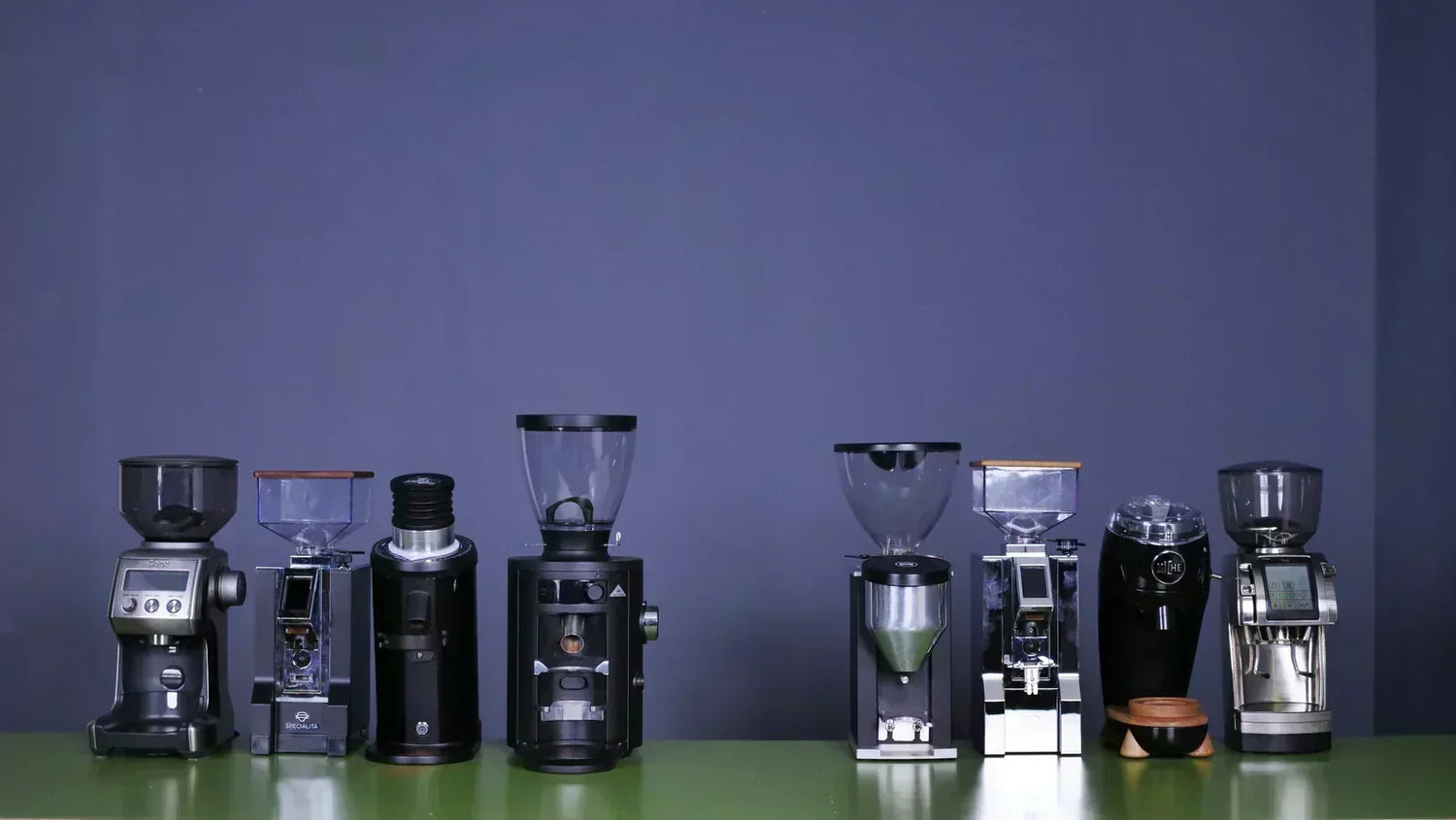

We tested 30 espresso grinders for home use over many months, measured them precisely, and examined them for consistency and espresso quality.
Which espresso grinder is best for home? Which has what strengths and suits whom? Do our professional baristas have personal preferences? We discuss all of this in our detailed espresso grinder test and final video. If you haven't gotten into espresso yet and are generally looking for a grinder, start with the basics of coffee grinders.
The price of the grinders ranges from 80 to 2200 euros, with an emphasis on grinders up to 1000 euros. The espresso grinders were tested according to the test protocol noted here.
Which espresso grinders did we test?
Initially, 24 espresso grinders in 6 groups were tasted. The groups cover different price ranges. The best grinders from the different groups (nine in total) were compared with each other again in a final round.
For this, the groups were evaluated in two blind tastings by our most experienced baristas and coffee sensory experts (see espresso tasting protocol).
Individual articles and videos are available for all tested espresso grinders. If you're looking for an espresso grinder, we recommend starting with the final video "Best espresso grinder for home". For further depth and decision-making, individual videos and comparison videos can help.
But which grinder category makes sense for you at all? The manual grinder, the single dosing grinder, or a dosing grinder? This is the decision you should make before deciding on a specific grinder. We have written a comparison article on grinder categories to help you with this decision.
Don't want to weigh each portion individually? Then a grinder with an integrated scale is an option. In our comparison of seven grind-by-weight grinders, we show which models convince – and where the limits of the technology lie.
Special thanks go to Dr. Marco Wellinger and ZHAW Wädenswil for their support in analyzing the particles.
More about grind-by-weight grinders and single dosing grinders.
The best espresso grinders for home
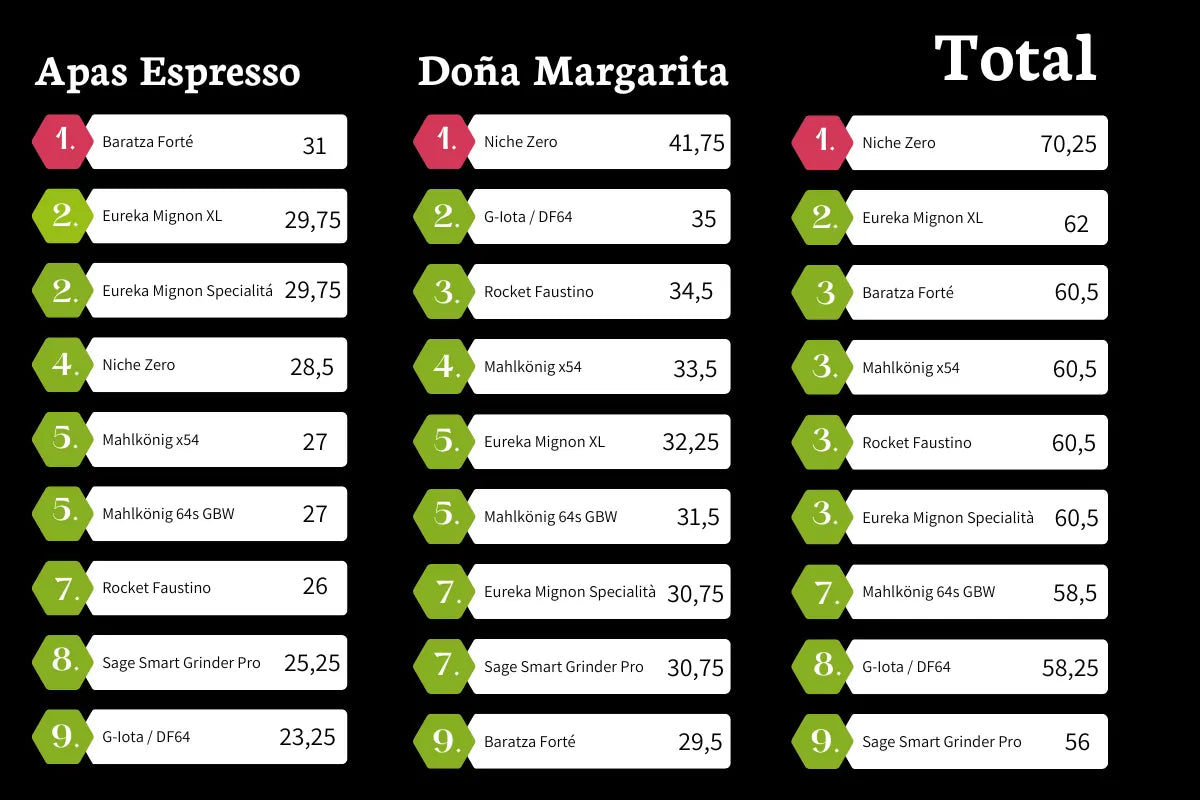
9 espresso grinders qualified for the final round of our espresso grinder test series. We examined them again and also compared them sensorially in a blind tasting. For this, we set a dark espresso (Apas) and a lighter espresso (Doña Margarita) as espresso.

We already presented the most important data on the espresso grinders in the individual videos. In the direct comparison, nothing changed, only was confirmed once more.
The best espresso grinder on the market is, in our view, not one grinder that we determine for you. The best espresso grinder is the one that suits your preferences based on the information gathered. Michel and Benjamin therefore have different preferences when it comes to the right espresso grinder for home.
A sensory blind tasting should provide further arguments for a decision.
The espresso grinder blind tasting
To challenge the best 9 espresso grinders from the test series again, a blind tasting was conducted. For this, we invited four of our most experienced coffee sensory experts.
The sensory panel
Michel Aeschbacher is a Q-Grader, coffee trainer, and vice barista champion in Switzerland. Felix Hohlmann is a multiple Swiss and German vice barista champion, Brewers Cup runner-up, and Aeropress champion. Philipp Schallberger is a two-time Swiss barista champion and semi-finalist at the World Barista Championship. He was a WBC judge and Q-Grader for many years. Benjamin Hohlmann is an Arabica and Robusta Q-Grader, was a German Cup Tasting Master, and Swiss Brewers Cup Master.
Together with David Wistorf (himself Brewers Cup runner-up and third in Switzerland), each set one or two espresso grinders to the best possible espresso recipe for each grinder. We decided on individual recipes because not all grinders reach their peak with the same recipe.
The result for each grinder should therefore be seen in connection with the barista's recipe. Additionally, it showed that the time factor of 20 minutes for adjusting a grinder benefited some espresso grinders.
The espresso roasts and coffees tasted
Tasting took place over two days with two different espresso roasts.
With Apas, we chose a medium roast espresso from Brazil. The coffee was processed as a natural. We use Apas as a standard espresso in our courses. It is nutty and chocolatey and forgives quite a bit during adjustment.
Doña Margarita is a complex espresso from our own farm in Nicaragua. The coffee is grown on Finca Santa Rita, fermented in cherries in a cooling room, and then dried as a natural. The coffee tastes of ripe cherries, has a heavy chocolate note, and reminds of tropical fruits. This lighter roast must be adjusted well so that it is balanced and its complexity comes to the fore.
The final tasting results
Final tasting results. Recipes and further tasting results to follow.
Comparison group espresso grinders 1: 760 - 2250 euros
- Mahlkönig E65S Grind by Weight - Video, Test report
- Ceado E37S nero - Video, Test report
- Rocket Fausto 2.1 - Video, Test report
- BARATZA Forté - Video, Test report


Comparison group espresso grinders 2: 640 - 750 euros
- ECM S 64 - Video, Test report
- Niche Zero - Video, Test report
- Mazzer Mini Electronic A - Video, Test report
- Eureka Mignon XL - Video, Test report
Particularly impressive in this set were the Niche Zero and the Eureka Mignon XL. Overall, the Niche Zero had a slight edge depending on the perspective. However, since a single dosing grinder does not meet all needs and the Eureka Mignon XL also performed very well, we decided to take both grinders to the next round.

In terms of particle distribution, the ECM also delivered strong performance. Thanks to its very low fine particle content across all extractions, it is well suited for espresso, café crème, and filter coffee. For filter coffee, it delivered the best results together with the Niche Zero in our test.

For more information on the grinders, we recommend our video reports and the individual reports on the espresso grinders linked above.
Comparison group espresso grinders 3: 500 - 530 euros
- Quamar M80 E Touch plus - Video, Test report
- Eureka Mignon Magnifico - Video, Test report
- Baratza Sette 270 Wi - Video, Test report
- ROCKET Faustino - Video, Test report

Comparison group espresso grinders 4: 400 - 470 euros
- Mahlkönig X54 - Video, Test report
- Eureka Mignon Specialità - Video, Test report
- Lelit PL72 - Video, Test report
- G-Iota or DF64 Probarista - Video, Test report
In this round, four espresso grinders did good work in individual areas. As many as 3 grinders impressed us enough to move them to the next round.
- One of them is the Mahlkönig x54, which is slow and otherwise only shines with average values, but brewed the second best espresso. In terms of speed, it is the slowest in the set and cannot score on grind adjustment precision and consistency either.
- The Eureka Specialità served only the third best espresso in the set, but the difference to the better grinders is very small. At 28 points, the espresso is still good. The grinder impresses with consistency and noise level. The filter coffee also tasted good to us. The grinding adjustment speed is in the mid-range. Adjusting the grinding setting via the small dial is difficult.
- The G-Iota not only brewed the best espresso (with very close margin), but also impresses with consistency, retention and grinding adjustment precision. Moreover, it is the most affordable and yet very good single-dose espresso grinder we know. For this reason alone, we want to see it in the next round, in a blind tasting against all group-winning espresso grinders.
The fourth grinder in the round also does good work. The espresso tastes good and the Lelit PL72 particularly impressed us with its single-dosing performance. However, the grinder is not very consistent, has high retention in normal use, and is also inaccurate when it comes to repeatability of brewing recipes. Because these attributes are quite essential, the Lelit PL72 does not make it to the next round.


Comparison group espresso grinders 5: 150 - 250 euros
- Sage - The Smart Grinder Pro - Bcg820 BSS - Video, Test report
- Lelit PL044MMT - Video, Test report
- Lelit PL043MMI - Video, Test report
- Sage - The Dose Control - SCG600BTR - Video, Test report
In the comparison of four espresso grinders between 150 and 250 euros, the Sage Smart Grinder Pro performed best. The grinder once again proved to be a good grinder for beginners that delivers good results in many areas and sometimes even performs very well for the price category.

Comparison group espresso grinders 6: 80 - 150 euros
- Graef CM 800 - Video, Test report
- Rommelsbacher Kaffeemühle EKM300 - Video, Test report
- Delonghi KG 521 M - Video, Test report
- Tchibo Kaffeemühle E mit Waage - Video, Test report


Current interim status across all tests - the group winners
Already tested:
We looked at some grinders in the past. However, in this context, we will examine them more closely again (see list above).
- Graef CM 800 – already tested
- Niche Zero - already tested
- Sage Smart Grinder Pro – already tested
Commercial grinder or higher price range
We will also look at these commercial espresso grinders at a later date. For now, we have decided to focus on grinders in the price range up to 1000 euros and use the results from two grinders as a reference from the higher price category.
- Lagom P64
- Etzmax (various models)
- Ceado E37S
- E65S GbW
- EK43
- Eureka Zenit
- Bentwood Vertical 63
- Anfim Practica
- Quamar Sirio Q
- Mythos Grinder
List is continuously updated. What's missing, what should be added? Please add suggestions.
The results were obtained after testing and working with each grinder individually. The compiled results describe our measurements and impressions.
Please also read the comments under our videos and compare different test reports to gather a differentiated picture from various sources.
The espresso quality assessment in the preliminary round was based on a tasting of two espressos by two tasters. In the next round of testing, a different espresso will be tasted by a larger panel.
The best grinder is useless without a recipe. How you find the grinding level and adjust the espresso in three shots is described in Preparing espresso.

da meine Graeff CM 800 nach 11 Jahren das zeitliche gesegnet hat, bin ich auf der Suche nach einer neuen Mühle. Dabei bin ich auf diese Seite gestoßen und bin wirklich begeistert von euch.
Zu meiner Suche, ich habe meine CM 800 zusammen mit einer Quickmill 0820 benutzt, was so das absolute Einsteiger-Setting sein dürfte. Ich bin auf der Suche nach einer robusten Mühle, die konstant ein gutes Mahlgut liefert für eine Espresso-Sorte liefert. Mich sprechen sowohl die Sage Grinder Pro als auch die Eureka Mignon Specialita an, wobei sie klar in unterschiedlichen Kategorien liegen. Würdet ihr sagen, dass sich die Eureka für mich lohnt oder dass die Sage reichen würde.
Vielen Dank und viele Grüße, Markus


eurer Blog und eure Videos sind einfach fantastisch!! Vom Anfänger bis zum Nerd, alle werden bei euch fündig.
Wenn Ihr demnächst Gastro-Espressomühlen bzw. höherpreisige Espressomühlen testen wollt, wäre es schön wenn Ihr euch die Fiorenzato F64 EVO Pro Sense anschauen könnt. Benjamin und Michel habe die Fiorenzato F64 Sense (ohne Pro) bei ihrem Besuch bei Espresso TV im November 2024 ja schon kennen gelernt. Besonders innovativ finde ich jedoch die Pro-Version. Damit soll die Reinigung besonders leicht von statten gehen.
Ich bin gespannt!
Liebe Grüße Roland

Wir behalten die Mühle sicherlich mal im Auge, ein Test ist aktuell aber nicht geplant.
Grüsse
Andrea

zunächst vielen Dank für eure sehr informativen Videos und Blogbeiträge.
Da Ihr gerade Single Dose Mühlen testet, würde ich mich sehr über einen Blick auf die LX Italia Edison 65 SD freuen.
Die Mühle stammt ebenso wie die Eurekas von Conti Valerio, hat aber ein komplett anderes Design und ein Metallgehäuse. Der Preis ist recht attraktiv. Leider findet sich im Netz nichts zu den "inneren" Werten.
Zurzeit ist kein Test dieser Mühle geplant. Vielleicht einmal in der Zukunft.
Grüsse
Andrea

ich hab seit 3 Jahren die Eureka Mignon Silenzio und hatte etwa 2,2 Jahre Spaß damit=) exakt die Mühle habt Ihr nicht getestet, daher meine Frage nun hier:)
Jetzt bin ich also schon über ein halbes Jahr bei der Fehlersuche, da es seit Monaten IMMER so ist, dass die zweite Mahlung wohl immer zu fein ist. Die zweite Mahlung fließt immer 2-3x länger, bis er die selbe Milliliter Zahl erreicht wie der Erste. Teilweise kommt auch gar kein Extrakt mehr raus. Der Druck baut sich bis 16 bar auf, daher würde ich mal sagen, dass es am Druck nicht liegen kann (Anzeige auf einer Quickmill Orione 3000).
Habe die Mühle natürlich immer mal wieder gereinigt (händisch/manuell), die Mahlscheiben habe ich auch schon gewechselt obwohl schätzungsweise nur so 100Kg gemahlen wurden, Tampen/Leveln tue ich immer möglichst gleich, die Kaffeemehl Menge ist immer auf 0,1g exakt abgewogen, habe auf Single Dosing umgestellt um Fehler bzgl. Kaffeemehl im Totraum zu verhindern..
Zuletzt bin ich noch auf ein Video gestoßen, dass es Sinn macht die Mahlscheiben mal mit Stift und Alufolie zu alignen/arritieren? Da gab es aufjedenfall was auszugleichen und macht daher auch Sinn für mich... wobei es nicht unbedingt erklärt, warum der 2. Espresso immer viel langsamer läuft.
Ja das wars von mir.. hat Jemand eine Idee was man noch tun könnte? Oder die Mühle mal zum alignen/arritieren der Mahlscheiben abgeben? Ich schaue mich derweil schon nach was Neuem um, aber ich dachte ich Suche hier nochmal um Rat =)
vielen Dank an die Kaffeemacher für Eure Videos Reviews und Alles =)
gruß Marius
An dieser Stelle also nochmal vielen Dank für Eure Videos, die es mit Recht auf die Spitze treiben!;)

Hut ab, für euer Arangement zum Kaffee.
Es macht einfach Spaß euch zuzuschauen. Aus diesem Grund habe ich mich auch für eine Siebträgermaschine entschieden. Da meine Mühle, die Single Dose Pro, einfach nicht kommen will, und ich auf dem Gebiet Neuling bin, verzehre ich eure Tests. Spannend finde ich die Blindverkostung bei den Mühlen. Ich habe mich wie schon oben erwähnt für die Erika single Dose pro entschieden mit zusätzlichen purpose Scheiben, im Zuspiel für die bianca v3.
Ihr sprecht von Reproduzierbarkeit.
In dieser Hinsicht freue ich mich schon auf ein Starter Set für Mühlen von Euch.
Vielleicht als Fühlerlehren Set, die bei ausgeschalteten Mühle zwischen die Mahlscheiben gelegt werden, bis diese auf Wiederstand treffen. Die es dann als Standard Einstellwert für Esspresso, Lungo, Crema und Filterkaffee gibt.
Spannend dabei finde ich auch, soweit ich das aus den Test entnehme, das die Mühlen nach Geschmack eingestellt werden, und dann die Partikelgröße bestimmt wird. Nach euren Aussagen, sind Partikelgrößen oberhalb von 300 nicht so lecker. Auffällig ist, das bei Einstellung der Eureka Mühlen nach Geschmack, die Partikel leicht über die 300 gehen?
Ist es nicht so, das bei feinerem Mahlgrad, die Partikelgrößen dann komplett unter die 300 gehen würde? Und das bei benetzen des Kaffeekuchens (Low Flow / Preinfusion) nicht sowieso feiner gemahlen wird? Dazu kommen noch die Unerschiedlichen Mahlscheiben, was ich auch besonders spannend in Bezug auf die verschiedenen Kafffeearten finde. Bleibt auf jeden Fall mit eurer Leidenschaft dabei, ihr seid eine Bereicherung, wenn nicht sogar eine Revolution in der Kaffeewelt.
Mit freundlichen Grüßen
Marcus aus Bremen

Ich liebe die einfachheit und bequemlichkeit sowie die automatisierten Techniken, deswegen mit Waage oder auch mit Zeitschalter wenn inmer präzise gearbeitet wird und das Ergebnis kontinuierlich reproduzierbar ist.
Bin Cappuccino Trinker.
Lege doch viel Wert auf hohe Qualität bei der Zubereitung des gemahlenen Kaffee.
Abwiegen und Bohnen zählen ist nicht so meins.
Budget so max 1200€
Mir würde die Zuriga mit Waage z. b. schon mal sehr gut gefallen, aber dann würde ich auch den Siebträger von denen kaufen, da ich Wert auf Optik lege. Jedoch gefallen mir andere Siebträger auch und hab mich da noch nicht festgelegt.
Ich bedanke mich schon mal für euer Feedback.

Bei der Zuriga Mühle machst du sicher sehr viel richtig. Wir haben sie seit dem Test regelmässig im Einsatz und sind nach wie vor sehr zufrieden.
Michel

So klar kann ich das leider nicht beantwortet. Da gibt es mittlerweile richtig viele gute Single Dose Mühlen. Einige neue Tests kommen aber in den nächsten Monaten
Michel

In Q2 wahrscheinlich

Stefan
Machen wir auf jeden Fall. Unsere Mühlen kommen im Januar und der Test dann wahrscheinlich in Q2 2025
Michel

Vielen Dank für Eure ausführlichen Tests und die kostenlosen hilfreichen YouTube Videos, die ihr regelmäßig mühevoll postet!
Ich habe aktuell eine Eureka Specialita neben meiner LM Linea Micra und überlege die Mühle upzugraden. Ich trinke eher mittlere und dunklere Röstungen und liebäugle mit der Etzinger Etzmax light. Ebenso finde ich die timemore 078s. Was haltet ihr für passender (Single Dosing mal außen vor gelassen aufgrund des minimalen Torraums der etzinger)?
Und könnt ihr schon sagen wann ein Test zur etzinger folgt? Ihr habt die Mühle ja bereits in der Liste :-)
Herzlichen Dank und LG
Im Moment haben wir noch keinen Test der Etzinger geplant. Es stehen grad viele Singledose Mühlen an. Darum kann ich dazu leider nicht viel sagen.
Liebe Grüsse
Michel

vielen Dank für euren ausführlichen Test! Nach langem Hin und Her habe ich mich zum Wechsel von meiner Baratza Forte AP zur Niche Zero entschieden. Die Niche passt einfach besser zu meinem Konsumverhalten. In Kombination mit meiner Rocket Appartamento ein gelungenes Duo. Positiver Nebeneffekt, mein kleiner (1,5 Jahre) hat jetzt keine Angst mehr vor der Mühle. Die Baratza war doch schon recht laut und bei der Niche kann er den Bohnen jetzt beim „Tanzen“ zuschauen. Ohne euren Test hätte ich den Wechsel wahrscheinlich nicht vollzogen. Also nochmals vielen Dank und weiter so!
Grüße Christopher

Meines Wissens nach ist bei der Stark einfach eine XL drin. Da machst du aber auf jeden Fall vieles richtig

Euer Test ist super und mit soviel Mühe gemacht.
Wir haben aktuell eine Lelit Mara X v1 und Rocket Faustino v1. Wir überlegen gerade ein Upgrade der Mühle, wobei ich die Mahlkönig x54 sehr spannend finde. Würdet ihr sagen, dass sich das lohnt auf die x54 zu wechseln, oder doch lieber mehr ausgegeben? Leider sagt ihr nicht genau warum die Rocket v1 nicht gut war.


vielen Dank für eure tolle Arbeit und die schönen Filme, die ihr mit so viel Freude und Lockerheit macht.
Ich habe bei mir eine Rancilio Silva und aktuell die Sage Smart Ginder Pro. Mit der Mühle komme ich jedoch nicht wirklich klar. Gefühlt sind die Parameter jeden Tag anders und es ist immer eine Überraschung wie der Espresso wird.
Ich Schwanke nun zwischen der Niche Zero und der DF64. Zudem bin ich am überlegen, ob ich die DF64 direkt auf die SSP Mahlscheiben umrüste. Ich frage mich jedoch wie viel hole ich da mit dann noch raus, oder kommt dann halt auch die Rancilio an die Grenze.
Was könnt ihr mir raten, bzw. wie wäre eure Einschätzung?
Ich denke bei den beiden mit Original-Mahlscheiben machst du alles richtig. SSP sind dann schon eher für komplexere Kaffees gut, ansonsten sind die normalen mehr als ausreichend.
Michel


Beides sind jedoch für zu Hause gute Mühle, mit denen du einen guten Espresso, für deinen Cappuccino machen kannst.
Grüsse Pascal


ich habe in letzter Zeit viel Gutes zur D40+ von MiiCoffee gehört/gelesen. Plant ihr zeitnah einen Test dazu zu veröffentlichen?
Ich bin gerade in der Research-Phase und die D40+ ist tatsächlich einer der Kandidaten - auch wenn von euch noch nicht getestet ;)

wie wäre es mit der Eureka Atom 75 W oder der Atom Excellence? Es ist schwer für diese Mühlen einigermaßen objektive Erfahrungsberichte oder (Vergleichs-) Tests im Netz zu finden.

mit großen Interesse habe ich eure Tests verfolgt. Selbstverständlich gibt es immer neue Mühlen auf dem Markt. Bei meiner Suche nach einer neuen Mühle bin ich auf die Ascaso H64 gestoßen. Da ich eine Ascaso Espresso-Maschine habe, klingt es nach einer guten Kombi. Das ist wohl ein spannendes Kombigerät mit Bohnenbehälter und Single Dosing Funktion.
Viele Erfahrungswerte gibt es dazu noch nicht. Habt ihr vor, auch mal diese Ascaso Mühle zu testen?


Und bei der Suche fällt mir eine Emil Mühle auf, wird die auch von euch getestet? Danke und Grüße


Ich suche eine single-dose-Mühle für Espresso und "Lungo" und möchte nicht in einem Jahr auf die nächstbessere Mühle schielen. Welche Mühle wäre die Mühle der Wahl wenn das Budget bis maximal 1000 € geht (sehr gerne aber auch weniger ;) )
Vielen Dank im Voraus und Danke für die vielen Tests!


Danke!

Aber so richtig schlau werde ich dabei nicht. Was ist denn jetzt DIE Mühle für Espresso?
Und was ist bei den Werten am wichtigsten?
Ich als Tschibo Mühlen Besitzer würde sagen Totraum und Temperatur. Wenn ich nach den grünen Felder gehe, sind da immer welche dabei die tief rot sind. Ich überlege schon länger mir eine gescheite Mühle für Espresso zu kaufen. Mir wäre der Totraum und die Größe am wichtigsten, da ich nicht viel Platz habe.
Was sind Eure Lieblingsmühlen?

ich bin "Neuling" in der Siebträger-Welt und habe mir nun endlich eine Profitec Pro 400 zugelegt. Nun schwanke ich bei der Mühle noch zwischen der Sage Smart Grinder Pro und der Eureka Mignon Specialita. Die Preis Differenz beträgt in Deutschland aktuell ca. 160€ zwischen den beiden Mühlen. Wäre dieser "Mehrpreis" für die Eureka gerechtfertigt oder sind Unterschiede im Endergebnis dann doch nicht so groß? Ich trinke insgesamt mehr Cappuccino als Espresso.
Vielen Dank für den tollen Test und eure Hilfe :)
Grüße Leo


Würde mich sehr freuen wenn es in Zukunft auch die Macap Leo 55 auf den Testtisch schaffen würde. Die Mühle ist von den Specs sehr interessant, jedoch konnte ich leider noch keinen Test dazu finden.


Werdet ihr euch die neue Niche Duo mit Wechsel-Mahlscheiben (!) (statt Kegelmahlwerk) bald näher anschauen?
Gruß Michael


die Commandante zählt wohl als die beste Handmühle der Welt. Könnt ihr diese mal bitte genau testen und mit den teuren Gastromühlen vergleichen.
Lg aus Deutschland


Solltet ihr den 2 Ausreissern in der Verkostung nicht nochmal nachgehen? Dazu zählen das mit Abstand beste Abschneiden der Niche mit dem Dona-Margarita-Kaffee und das überraschend schlechte Resultat der Mahlkönig 64sGBW, das dem sensorischen Ergebnis des Einzeltest widerspricht. Ihr habt auf den menschlichen Faktor in diesem Test hingewiesen. Vielleicht lässt sich die goldene Einstellung der Niche bei Dona Margarita auf einer anderen Mühle annähernd reproduzieren? Sonst bleibt als Erklärung noch der Unterschied zwischen konischen und flachen Mahlscheiben. Die Mahlkönig hat ggf. Pech gehabt und war nicht optimal eingestellt, wettbewerbsgestählte Baristas hin oder her. Das schlechte Ergebnis der G-iota mit dem Apas-Espresso passt auch nicht zum Einzeltest.
Ich bin mit meiner Niche sehr zufrieden.
Was ich an eurem Testaufbau aber nicht verstehe: Jede Mühle wurde von anderen Barista eingestellt - damit sagt das Ergebnis doch kaum etwas über die Mühlen aus, sondern eher darüber, wie gut der jeweilige Barista sie eingestellt hat auf den jeweiligen Kaffee.
Schade, so lassen sich die einzelnen Ergebnisse/Erfahrungen/Bewertungen ja kaum untereinander vergleichen…😢

Tolle Mühlen Reihe, m.E. absoluter Benchmark im Web. Danke Dafür 👍🏼.
Mich würde interessieren ob die Lagoms (P64/P100) nochmal einen Mehrwert liefern.
BG

super Mühlentest, danke dafür.
Ich weiß ihr könnt nicht alle Mühlen testen, deshalb meine Frage, habt ihr erfahrungen mit der Eureka Atom?
Danke und VG
Michl

Aber was ist mit Filterkaffee - ist die Niche Zero für Filterkaffee zu empfehlen?
Gruß Michae
Na endlich seid ihr auf der Ziellinie, ich war gespannt wie ein Gummibärchen. Der Knaller ist für mich als Besitzer einer solchen, das Ergebnis bei der Eureka Specialitá. Wollt ihr wissen warum? Na klar wollt ihr, wir lernen ja alle miteinander.
Es ist so: Was bei eurem Test eigentlich nur eine Randnotiz ist, löst bei mir einen Knoten, an dem ich seit Monaten herumfitzele. Ihr habt nämlich eine dunkle und eine helle Röstung getestet und ich bin SUPER DANKBAR dafür.
Ich probiere nämlich regelmäßig andere Bohnen aus. Ich weiß, ich weiß, kniffelige Mühle dafür. Sagen wir einfach, euer Einzeltest kam zu spät ;)
Mit dem Naturalemente Dolce von Cafe Diemme komme ich noch zurecht, aber hellere Bohnen, wie z.B. Santa Elena und San Miguel der Murnauer Kaffeerösterei bekomme ich einfach nicht ordentlich hin. Zu viel offensichtliches Channeling, der Geschmack passt einfach nicht, etc. Nun wollte ich die schon abhaken, da kam mir die Idee: Was ist, wenn ich das IMS-Sieb (selbes wie bei euch) gegen das Standardsieb tausche. Dann könnte ich etwas gröber mahlen und würde vielleicht glücklicher?
Randnotiz: Eure Mühle ist auch schneller als meine.
Da ich nicht weiss, was du für ein Standartsieb hast, ist es schwer zu sagen, ob es dadurch besser wird. Ein Versuch ist es bestimmt wert. Gruss Pascal
Mit Standardsieb meine ich das bei meiner Mozzafiato mitgelieferte Sieb. Nun habe ich mir heute Nachmittag gedacht, mache ich doch mal einen Test mit beiden Sieben nebeneinander. Und jetzt, da ich darüber schreibe fällt mir ein, dass ich das natürlich schon gemacht hatte, als ich das IMS-Sieb bei euch gekauft habe. Ich lasse also an Mühle und Maschine alle Faktoren gleich: Mahlgrad, Füllmenge, Temperatur, Durchlaufzeit tausche nur das Sieb und bringe es auf Temperatur.
Mit dem Standardsieb bekomme ich eine saure Spitze, was rauchiges, dann eine bittere Spitze. Mit dem IMS bekomme ich etwas Säure, was rauchiges, etwas Bitterkeit UND Haselnuss. (Murnauer, San Miguel) Der IMS-Shot war deutlich balancierter. Das war sehr erfreulich.
Trotzdem werde ich in Zukunft darauf achten, etwas dunklere Röstungen zu nehmen, z. B. mal wieder den Dreispitz. Letztes Jahr habe ich sicher 10 verschiedene Kaffees probiert. Der Dreispitz war mein absoluter Favorit.
Freut uns zu hören, dass dir der Dreispitz so gut schmeckt. Grüsse Pascal
Freut uns zu hören, dass dir der Dreispitz so gut schmeckt. Grüsse Pascal


Könntet Ihr die Mühle Quickmill Evo 060 testen und Tips dazu abgeben.
Grüsse


Ich bin gerade auf der Suche nach einer neuen Mühle. Derzeit habe ich die Mignon Specialita. Bin zwar grundsätzlich zufrieden, aber es ist noch Luft nach oben! Kennt jemand die Remidag MST-64P EV Mühle? Bzw. wie ist die Partikelverteilung bei der Atom 65 bzw. Helios 65? Gibt es da evtl. Testergebnisse?
Danke für eure tollen Videos und Blogbeiträge!!!
P.S. ich stehe vor der gleichen Entscheidung wie Dennis ein Kommentar unter meinem. — echt schwierig!!!

Wir haben uns eine Linea Micra bestellt. Ich hätte gerne eine Mühle, die zwar relativ kompakt, aber auch performant und flexibel ist. Mehr als 1500€ sollte sie jedoch nicht kosten.
Die Frage die ich mir zudem stelle: werde ich bereits mit einer Mignon XL glücklich, oder muss es etwas a la ceado e37s sein.
Über euren Ratschlag würde ich mich sehr freuen.

ist der finale Vergleich der Gruppensieger auch schon zu sehen? Ich habe ihn leider nicht gefunden.
Ist weiterhin geplant diesen noch durzuführen und auszustrahlen?
Bin gerade am überlegen ob ich mir vll auch eine bessere Mühle kaufen sollte da ich derzeit noch mit der graef arbeite.
Viele Grüße,
Sascha


I would be essential to have a review of Fiorenzato Allground and the rest F series will be vital to be tested, especially to compare their graphic of particles - https://youtu.be/rmSgIhLu6zY?t=205


vielen Dank für eure Ausführlichen Tests zu den Kaffeemühlen. Testet ihr auch noch weitere Mühlen im Niedrigpreisigen Segment? Darüber würde ich mich sehr freuen :) Ich habe eine Rommelsbacher EKM 500 geschenkt bekommen und bin auf Grund des hohen Totraums und der statischen Aufladung des Mahlguts am überlegen, diese umzutauschen. Die Sage Grinder Pro ist mir allerdings etwas zu teuer und die Sage Dose Control hat wohl häufiger Probleme mit dem Netzstecker.
Vielen Dank für Eure Antwort und ein etwas spätes Frohes neues Jahr :)
Gruss Pascal


nach meiner Einstiegszeit mit einer Delonghi EC 685 und einer Sage Smart Grinder Pro bin ich vor zwei Monaten auf eine Lelit Mara X V2 umgestiegen. Der Espresso schmeckt seitdem deutlich besser, aber ich schmecke noch nicht ganz die bohnentypischen Aromen heraus.
Nun habe ich zwei Überlgungen:
1. Schmecke ich einen deutlichen Unterschied zwischen der SGP und zum Beispiel der neuen Eureka Mignon Libra oder sind das nur minimale Nuancen?
2. Rechtfertigt das in jedem Fall die Anschaffungskosten?
Ich freue mich, falls ihr mir darauf eine Antwort geben könntet, finde eure Videos allesamt Klasse und sehr unterhaltend! :D
Viele Grüße und frohe Weihnachten!
Schwer zu sagen, der Unterschied ist Sensorisch gesehen bestimmt sehr klein. Da ist die Frage ob man es überhaupt schmeckt diese Nuancen. Kommt dann auch immer auf den verwendeten Kaffee darauf an. Würde mir eher wen dann eher ein deutliches Upgrade machen zu einer XL.
Danke für dein Feedback und Grüsse aus Basel
Pascal
Und was ist mit Macap, Fiorenzato und SanRemo Mühlen, stehen da schon Tests auf dem Plan?

Ich möchte mir, analog zu Ludwig, eine Mühle bis ca. 800€ kaufen und schwanke d. b. zwischen der Fausto 2.1 und der Mignon XL. Es geht mir rein um den bestmöglichen Geschmack.
Welche der beiden Mühlen würdet ihr unter diesem Gesichtspunkt bevorzugen bzw. ist es möglich mit beiden konstant eine hohe geschmackliche Qualität zu erzielen?
Viele Grüße
Hanno

Thank you for the hard work testing all those grinders, your datas are very useful!
One points I wanted to make: parallelism of the the burrs can vary a lot from unit to unit (my Specialita came with very unaligned burrs) and I wonder how much the results of the QS and particle distribution tests would vary comparing two same grinders which burrs aren't manually aligned.

im Gegensatz zu den anderen Vergleichsgruppen wurde bei der Gruppe 3 bisher noch kein 'Esprsso QS' angegeben.
Ich wäre da recht neugierig wie die Eureka Mignon Magnifico abgeschnitten hat - gerade auch weil von Eureka schon einige andere Mühlen, zB Specialita, aus anderen Vergleichsgruppen (Preisregionen) gstestet wurden. :-)
Gruß, Thomas

eure Testreihe ist großartig und einzigartig, möchte ich meinen. So detailverliebte Tests findet man wirklich selten. Mir bescheren sie regelmäßig in der Bahn, beim Essen oder auch sonst wunderbare Minuten.
Nun aber genug der Blumen. Mich würde aus eigenem Interesse die Rancilio Rocky S interessieren. Nicht besonders schön, hat ihre Schwächen, aber auch Stärken und ist im Einstiegssegment sicher eine gute Alternative. Meine Rocky habe ich gebraucht gekauft, gereinigt und es war tatsächlich die bessere Alternative zum Beispiel zu einer Graef oder De'Longhi, möchte ich behaupten.
Genauso würden mich die Macap Mühlen interessieren. Die hattet ihr bisher glaube ich noch nicht wirklich getestet? Im unteren Preissegment ist die M2M bzw. M2D ja ganz interessant. Die M42D wäre auch einen Test wert.
Von Anfim wäre für den Home Barista sicher die Best on Demand EL spannend.
Wenn es eine Mühle von Eureka sein soll, vielleicht mal keine Mignon. Wie schneiden denn Atom, Zenith, Helios und Olympus ab?
Und um im Highend-Bereich eine Konkurrentin für die Mahlkönig zu finden, schlage ich die Vidtoria Arduino Mythos vor. :)
Ich glaube, euer Mühlentest kann noch einige Jahre fortgeführt werden. Zu testen gibt's auf jeden Fall genug Geräte. :)
LG
Mathias


Hallo Ihr Kaffeemacher,
Sehr schöne Testreihe und sehr hilfreich. Ich würde sehr gerne die neue Arco Kaffeemühle im Test sehen. Ihr habt mir übrigens schon sehr viele schöne YouTube Stunden beschert und ich bin eigentlich nur durch euch zu meiner Siebträger Maschine gekommen.
Vielen Dank dafür. Ich möchte Sie nicht mehr missen.
Viele Grüße
Martin


Klar, Ihr seid schon mit den Tests durch, aber diese Mühle ist eine interessante und (noch) bezahlbare Alternative zu den anderen SD Mühlen. Ich bin erst vor kurzem im kaffeenetz auf die Mühle aufmerksam geworden und diese Mühle wäre ein Kauf Kandidat für mich.
Eure Tests sind wirklich gründlich und für mich nachvollziehbar, daher warte ich auch auf Euer Schlussplädoyer bevor ich mir eine neue Mühle kaufen werde.
Was mich auch noch interessieren würde, wären solche Sachen wie Ersatzteilbeschaffung, Produktionsstandort, Gewährleistung,... Das kam leider in Eurem Test bisher etwas zu kurz, spielt aber für mich beim Kauf eines jedweden Geräts eine Rolle, da ich immer darum bemüht bin, ein kaputtes Gerät zu reparieren, was bei China Geräten oftmals nicht möglich ist.
Selbst die von Euch gescholtene Vario Home konnte ich bisher immer wieder (kostengünstig) reparieren und sie mahlt noch fleißig Kaffee.


-SSP Red Speed Burrs (Multi-Purpose)
-SSP SWEET LAB Cast
-SSP RED SPEED ESPRESSO
Aufgrund der tollen Videos hier habe ich mich für die G-IOTA/DF64 entschieden und habe diesen Kauf bisher nicht bereut. Ich hatte die Auswahl zwischen den 'Standard' Mahlscheiben und diesen drei SSPs.
Da ich gerne die süßeren Kaffees mag und auch gerne Filterkaffee und Espresso/Cappuccino trinke, habe ich die DF64 mit den SSP Sweet Lab cast burrs bestellt. Auch der Verkäufe hat mir für diese Zwecke zu diesen Mahlscheiben geraten.
Leider fehlt mir nun aber der Vergleich. Deshalb würde es mich sehr interessieren zu welchen Ergebnissen Ihr bei den verschiedenen Mahlscheiben kommen würdet.
Herzlichen Dank Euch für die ganzen tollen Videos, Informationen und Eure ansteckende Begeisterung...
Übrigens, tolle Tamper habt Ihr da entwickelt. Habe mir direkt einen bestellt - mit Olivenholz passend zu meiner ECM mit Olivenholzgriffen. Er ist wirklich toll (endlich kein Vakuum mehr) und er sieht klasse aus!
LG
Sandra
Die SSP Burrs stehen bereits auf unserer Liste, jedoch kann ich dir nicht versprechen wann und ob ein Video dazu kommt. Grüsse Thomas

Quetscht Ihr Sie da noch rein und macht was dazu oder schiebt das (vermeintlich?) gute Zeug auf später (wann denn etwa…)?
Als single dose passen beide nicht so recht in den Gastrobereich – da vermute ich nur Behältermühlen, oder?
Hallo!
Bisher habe ich mich kaum mit dem Thema „Single-Dose-Mühle“ beschäftigt, aber inzwischen finde ich es nervend, dass der für eine bestimmte Bohne gefundene Mahlgrad beim Espresso ja tatsächlich allenfalls für Bohnen direkt aus der Verpackung „gültig“ ist (mit kleineren Abweichungen durch Wetter usw), oder? Bei Bohnen in einem Hopper muss ich die Mühle im Laufe von einigen Tagen immer feiner stellen (mit einem deutlichen „Sprung“, falls man mal 2-3 Tage keinen Espresso zubereitet hat) - vermutlich weil die Bohnen in Hopper schnell trockener werden? Wenn man dann wieder Bohnen aus der Verpackung einfüllt, kann man meistens wieder deutlich gröber stellen…
Dieses „Problem“ gibt es ja vermutlich nicht beim Single-Dosing, oder?
Leider ist meine Mühle Rocket Nuovo Fausto 2.1 zum Single-Dosing tatsächlich nicht geeignet wegen des großen Totraums, der sich auch bei längerer Laufzeit nicht „leer mahlt“.
Mal schauen, ob ich mich da „verändern“ sollte…
Gruß Michael
Ich muss jedenfalls bei Bohnen, die zB 5 Tage im Hopper sind, jeden Tag feiner stellen; wenn ich denn Bohnen aus derselben Packung nach Leerung des Hoppers wieder auffülle, bin ich sofort wieder deutlich grober, quasi wieder beim ursprünglichen Mahlgrad…
Daher dachte ich, dass man bei SD diesbezüglich weniger nachstellen muss…

wann gibt es denn die restlichen Videos zur Mühlentestreihe?
Ich warte aktuell sehnsüchtig auf das Video und die Testung der Mahlkönig E64S GBW. Sie gehört ja in die letzte Reihe...
Danke euch und ganz herzlichen Dank für eure Hammerarbeit!!
Viele Grüße Marcel

Habt ihr mit der Etzmax Light schon mal gearbeitet? Mir würde helfen zu wissen, ob sie sensorisch deutlich besser als die Eureka Mignon XL einzustufen ist.

Ich finde das Konzept genial. Jetzt interessiert mich natürlich, ob sie auch in der Tasse performt.
Werdet ihr mal (passend zur Ascaso Steel Duo PID) eine Ascaso-Mühle testen? Gibt es evtl. Erfahrungen?
Gruß
Michael
Habt ihr die Ascaso Steel Duo PID nicht schon getestet?
Oder ist die in einer neuen Version herausgekommen?
Hmm, also ich habe hier eine Rocket R Cinquantotto. Ich sollte also total zufrieden sein.
Aber… Ja, ich überlege ernsthaft, ob ich auf eine Ascaso Steel Duo „downgraden“ soll!
Warum? Also, ich trinke eher puren Espresso, meine Freundin mag gerne Cappuccino.
Aber: Die Bedienung der E61-Brühgruppe inkl. Reinigung/Rückspülen usw. ist ja nicht soooo „ohne“ für jemanden, der „mal eben einfach nur einen Espresso trinken will“. Somit „traut“ sich meine Freundin nicht so wirklich an die Maschine heran; die Bedienung ist einfach „nicht ihr Ding“. Das Wasser im Dampfboiler steht also die meiste Zeit „kalt herum“ (da Dampfboiler meist ausgeschaltet). Dazu ist es mit „spontan Espresso-trinken“ wegen der langen Aufheizzeit der Maschine ja eher schwierig, und wir machen uns dann bei Bedarf dann doch oftmals eher einen leckeren Filterkaffee. Überhaupt lieben wir Filterkaffee, so dass die Rocket Cinquattotto für uns eigentlich total überdimensioniert ist. Wenn ich mir mal überlege, wieviel Energie und Menge an heißem Wasser da für ein kleines Tässchen Espresso aufgewendet werden muss…
Kurz: An der Ascaso reizt mich vor allem die leichtere Bedienbarkeit („Knopfdruck“) mit „kurzer Lernkurve für Familienmitglieder“ und die total schnelle Aufheizphase; die Rocket R Cinquantotto wäre bei täglich hohem Espresso-Bedarf bestimmt die richtige Wahl (dann vorzugsweise mit Festwasseranschluss und entspr. Filteranlage); aber in meine/unseren Fall überlege ich tatsächlich eine „Reduktion“ zur Ascaso Steel Duo PID… Ist das nachvollziehbar?
Gruß
Michael
Schade, wäre schon eine Erleichterung gewesen…
Ehrlich gesagt habe ich sogar schon über einen Einkreiser wie die Ascaso Steel Uno/Dream nachgedacht, da nur selten Milch geschäumt wird.
Ach, mal abwarten, ich denke nochmal in Ruhe nach! Danke für eure Tipps!
Habe wie gesagt sogar schon über einen guten Einkreiser nachgedacht, da wir hier zu zweit sind, zumeist Filterkaffee trinken und „nur mal ab und zu Espresso zwischendurch“, eher selten mal einen Cappuccino für einen von uns beiden (☺️).
Einkreiser habt ihr aber kaum getestet, oder habe ich die übersehen?
Hatte ganz früher mal eine Rancilio Silvia - eine etwas „gehobenere Bauweise“ (Stichwort: „Fertigungstoleranz“) bei gleichzeitig etwas ansprechenderer Optik dürften es aber schon sein… 😇
Oder was haltet ihr von einer La Pavoni Europiccola (Handhebelmaschine) für gelegentlich mal einen Espresso und/oder Cappucino? Kennt ihr die? Testvideo?
Eure Tests sins so akkurat und genau, dass ich mich nicht raue eine Mühle zu kaufen, di enicht durch euch getestet wurde.
Zwischen der Eureka Xl und der Etzmax Light t schwanke ich hin und her, kann mich aber ohne eure einschätzung nicht entscheiden.

ich bin sehr begeistert von euren Tests da sie im Vergleich zu den anderen die man so findet wirklich sehr objektiv sind. Da ich weiter in das Thema Kaffee eintauchen möchte und gerade auf der Suche nach einer vielseitigen Mühle bin sind die Videos mehr als hilfreich.
Mir währe nur noch die Fiorenzato Allground Mühle aufgefallen und wollte fragen ob ihr diese noch zusätzlich im Test haben werdet auch wenn sie primär nicht vorgesehen war. Klingt irgendwie sehr spannend für mich. Ziel für mich ist es weiter mit Kaffee zu experimentieren und mich nicht nur auf eine Zubereitungsart zu beschränken.
Ich freue mich auf eure weiteren Videos und auch auf die Zweikreiser Serie :-)
LG in die Schweiz Matthias

Ich finde Eure Videos immer sehr aufschlussreich und es auch interessant wie sich die Partikelverteilung mit euren Geschmackseindrücken überlagern.
Mich würde ergänzend zu eurem Test noch interessieren, wie sich die Partikelverteilung, gerade bei einer günstigeren Mühle (Eureka Mignon ;)), ändert wenn man ein "Burr alignment" durchführt.
Alles nur Einbildung oder doch messbare Unterschiede?!
Grüße

ich habe gelesen, dass die Eureka ATOM schon auf eurer Liste steht. Könnt Ihr auch die HELIOS jeweils in der 65er Variante mit aufnehmen oder sind dies identische Mühlen mit einer anderen Optik außen rum? Sind diese dann auch mit der XL identisch?
Vielen lieben Dank.

Kann man denn schon ungefähr sagen, wann die Eureka Atom getestet wird?
Ich stehe aktuell vor der Frage, soll es die Mignon XL werden, oder die Atom Digital… bisher habe ich nur herausgefunden, dass die Atom Digital wohl etwas schneller sein soll. Habt ihr da bereits Erfahrungen, die ihr vielleicht vorab teilen könnt?
Vielen Dank! Lg

Hallo Michael,
und natürlich Hallo an das gesamte Kaffeemacher-Team
ersteinmal vielen, vielen Dank für euern Blog und eure Begeisterung am Kaffee, den detaillierten aber kompakten und super informativen Tests (mit den wichtigen und richtigen Infos wie ich finde). Eure Begeisterung finde ich echt ansteckend und es macht mir richtig viel Spaß, mich bei euch zu informieren. Ich finde euch echt den besten Kaffee-Blog, dem ich bei meiner Recherche begegnet bin - Bitte mehr davon!
So, genug der Lobhudelei ;)
Meine Frage:
Wann veröffentlicht ihr die Test für die Mühlen der obersten Preiskategorie? Ich will mir alsbald möglich eine Mühle Anschaffen und will wissen, ob die Baratza Forté bzw. die Rocket Fausto besser ist und ob der Preissprung von diesen beiden Mühlen zur Ceado gerechtfertigt ist bzw. ob der Sprung für Heimanwender Sinn ergibt?
Vielen Dank schonmal und viele Grüße
Thomas
vielen Dank für deine Nachricht! Die Tests zu den angesprochenen Mühlen sollten demnächst veröffentlicht werden. Bitte noch um ein wenig Geduld. Deine Fragen werde ich unserem Testteam weiterleiten, damit sie diese im Vergleichstest aufgreifen können. Schöne Grüsse, Thomas

Ich habe eine Rückfrage zu Eureka Mignon XL, diese schneidet im Espresso QS mit 34.5 soweit ich das überblicken kann bisher am besten ab (klar, das ist bisher nicht blind verkostet und bisher nur ihr beide und Geschmack ist natürlich individuell und subjektiv). Dies kann ich nicht ganz mit eurer Wertung im Video in Einklang bringen, hier stört euch insbesondere die Staubigkeit im Abgang und sagt sogar, es sei ein guter aber kein sehr guter Espresso. Sind die QS Scores überhaupt über die verschiedenen Kategorien und Mühlen vergleichbar und wie kommt es zu diesem deutlichen Abstand zu den anderen Mühlen, obwohl ihr den Espresso gar nicht so gut fandet? Habe ich hier etwas total missverstanden?

Ditting 804 Lab Sweet
Monolith Conical (MC4)
Kafatek Monolith Flat Max
lg und weiter so
Janosch

Danke für die vielen informativen Tests. Wäre es möglich ebenfalls eine Eureka Atom Mühle zu testen?
Viele Grüße
Jonas

Ich warte noch gespannt auf den Test der Ceado e37s (hab ich selbst). Mich würde aber interessieren, ob ihr schon mal einen ganz kurzen Blick auf die Lagom P64 geworfen habt und ob ihr schon ein Mini Statement dazu abgeben könnt? Überlege auf Single Dosing umzusteigen und die Lagom würde mich sehr reizen.
Freu mich auf Feedback!
Viele Grüße, Julia

erstmal ein herzliches Dankeschön für die ganze Arbeit und die super Idee der Testreihe!!! In meinem Fall sehr hilfreich, bei der Suche nach einer geeigneten neuen Mühle für zuhause...Interessieren würde mich noch sehr ein Test mit der Anfim Best On Demand über diese Mühle habe ich leider nur sehr wenig Info`s/ Tests im www gefunden, scheint aber durchaus interessant zu sein! Grüße aus dem Ruhrpott....Chris

ich würde mich wirklich freuen wenn ihr auch mal Mahlscheiben testen würdet. Man testet ja nicht nur Mühlen sondern eigentlich auch das Herzstück die Mahlscheiben. Bei einigen kann man ja sogar auswählen was verbaut werden soll. Gerade mit den Super Partikelverteilungsmessungen könnte man wirklich die unterschiedlichen Eigenschaften sehen. Mir kam der Gedanke nachdem ich mit einer Mazzer Mini am Espresso verzweifelt bin (immer bitter) bis ich bemerkt habe dass die Mahlscheiben nicht Plan aufeinander waren. Hatte auch überlegt die Mahlgeschwindigkeit durch zb ssp espresso burrs zu erhöhen. Vielen Dank für eure tollen Analysen!
Grüße Uli

Wisst ihr schon wann ihr die weiteren Mühlen testet? Insbesondere würde mich die Mahlkönig E65S GbW interessieren.
Tolle und interessante Tests und Auswertungen die ihr macht!!
Viele Grüße Tim


Ist die neue Eureka Mignon Single Dose (Oro-Serie) eine gute Alternative zur Niche Zero? Könnt Ihr diese Mühle vielleicht auch noch testen?
Ich würde mich wirklich freuen und könnte eine Entscheidungshilfe zum Kauf brauchen.

habt ihr euch im Einsteigersegment auch einmal die neue Kaffeemühle von KitchenAid angeschaut? Für mich als Neuling ist sie einfach zu bedienen und produziert Pulver ohne Klumpen, deutlich angenehmer als bei der von euch bereits getesteten sage grinder pro . Qualitativ kann ich das aber leider nicht beurteilen, daher würde mich eure professionelle Meinung dazu interessieren.


ich will mir eine Lelit Mara X zulegen und bin auf der Suche nach den passenden Mühle. Ich habe eure Test soweit gesehen/gelesen, vielen Dank dafür, ist ein wahnsinniger Aufwand, den hr da treibt. dennoch habe ich eine Frage hierzu: auf der Eureka-Website werden für die Mignonmodelle als Feinheitsgrad u.a. auch Turkish angeben, bei der Atom 60 nicht. Das wundert mich ein wenig. Habt ihr hierzu Erfahrungen aus eurer Testreihe der Eurekamaschinen? Welche der Eurekamodelle würdet ihr bevorzugen. Mignon specialita, Mignon Magnifico, Mignon XL, Atom 60?
Ich freue mich auf eure Antwort und netter Gruß in die Schweiz
Peter

Ich finde eure Testreihe superspannend! Eine Sache vermisse ich allerdings: Ist es möglich auch eine Aussage zur Verschleissfestigkeit einer Mühle zu machen? Ich benutze seit einiger Zeit eine Baratza Sette 270 und habe heute das 3. Getriebe (!!!) verbauen müssen, da diese Getriebe aus Kunststoff gefertigt wurden und nach kürzester Zeit verschleissen. (Der Fehler ist dann, dass die Mühle noch lauter wird und sehr unsauber mahlt bis zum Totalausfall). Ein Ersatzgetriebe zu bekommen ist manchmal nur über eine Warteliste möglich. Aus diesem Grund suche ich nun erneut eine andere Mühle. Kannst du mir schon eine empfehlen? (Bis 750€/ wenig Totraum/ Heimanwendung für 4 Cappuccino am Tag/ konstante Mahlergebnisse sind wichtig) Liebe Grüße
Es dauert nicht mehr lange, bis wir zu den höheren Preisgruppen kommen.


großartige Arbeit! Danke für die vielen ausführlichen und nachvollziehbar gestalteten Tests.
Ich habe seit Jahren eine Eureka Mignon MCI und bin mittlerweile mit der Qualität, Klümpchenbildung, Einstellbarkeit etc. nicht mehr zufrieden.
Nachdem ich nun eure Tests rauf und runter geschaut/gelesen habe fühle ich mich top informiert und leider euch etwas frustriert.
Für mein Budget bis max. 800€ hatte ich mir die Rocket Fausto 2.1 ausgesucht. Nach eurem Test schreckt mich für den Hausgebrauch (~5 Espresso/Tag) der Totraum jedoch ab.
Wenn man den restlichen Testresultaten folgt kommt man am Schluss bei der Eureka Mignon XL heraus die in allen Kategorien voll zu überzeugen scheint.
Jetzt kommt der Punkt an dem ich nicht weiter komme. Die XL hat Top Werte in allen Kategorien und sogar einen QS Wert von sagenhaften 34,5 trotzdem schreibt ihr in eurem Test von meist guten Espressos und nie sehr guten. Dahingegen habt ihr die Fausto 2.1 mit einem QS von 28,25 angegeben und schwärmt im Test von durchweg sehr guten Espressos.
Andersherum: Ungeachtet der restlichen Werte wie Lautstärke etc... welche Mühle ist denn nun im Preisbereich bis 800€ zu haben die tendenziell sehr gute Espressos erreicht ?

Beim wechseln des Kaffeebohnenbehälters bleibt keine Bohne mehr in der Mühle, Sie könnten dann sofort einen anderen Bohnenbehälter mit anderen Bohnen drauf machen und mahlen.
Am Behälter ist auch eine patentierte Portioniereinstellung vorhanden.
Dazu sind die Behälter aus Glas.

https://www.youtube.com/watch?v=MpSrbS-gmRc
nehmt ihr in eure Tests noch doe Baratza Vario mit auf? Der Preis liegt um die 350,0 € bei roastmarket. Sie soll Keramirkscheiben haben mit 54,, Durchmesser haben, die über einenRiemenmotor angetrieben werden. Die Maschine hat 10 Makrostufen, die ihrerseits noch einmal in 20 Feinstufen unterteilt werden können. Damit soll das Kaffeegetränkspetrum von Frenchpress bis türkischem Mokka abgedeckt werden können. Sie arbeitet mit 1000 U/min und soll bis zu ca. 2,2g/sec. mahlken können.

Der "Auspinsel-Test" zeigt natürlich wie viel Totraum die Maschine wirklich hat. Aber vielleicht bleibt das alte Pulver da auch für immer liegen und landet eigentlich nie im Siebträger.
Generell fände ich es echt cool, wenn ihr bei euren Tests einen noch stärkeren Fokus auf Single-Dosing und User:innen die zwischendurch mal Bohne oder Zubereitungsmethode wechseln wollen legen würdet. Leider konnte ich für so eine Nutzung noch keine Mühle finden, die bezahlbar und gleichzeitig nicht dauerhaft ausverkauft ist. Niche Zero oder Option-O Lagom Mini wären eigentlich meine Kandidatinnen, sind aber schlecht zu bekommen.
Sonst natürlich großes Kompliment für eure Tests!! Auch durch euren anderen Videos konnte schon viel lernen!


gibt es schon einen ungefähren Zeitplan, wann die Mühlen der o.g. Gruppe 5 getestet und besprochen werden sollen?
Ich hatte mir wegen der guten Beurteilung der Stiftung Warentest (Test 12/2019) die Melitta Molino gekauft und finde, dass das Kaffeemehl für Siebträger nicht gleichmäßig und fein genug ist. Nun suche ich nach einer geeigneten Mühle in der Preisklasse der Gruppe 5. Vor einem Kauf möchte ich natürlich erst mal eine fachkundige und unabhängige Beurteilung sehen. Fachkunde könnte ich zwar evtl. auch im Fachhandel finden, dort ist aber m.E. die Marge interessanter, als die Kundeninformation....

habt euch was vor , die neue Eureka MIGNON TURBO + EUREKA MIGNON Single Dose zu testen ?
Danke für eure professionelle Beratungen & "Teaching".
Respekt.
mfg.
Ali

der Test ist super und sucht Seinesgleichen. Als Ingenieur habe ich Respekt vor der Akribie und als Genussmensch vor eurer Expertise hier.
Wunsch: Ich beziehe nicht mehrere Espressi pro Tag. Morgens eher Lungo - vielleicht Americano oder Cappuccino, danach eher Espresso - da wird der Italiener in mir wach.
Ich denke dass Single Dose für mich wie gemacht ist.
Ein Nebeneinander von Niche, Eurka Oro SD, Kopi Deva und G-Iota DF 64,... würde mich sehr interessieren - mehr als alle Eurekas nebeneinander zu stellen.
Wie gesagt Wunsch an ein nahzu schon perfektes Testszenario
Christian
habt euch schon die Delonghi Dedica 521M getestet ? Wo finde ich das Test Bericht / Video ?
Vilen Dank im Voraus.
mfg
Ali

ich finde es Klasse in welcher tiefgehend und analytischen Form Ihr euch dem Thema Kaffee und den dazugehörigen Geräte widmet. Ganz herzlichen DANK dafür und macht bitte weiter so.
Mit dem "großen" Mühlenvergleich habt Ihr aktuell, nach meinem Kenntnisstand, ein Alleinstellungsmerkmal. Als Verbesserungsvorschlag möchte ein klarere Differenzierung zwischen Mühlen für Einzelportionen und "Vorratsmaschinen" vorschlagen. In dem Fall unterscheidet sich auch der Nutzer (z.B. Standard Nutzer, passionierter Nutzer).
Und zusätzlich ist der Faktor "Zeit" im privaten Umfeld wohl eher zu vernachlässigen (meine persönliche Meinung :-), ob ich jetzt 10 Sekunde länger meinen Espresso zubereite oder nicht...)

Meine Sette 270 ist grad nach 2 Jahren gestorben: sie wurde immer Lauter und seit heute dreht nur noch der Motor leer ohne das Mahrlwerk anzutreiben. Wenn Ihr nach "Sette Gearbox" googlet, dann wird offensichtlich, dass das ein "billig gebaut" Problem ist, weil die Lager aus Kunststoff zu sein scheinen.

mit Scheibenmahlwerk und variabler Mahlgeschwindigkeit
ist eine Alternative zu Nice Zero würde mich freuen wen ihr sie testen würdet.


Ein kleine persönliche Anmerkung:
Selbst besitze ich ein Macap M6D und mein Vater eine M4D. Es wäre schon sehr spannend, wo sich eine der beiden Mühlen hier im Test einreihen würden. Sehr Schade das es keine Macap in den Test geschafft hat.
Zudem muss ich Anmerken, dass nicht jede Espressomühle für jede Espressosorte geeignet ist. Die Eureka Maschinen schneiden bei euch eher gut ab. Bei mir persönlich fällt die Eureka Mignon E50 komplett durch. Sie mahlt klumpig, streut massiv und es fällt Espresso nachdem Mahlvorgang aus dem Auswurf raus. Darauf wird in dem Test zu wenig eingegangen bzw bewertet. Klar muss es vergleichbar gemacht werden mit einer gewählten Espressosorte, aber bei meiner Espressosorte Malabar kann nicht nicht ablesen welche Maschine für mich geeignet wäre. Die Macap streut überhaupt nicht im Vergleich zu einer Eureka. Und es gibt keinen Verschleiß an Espresso. Das summiert sich die Jahre auf und ist ein wirtschaftlicher Aspekt.

wird alles kommen. Herzlich, Benjamin

mich würde in der Testreihe noch die Kaffeemühle der ECM Einsteigerserie die ECM C Manuale 54,interessieren.
Viele Grüße aus Karlsruhe
Ihr bringt die Informationen, in euren Videos, auf eine sehr ansprechende Weise rüber.
Heute ist mir eine Macap M42D angeboten worden. Eine Mühle die für mich ebenfalls in Betracht kommt. Könnt ihr zu dieser Mühle etwas sagen, oder sie testen?

TITUS
Bentwood
Weber EG-1
kafetek
:-)


Könnt ihr auch die Eureka Mignon Single Dose im Vergleich zur Niche Zero testen?
Danke, viele Grüße und weiter so! Macht Spaß eure Beiträge zu sehen.
Lasst die Design Diskussionen weg - das ist rein subjektiv.
Mich interessieren die Fakten und die sensorischen Eindrücke - und die sind gut gemacht !!


ich verfolge eure Beiträge und Videos schon seit längerem und finde, dass ihr das richtig super macht! Bei diesem Test würde mich zusätzlich noch interessieren, wie sich eine Comandante oder gleichwertige Handmühle gegenüber den elektrischen Mühlen schlägt. Das geht natürlich nur eingeschränkt, aber in bestimmten Kategorien auf jeden Fall.
Viele Grüße aus Dresden

Vielen Dank!


ich habe die selbe Mühle und auch festgestellt das diese sich sehr stark statisch aufladen kann. (Bohnen Explosion :))
Ich bin dem Problem ausgewichen in dem ich hellere Kaffeebohnen verwende dann ist das Problem nicht mehr vorhanden.
Kann jedoch verstehen wenn dies für dich keine gute alternative ist...
Gruss
Pascal

Sonst: hast Ihr das ueberlegt vielleicht eine Vergleich zwischen Originalmahlscheiben und SSP Mahlscheiben zu machen und ob das sensorisch etwas Unterschied macht?

um das 100% präzise zu beantworten, müssen wir das noch mal direkt quer vergleichen. Aber... im Zweifel ist die Handmühle langlebiegiger als die günstige Elektronik.

das werden wir machen und auch noch mal die Handmühlen messen. Wird aber noch etwas Zeit in Anspruch nehmen. Danke für den Vorschlag.

Habt ihr die Titus Nautilus als „küchentauglichere“ alternative zur EK43 schon auf dem Schirm?
Leider findet man da keine Reviews oder auch nur Videos von.
Oder die Weber Workshops EG1 oder Key?
Ich hab aktuell eine Niche Zero, bin aber nicht wirklich zufrieden.
Aktuell Benutze ich lieber die Comandante C40.
was stört dich an die Niche Zero? Die Tituts ist aber nicht wirklich verfügbar, oder? Wir haben sie auf dem Schirm und finden die Arbeit genial. Gerne rückmelden, wenn du da mehr rausfindest.
Ich hab oft Channeling und Inkonsistente shots. Sprich wenn ich's dann mal treffe kommt der nächste sicher wieder ganz anders.
Erst dachte ich es liegt an der meiner Technik, aber mit der Comandante hab ich das mit der inkonsistenz nicht so, allerdings ist die Mahlgrad verstellung zu grob. Hab mir jetzt die Redclix Achse bestellt und muss noch etwas experimentieren.
Bei mir geht bei der Niche ohne WDT oder RDT nichts, viel zu viele klumpen. Wenn ich die Bohnen vorher Nass mache, kleben sie am im Trichter fest und ich muss den Deckel 1-2 mal öffnen um sie zu lösen.
Hab die Mühle schon über 2.5 Jahre und vorher immer für Filter verwendet, kann gut sein das es einfach ein Problem bei meiner ist.
Die Nautilus wird scheinbar gebaut und Verkauft.
Ich hätte mir fast eine Bestellt aber das externe Netzteil und der Schalter waren mir etwas zu abenteuerlich und es fehlt an Videos oder Reviews.
Es läuft einfach alles via Instagram oder Mail.
Wenn du mir ein Mail machst kann ich dir die Infos weiterleiten.


Geht ihr auch darauf ein, das unterschiedliche Mühlen für unterschiedliche Röstungen mehr oder weniger geeignet sind?
Das würde mich interessieren. Insbesondere auch die Begründung, da hört man unterschiedliches. (Peak vs double peak Verteilung aber auch Erwärmung des Mahlguts)
Selbst nutze ich eine Bentwood für helle Röstungen und die Ceado 37S für dunkle.
Ich bin gespannt zu hören was da am Ende bei euch im Vergleich rauskommt.
VG
Sebastian
das ist ein interessantes Thema. Das müssen wir mal noch genauer untersuchen. Wir können aus unseren Tests hier keine absolute Empfehlung ableiten. Es gibt aber doch einige Evidenzen, was z.B. Mühlen mit kleinerem Fine Peak angeht. Das sprechen wir an, wenn wir darauf treffen.


Mehr Mühle für weniger Geld. Klein, leise, transportabel, kein Totraum, ...
Kinu, Commandante,....
Vielen lieben Dank für eure tolle Arbeit!


Option O Remi
1ZPresso JX-Pro / K-Pro / K-plus
Kinu M47 (und / oder Phoenix)
Commandante C40
Goat Story Arco (falls schon möglich zu bekommen, wäre sowohl im Hand- als auch Elektromodus interessant)
Danke für eure super Videos!


bitte testet die Ceado E5SD.
Vielen Dank. :)
Liebe Grüße aus dem Schwabenländle


super, dass Ihr euch in der Zwischenzeit noch Mal Mühlen vornehmt. Die Sage smart grinder Pro habe ich auch noch im Einsatz, allerdings nicht mehr für Espresso, sondern für Filterkaffee. Wäre schön, wenn ihr Filterkaffee als weiteres Testkriterium aufnehmen würdet. Ich glaube ich bin nicht der einzige, der zu Faul ist per Hand zu Mahlen. ;)
Macht m.M.n. sehr viele Fines, die ich aber aussiebe. Was mir bei meiner Mühle fürchterlich auf den Zeiger geht ist neben der Lautstärke des Kegelmahlwerks das hochfrequente fiepen vom integrierten Netzteil. Stecker wird also nach dem Mahlen immer rausgezogen.
Als Espressomühle nutze ich die Eureka Specialita und bin recht zufrieden.
Ich freue mich auf die Videos, macht weiter so!
Viele Grüße aus dem Sauerland
Tobias


Für einige Mühlen (Eureka Mignon, Baratza sette, Mazzer mini) gibt es inzwischen Single Dose Hopper (sogar mit Blasebalg) aus dem 3D-Drucker. Fände es interessant, wenn ihr die bei der jeweiligen Mühle auch testen könntet. Single-Dosing wird ja im Heimbereich immer populärer. Der Instagram-Account "paralyse3D" kann euch mit den 3D-Mods bestimmt weiterhelfen.
Wenn man aus einer Mignon Manuale eine preiswerte Alternative zu einer Niche Zero oder G-Iota machen könnte, wäre das bestimmt für viele eine Überlegung wert.


Doppelwandige Siebe in dem "Siebträger" und zu wenige Verstellstufen der Mühle gepaart mit nicht fein genug einstellbar.
Also schnell wieder vergessen und nicht auf das Marketing reinfallen ;-)


Die sind halt beide eher weniger für den Heim-Bedarf, aber Ceado gibt es ja auch für Zuhause:)


Mich würden z.B. die Option-O Lagom P64 und die EtzMax interessieren


Ein Hersteller der in der Liste noch fehlt:
ECM Automatik 64


Mit der Mignon XL, der Atom65 und der Helios65 gibts da grad drei Kandidaten vom selben Hersteller.


Lg Max

Lagom P64
Ceado E5SD
DF64


Da ihr scheinbar einen guten Draht zu Ascaso habt würde mich interessieren was ihr zu deren Mühle(n) sagt.
Ich quäle mich mit einer mehrere Jahre alten I steel rum ... Vielen Dank