








There are moments when a new player enters the field and makes the established industry giants nervous. The Arkel Coast is precisely one of those contenders. We are dealing here with a dual boiler espresso machine that originates not from the classic Italian workshops of Milan or Florence, but is manufactured entirely in Portugal.
Priced at around €2,300, it sits in an extremely compelling market segment. It is more expensive than typical entry-level machines, but significantly cheaper than cult icons like La Marzocco, which often cost twice as much. But how much machine do you actually get for your money?
We tested the Arkel Coast over several months, evaluating various production revisions, and can state today: the machine in front of us impresses and certainly doesn't need to hide from the big names mentioned above.
| Specification | Arkel Coast |
|---|---|
| Price | approx. €2,300 |
| Type | Dual boiler with vibration pump, manufactured in Portugal |
| Coffee Boiler | 0.7 liters, integrated directly into the group head as a saturated group |
| Steam Boiler | 1.0 liter, independently switchable |
| Flow Control | Paddle with bypass system |
| Warmup Time | approx. 12 minutes |
| Water Tank | 2.5 liters (no direct plumb-in connection) |
| Drip Tray | 1.2 liters |
| Dimensions (W × D × H) | approx. 37 × 37 × 40 cm |
| Weight | 23 kg |
Design & Dimensions: Architectural Kitchen Design
Standing in front of the Arkel Coast, its compact cubic shape looks like an architectural structure. It consciously avoids retro curves or nostalgic flourishes. With a height of 40 cm and a width and depth of roughly 37 cm, it is a nearly square monolith that sits solidly and calmly in any room.
The front acts like a smooth building facade—a sleek, dark glass surface that doubles as the touch control panel. The materials underscore this heavy-duty presence: the machine weighs a impressive 23 kilograms. Dark metal dominates, creating a clean, disciplined aesthetic. In our tactile inspection, we found no sharp edges, and the powder coating feels remarkably high-end.
In terms of practical details, the Arkel Coast is functional, albeit with a few unique traits:
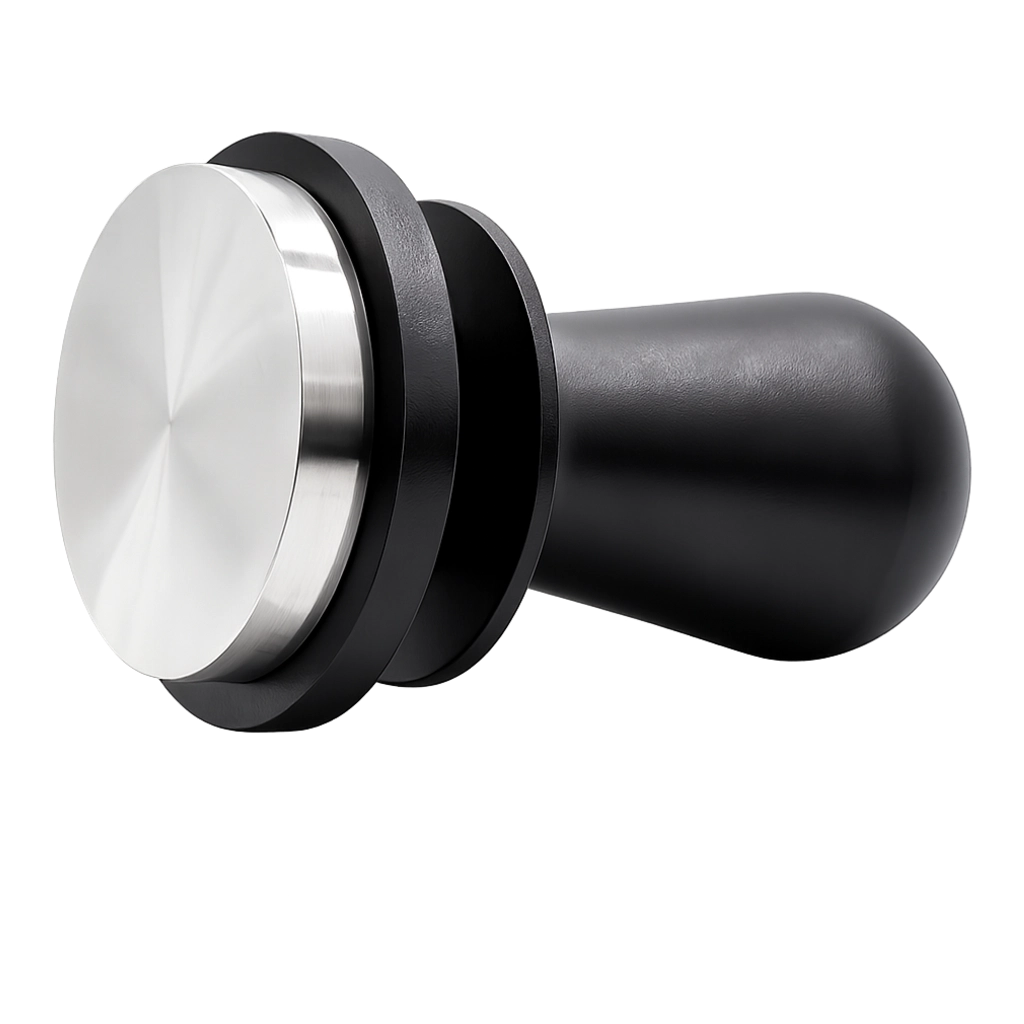
We rate the build quality and materials of the Arkel Coast at 7.5/10 points, and the included accessories (high-grade tamper, portafilter, and basket) at 8/10 points.
Engineering & Warmup Time: A Sprint for a Dual Boiler
Anyone familiar with classic E61 dual boilers knows the wait: 25 to 30 minutes often pass before those chrome monsters are fully heated through. The Arkel Coast breaks with this unwritten rule. In our test protocol, we were pleasantly surprised: the machine is ready to pull shots after just 12 minutes.
How does it achieve this? The engineers opted for a 0.7-liter coffee boiler integrated directly into the group head as a saturated group. This is supported by an auxiliary heating element designed to ensure thermal stability right from the start. The 1.0-liter steam boiler in the back operates completely independently and can be switched off separately. That means if you only want a quick espresso in the morning, leave the steam boiler off to save time and energy.
Those 12 minutes represent a genuine real-world advantage. Want a quick spontaneous espresso in the morning? No problem with the Arkel Coast. It enters the territory of fast thermoblock machines while offering the thermal mass of a real boiler. To be completely transparent, however: while it leaves many boiler competitors behind, there are now machines with thick-film heaters on the market that are ready in just five minutes. The Arkel is extremely fast for its build type, but not the absolute record holder on the market.

Lab Energy Measurements
Every espresso machine review in our testing protocol includes an unbribable look at the power meter. Here, the Arkel Coast benefits noticeably from its quick warmup time, though it shows two distinct faces depending on how you operate it.
The energy efficiency of the Arkel Coast is literally in your hands: use the steam boiler switch mindfully, and you'll have one of the most efficient machines in its class in your kitchen.
Taste & Espresso Quality: Where Physics Meets Craft
Let's talk about what matters most: what actually ends up in the cup? How does an espresso pulled on the Arkel Coast taste? That depends on bean selection and barista technique, but the Arkel Coast provides an exceptional foundation.
Temperature Profile: A Curve with an "Upward Slope"
The fundamental prerequisite for great taste is a stable temperature. In our detailed lab analysis, the Arkel Coast exhibited a very specific thermal behavior. Once fully warmed up, it hits the target temperature of 93 °C nearly perfectly—measuring a steady-state average of 92.87 °C. This earns top marks in our "Target Accuracy" metric. However, be cautious with the very first shot in the morning: the "first shot" averages roughly 1.5 °C below target. Running a quick flush of hot water through the portafilter beforehand fixes this instantly.
Things get interesting during the extraction itself. We observed an "intra-shot temperature rise." Unlike many machines where temperatures drop slightly toward the end of a shot, the Arkel's temperature rises by nearly 2 °C during extraction (intra-shot rise). This is not a mechanical defect, but it carries sensory consequences: higher heat toward the end of an extraction amplifies bitter compounds, giving the cup profile a slightly more "assertive" edge.
Additionally, you should know the offset: we found that the display readout doesn't match the exact temperature delivered to the puck. Setting the display to 92 °C delivers roughly 93.5 °C at the coffee bed. That's physics, not a flaw. Since this offset is consistent, you can easily account for it: set the display 1 to 2 degrees lower to hit your desired brew temperature.


In our testing protocol, the Arkel Coast earns 6 out of 10 points for its temperature profile. This is solid performance in our demanding lab tests, especially as most points were lost during the high-cadence WBC protocol.
1. Cluster A: Daily Usability (4.0 / 5.3 pts)
Part 1: Cold Start / First Shot (2.0 / 3.3 pts):
Average Shot 1: 91.40 °C vs. Average Shots 3–5 (Steady State): 92.87 °C. Delta: 1.47 °C.
The first shot runs about 1.5 °C cooler than steady state. This sits right on the threshold for 2.0 points. A warming flush eliminates this delta.
Part 2: Target Accuracy / Calibration (2.0 / 2.0 pts):
Once fully warm, the machine hits target brew temperature almost flawlessly. Full points.
2. Cluster B: Intra-Shot Stability (1.3 / 2.7 pts)
Shot 5 Analysis (Secs 8–25): Starts at 92.13 °C, ends at 94.03 °C.
Temperature rises by nearly 2 °C during extraction. Under Protocol V2.1 rules, an "intra-shot rise" is penalized more strictly than a drop due to bitter flavor extraction.
3. Cluster C: WBC Performance (0.7 / 2.0 pts)
The Arkel stays well within the 3-degree window required for home machines, but shows a drifting upward curve under rapid succession rather than a flat line like commercial machines.
Flow Control as a Taste Tuner
The flow controller paddle mounted on the right side of the Arkel offers a powerful tool for flavor tuning. The mechanics behind it do not rely on a simple needle valve that chokes flow. In its latest revision, Arkel utilizes a bypass system. Moving the paddle opens a bypass channel that bleeds off excess pressure. The pressure gauge always indicates the true effective pressure on the coffee puck.
This unlocks three distinct flavor tuning scenarios:
Solid thermal performance combined with versatile flow control provides a powerful toolkit for pulling great espresso shots. The Arkel Coast achieves 7 out of 10 points in the Espresso Potential category.
A Brief Note on Volumetrics
Please do not rely on the timed automatic shot feature for taste consistency. Because the timer measures time only (e.g., 25 seconds) rather than fluid volume, in-cup yield varies dramatically as soon as you adjust grind size or engage the flow paddle. For repeatable taste, using a scale is essential. Timed shot cutoffs are better than no auto-stop at all, and once your grind size is locked in, it works well enough.
Steam Power: A True Fog Machine
Anyone who loves cappuccinos will fall in love with this machine. The steam boiler carries incredible power. In our tests, it took just 23 seconds to heat a large pitcher of milk to 60 °C. Michel aptly called the steam system a "fog machine." The microfoam is fine-pored, and steam pressure barely drops even across back-to-back 600 ml pitchers.
The Arkel delivers stellar milk frothing performance: 8 out of 10 points in our test protocol.
Cleaning and Maintenance
An often overlooked aspect is long-term maintenance. Here, the Portuguese designers put real thought into usability. A dedicated drain valve under the machine allows you to completely empty the boilers if you want to perform a manual descaling procedure. You read that correctly! As a rule, we generally do not recommend home baristas perform DIY descaling on boiler espresso machines. Even with soft, filtered water, descaling becomes necessary eventually. But for complete descaling without leaving acid residue behind, most boiler machines require extensive disassembly.
Not so with the Arkel: its integrated boiler drain system allows complete drainage. This means you can easily carry out descaling yourself at home, saving real money over time. Professional descaling services every 2 to 3 years can easily cost €200 to €300! When comparing prices against other classic machines, you can subtract significant long-term maintenance costs from the Arkel's total cost of ownership.

Catering Potential: Ready for Events?
We are often asked if machines like this can be used for pop-up events, weddings, or community festivals. The Arkel Coast sends mixed signals here, though it is fundamentally an exciting option for mobile setups.
On the upside: brute steam power and an enormous drip tray. Anyone serving cappuccinos in volume will love not having to empty the drip tray every five minutes. Its thermal stability across rapid shot sequences also handles heavy workloads well. Plus, at 23 kg, it is still portable enough to transport without needing a freight carrier.
However, there is a catch for commercial use: the Arkel Coast has no direct water line plumb-in option, nor can the drip tray be plumbed to a drain line—though its 1.2 L capacity helps. You are reliant on the 2.5-liter internal water tank. During high-volume service, you must monitor water levels continuously. For private garden parties or small-scale catering, it is fantastic—for high-throughput commercial environments, it lacks a direct water line hookup. If you can live with that, you get a serious workhorse.
Verdict
The Arkel Coast is a strong statement. A high-end dual boiler espresso machine manufactured with European components in Portugal that, thanks to its flow control system, holds its ground against icons like the Micra, Zuriga, or Mozzafiato.
Solid real-world temperature stability and accessible customer support make it a very attractive option, while its milk frothing performance is second to none. We are thoroughly impressed by this Portuguese espresso machine debut and look forward to their next announced model, the "Tide."