






The Gaggia Classic. A name like thunder in the coffee world. However, the historical legacy has increasingly faded in the face of ownership changes and immature machines in recent years – like that very thunder. With a shift in production back to Italy, a split in the Gaggia brand (Evoca Group: gastro machines and Saeco Professional; Versuni/Philips: household machines like the Gaggia Classic and super-automatics), which is not further discussed here, and a return to old values, everything should now improve.
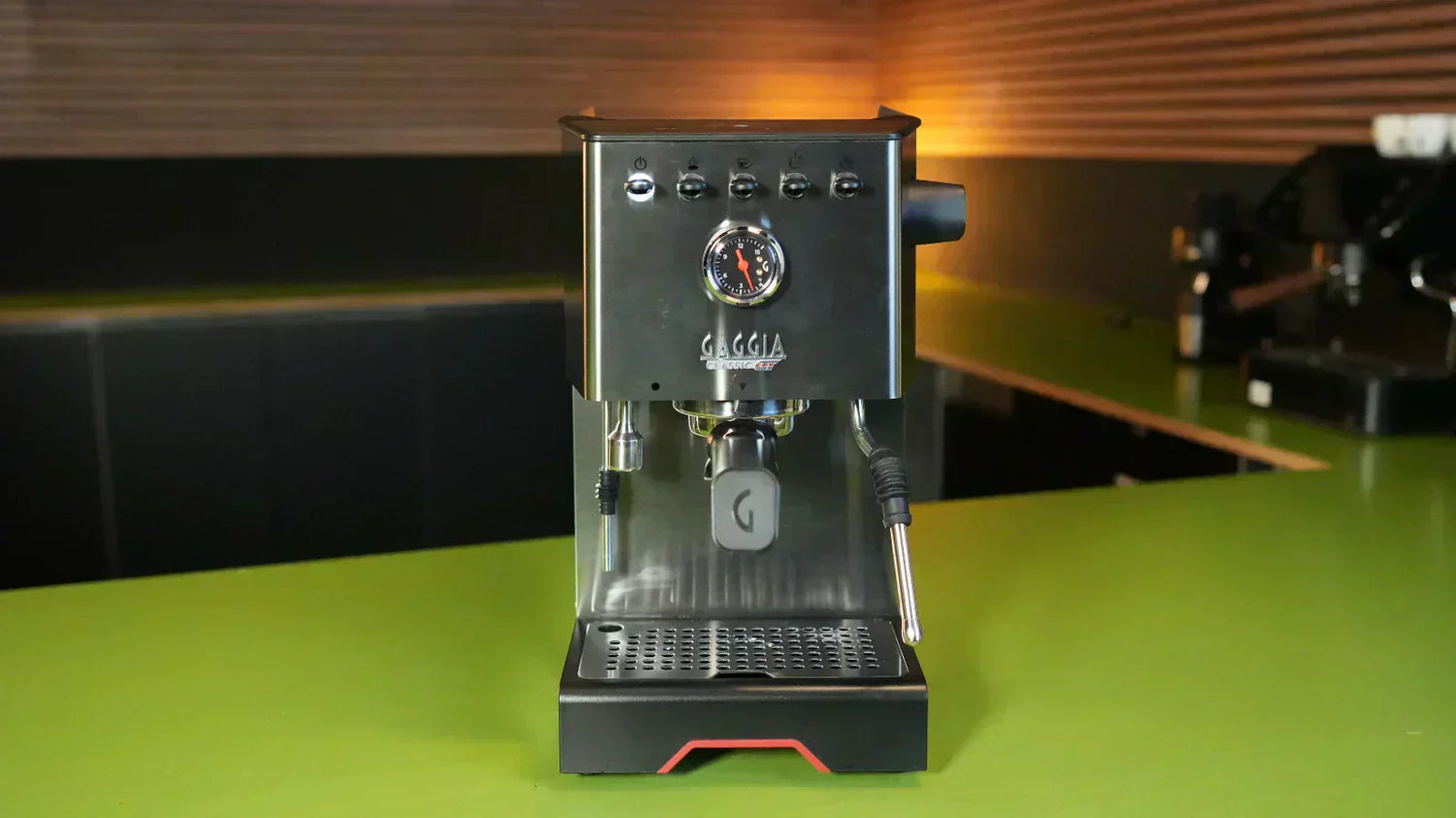
The Gaggia Classic GT is an expression of this effort and at the same time a major leap forward. In design terms, it leans on the much cheaper Gaggia Classic and thus follows in the footsteps of the pioneer of home espresso machines, the Gaggia Baby. In terms of ambition, however, the Classic GT is a dual boiler that with a vibration pump and some predefined flow profile functions offers quite interesting possibilities.
The Gaggia Classic GT promises much: volumetrics, fast heat-up and temperature stability. But can it deliver? Our first impression is mixed. While the internal values shine on paper, opinions differ on the exterior. As always with this test: we bought and tested the Gaggia Classic GT ourselves conscientiously.
The espresso machine costs between €1,600 and €1,700 or francs in retail.

Design, Dimensions & Feel: 80s Charm
Design is a matter of opinion, and we debated that on the team too. While some like the industrial angularity, the front section with its large buttons and unusual layout reminds me more of the dashboard of my grandmother's Opel Kadett. It's a design that screams "retro," but may have taken a turn too early.
At 23 centimeters wide, the machine is extremely narrow, but takes up a considerable 42 centimeters in depth. So it fits into smaller niches – as long as there's enough space in the back. What bothers us, however, is the material mix: alongside solid stainless steel, we find irritatingly much plastic. The portafilter handle in particular doesn't feel as high-quality as we would expect at this price point. The drip tray and cup rest also tend to rattle as soon as the pump runs.
Technology & Heat-Up Time
Technically, we're dealing with a genuine dual boiler here. This means separate boilers for coffee extraction and steam – unlike a heat exchanger or single boiler, where compromises are always necessary. Gaggia uses a brew boiler as well as a stainless steel steam boiler.
The manufacturer promises fast heat-up – and that's exactly what we find, especially compared to dual boilers in a similar price range. Many E61 machines need 20 to 30 minutes before they're really heated through. Our KM temperature protocol shows a pleasing reality here: after a measured 9 minutes, the machine including portafilter is up to temperature. For a dual boiler, that's an excellent value and absolutely practical for everyday use.
But be careful: don't blindly rely on the machine's display. Give it those full 9 minutes so the portafilter is really hot too.

Energy Consumption Manageable
In our power measurement, the Gaggia Classic GT positions itself as a classic boiler machine with solid values. With a measured heat-up time of 8 minutes and 30 seconds, it initially requires 0.1457 kWh to be ready to go. If you make a single espresso in the morning, including heat-up you're at 0.1555 kWh. Add milk, and a cappuccino rises to a moderate 0.1759 kWh.
Compared to many dual boilers, the Gaggia stands out pleasingly well. While large machines for the scenario "one espresso including heat-up" often consume significantly over 0.20 or even 0.30 kWh, the Gaggia operates comparatively economically. The standby consumption of just under 0.07 kWh per hour is also acceptable for this boiler size.
However, if you compare the Gaggia to modern efficiency leaders like current thermoblock machines or insulated single boilers, the energy difference of the classic design becomes visible. If you're looking for maximum energy efficiency and mainly drink individual espressos, you'll find significantly more economical alternatives there.
Noise Level
The installed vibration pump operates audibly. We measure approximately 63 dB in operation. That's not whisper-quiet, but not a jackhammer either. However, the vibrations transfer to the housing, which promotes the aforementioned rattling of the cup rest.

Volumetrics of the Gaggia Classic GT
In order to set the espresso, the Gaggia Classic GT offers a volumetric function that worked surprisingly precisely in our tests. The programmed quantities reliably landed in the cup and ensured a pleasant workflow.
This volumetric function is truly a game changer. In this price class – and often well above – you frequently find only time-controlled extraction. Since the resistance of the coffee puck varies, constant quantities are hardly achievable with that approach.
Reliable volumetrics are extremely valuable for setting up the espresso machine as well as for everyday use. Without it, you have to constantly work with a scale. Fluctuating water quantities change the brew ratio – and thus the taste in the cup significantly.
Temperature Performance & Taste
Let's get to the most important question: How does the coffee taste? If you give the machine enough time to heat up and do a short flush shot before the first extraction, the Gaggia Classic GT delivers convincingly. The first shot without flushing is actually significantly too hot. Our measurements show an overshoot of over 1 °C compared to the steady state.
A short blank extraction before the first espresso immediately harmonizes the temperature. If you take that into account, you get full marks for speed.

Everyday Usability (KM Protocol)
In simulated home use – multiple espressos in succession with realistic breaks – the Gaggia shows its best side. Once it's dialed in, it hits the target temperature of 93 °C very precisely. The extractions three through five were extremely consistent.
Typical for machines with smaller boiler volume, the temperature curve during extraction shows a slight drop. Sensorially, that's not a disadvantage: many espresso enthusiasts appreciate this profile because it reduces bitter compounds and makes the espresso taste rounder.

Stress Test (WBC Protocol)
In the tough WBC stress test with continuous extractions and simultaneous steaming, the Gaggia Classic GT reaches its limits. The small 0.1-liter brew boiler can't supply energy fast enough. So it's not designed for a garden party with 20 cappuccinos – but it's completely sufficient for enjoyable everyday use.
The Taste: Fruit Meets Body
Our tests with the "Mano" espresso confirm the measured values. With classic pressure buildup (9 bar), there's a good balance, sweetness, and clear fruitiness – a sign of clean, controlled temperatures.
If you use the manual preinfusion, however, the flavor profile shifts. A long, gentle pre-brew of about 15 seconds brings more body, chocolate, and nuts. This shows: despite limitations under load, the GT offers real experimentation potential.
In our temperature rating, the Gaggia Classic GT achieves 6 out of 10 points – solid middle ground. It's not a gastronomic monster, but a fast, thermally forgiving partner for home use.
Flow Profiles
Gaggia heavily advertises preinfusion, with profiles like "Light," "Medium," and "Dark." Unfortunately, the preset water quantities are so low that the puck often isn't fully saturated. This promotes channeling rather than clean extraction.
Our recommendation: Use the manual preinfusion. It gives you control and allows uniform saturation of the coffee puck – which pays off in a sweeter, more complex espresso.
We discuss this topic in detail in the video.
Steaming & Steam: Power with Obstacles
Thanks to the dual boiler principle, we benefit from constant steam availability when frothing milk. No waiting or venting required as with a thermoblock or single boiler. The steam power is absolutely sufficient for home use.
The rubber element on the steam wand is somewhat clunky and occasionally interferes with small pitchers. The result is convincing nonetheless: fine-textured milk foam is achieved reliably. For a 0.6-liter pitcher, the machine needs about 40 seconds – rather slow for a dual boiler, but overall a solid average.
Conclusion & Recommendation
Who is the Gaggia Classic GT right for? For anyone who likes the design and values good temperature consistency and especially volumetrics. 8:30 minutes heat-up time is competitive, the steam power is solid. Apart from the unconvincing profiles, the machine doesn't have any major flaws.
Everything else is – as so often – a matter of taste. And taste, as we know, is on the tongue. There the Gaggia Classic GT leaves little to be desired.
Do you have experience with the Gaggia Classic GT? Feel free to write it in the comments.
Gaggia Classic GT
Test Report Summary. Protocol 2.1 updated on 7.12.2025Especially with the Gaggia, puck preparation makes the difference. The complete process is in preparing espresso.