






















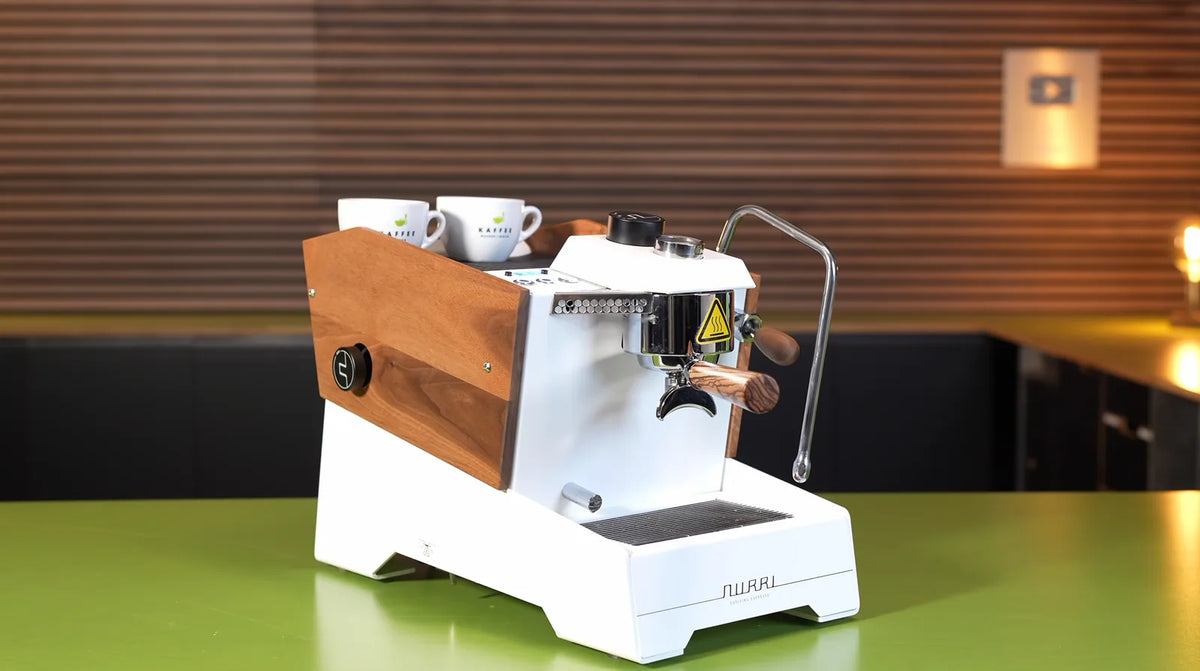

The Nurri R-Type Dual Boiler costs around 3,000 euros with wood applications, and for once we didn't buy it but rented it on a lease invoice. Antonio Nurri is a Neapolitan coffee legend: he roasts, he builds lever machines (with his Leva he brewed in our test of Italian espressos in Basel), and with the R-Type he built a compact dual boiler with a rotary pump and its own heated brew group. So no E61, which dominates the form language on so many dual boilers. The machine is aimed at people who value craftsmanship and aesthetics and want to customize their machine according to their own wishes. We measured it according to our test protocol 2.3.2. The central question: What's behind the beauty, and is it enough for 3,000 euros?
 Nurri R-Type in test: the full video · 28 min.
The video only loads from YouTube when you click. Data is transmitted to Google; find out more in our privacy policy.
We did not buy this test machine; we rented it from Stoll Espresso and paid a rental invoice for it. It is the white version with wood application by Wiedemann. Nurri had no insight into measurements or text; there were no restrictions.
Design and craftsmanship of the Nurri R-Type
The Nurri R-Type reaches 32 centimeters in height without cups. It is 26 centimeters wide and with the portafilter inserted, 56 centimeters deep. This means it fits under most wall cabinets; you just need a little headroom to pull out the water tank. In any case, you have more headroom than with classic espresso machines with a Faema E61 brew group. On a standard work surface with 60 centimeters depth, the portafilter doesn't get in the way. At 17 kilos, it can still be lifted, and because you can get a good grip underneath, moving it around during daily use was no problem.
The R-Type comes standard in white or black. The wood applications vary depending on the dealer—they come either directly from Nurri or from partners. Our test machine is from Stoll Espresso in Germany, which works with Wiedemann and offers zebrano, walnut, or oak. If you like, you can have them painted. With wood, the price is around 3,000 euros; a paint job costs an additional 200 to 300 euros depending on the supplier. The idea behind it is clear: this should be your machine, not just any machine.
Regarding craftsmanship: We examined the housing and found exactly one sharp spot—a pointed edge on a metal sheet on the brew group and front that gets hot anyway in daily use and that no one touches. Otherwise everything is rounded, the controls feel high-quality, nothing wobbles. What stands out is that some recesses like the pressure gauge or the steam control knob don't sit flush in their designated holes. This is a real letdown for a machine in this price range that also brings a corresponding expectation of quality.

Technology: two 0.8-liter boilers, heated brew group, rotary pump
Inside the housing are two boilers with 0.8 liters each, one for steam, one for coffee. There is no hot water function; the steam boiler only produces steam. The brew group is a custom design with its own heater; boiler temperature and brew head temperature can be set separately. The rotary pump delivers up to 14 milliliters per second, which is great for lungo shots and turbo shots.
The machine is operated via a small LED panel, a lever on the left side, a pressure gauge on top, and a brew button that Michel considers the most elegant we've seen. However, it can only do start and stop. It is switched on and off via a main switch on the side, and here comes a quirk: after switching on, you need to individually activate the steam boiler and brew boiler separately. If you turn the machine off and on again at the main switch, you're faced with two cold boilers because the machine doesn't remember the setting. A smart plug for preheating doesn't work, therefore.
Michel still thinks it's well solved. When he has just one espresso in the evening, he presses a button for the brew boiler and doesn't have to fiddle with a menu. I would have wished that the machine at least adopts the last setting or starts both boilers together. Antonio is a friend of handwork; maybe that explains it.
Heat-up time: 15 minutes to the first shot, 20 to 25 for series shots
After 15 minutes the first extraction is up to temperature. That's true, and yet it's only half true, because the machine is not fully heated through then. In our protocol, a machine is considered heated up when the first extraction deviates by no more than one degree from the average value of the fully heated machine, and that's the case after 15 minutes. If you want to extract multiple espressos in succession, it's better to plan for 20 to 25 minutes. This puts the R-Type between modern quick heaters and classic E61 machines, which take a bit longer.
Temperature in the KM protocol: 93.4 °C on first extraction, then a drop
We measure with the Scace 2 directly in the portafilter, five double extractions at one-minute intervals, steam boiler switched on, boiler set to 94 °C and brew head to 95 °C. The first extraction averages 93.4 °C, exactly where we want it. The second drops to 90.3 °C, the third to 90.0 °C, only the fourth is back at 92.9 °C, the fifth is at 92.5 °C. Three degrees between shot one and shot three—you'll taste that in the cup.
Within a single extraction, the curve is clean. On the fourth extraction, the temperature rises from 92.1 °C after five seconds to 93.4 °C at the end of 25 seconds. And once the machine is really warm, it also holds steady: in the WBC protocol we do 14 extractions at short intervals after one hour of running time. There all extractions are between 91.4 and 93.5 °C, a window of 2.1 °C. That's very good for a home espresso machine and stable enough for entertaining guests.
The practical solution is simple. If you want just one espresso or a double after a quarter hour, everything is fine. If you want two in a row, wait two, preferably three minutes between extractions. In a measurement series with two minutes' pause, the second extraction was still 1.7 °C below the first, then extractions three to five were within half a degree. Or give the machine 20 to 25 minutes from the start. Then you can really "brew, brew, brew".
Espresso in the cup: 19 grams Robusta in, 41 grams out
We brewed with our Bharath, a pure fine robusta from India, because Michel wanted something with punch and yet a certain elegance, fitting for Naples. 19 grams in the basket, 41 grams in the cup, so a bit longer than 1:2. The crema was so thick that the spoon almost stuck. In the cup: very full body, cocoa, for me dark bread and very long finish. After that, you don't need to go to the gym for a week; that's how much body this coffee has. The first shot after 15 minutes was spot on, 93 degrees nailed.
Technically, the R-Type gives little away with the espresso. Apart from pump pressure, there's nothing else to adjust; there's no pre-infusion. The metal portafilter is heated through, pressure builds up steadily, and what reaches the cup is what the machine can deliver.
Adjust pressure: from 9 to 7 bar without tools, but no pressure profiling
What we like: you can adjust the pump pressure on the outside of the machine without opening the housing, and you see the result directly on the pressure gauge. From 9 to 7 bar for a fruity coffee, we often brew our purple line at 7 to 7.5 bar, and with one and a half turns back to 8.5 or 9 bar. That's fine-tuning per coffee, and Antonio solved that well.
It's not a pressure profile. Michel tried it with the Bharath and turned it back to 5 bar at the end of the extraction: that requires too many turns, takes too long, and isn't reproducible. So understand the dial not as profiling, but as a tool to set the bar setting to a baseline value.
No volumetrics: every shot is stopped by hand
The R-Type has no volumetrics. You start and stop each shot yourself, and if you want precision and a clean brew ratio, you put a scale under the cup. At home that's a matter of habit. For me it's a deal-breaker for the food service industry: in a bakery or a small café where coffee generates significant revenue, I don't want to extract shots by guesswork, and I can't weigh under stress. In our protocol, this is the machine's biggest weakness, but it mainly applies to commercial use.
For us, this is a missed opportunity. A flow meter would have pushed the Nurri R-Type into very interesting categories. Too bad, because the upcharge would barely make a dent at the high price, but would have opened up new areas of use.
Milk foam: 34 seconds for 300 milliliters, 15 milliliters condensation
300 milliliters of milk from 8 to 60 °C takes 34 seconds. That's not super fast; other dual boilers in this class manage 20 to 25 seconds, but the wand has real power: the pitcher can stand upright and the milk still spins cleanly. Michel had the steam boiler set to 140 °C, the maximum, and advises against it for a single serving because that's just too much power. Turn the pressure down a bit or froth a double pitcher, then it works.
Two things bother us. First, the wand: according to the manufacturer it's no-burn, but in practice still very hot. Second, the condensation. Before frothing, about 15 milliliters of water come out of the wand, even after long heat-up, and if you don't blow it out, you have that water in your milk too.
That's important because the frothing process itself adds about 10% water to the milk. So blow out briefly into the drip tray before each froth. The cappuccino with the Bharath was then really good, hazelnut and milk chocolate, with fresh milk. Michel's tip for latte art on robusta-heavy coffee: first add a splash of milk to the espresso, swirl, then pour.
With long milk runs you feel the boiler size: five times 300 milliliters at 90-second intervals, and from the fourth round onward the steam goes slowly to its knees. Irrelevant at home, not for catering. At least: the machine has a water line connection, only the drip tray has no drain.
Power consumption: 0.183 kWh for heat-up and one espresso
With the steam boiler switched on, the R-Type draws 0.168 kWh for heat-up and 0.183 kWh for heat-up plus one espresso. That's our reference value based on the "espresso first" principle. A cappuccino including heat-up is 0.207 kWh, heat-up plus five extractions is 0.242 kWh. For comparison: the Lelit Elizabeth was 0.17 kWh, a La Marzocco GS3 with its 3.5 and 1.5 liter boiler volume over 0.4 kWh. For a dual boiler with this much steam power, that's reasonable.
If you skip the steam boiler, you save significantly: 0.086 kWh for heat-up and 0.099 kWh with one espresso. Idle power costs 0.101 kWh per hour with steam boiler and 0.071 kWh without. The separate boiler switches, which I griped about above, thus have a real practical benefit if you only drink espresso in the evening.
Noise level: 57.6 decibels during extraction, the relief valve is louder
During extraction we measure 57.6 dB(A) at 20 centimeters distance. A pleasantly quiet machine, even for the living room. Louder than the extraction itself is the relief afterward, when water shoots with pressure into the drip tray.
Workflow and daily use: drip tray and water tank
The drip tray holds 900 milliliters, which is decent for this size. But that's relative, because with each extraction almost all the water from the brew group is relieved back down toward the boiler. After a few brews you're at the limit, plus there's the condensation from the wand.

The water tank holds 1.5 liters and is easy to remove; there's no visible water level from the outside.
Accessories: two portafilters, three baskets, no tamper
We borrowed the machine and simply forgot to borrow the accessories, so from second-hand sources: in the box are a double portafilter, a bottomless portafilter, and three baskets, a single basket, a large and a small double basket. According to the manufacturer, there's also a portafilter with a single spout. Solid quality, nothing fancy. A tamper is missing. A missing tamper is always a thing. For a machine in this price range, we'd expect it. On the other hand, that's something where everyone wants to customize anyway.
For us with our new pressure tamper, it's less tragic because we love it so much right now that we use it at every opportunity.
Price: around 3,000 euros, and two ways to look at it
Around 3,000 euros with wood, painted 200 to 300 euros more, as of November 2026. Michel thinks the value for money is very good, because of the craftsmanship and customization. If you just compare the measured values to the price, you're paying a significant premium for craftsmanship and customization. Both are true. There are dual boilers for 2,000 euros that can do more.
Where you can buy the Nurri R-Type
Our test machine comes from Stoll Espresso*, where you can also get the wood versions from Wiedemann and custom paint jobs on request. If you're interested in the internal design, Philipp at Welter & Welter has a very technical test video of the machine.
* Links to specialty retailers may be affiliate links. The price doesn't change for you; we receive a small commission. We tested independently regardless.
Measurements and technical specifications
| Feature | Value |
|---|---|
| Price | approx. 3,000 euros with wood application, paint approx. 200–300 euros upcharge (as of November 2026) |
| Boiler | Dual boiler, 0.8 liters each (brew and steam boiler) |
| Brew group | custom, heated brew group; boiler and brew head temperature separately adjustable |
| Pump | Rotary pump, pressure externally adjustable, pressure gauge; up to 14 ml/s |
| Hot water | not available |
| Volumetrics | none |
| Heat-up time | 15 minutes to first extraction |
| Brew temperature extractions 1–5, 1 min. pause | 93.4 / 90.3 / 90.0 / 92.9 / 92.5 °C (after 15 min., Scace 2, boiler 94 °C / brew head 95 °C) |
| Brew temperature extractions 1–5, 2 min. pause | 93.5 / 91.8 / 93.1 / 93.1 / 93.0 °C |
| WBC window | 2.1 °C over 14 extractions |
| Power with steam boiler | Heat-up 0.168 kWh · + 1 espresso 0.183 kWh · + 5 espressos 0.242 kWh · cappuccino 0.207 kWh |
| Power without steam boiler | Heat-up 0.086 kWh · + 1 espresso 0.099 kWh · + 5 espressos 0.150 kWh |
| Idle power per hour | 0.101 kWh with, 0.071 kWh without steam boiler |
| Noise level | 57.6 dB(A) |
| Milk | 300 ml from 8 to 60 °C in 34 s; approx. 15 ml condensation |
| Water tank | 1.5 liters |
| Drip tray | 900 ml |
| Dimensions (W × H × D) | 26 × 32 × 56 cm (depth with portafilter, height without cups) |
| Weight | 17 kg |
| Colors | White or black, wood applications and paints vary by retailer |
Measurements from our KM test protocol 2.3.2, measured August/September 2026, test machine rented.
Our assessment: preliminary, without score
The R-Type delivers a first espresso spot-on after 15 minutes, froths with plenty of power, and is quiet at 57.6 dB(A). Its biggest strength is its craftsmanship, even though the flush-fitting control knobs disappoint. For multiple espressos in succession, you should give the machine 20 to 25 minutes of heat-up time so it reaches its temperature retention.
Conclusion
The Nurri R-Type Dual Boiler is a beautifully built machine with a weakness that annoys us because it's unnecessary. The espresso is good, the temperature is right once the machine is fully heated, the steam has power, it's quiet, and you can adjust the brew pressure without tools. For that you need patience between shots after 15 minutes, you stop each extraction by hand, and you live with weakening steam on milk runs.
If you wait longer, the machine reaches its true temperature retention, and you can run a higher frequency.
Who is it for? For people who drink espresso and the occasional cappuccino at home, want a machine with character on the counter, and work with a scale. Not for restaurants, not for catering, and not for people who need their first shot in two minutes in the morning. Find out which design suits you in our buying guide.
We'll add the score when we release the new test protocol.
We did not buy this machine; we rented it on a lease invoice. This test was not commissioned by Nurri.



