






















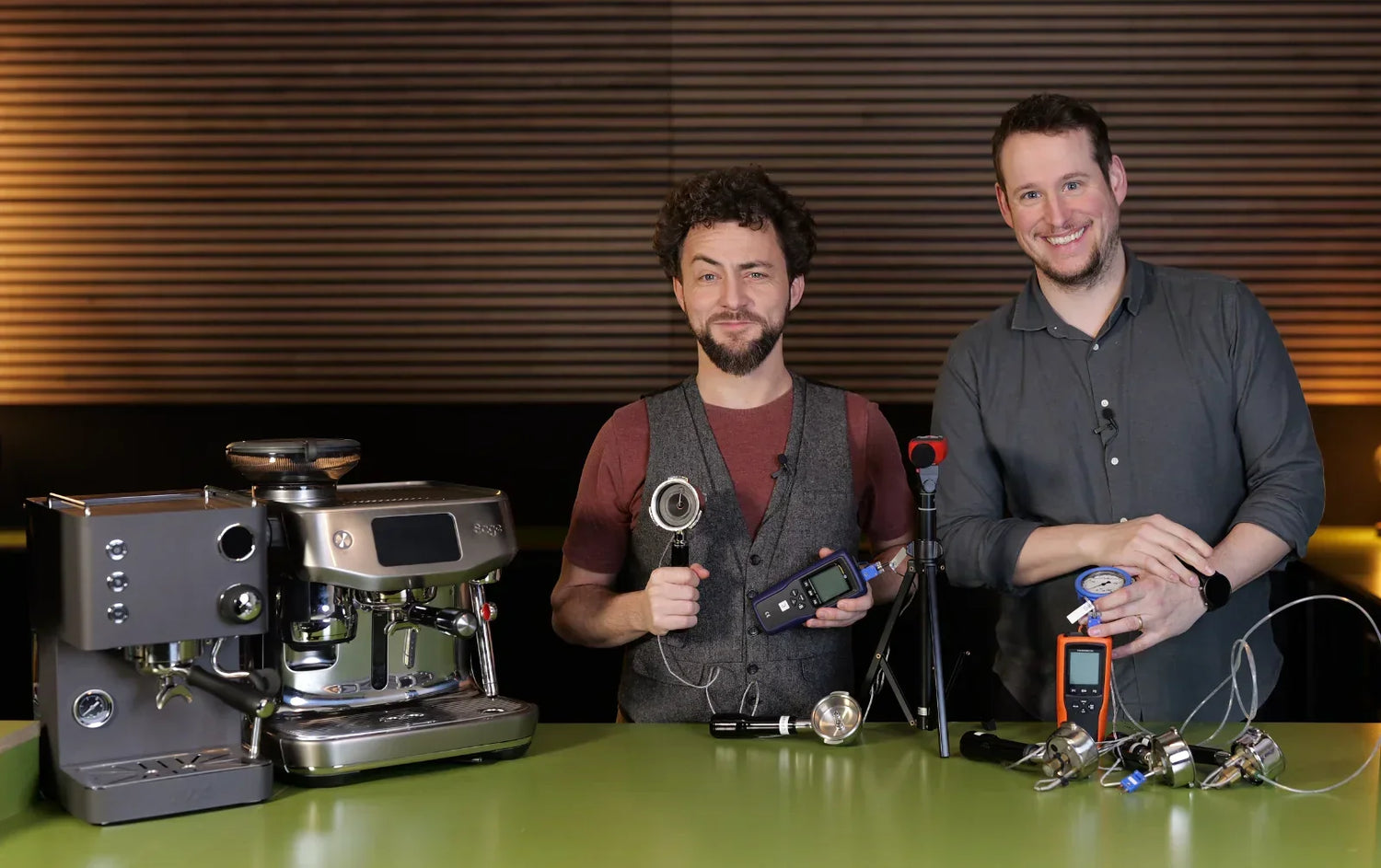

A thermoblock machine for 400 euros and a dual boiler for 4,000 euros stand on the same shelf. How do you compare them? We measure. Every machine goes through the same protocol, receives a grade from 0 to 10 in eleven categories, and from that a total score of 0 to 100.
With Version 2.4, we rebuilt the protocol in several places. The reason: When we recalculated our own tests, we saw that averages hide too much. A machine that hits 93 °C on the first shot and delivers 96 °C on the second looked better in the old protocol than it actually is.
What's new in Version 2.4
Temperature: We count how many seconds of a shot fall within the target range. The first shot after heating counts most.
Warm-up time: A machine is considered heated up only when the first espresso reaches the target temperature.
Volumetrics: Every single shot counts. An outlier no longer disappears into the average.
Steaming: We weigh the milk before and after steaming and see how much water the steam introduces.
Power consumption: Both espresso and cappuccino flow into the rating, in a 2 to 1 ratio.
Total score: The module for catering no longer counts. You can enable it if you make many drinks in a row.
The graphics show how we will present measurement values in each test going forward. They are based on sample data from a fictional machine and are labeled as such.
Three principles
Time on target instead of average. An average of 93 °C can consist of 25 calm seconds or a progression from 88 to 98 °C. For espresso, that's a big difference. That's why we count every second and every shot individually.
The first shot counts most. Most of you make a double espresso at home and perhaps another one later. If you turn on in the morning, you want to know what the first shot can do.
Measure and disclose. Every threshold in this protocol is stated here in the text. If we change one, it goes in the change log.
How to read the total score
The total score is a weighted average. A machine with 70 can have a 9 in steaming and a 4 in warm-up time. So always look at the individual grades and ask yourself what matters to you: Do you only drink espresso? Do you make cappuccino daily? Should the machine be ready in five minutes?
The weighting
| Category | Factor |
|---|---|
| Espresso potential | 3 |
| Temperature management | 2 |
| Volumetrics | 2 |
| Steaming quality | 2 |
| Build quality | 2 |
| Usability | 2 |
| Warm-up time | 2 |
| Power consumption | 2 |
| Noise level | 1 |
| Accessories | 1 |
| Price-to-performance | 1 |
The factors add up to 20. The total score is the sum of grade times factor, divided by 20. We always convert this result to a scale of 0 to 100: 7.0 becomes 70.
Quality classes
| Score | Class | Meaning |
|---|---|---|
| from 93 | World class | Reference device without notable weaknesses |
| from 80 | Excellent | Excellent, with minor compromises |
| from 65 | Very good | Strong performance, recommended for most |
| from 50 | Good / Standard | Solid, meets basic requirements |
| from 30 | Compromise | Noticeable weaknesses |
| Below that | Inadequate | Not recommended |
Espresso potential (Factor 3)
How good can the espresso be that you get out of the machine? That's our most important category. It consists of four building blocks.
Temperature (up to 3 points). The temperature grade of the machine, times 0.3. A score of 8.0 in the temperature chapter gives 2.4 points here.
Profiling (up to 3 points). What brew control does the machine allow?
| The machine can | Points |
|---|---|
| Control flow, pressure, and stages freely | 3 |
| Program pressure profiles | 2.5 |
| Adjust pre-infusion | 1.5 |
| Fixed pre-infusion that saturates the puck | 1 |
| Profiling by hand via paddle or lever | 1 |
| None of the above | 0 |
A fixed pre-infusion only counts if it really soaks the puck. We weigh afterward: During the pre-infusion time, at least 1.5 times the amount of coffee in water must flow through; at 18 g coffee, that's 27 g. Machines that monitor flow during the shot and self-regulate get an additional half point, up to a maximum of 3.
Hardware (up to 2 points). How evenly does the shower distribute water? Is the portafilter fully heated, does pressure build up stably?
Sensory evaluation (up to 2 points). In the end, we taste with reference coffees. The panel is led by Q-Grader Benjamin Hohlmann. Evaluation follows WBC criteria: sweetness, acidity and bitterness, plus body, texture, and finish. The question is: Does what the technology promises arrive in the cup?
Temperature management (Factor 2)
We measure with the Scace 2 or equivalent calibrated measurement portafilters for each basket size, one measurement per second. Water in the tank is 20 °C, the target is 93 °C at the puck.
The KM Protocol. After heating, we pull five double espressos at one-minute intervals: 27 seconds pull, 15 seconds sitting in the group, 45 seconds pause, 2 seconds flush.
Temperature · Measurement · Sample data
Here's what it looks like in the test: the first shot on target, the following ones slightly cooler
Seconds 10 through 25 of each shot are rated. The first nine seconds are ramp-up.
| Building block | Points | What we check |
|---|---|---|
| First shot | up to 3 | How many seconds does the first shot stay on target? ±1 °C counts fully, ±2 °C counts at half value |
| Subsequent shots | up to 2 | The same for shots 2 through 5 |
| Repeatability | up to 3 | How far apart are the five curves? 0.3 °C spread gives full points, 4 °C gives none |
| Stability during shot | up to 2 | Is the curve flat, steady, or erratic? |
Temperature · Classification · Sample data
These seconds make up the grade
What about the offset? Many machines show 93 °C but deliver 92 or 94.5 °C. Previously we adjusted the offset before measurement until it matched. Now we calculate from the measurement data where the machine actually sits and write it in the test: "displays 94 °C, delivers 93.5 °C". This costs points only if the display is more than 2 °C off. Then we deduct half a point.
We divide machines into four classes: hits out of the box · offset adjustable in menu · temperature display without offset menu · only stages or not adjustable at all. For the last class, 93 °C is fixed.
The WBC stress test. 14 shots in quick succession, plus milk steaming, after one hour runtime. We discuss it in each test. Points only in the catering module.
Warm-up time (Factor 2)
When is a machine heated up? When the first espresso is correct. The machine's ready light never counted for us, even in earlier versions. What's new is the standard: We used to compare the first shot to the average of the fully heated machine; now it's to the target temperature. The earlier exception for light portafilters (1.5 °C tolerance) no longer exists.
We measure several series with different warm-up times. Warm-up time is the shortest time at which the first shot averages no more than 1 °C below target in second 15 through 25.
Warm-up time · Measurement · Sample data
Still too cold after 6 minutes, ready after 9 minutes
| Warm-up time | Grade |
|---|---|
| under 2:30 minutes | 10 |
| under 4:30 | 9 |
| under 7 | 8 |
| under 10 | 7 |
| under 14 | 6 |
| under 18 | 5 |
| under 24 | 4 |
| up to 30 | 3 |
| up to 40 | 2 |
| beyond that | 1 |
Volumetrics (Factor 2)
You program 45 g and want to get 45 g, even if the grind isn't quite right. We test this in five stages with our Apas espresso, a Mahlkönig E64 GbW, and a 1:2.5 brew ratio.
Before stages 1 and 2 we pull three adjustment shots. Their average is the reference value. Each rated shot that deviates by no more than 1 g counts in full; up to 2 g counts at half value; more than that doesn't count.
| Building block | Points |
|---|---|
| Repeatability accuracy at Scace | up to 3 |
| Repeatability accuracy with coffee | up to 2 |
| Robustness under stress | up to 3 |
| Input in grams or milliliters | 1 |
| Built-in scale | 1 |
A pure time-based dose gets a flat 3 points; a machine without volumetrics gets 0. If a machine reliably delivers 46.5 g instead of the set 45 g, that goes in the test. It doesn't cost points because you adjust once and then you're done.
If a machine can be paired with a scale, we test twice: with and without scale.
Steaming quality (Factor 2)
Tested with 300 ml cold milk in the 0.6-liter pitcher. In Version 2.3, this said "in testing phase". Now the points are set.
| Building block | Points | What we check |
|---|---|---|
| Steam power | up to 3 | Does the steam get the milk spinning if we hold the pitcher vertical? The more we have to tilt it, the fewer points |
| Speed | up to 3 | Time to heat 300 ml from 8 to 60 °C. Under 25 seconds gives full points |
| Workflow | up to 1.5 | Wand you don't burn yourself on (1), ball joint (0.5) |
| Condensation water | up to 1 | How much water comes from the wand before steam? |
| Water retention | up to 1.5 | How much heavier is the milk after steaming? |
Why we weigh the milk. Steam heats milk by condensing in it. Without water it doesn't work: Theoretically, even perfectly dry steam adds about 8.5%. Wet steam brings more water and dilutes the milk. Up to 12% increase gets the full 1.5 points; up to 18% gets 1 point; more gets none.
Single boiler. On a machine with just one heating circuit, you can't brew and steam at the same time and must switch. We deduct one point in steaming for this.
Power consumption (Factor 2)
We measure with a Christ CLM1000 Professional at second intervals, after at least six hours rest, with 20 to 24 °C warm water in the tank, from cold: heat up, five espressos, five hot water shots, five steam shots, 20 minutes keeping warm.
Power · Measurement · Sample data
The power curve shows when the machine really heats
Two values go into the grade:
Espresso: Heat up plus one double espresso. If the steam boiler can be turned off, we rate the economical mode.
Cappuccino: Heat up plus one espresso plus one steam shot.
The espresso value counts double, the cappuccino value counts once. The ratio is based on our survey of 2,700 participants.
| Consumption | Grade |
|---|---|
| under 0.05 kWh | 10 |
| under 0.08 | 9 |
| under 0.11 | 8 |
| under 0.14 | 7 |
| under 0.18 | 6 |
| under 0.22 | 5 |
| under 0.30 | 4 |
| under 0.40 | 3 |
| under 0.55 | 2 |
| from 0.55 | 1 |
Power · Classification · Sample data
What does that mean compared to other devices in the kitchen?
We state the consumption during idle time in every test, but it doesn't earn points.
Build quality (Factor 2)
| Building block | Points |
|---|---|
| Surface quality: gaps, edges, fit | up to 3 |
| Materials and haptics, plus 0.5 for high-quality controls | up to 3.5 |
| Construction and stability | up to 3 |
| Interior: How neatly are cables and hoses routed? | up to 1 |
No more than 10 points. We can't test longevity in a few days. For that we rely on user feedback.
Usability, workflow, and cleaning (Factor 2)
| Building block | Points |
|---|---|
| Interface and controls, plus 0.5 for programmable shortcuts | up to 3.5 |
| Daily routine: tank, water level, drip tray, portafilter, water filter, layout | up to 3 |
| Cleaning and maintenance | up to 3 |
| Documentation | up to 1 |
For every irritant that really bothers you in everyday use, we deduct one point and note which one.
Noise level (Factor 1)
We measure at 20 cm distance at the height of the group, in the film studio, taking the highest value during a shot under load, at 9 bar with blind basket or puck.
| Measurement dB(A) | Grade |
|---|---|
| under 54 | 10 |
| under 55.5 | 9 |
| under 57 | 8 |
| under 58.5 | 7 |
| under 60 | 6 |
| under 63 | 5 |
| under 64.5 | 4 |
| under 66 | 3 |
| under 70 | 2 |
| from 70 | 1 |
If a machine sounds particularly annoying or particularly pleasant, we adjust by up to one point and explain why.
Accessories (Factor 1)
Points go to the basics (portafilter with two spouts, at least two baskets, tamper, blind basket), the quality of tamper, baskets, and portafilter, and extras like a bottomless portafilter or a good milk pitcher. A tamper with more than 2 mm play costs one point.
Price-to-performance (Factor 1)
We set quality in relation to the square root of the price. This way an expensive machine isn't penalized for the last percentages of quality costing disproportionately more.
An example: Machine A has a quality base of 80 and costs 1,600 euros, raw value 20.0, grade 6.7. Machine B has 70 and costs 900 euros, raw value 23.3, grade 7.8. Machine B offers more for the money.
For reference: Over 8 is a great deal; between 5 and 6.5 is a fair price; below 5 you're paying a premium for enthusiasts.
Optional: what doesn't go into the total score
Volume potential and catering. For anyone making many drinks in a row. Rated are temperature across the 14 shots of the WBC test (up to 4 points), five times 300 ml milk at 90-second intervals (up to 3 points), and features like fixed water connection, drip tray with drain, and large cup platform with pre-warming (up to 3 points).
Espresso only. If you never steam milk, look at power consumption for espresso alone.
Dark roast. For classic dark roasts, pre-infusion helps; elaborate profiles add little. In this view, profiling counts only up to 1.5 points.
How we place each machine in the test field
At the end of each test, we show in four comparisons where the machine stands. Swipe or scroll through.
What we're not yet differentiating in the data
Very economical machines: Everything under 0.05 kWh gets a 10 for power. We don't distinguish between 0.02 and 0.047 kWh.
Measurement scatter: Two test days on the same machine can differ by some tenths on temperature. Differences under half a point shouldn't be overweighted.
Interval of subsequent shots: We measure at one-minute intervals. If you wait five minutes between two espressos, you'll experience many machines as more stable.
Our promise
Every machine goes through the same protocol. We buy the machines ourselves; for very expensive ones we rent. We spend several days on each. This protocol remains a living document.
Change log
Version 2.4, November 2026
Temperature: Time in target range instead of average; first shot weighted most; offset is stated instead of adjusted.
Warm-up time: Standard is target temperature in first shot instead of average of fully heated machine. No more exception for light portafilters.
Volumetrics: Rating per shot; adjustment shots as reference.
Espresso potential: Temperature continuous; adjustable pre-infusion 1.5 points; fixed pre-infusion only with saturation (1.5 times coffee amount).
Steaming: Points distribution set; water retention of milk new; fixed deduction for single boiler.
Power: Espresso and cappuccino in 2 to 1 ratio.
Total score: Catering as optional module; sum of factors 20 instead of 21.
Version 2.3, January 2026
Full points for temperature stability even with wrong absolute value out of the box.
Points distribution for steaming quality and build quality still in progress.
Version 2.4 | As of November 2026
Authors: Andrea Perin, Michel Indelicato, Benjamin Hohlmann, Alexandra Frantzikinaki



