






















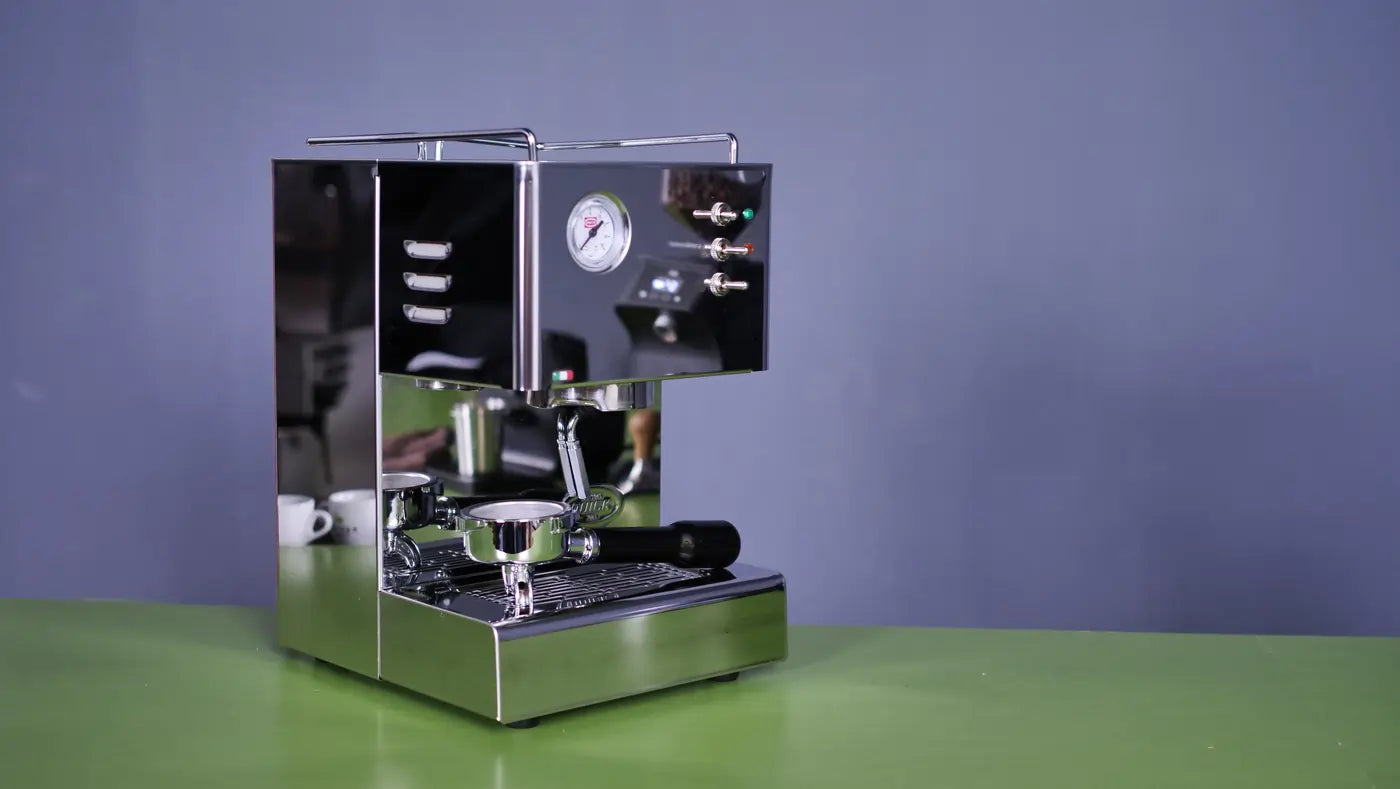

The Quick Mill Orione 3000 was already on our test bench around two years ago. At that time, the espresso machine delivered good performance as an entry-level espresso machine with a few tricks. However, an important question with cheaper espresso machines is always: how do they perform when they have to be used in everyday practice over several years?
That's why we like to lend interesting espresso machines to shared apartments. Including the Quick Mill Orione 3000. Now it's back. In this article, we briefly summarize the results from back then and then let the shared apartment residents speak for themselves.
One thing up front. Our conclusion hasn't changed. The Quick Mill Orione 3000 is reliable and brews good espresso with a bit of temperature surfing.
Pros and Cons of the QuickMill Orione 3000
Pros:
- Solid workmanship, lots of stainless steel and still beautiful after two years in use, with a bit of patina.
- Fast heating and thus quickly ready for operation.
- Compact and heavy.
- Consistent in inconsistency (temperature). However, this allows the temperature to be estimated and controlled.
Cons:
- Outdated milk wand
- Poor temperature behavior during normal use
- Small drip tray with poor coverage
Important Tips for the QuickMill Orione 3000:
- Get a replacement for the plastic tamper
- Better baskets lead to more even extraction. Either VST baskets or IMS baskets tapped flat at the edge, or follow this tip from a user on Youtube: replace the 4 screws on the stainless steel brew head with countersunk or lens head screws and all E61 baskets will fit. (They just won't always seal because they seal on the inside rather than on top.)
- Flush with water for 6 - 8 seconds to reach ideal brewing temperature
- Follow milk frothing tips
- Use a good entry-level espresso grinder, like the Sage Smart Grind Pro or Eureka Mignon Perfetto

After we got the QuickMill Orione back, the temperature curves were initially not as they were two years ago. The machine was well maintained and descaled, but the last descaling was a while back.
That's why we got down to descaling and measured again. Afterwards, we could replicate the same temperature curves as two years ago. Accordingly, our tips continue to apply, as we provide them in the following video.
Our Conclusion on the Quick Mill Orione 3000
The Quick Mill Orione 3000 is a good choice for getting started in the world of espresso machines if you're willing to engage with it and follow our tips. Without modifications, the machine will be less enjoyable, but with some experimental enthusiasm, you can get a lot for little money. And then the machine still does good work after several years, as our test after two years of shared apartment use proves.

Report from the Espresso Machine Shared Apartment Time
For the past good year, the QuickMill Orione 3000 has been at my wife's (Fabienne) and my (Benjamin) home and has served us since then as a coffee machine for espresso, cappuccino and other coffee drinks. During this time, we were able to test the machine thoroughly. Previously, we had a used Bezzera BZ07 dual boiler espresso machine, which unfortunately gave up the ghost (or thermostat) shortly before the coffee makers' test call.
The advantages of a thermoblock machine are obvious: heats up quickly, inexpensive to purchase, and with their often compact design, they find a place on any kitchen counter. All these properties are what we were actually looking for in a new espresso machine. So we were delighted to be able to test the Orione for a year.
As already mentioned in the coffee makers' video, not everything that glitters is gold, and so the Orione has some weaknesses. Much in advance – these remained undiscovered by us – and yet we found one or another trick.
Temperature Stability and Espresso Taste
Besides cappuccinos, I also really enjoy espressos, and I like to drink not just classic dark roasted coffees but also light and acidic coffee roasts. In the coffee makers' test, temperature stability and temperature curve are specifically criticized. It becomes clear that the temperature with brief flushing is far too high and only with a long 8-second flush does a temperature of 93 degrees reach, which however doesn't really remain stable during extraction.

With this foreknowledge, I approached the machine and could actually detect a difference between long, short, or no flushing. Our house roast is the Nutcracker, a Brazilian Direct Trade from Bösigers Kafignuss and comes from the APAS Cooperative. At first, I liked the result with 8 seconds of flushing, and I didn't question it much. But knowing that the temperature curve could be very different, I began to experiment and after some time had to realize that these 8 seconds were very difficult as a rule of thumb. Once the espresso was great with 8 seconds, then it was even better with 6 seconds or even 4 seconds, and occasionally it didn't taste quite right at any of these times. The statement from the coffee makers: "Consistent in inconsistency" actually fits very well here.
For a while, the Don Roberto coffee was in use, a heavy, lush and fruity espresso from El Salvador, roasted by the coffee makers. To my luck, I was able to taste this espresso in one of the coffee makers' coffees and thus knew how it should taste roughly
The Kryptonite – Milk Frothing
Mostly we drink cappuccinos at home, whether that's in the morning after waking up or when we have visitors. But precisely here the Orione shows one of its greatest weaknesses. Since it only has a thermoblock, it takes a few seconds for it to heat up for steam. When the next espresso is then to be pulled, the thermoblock must first cool down again through a longer idle extraction, otherwise the temperature is far too high.
If at least the power when frothing was good, the heating up and cooling down could be forgiven. But precisely at the power, there's really little good to say about the machine. To froth the amount of milk for a cappuccino takes over a minute if the milk comes fresh from the fridge. Sometimes the power also fails completely, which the coffee makers also suffered multiple times in their test, and the machine must heat up again. If you do get the idea to froth milk for two cappuccinos right away, this power collapse pretty much always happens. So I can really only advise against that…
Nevertheless, the slow heating of the milk allows frothing to be practiced very well and you can separate the pull and roll phase very well. With a bit of patience, you can also make nice cappuccinos with the Orione, including latte art!
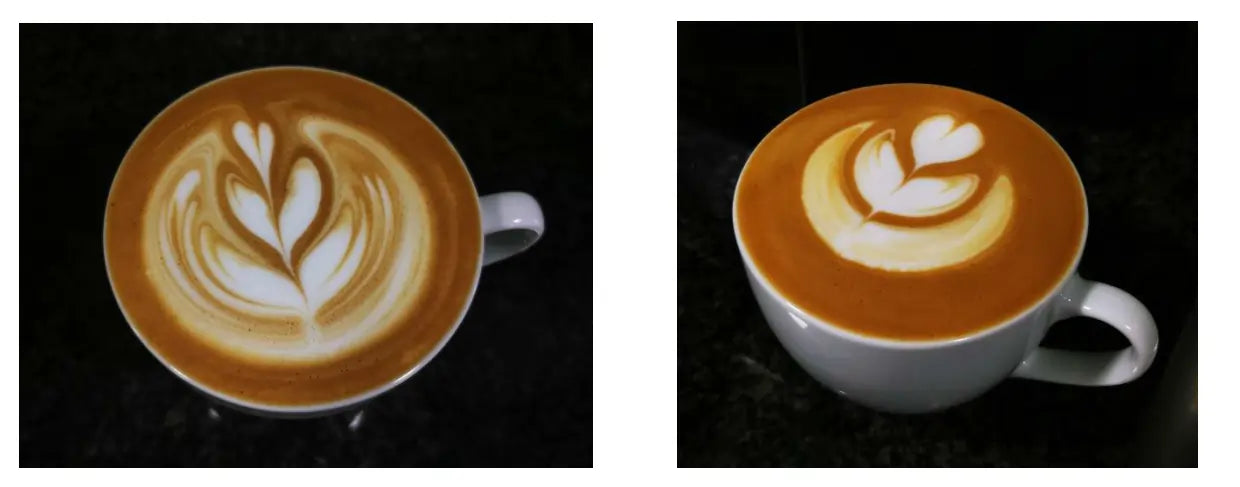
Over time, the steam power of the machine seemed to decrease more and more, and during frothing it also steamed quite a bit from the brew group. After some googling, the problem seemed to be found; the machine apparently had built up too much limescale despite filtered water. Using the following YouTube video, I then descaled the machine, paying special attention to the three-way valve, which sits between the steam wand and brew group. If this scales up, it steams out of the brew group during frothing and over time damages the valve as well. Since descaling, the machine has had more steam power than ever and in my opinion even performs better than shortly after pickup. The problems with stalling steam power during frothing have also been reduced to a minimum if you follow the following tricks.
Tips and Tricks
Even before I received the machine, I really wanted to find a way to get a handle on the problem with stalling steam power mentioned by the coffee makers. I spent a lot of time on this and experimented quite a bit with the machine, until I finally came up with the following solution:
The Solution for Strong Steam Without Stalling
No stress, the machine just needs a bit of time. After an espresso has been brewed, the machine heats back up, visibly indicated by the red glowing light. If you start unfolding the steam wand and blowing it out while the machine is heating, the thermoblock absolutely doesn't want to and will punish you during frothing with massive steam loss. But if you give the machine time until it has heated up (red light off), then wait another 5-10 seconds and only then blow out the steam wand, I rarely to never had problems with stalling steam. Important, but only the amount of milk for one cappuccino may be frothed, otherwise this trick unfortunately doesn't work. Frothing two cappuccinos at once is thus unfortunately not possible even with this trick.
If steam loss does occur during frothing anyway, the biggest problem is actually that the foam settles on top of the milk and there's no good mixing anymore because the milk doesn't swirl nicely in the pitcher. You can counteract this by immersing the milk pitcher deeper during frothing and then manually keeping the milk in motion. This is not particularly practical and also not really the goal of the whole thing, however, I still had acceptable milk foam for latte art with this technique.
Last but not least, do your machine a favor and just descale it! It's not rocket science, but if you're unsure, you can also take it to a specialty shop.
Using Different Baskets
From my previous machine, I had a VST precision basket in use, with which I was very satisfied and which I actually wanted to use again. The Orione needs classic 58mm baskets in terms of diameter, so this shouldn't be a problem.
But wait. Classic 58mm baskets have a curved rim (left in the picture).
After the Orione sprayed the shelf with water and coffee, I realized that the Orione absolutely needs a basket with a flat rim, because otherwise the sealing ring together with the basket cannot hold the pressure. Well, the internet has a solution for almost every problem and this was no exception. In the Kaffee-Netz forum I found relatively quickly owners with the same problem. One user reported that he simply bent the rim of the normal 58mm basket using a flat-nose pliers and a hammer. The plan was clear, this had to be tried! After some quick bending and hammering, the rim was flat and I could use my newly purchased and modified basket (right in the picture) in the Orione with almost no problems!

At first it still pressed out a bit of water, which only flowed slowly down the piston and handle. After I made the basket rim a bit more evenly flat, this problem was also solved.
General Conclusion
The QuickMill Orione 3000 gave me a lot of fun during testing and produced many delicious coffees! There were some problems to overcome, but for (almost) everything there was a solution in the end. One problem, however, that can only be solved with great expertise or by QuickMill itself, is the missing overpressure valve. Unfortunately, the QuickMill doesn't have such a valve, which is why the pressure during extraction is very high at first and then slowly drops. This probably also leads to the described different results in espressos. Because even if the grinder is set cleanly and the coffee grounds were pressed with the same pressure, the result will always be a bit different due to the varying pressure.
For me, a portafilter machine means a constant pursuit of the perfect coffee espresso cappuccino. But with the QuickMill, I could unfortunately never really achieve that. Without question, the espressos and cappuccinos I drank were sometimes very good, but after a year it feels like I've exhausted the machine and there's no way to improve my results anymore.
I personally would only conditionally recommend this machine and would not personally buy or continue to use it. It gave me fun and yet it now needs a new challenge. The topic of flow profiling and also playing with different temperatures interests me very much. But the Orione cannot offer me either of these. I also find the machine overall problematic for beginners, as in my experience only limited reproducibility is possible and it takes a lot of experimentation to produce a good espresso/cappuccino. But if money is a severely limiting factor, the machine can certainly be considered and in my opinion is certainly a valid option as a used machine.
Finally, I would like to thank the coffee makers warmly for this opportunity, look forward to many future test videos and wish them continued success!




