



Does coffee from small roasters taste better than from large ones? And are "industrial roasters" actually the worse roasters? And when is a roastery even considered large? We wanted to understand more about who roasts how and spoke with micro and large roasteries. We summarize the results here in an overview. In short: much is not what it seems.
When roasting coffee, raw coffee is heated to specific temperatures for a specific time. During this process, the coffee undergoes various physical and chemical processes. The previously green beans become brown beans, which are then ground and extracted.
As simplified as the roasting process is described here, it appears just that simple. Green becomes brown. The processes that occur during coffee roasting are the same—whether 50g of coffee, 5kg or 500kg are roasted. However, they differ in their intensity, duration, and precision.
- If roasting is theoretically so simple, why do the same coffees taste different from different roasters?
- And why are larger roasteries often criticized for roasting large quantities quickly?
- And is that even true?
- And why, according to common belief, should coffee roasted in smaller batches be much better?
The "800° for two minutes" roast
Many of these statements seem like truths, and they do because they are repeated over and over again. And when we hear the same statements repeatedly, they feel like a truth (known in psychology as the truth effect).
For example, the "800° roast for two minutes." Also known as the high yield roast of the very large roasteries. Yes, roasting was done that way, and we still find this roasting style in some places today, but likely much less common than assumed. Not every supermarket offers the worst coffee, and not every small roastery offers the best.
We wanted to know more and spoke with very small and very large roasteries. Aldi, Melitta, UCC Switzerland and Delica explained their roasting philosophy to us. Hochstrasser and Rast Coffee explained how they roast, as did the nano-roasteries Birchbach Coffee and Röststube Lübeck. We also open our roasting notes and explain what we actually do, for example here.
Contrary to expectations, we encountered extremely open ears. Few roasteries dismissed our request. It seems that especially among large roasteries there is a need to describe their own perspective. Many probably also saw it as an opportunity to correct mere assumptions and push back sharply—which, however, was sometimes softened by marketing departments afterward. Some large roasteries were notably more cautious in the end.
Prologue: Gentle drum roasting vs. industrial roasting
Far too often we hear and read the same, imprecise statements about large roasteries. Roasting is said to be done at 500° to 800° in two minutes, raw coffee breaks down no chlorogenic acid, and raw coffee quality is poor. In contrast, the concept of small roasting machines is then presented, which roast in smaller batches, with significantly longer roasting times and lower temperatures. It should be "gentle" and therefore better.

As coffee professionals, we greatly enjoy small projects pursued with passion, craftsmanship, and genuine interest in getting to the bottom of things. However, we can make little of the above statements. The information content is thin, and denigrating one roasting style serves to elevate another approach. Moreover, discussions about industrial and small roasteries are often conducted very emotionally.
Often it seems as if on one side there are small roasteries, most of which work with drum roasters, and then on the other side of the spectrum there are so-called industrial roasteries, which roast something or other. As if the coffee world consisted only of small and large, black and white, good and evil, and milk or no sugar. But it is far more complex.
We often hear and read criticism of large roasteries—in terms of coffee quality—from smaller roasters. Yet many roasters wouldn't even need to speak disparagingly about other roasting approaches.
Mirjam Baumgartner installs the very large roasting machines for Bühler, one of the leading manufacturers of industrial roasting systems. Baumgartner doesn't hold back her assessment:
The quality of coffee depends not on the size of the roastery but on the quality of the raw material and on understanding the craft. And this is a matter of the roastery's philosophy.
Mirjam Baumgartner
And she further says:
"Gentle long-term roasting," "hand roasted" or roasted according to "traditional drum roasting methods" are about as specific statements as when you call someone a "hipster." You roughly know what's meant, but it's simply not clearly defined. Such statements are an attempt to distance oneself from big industry.
Mirjam Baumgartner
And Baumgartner is right about that. Differentiation through disparagement is easy, but it ignores the fact that different roasting approaches, coffee, and raw coffee qualities enrich and are necessary for the market.
This article attempts to draw a differentiated picture of roasteries of all kinds. At the same time, it is an appeal and a request to roasteries to communicate their own strengths in their own marketing rather than profiling themselves through disparaging differentiation.
A new categorization of the roastery landscape
In 2007, Probat published its own definition for the industrial roastery in the standard work "Industrial Coffee Refinement":
"Industrial roasting is said to begin with a roasting container capacity of 60 kilograms, the standard weight of a raw coffee sack"
Probat, 2007
Coffee Circle in Berlin roasts on a 60kg Probat roaster, so by the Probat definition, which only considers quantity, would be an "industrial roaster." Does that get us any further? Not really. Because Coffee Circle defines itself quite differently and would probably not see itself as an "industrial roaster." The term has also become heavily loaded in recent years, especially with disparaging connotations.
A division into small and large roasteries, or into so-called artisanal and industrial operations, remains superficial. We attempt here to reclassify roasteries according to precise criteria and rename them. We compare by size and roasting machines.
Comparison 1: The size of a roastery—from nano to mega
Roasteries are limited in size by customer demand, the choice of roasting apparatus, or by conscious decision for a maximum production quantity. Depending on size, roasteries combine similar processes and challenges. This makes a division into size groups meaningful. A division into five groups facilitates communication about roasteries and also makes sense content-wise due to similar processes and challenges.
This allows us to better differentiate smaller roasteries and the midfield, and to move away from the emotionally charged term "industrial roastery." We propose: nano-, micro-, meso-, macro-, and mega-roasteries.
 Our proposal for a new categorization of roastery sizes (2020).
Nano (1t-5t roasted coffee per year)
A nano-roastery roasts between one and five tons of coffee. The roasting infrastructure consists of a 500g – 2.5kg roaster or a larger roasting apparatus used only on a few days.
The roastery project is run alongside a main profession or grows into an existing business (café, roastery, retail shop). Most processes such as packaging are carried out manually. The raw coffee assortment is rather small, since on the market 60 or 69kg sacks are typically available and must first be roasted in many small batches.
From practice
When we started our coffee professionals roastery, we were able to roast seven tons of coffee in the first year. The term "nano-roastery" fit well then. We are now in our 4th year and approaching 30 tons per year. The term "nano" no longer fits, as we know dozens of roasteries that are smaller and have just begun. Flavio Lissandrello from Birchbach Coffee calls his project "Nano Roastery" because he doesn't want to get much larger either. Flavio roasts on a Bullet, a 1kg roaster
Examples: Birchbach Coffee, Röststube Lübeck
Micro (6t – 50t)
Work processes are professionalized over the years and the product range has stabilized. The raw coffee purchasing strategy is refined and more customers have differentiated needs. Depending on production location and cost structure, a full-time position is typically created and financed per approximately 15 tons. The roastery is no longer a side project but established—we speak of a micro-roastery. Many roasteries consider at this threshold how much longer they want to roast with their first machine, and when an upgrade to a larger roaster makes sense. A stable customer portfolio helps with this decision, and roasteries often upgrade accordingly. From 5kg to 15kg, from 12kg to 35kg, or from 15kg to 45kg roaster.
Examples: Kaffeemacher, Adrianos, Miro, Vertical Coffee, Günter Coffee Roasters
 In micro-roasteries, almost everything is packaged manually.
Meso (51-200t)
Anyone roasting this much coffee has already created some full-time positions. With a larger machine, more coffee is roasted in less time, and production costs begin to decrease. At this volume, coffee is increasingly packaged less manually. Conveyor systems, volumetric-electronic pre-portioners, and software interfaces between orders and production planning help optimize workflow and shift focus increasingly to post-roasting. Roasting itself often runs automated—a program created by the roastmasters is now often executed by computer. This allows more freedom and even more control. The focus at meso-roasteries shifts increasingly toward packaging and shipping. Logistics becomes more important and must be coordinated more precisely.
Macro (201-2000t)
A macro-roastery often roasts in multiple shifts and can get around 1500 tons per year out of a 250kg roaster. Such roasteries typically have additional, smaller roasters (25-100kg) with which they can also meet private label offers. The roasting machine itself takes up less space in a macro-roastery. The periphery around it—mixing silos, loading the roaster, destoning, transport tubes, grinding systems, and packaging systems—now much more resembles a well-thought-out work process. Capacity utilization becomes the magic word here—such large systems rarely stand idle—especially roasteries of this size often offer private label services where coffee is roasted for others.
Example: Hochstrasser Coffee Roastery
Mega (2000t – 100'000t+)
The difference from the very large roasteries is primarily that more and more processes become mechanized. In a roastery that roasts 20,000 tons annually, only about six production workers work in a shift—in micro-roasteries roughly 1000 times smaller, three to four people also work per shift if everything must be packaged manually and delivered quickly. In mega-roasteries, coffee is barely visible—after roasting it travels through various channels, possibly mills, until it is packaged via packaging machines.
 Work hours are significantly reduced by efficient systems as a roastery grows larger.
Comparison 2: Roasting machines
It's obvious that larger roasteries can only roast so much with larger roasting machines. In contrast, small roasteries often roast on small machines for several years. Purchasing a roasting machine is not a walk in the park for any roastery. Even a 1kg roaster means an investment of up to 10,000 CHF. A 400kg roaster along with necessary peripherals and installation represents a million-franc investment.
Within the size ranges of roasting machines, there are of course technical and qualitative differences. Ultimately, however, a roasting machine is like a car. Every car gets you from A to B, you just need to know exactly how. So with a focus on potential roasting quality, there is no such thing as a better or worse roasting machine. The demands on the machine, the roasting style, the reliability and convenience degree make the biggest differences here.
Roasting machines at nano-roasteries
In recent years, more and more small roasting machines have come onto the market, and so we also see more and more nano-roasteries offering such small quantities for their clientele. These small machines mostly roast beans with hot air, lots of movement, and over a shorter roasting time. It simply doesn't pay to heat up much material for little quantity and roast the beans via contact heat. Instead, convection receives much attention here. This roasting approach with a focus on heat transfer through lots of hot air goes back to Michael Sivetz' Fluid-Bed technology from 1975. Small quantities can be precisely roasted and replicated.
Examples: Roest, Ikawa, Neotec, Aillio Bullet
Roasting machines at micro-roasteries
Micro-roasteries try to stand for the "real" and the craftsmanlike with their craft. For many, this includes a powerful roasting machine where much is done by hand. Some roasteries deliberately avoid any degree of automation because it doesn't match their vision of the craftsmanship they want to represent. At the same time, a roasting machine—in this case a drum roaster—simply makes a good impression for many people. A steel colossus of at least 500kg that still gleams is usually well positioned in a roastery or café to show: coffee is still roasted here by hand.
Drum roasters are the first choice for many here. An outer shell is warmed by direct or indirect heat and keeps the system hot. Inside, a drum rotates—depending on the manufacturer clockwise or counterclockwise—in which the raw coffee is moved by precisely shaped fins and paddles. Heat transfer in these roasting machines is a mix of air flowing through the roaster, heat transfer from the hot material, and heat transfer from bean to bean.
Drum roasters sound like history and to many represent the authentic way of roasting. But for coffee to always taste the same, it requires precise understanding of how to operate the roaster, its quirks and behaviors.
Roasting machines at meso-roasteries
These roasteries have already purchased a second, or even a third roasting machine. As a rule, it makes sense to upgrade from a 15kg machine to at least 3x larger, since it can often be fully utilized quickly.
If we assume that a roastery roasts 3-4 batches per hour, and that for 6 hours per day, 5 days, at full capacity of a roaster (15kg roaster = 15kg raw coffee), it can roast about 60+ tons per year, though every day is roasted, and the stress on infrastructure and team is high.
A roasting machine of 35kg, for example, roasts 70 tons per year in half the time and is thus much more efficient. Many roasteries upgrade to a significantly larger machine at the latest here.
Larger roasting machines, however, also require larger conveyor systems, more efficient air filters, cyclones, and possibly an afterburner or different air filter. We're then no longer talking about just a roasting machine, but about a whole roasting system, where the roasting machine itself takes up only about a third of the space.
"Classic" roaster brands like Probat, Joper, or Giesen have settled into these roastery sizes and offer complete systems. Diedrich offers an intermediate solution with a 25kg roaster to cover this size transition.
Roasting machines at macro-roasteries
Macro-roasteries function technically similar to meso-roasteries, just everything is a bit larger. A larger drum roaster, more efficient transport system, larger raw coffee lift, larger packaging system—the Goliath of still seemingly artisanal roasteries.
Drum roasters of 140 to nearly 300 kg per batch work on the same principle as their smaller versions, but require significantly more energy. Anyone wanting to roast 300 kg of raw coffee in 15 minutes in a drum roaster needs lots of gas and appropriate supply lines or tanks.
Roasting machines at mega-roasteries
Theoretically, the drum roaster principle could be made even larger, but the system loses efficiency. And large roasteries are geared toward efficiency—so the drum roaster process is out of place.
Batch sizes reach 500 kg or even more. And here roasting with hot air is much more efficient. These roasting systems blow and push coffee in ellipses over longer distances. A hot air stream surrounds the bean and can heat it in a short time. These tangential or shell roasters take up much space and require lots of energy. However, they recycle some of the hot exhaust air back into the system, so the system retains heat.
Temperatures in these systems are also significantly higher than in a classic drum roaster. Again, Mirjam Baumgartner from Bühler:
Air temperatures always depend on the air-to-bean ratio. What's important, however, is the amount of heat transferred to the beans and the temperature development of the bean. The flavor-forming chemical reactions take place in the bean, not in the ambient air. Accordingly, you can also roast at 450°C in 3 minutes if you want and have enough air available. Some of the world's most commercially successful coffee products use short-roasting times. Roasting air temperatures range everywhere between 450°C and 280°C.
Mirjam Baumgartner
The most extreme form of fast and efficient roasting is so-called continuous roasting. Unlike batch roasting machines, in which coffee is processed in fixed batches, in continuous roasting coffee is constantly added on one side and roasted coffee is removed on the other. Probat writes about this:
"Continuous roasters allow for rather short roasting times with low scorch due to the high convection component. (…)
In my attempts to contact very large roasteries with continuous roasters, I have not yet been successful. In addition to fast processing of large volumes, the continuous roaster has another advantage, as this quote from the Probat book also shows:
Since the drum in this system is not perforated, raw coffees with high breakage can also be processed without any problems."
p. 37, Industrial Coffee Refinement, 2007)
Breakage, fast roasting, grinding—this is primarily about the most efficient processing, more or less consistent taste, and no longer about quality.
Roasted coffee quality. Who roasts how, and most importantly, who roasts better? And why?
For me, good and less good roasteries differ mainly in whether they work consistently. Whether all batches taste as desired, or whether unexpected mishaps occur. Again: understanding your own machine is the be-all and end-all here.
The smaller the batch, the greater the potential for deviation, and vice versa.
Large roasteries are thus at a significant advantage when it comes to differences between individual roastings. Large systems are more sluggish because they move more mass—but whoever can harness this roasts incredibly consistently.
Small roasting machines are more prone to fluctuations—the small amount of material stores less energy than larger systems. Temperature fluctuations in the roastery can affect the small drum just as much as slightly different air pressure. Of course, it's also possible to work precisely and consistently with small roasters, but it requires intensive engagement with the technical peculiarities of the machines—and I see much potential in the small roasting scene here.
Looking only at consistency, I have consistently found much more consistent roastings from meso-, macro-, and mega-roasteries. The most inconsistent roastings I've encountered have always been from nano- and micro-roasteries.
So what exactly is "industrially roasted coffee"?
It's clearly insufficient to divide the roasting world into micro and industrial. There are various sizes in between, and in function, some are considerably more industrial (more efficient, larger, more technical, more automated), even though they still have the appearance of an artisanal roastery.
Automation
It seems that the high degree of automation at large roasteries brings the industrial comparison. The degree of automation that apparently only asks roastmasters to monitor roasting curves on a screen but no longer actively intervene.
With more automation also comes a loss of some of the romance that inspired so many roasteries to roast in the first place. The manual, the craftsmanlike, the risk, the possibility that something can go wrong because we as humans reacted incorrectly—the guarantee that never everything works as desired—has become for many the embodiment of true craftsmanship.
Freshness
When it comes to freshness, small roasteries that sell directly or through their own shop have a significant advantage. Very large roasteries sell their coffee in retailers, which in turn have their own intermediate storage. By the time coffee goes from the roastery through intermediate storage to the shelf, several weeks pass.
 Raw coffee sacks at nano to macro-roasteries. At mega-roasteries, big bags of 1000kg per sack dominate.
There are differences between small and large. And whoever roasts more supplies more people with coffee, makes more friends but also has more critics. More quantity smells of more consistency, and that of more uniformity. Uniformity in process and often also uniformity to the point of blandness in taste.
Do coffees from small and large roasteries taste different?
Ideally, coffees from smaller and medium roasteries taste more varied than those from very large roasteries. Nano-, micro-, and micro-roasteries with their smaller drum roasters can roast smaller batches. The smaller batch size invites roasting even tiny quantities, so-called nano-lots. These are sometimes highly experimental raw coffees made for a boutique market.
These small quantities are quite limited and therefore valuable—as if made for a roasting machine of 1 to 15kg. But the small batch size doesn't necessarily guarantee perfect roasting from the start. Two to three batches are usually needed to develop a roasting profile, sometimes more.
Limitation of creativity by one's own size
Meso and macro roasters can't roast such small quantities because their roasting systems are designed for larger capacity. Large roasting systems must be loaded to at least 70% of their possible maximum load. Larger roasteries can't afford to make a few roasting profiles for top coffees or try something they've never done before. The cost of raw materials prohibits it—or who would happily experiment with 140 kg of raw coffee?
So large roasteries essentially rely on raw coffees that are cheaper and sensorially often less characteristic because of their size. They need coffees that have a stable profile and are available in large quantities. This approach defines the entire supply chain differently than a small roastery would: mega-lots instead of microlots, containers instead of jute sacks, stable profiles instead of surprises.
Practically speaking, large roasteries limit themselves by their size to being able to roast sensorially complex coffees, to experiment, and to make large leaps. However, many small roasteries also limit themselves by communicating roasting craftsmanship but then roasting the same raw coffees as the very largest.
 Flavio from Birchbach Coffee (Photo: Flavio Lissandrello)
That small roasteries do everything better, Flavio Lissandrello from Birchbach Coffee doesn't see at all.
"In my opinion, often the opposite is true. Small roasteries unfortunately often do many things worse than the large ones, due to inexperience, lack of funds, and technologies. Yes, in my opinion there are also good large ones."
Flavio Lissandrello
Mirjam Baumgartner from Bühler also often sees that large roasteries are more professionally equipped.
The disadvantage of large roasteries is often that raw materials for popular products must also be available in large quantities. On the other hand, large roasteries are often more professional in terms of coffee knowledge and understanding and can afford better equipment. For example, small roasteries are usually limited to drum roasting technology because they don't have the ability to use other technologies. Large roasteries can use more advanced technologies in many respects (e.g. variety of roasting profiles, auto-correcting profile roasting systems, green coffee pre-heating, etc.). But of course there are always exceptions.
Mirjam Baumgartner
Knud Buck from Röststube Lübeck confirms this. "Sometimes there's more human error than I'd like." Knud roasts on a 1kg Giesen roaster mainly for himself.
 Knud's informative Instagram account
He sees the fallibility of roasting as an advantage for himself:
"Since I only roast for myself, I don't depend on reproducibility. I don't have a customer base that relies on always the same coffee taste. This leaves me the freedom to constantly experiment. In principle, no roast is like the other. Even though I practice reproducing particularly successful roasts."
Knud Buck
Experimenting on a very small scale is feasible, but again, with a batch size of 150 kg or more, the reason for an experiment must be really good.
Really bad coffee at the very large roasteries
When you're large, you can produce cheaply and target deep-price markets—and these markets are huge. But the size of a roastery itself is not decisive whether it now buys clean (defect-free coffee) or not. It has to do with approach and quality understanding.
Nespresso, which probably roasts well over 100,000 tons per year, doesn't buy defective coffee—it contradicts their quality promise and brand message. Others, who roast far less but want to target deep-price markets, do resort to sensorially inferior coffee.
For those who "just need a coffee" or even better "a caffeine boost," quality doesn't matter. And the coffee quality reflects that precisely; you get what you pay for.
Cheap raw coffee is often poorly sorted, with lots of breakage, etc., while better raw coffee also becomes more expensive. This equation is simple. Whoever insists on paying little for coffee gets the rejects. And yes, you sometimes find qualities that even laymen would visually identify as bad coffee. But this coffee doesn't come in bean form but ground, as instant coffee, or in pre-portioned units.
I have personally never heard of a small roastery successfully selling bad coffee. Such a roastery would likely quickly disappear. The really bad tastes are found with the very large roasters targeting deep-price markets—but hand on heart: who would seriously expect the best quality at the cheapest prices?
One size fits all—roasting profiles
So if we assume that very large roasteries roast cheap raw coffee, and do so as efficiently as possible, that is, lots of coffee in little time, then the optimal, finely tuned profile doesn't come into play.
Usually they are one-size-fits-all profiles where coffee is roasted over the same time but with more or less final temperature (= lighter or darker). As a result, cheap coffee from large roasteries is often roasted considerably darker. Strong roasting can mask defects and level out differences.
But large roasteries of course also roast light coffees, which are often the "mild" and "harmonious" ones. The roasting depth, also called roasting degree, often marks the bigger difference among very large roasteries' coffees than completely different blends. The same blends are often roasted lighter or darker to create their own product.
The roasted products of very large roasteries are more standardized, sensorially undemanding, but extremely consistent coffees that serve the purpose for the vast majority.
And here large roasteries have the tricky task of precisely cupping coffees, blending themselves or having them blended, so they always taste the same. This is sensorially monotonous but no less demanding than cupping the most complex coffees.
Now straight talk—who roasts how? Small and large in conversation
It's remarkable how many speak of a "roasting secret"—a special way of turning green beans brown. I was also surprised that especially the large roasters spoke openly about their way of roasting coffee. Many probably also saw it as a window to clear up the rumors of "800° and two minutes." We asked around, among the very small and very large.
Nano-roastery
How does Röststube Lübeck roast?
Knud Buck is probably about as close as you can get to a nano-roaster. Following his Instagram channel, you see how meticulously Knud tries to perfect every parameter of roasting, but also of preparation. A real lab. He roasts on a 1kg Giesen roaster, with batches of 750g.
"This amount is excellent to control and I can do double as many roastings, thus gain double the experience, than if I always chose the maximum batch," says Knud.
Intentionally underfilling the roasting drum lets you drastically shorten roasting time. The small roasting drum also has its weaknesses, according to Knud. "Larger roasting systems have more thermal mass by design, which could theoretically provide more stability in the roasting process."
For him, roasting coffee is a hobby, but one he pursues as precisely as few small roasteries do.
"I associate small roasters with craftsmanship, with more love, with more dedication and thus ultimately with more quality in the cup. But that doesn't always have to be true!"
Knud Buck
Knud's roasting times range from 7 to 15 minutes with maximum bean temperatures of 205°. These temperature values should be taken with caution as they cannot be compared.
Knud roasts like many other roasters I surveyed in a Facebook poll based on the first crack and development time.
"For most filter roasts I try to achieve the first crack (FC) after 9:00 minutes and calculate a development time between 12 and 18% from there, depending on the coffee. Another reference point is the temperature development from FC to final temperature, here my range is +4°C for light filter roasts to +10°C for espressos. I don't roast darker."
The rate of rise is also decisive for Knud: "Especially when exchanging with other roasters and talking about roasting profiles, the RoR is much more informative than comparing absolute temperatures. For me, the RoR is the decisive value for assessing roasting profiles."
Micro-roastery
How do Kaffeemacher roast?
Our roasting philosophy is closely tied to the raw coffees we purchase. We tend to use heavier coffees for espresso and roast floral and fruity coffees more for filter coffee.
 Yellow: Filter coffee, Red: Specialty Espresso, Blue: APAS
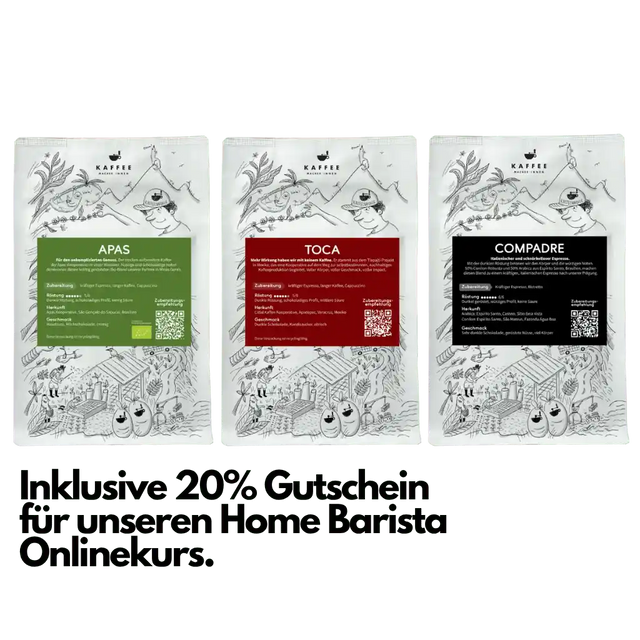
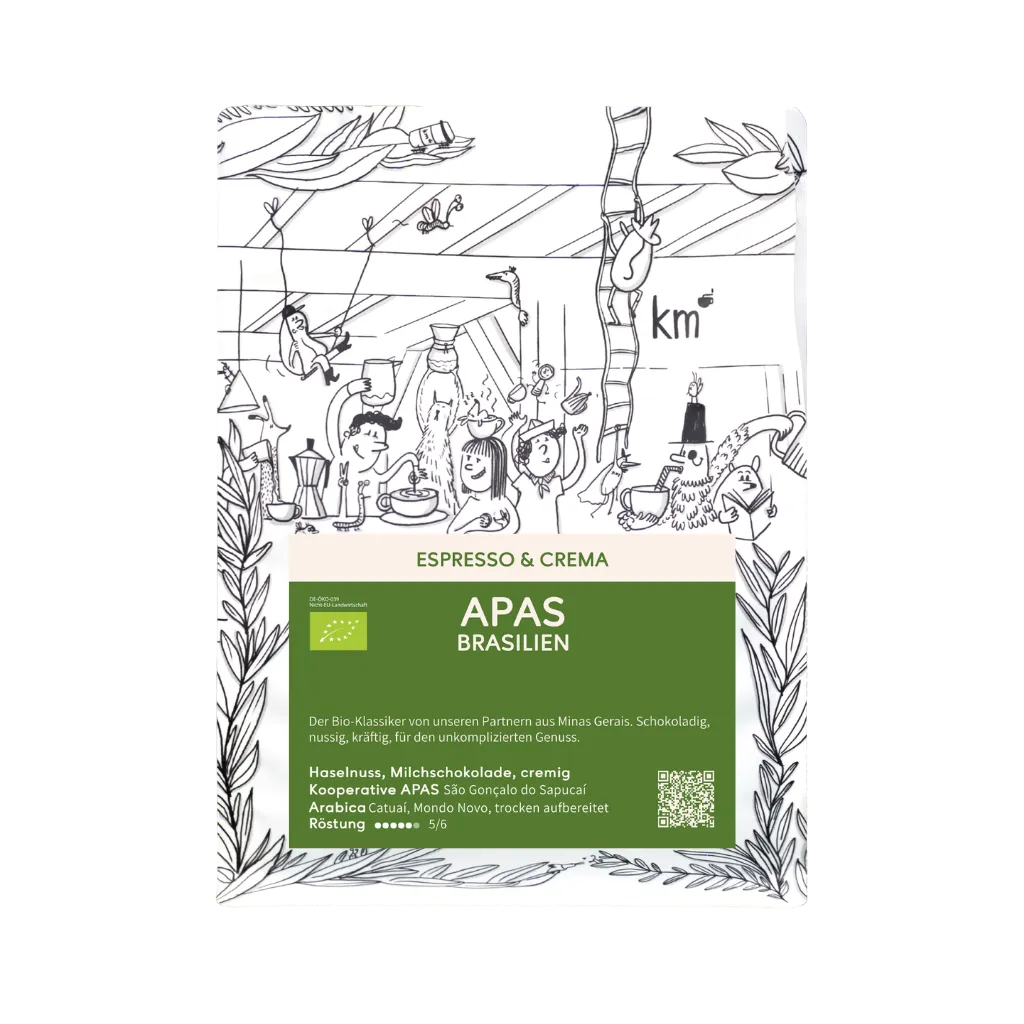
We treat each coffee a bit differently. Not because we simply want to, but because the coffee demands it. For example, a coffee from Brazil from the APAS cooperative behaves differently in the roasting drum than a coffee from our Santa Rita farm in Nicaragua.
If we had a roasting dogma, it would probably look like this:
- we roast for the respective purpose, because
- we distinguish between filter, espresso, and coffee crème roasts
- We roast as much as necessary and as little as possible, because
- we like coffees with intensity of aromas, with a soft mouthfeel and character
We fill the 12 kg drum for filter with 4-5kg, for specialty espresso with 8-11kg, and for more developed espressos with 12kg. Full utilization of the drum requires different gas input than a less-filled drum. We also extend roasting times this way.
We roast with roasting software from Cropster and analyze live how we roast. We follow our self-developed roasting curves and can thus ensure that the roast—theoretically—tastes the same. Additionally, we cup the batches and thus sensorially match the coffee with the roasting curve.
Over the time a raw coffee is in our storage, it's quite possible we adjust the roasting profile multiple times. When we receive a coffee in high summer and roast it until Christmas, we must adjust the profile according to outside temperature. This keeps roasting coffee never boring.
Meso-roastery
How does Rast Coffee roast?
Beatrice Rast from Rast Coffee Roastery writes me the following lines.
"I find it generally difficult to make evaluative distinctions between large/small; we prefer to leave assessment (also regarding manufactory / industry) to the customer and focus on our work, that is, we prefer to focus on ourselves and have the drive to continuously develop and convince the customer of our work, our coffee, service, and quality.
We roast in Ebikon on Probat drum roasters of various sizes (5, 12, 45 & 90kg). This makes us very flexible and allows us to better serve our customers to guarantee them our roasting freshness. The roasted coffee is air-cooled on all machines.
Our roasting times and temperatures vary depending on the machine, raw coffee, and roasting profile. We typically roast for about 15–20 minutes, and since we have everything from light through medium to dark in our range, final temperatures vary accordingly.
Through our generally long roasting time, much chlorogenic acid can be broken down, making the coffee easier on the stomach, but of course also more costly due to the high time input.
Roasting is done according to roasting profiles we developed, times, colors, end and development times. With raw coffee purchases or material purchases, we strive for long-term partnerships and want close relationships with our partners."
Macro-roastery
How does Hochstrasser roast in Lucerne?
At Hochstrasser AG Coffee Roastery in Lucerne, I spoke with Production Manager Kevin Heer and Master Roaster Andy Strittmatter. Hochstrasser is among the ten largest roasteries in Switzerland and roasts approximately 1500 tons of coffee annually.
On four roasting systems (5kg, 60kg, 120kg, and 240kg), Hochstrasser can meet various requests. The company has long stopped roasting only for itself and fulfills various private label wishes.
The larger the roasteries, the more important private labeling becomes—it helps the roastery efficiently use large capacity. For private label customers, it's also attractive because coffee can be produced consistently and inexpensively by a third party.
Kevin Heer says: "We roast exclusively with drum roasters from Probat, the industry leader. Furthermore, we are very efficient and can execute large orders in high quality, and we're also flexible enough to handle small orders."
Probat's largest drum roaster is almost as big as a small truck. With the peripherals around it, the exhaust and intake pipes, the lines for roasted coffee transport, and the afterburner, the system takes up the space of a small single-family home.
With the drum roaster, roasting times also extend. So Hochstrasser roasts between 13 and 17 minutes, timing very similar to us at Kaffeemacher. Roastmasters at Hochstrasser also monitor roasting on a monitor, though it's positioned by the roaster. The physical proximity to the roaster itself is there, especially when special orders must be roasted according to markers like the 1st or 2nd crack. The roasters mark these manually.
The roasting temperatures (the hot air flow temperature) are between 230 and 250 degrees. Larger systems have some advantages, according to Heer:
"With large roasting systems you have much more consistency, also through the many adjustment options of the system."
Regarding gentle long-roasting, Heer emphasizes that especially the energy transfer to the beans is gentler when heated through lots of hot air, not directly through the drum's contact heat.
Large roasteries like Hochstrasser sometimes quench coffee, "but only with as much water as the roasted coffee doesn't absorb," according to Heer.
"From our perspective, quality is defined by roasting time and roasting curve through the roasting system. If all these factors are right, it's possible with a larger roasting system to achieve more consistency. Other important factors for us are raw coffee qualities, quality controls of raw and roasted coffee (via cuppings), and subsequently optimal packaging to protect the roasted coffee."
Mega-roastery
How does Melitta roast?
I was also able to have an interesting conversation with the production management of Melitta. The handling of roasting information was very open. Later, the text I had written based on an interview was revised again and adjusted to company guidelines. The result is now a text that is based on mine, but was subsequently modified.
Released text from Melitta
In conversation with Dörte Lämmerhirt (Head of Production in the Coffee Business Segment of Melitta), it became clear that they also deal with developments in the specialty and small roaster segment.
Melitta roasts on various roasters, including drum or chamber roasters. The possible batch size is up to nearly 10 coffee sacks.
Anyone roasting very large quantities of coffee needs large batches, that's clear. According to Lämmerhirt, this doesn't come at the expense of roasting time: "We don't pursue high yield roasts of just minutes—and I've been on board for almost a decade now." Roasting times at Melitta range from seven to up to 20 minutes—depending on variety and coffee segment. For example, dark espressos have very long roasting times.
"Nothing about two minutes at 800 degrees." Lämmerhirt emphasizes that good coffee takes time. Melitta roasts primarily by roasting color and final temperature. Roasting systems are operated from a central console from which coffee roasting profiles are precisely controlled.
Large machines allow Melitta to roast coffee very consistently and in consistently good quality. "This also has to do with the high quality expectations our consumers have for our products, which we thus always meet." Human error goes to nearly zero as much is automated. "We talk a lot about coffee," says Lämmerhirt, "and it's not always the same." Raw coffee is a natural product that, despite specification, doesn't have standardized and always identical properties. "At Melitta, we adjust individually with our roasting profiles to each individual raw coffee."
Roasting itself is not just important for large roasters, according to Lämmerhirt. After all, roasting is generally an expression of high quality, which Melitta has pursued for over 111 years. However, it's also clear that the manufactory spirit and specialty coffees increasingly trigger something positive in consumers.
But this is generalized: "There are excellent and bad roasts—among the very small and among the very large."
How does Delica Coffee Roastery roast?
At Delica too, they know the arguments and claims from other roasteries that the large ones don't roast well. Nicole Gisi, Project Manager, former master roaster, and author of the book "Coffee. Passion-Passion-Science" on this:
"We rise above that because we know the truth. Ultimately, everyone is convinced they're doing the right thing. We at Delica AG are proud that our roasting methods are on par with commercial roasters. It's not the size of the roastery, but the experience, the roasting method, and the quality of raw coffee, as well as the grinding and extraction method that makes good coffee."
Gisi elaborates that small and large is neither good nor bad: "In my view, there are neither advantages nor disadvantages, because you have to adapt to the situation and take appropriate precautions."
Gisi and her team roast on tangential and centrifugal roasters. Batch sizes range between 140–500 kg, roasting approximately 17,000 tons of coffee annually.
She dismisses the 2-minute 800° claims—"we roast at least 7 minutes, the longest roasting times are 20 minutes."
Regarding gentle long-roasting, Gisi makes clear this isn't about quality but only marketing a roasting style:
"These are marketing statements with little substance regarding quality.
Nicole Gisi on gentle long-roasting
Of course there are parameters regarding roasting duration that point to high-quality. "Hand-roasted" is for me no quality marker. The roaster stands by the roaster and manually ends the roast—depending on experience, light conditions, and the roaster's disposition, the roasts will taste and smell different since the process isn't standardized—this is also a philosophy, but if the customer always expects the same result, standardization of the process is necessary." (Craft involves people and thus increases the risk of errors. The higher the degree of automation, the fewer surprises—but also the less risk-taking).
"We try to keep the error rate as low as possible at all stages so consumers get stable end products."
Gisi addressed the topic of chlorogenic acid in detail.
"Chlorogenic acid is understood as a group of esters from hydroxycinnamic acid and quinic acid. Chlorogenic acid as well as its breakdown products contribute significantly to flavor and aroma formation as well as color formation in coffee. Since chlorogenic acid is thermally unstable, it's broken down during the roasting process through hydrolysis to quinic acid and caffeic acid. With heavy roasts, nearly complete breakdown to various phenolic compounds can occur. Its breakdown products can be sour and astringent. With incomplete or very light roasts, larger amounts of chlorogenic acid remain in the bean. In sensitive people, it can lead to intolerance and stomach complaints."
How does Aldi roast?
In conversation with Michael Körnig from NewCoffee GmbH, Aldi's coffee roastery, I also learned much about the recent history of large-scale roasting.
But first I wanted to know from him how he feels about smaller roasteries?
"I always enjoy discovering special microlots at small specialty roasters. Small roasteries have possibilities here that we as a large operation don't. They can work out sensory details and are certainly an enrichment to the coffee landscape."
Michael Körnig, NewCoffee GmbH
Körnig, like few others, made clear that there are mainly technical differences that allow or prevent certain things. He didn't try to argue this away but rather sensed possibilities.
"I see much good in small roasteries, but we large ones also have our advantages. However, the uptake of microlots is not possible for us since we can't process tiny quantities. We need coffee quantities sufficient to supply around 1,940 stores."
In stark contrast: as Kaffeemacher we just bought a nanolot of 70kg. We make about three sample roasts and then sell 55kg—it pays off for us since we roast filter coffee in 5 kg batches. For any larger roasters this quickly becomes complicated to impossible.
Though it's difficult for NewCoffee to process tiny quantities. The use of different profiles is possible. "Our business model is simply different." He sees the lever for the large ones especially in the degree of automation in packaging: "We can, among other things, package more cheaply. This lowers labor costs and positions us to offer qualitatively high-quality coffees at reasonable prices."
NewCoffee roasts for ALDI as well as other external customers at two locations—in Ketsch and Mülheim an der Ruhr.
For roasting times, NewCoffee distinguishes between ground coffees and coffees for coffee pads, which range from 6-9 minutes, and bean coffees, which are typically roasted for 12 minutes and in exceptional cases up to 15 minutes. For large roasteries, those are times one might not have imagined.
Körnig explains: "One reason for longer roasting times, especially for ground coffees, was the acrylamide problem. If too short, the acrylamide level would be too high. That's why no roasting time falls below six minutes at us." "
Körnig mentions, like Gisi did for chlorogenic acid, concrete facts on topics large roasteries are repeatedly asked about. Smaller and medium roasteries do testing and sampling for acrylamide, furan, OTA, and residues in coffee far less or not at all—despite all four topics not being ruled out.
Körnig also speaks precisely about the "high yield process"—"we never did that." From internet research, coffee was roasted in 90 seconds with that process. The coffee volume increased much more than usual, density was low, suddenly 400g roasted coffee needed the space of 500g roasted coffee. You can read more in a 1984 article from Der Spiegel.
So there's something to the 90-second roasts—but the question is whether that's still the case today? I'm convinced, but I haven't yet reached those roasteries.
Körnig sees the "gentle long-roasting" differently:
"What is gentle? Long-roasting brings a different taste profile but also breaks down acids. Unwanted and wanted ones. Coffee often just tastes baked."
Michael Körnig
Körnig also speaks on chlorogenic acid: "Chlorogenic acids are in coffees, but especially with very short roasts. Since we roast for at least six minutes, the problem barely comes up for us. But we roast 90 percent Arabica and barely Robusta—and since the chlorogenic acid proportion in Robusta is significantly higher than in Arabica, this doesn't affect us as strongly."
How does UCC Switzerland roast?
UCC, the Ueshima Coffee Company from Japan, roasts in Switzerland in Zollikofen near Bern. UCC roasts a lot of private label, among them major Swiss retailers are among the largest customers. Benjamin Schütz from UCC spoke with me about their roasting style.
Schütz sees advantages in large roasting systems in consistency. "We define 12 to 13 anchor points in a profile and the roaster executes them, come what may." UCC roasts on two roasters from the company Lilla from Brazil each with 500 kg capacity.
Batch sizes range between 400 and 500 kg. The Lillas are drum roasters, so different systems than those we encountered at Aldi, Delica, or Melitta. Drum roasters are less efficient than hot air systems, so average roasting times are significantly longer: between 12 and 16 minutes for a roast at UCC.
So large drum roasters work because the hot exhaust air is partly recycled and fed back into the system. So this "new" air no longer has to be heated. If only fresh air were drawn in, fast roasting with such a machine wouldn't be possible.
UCC roasts four to five batches per hour, equating to well over 7,000 tons of roasted coffee per year. In a shift, besides the master roaster, about four more people work on subsequent processes like grinding and packaging.
The roasting cycle is very high, meaning the time between batches is very short. Only about 10 seconds does the roaster sit empty before new raw coffee is loaded.
UCC roasts until the desired color, by which they determine the end of roasting. Here, the 1st crack, development time, and rate of rise play no role. Quite different from roasteries with smaller systems, where these orientation aids are used much more.
Schütz speaks little diplomatically about gentle long-roasting. "That's like low-temperature cooking. With meat it tastes good though." What he thinks about the claim that coffee is "hand roasted" makes him smile. "Yes, roasting machines can be operated by hand. But that's about it."
Like many larger roasteries, UCC also quenches, cooling roasted coffee immediately after exiting the roasting drum with water. 70 to 74 liters are needed for a 500 kg batch of coffee, resulting in about 3-3.5% residual moisture in the bean. Quenching happens in the drum after reaching the specified final temperature.
Schütz, like Gisi, has a natural science background and welcomes the chlorogenic acid discussion.
"The stomach must be able to absorb acids, that's its function. When acid comes, it must buffer it with bases. But if it's already oversaturated, for example from animal proteins, the body has much more difficulty processing acidic foods. This can lead to heartburn."
Benjamin Schütz, UCC Switzerland
For Schütz, it's clear that chlorogenic acids alone aren't stomach-damaging, but overall diet determines coffee's retention. And, clearly, whether now sugar is added to the coffee also has an impact. More sugar means more acid in the stomach.
Comparison table. How different roasteries roast coffee?
We extracted information from the conversations and organized it in a table for comparison.
| Nano | Nano | Micro | Meso | Macro | Mega | Mega | Mega | Mega | |
| Röststube Lübeck |
Birchbach Coffee |
Kaffeemacher | Rast | Hochstrasser | UCC Switzerland | Delica AG | Aldi / NewCoffee GmbH |
Melitta | |
| roasted quantity per year in tons | <1 | 3 | 26 | n.a. | 1500 | 7000 | 17000 | n.a. | n.a. |
| number of roasting machines |
1 | 1 | 1 | 4 | 4 | 2 | 3 | n.a. | n.a. |
| minimum batch size |
0.7 |
1 | 4 | 5 | 230 | 420 | 140 | n.a. | n.a. |
| maximum batch size |
0.7 | 1 | 12 | 90 | 280 | 500 | 500 | n.a. | 650 |
| minimum roasting time | 7:00 | 8:30 | 9:00 | 15 | 13 | 10:30 | 07:00 | 06:00 | 07:00 |
| maximum roasting time | 15:00 | 10:00 | 16:30 | 20 | 17 | 15:00 | 20:00 | 15:00 | 20:00 |
| definition of roast end | |||||||||
| time | x | x | x | x | x | x | |||
| final temperature | x | x | x | x | x | x | x | x | |
| color | x | x | x | x | x | x | |||
| priority in roasting philosophy |
|||||||||
| 1st crack | 1 | 3 | 1 | 1 | |||||
| 2nd crack | 3 | ||||||||
| RoR (rate of rise) | 1 | 1 | 1 | ||||||
| final temperature | 1 | 1 | 1 | 1 | 1 | 1 | |||
| development time | 1 | 2 | 1 | 1 | |||||
| roasting color | 4 | 2 | 1 | 1 | 1 | 1 | 1 |
Who roasts according to the 1st crack, rate of rise, development time, final temperature...
The roasting stages are measured differently by roasteries. In a Facebook survey, most specialty and small roasters mentioned the following order to me:

The "total roasting time" received not a single vote in the roaster forum, final temperature also only three.
This makes the difference to large roasteries clear: from a certain roastery size onward (meso and above), roasting is typically done by time, final temperature, and roasting color. The 1st crack, development time, and rate of rise play little to no role. It's the opposite for nano and micro-roasteries, which physically stand closer to the roaster, hear and mark the 1st crack, and derive development time from it.
Mirjam Baumgartner from Bühler confirms these findings:
From my experience, only small, manual operations orient themselves to 1st and 2nd crack in daily production. These operations roast with much expertise and roastmaster attention.
At a large roastery, of course, there's talk of 1st and 2nd crack when developing a new roast, but it's unthinkable that a roastmaster observes these parameters 1:1 with every roast. In this case, you rely on the roaster's reproducibility and break in most cases by temperature. This can certainly also be the case at small roasteries.
In other words: If the roasting machine has temperature control under control, then 1st crack and 2nd crack always occur at exactly the same time. The roastmaster of a large system then needs to pay the cracking no attention.
So where is the journey heading?
Large roasteries are getting larger
It shows every few weeks: large roasteries are getting even larger, and roasting machine manufacturers feel it too. Again, Baumgartner:
Bühler's core competence as a machine builder is system design, which is why the Infinity Roast is our flagship roaster. It comes in 180 kg, 360 kg, or 540 kg batch sizes, offering full flexibility and reproducibility through variable air-to-bean ratio and auto-correcting profile roasting. Our largest system produces around 6 t/h in continuous operation in the USA, but we have large roasteries as customers worldwide.
Our proposed five-category division: nano, micro, meso, macro, mega, will likely soon be supplemented with "giga"—and this already applies to certain roasteries today.
There are more and more small roasteries
At the same time, there's a counter-trend, that of nano- and micro-roasteries. It will be interesting to observe how large nano-roasteries grow, whether micro-roasteries limit growth, become meso-roasteries, or even merge with another micro-roastery. We maintain a current collection of coffee roasteries in Switzerland, Quijote Coffee maintains a collection of roasteries in Germany.
Coffee quality is improving
It's increasingly enjoyable to drink coffee elsewhere. Generally, the coffee offering is becoming more varied—and we're not talking about drink categories, but flavor profiles that consumers can get today.
More and more nano and micro-roasteries are betting entirely on specialty coffee. For reasons thoroughly discussed, these smaller roasteries can shift their focus differently than large ones.
The large ones are going small
Jacobs and Dallmayr pioneered it, others will follow. Large roasteries are increasingly focusing on smaller projects, smaller roasteries intended to open this segment for them, which they otherwise can't target. The large ones have understood that the manufactory spirit is not just pure marketing but truly a message that makes many consumers feel they're holding something genuine. No nice brochures and campaigns can overcome this—for many, the small is simply the more authentic.
The question remains how credible the small projects of large roasteries will be. It won't fail due to know-how, access to raw coffee, or roasting understanding—but I see acceptance with an audience geared toward specialty coffee as limited. The large name will probably still overshadow what's being offered for many. I'm curious to see who separates the product from the name.
We all learn together
This article about roasting will be further expanded by me. Additional manufacturers and roasteries should be added. Perhaps one or another roastery will also be ready to contribute roasting profiles.