







We have been roasting, brewing, training, and selling coffee for years, but we know surprisingly little about the substance that makes it interesting for most people; caffeine. I wanted to change that and spoke with Dr. Carolin Reichert, deputy director at the Center for Chronobiology in Basel. She has been researching for almost twenty years how caffeine and adenosine control our sleep, and also works as a psychotherapist.
Her first answer to almost every question was: "that is individual." Her second: "there is no evidence for that." So what caffeine actually does to us, what can be perceived truths and where Carolin Reichert testifies to us all a bit of carelessness, I clarify in this article.
5 hours half-life on average, individually 1.5 to 9.5. 100 mg are still inconspicuous four hours before bedtime, 400 mg disrupt sleep even from a twelve-hour distance. 400 mg are considered a safe daily amount for healthy adults, 200 mg for pregnant women. And one cup a day is already enough to trigger withdrawal symptoms when stopped.
What caffeine does in the brain: blocking adenosine, not providing energy
Caffeine doesn't give us energy, but blocks the signal that tells us we're tired.
Adenosine is responsible for this. Reichert clarifies a distinction that is often misunderstood: "Adenosine is not a hormone, we call it a neuromodulator or sleep factor." It accumulates throughout the day and docks onto receptors. Caffeine sits on the same receptors.
"It's like a keyhole system where the keyhole is essentially closed and adenosine can no longer unlock it."
So the tiredness is still there, it's just not reported to us. This also explains why it comes back once the caffeine is broken down.
In research, two receptor subtypes are relevant, and they do different things. The A2A receptor is responsible for the wake effect: in mice without the A2A receptor, caffeine no longer had a waking effect, in mice without the A1 receptor it did. The A1 receptor, on the other hand, is responsible for building up and breaking down what's called sleep pressure. At usual doses, caffeine only partially occupies adenosine receptors, estimated at 25 to 50 percent, and not selectively.
Half-life: on average five hours, individually two to ten
Caffeine is absorbed through the gastrointestinal tract. Around 99 percent is absorbed within 45 minutes, with peak levels occurring between 15 and 120 minutes depending on the person.
After that, breakdown begins, which also varies individually. The average for healthy adults is about five hours, with a range from 1.5 to 9.5 hours. An independent measurement series found half-lives between 2.27 and 9.87 hours at 5 mg per kilogram of body weight.
Half-life means: after this time, half of it is gone. With an espresso containing 70 mg at 4 p.m., at five hours half-life, 35 mg remains in the blood at 9 p.m., and around 17 mg at 2 a.m. In a person who breaks down caffeine slowly, the same espresso can still be at over 40 mg at 2 a.m.
| Group | Half-life |
|---|---|
| Healthy adults | approx. 5 h, range 1.5 to 9.5 h |
| Smokers | up to 50 percent shorter |
| With oral contraceptives | approximately doubled |
| Pregnant women, third trimester | up to 15 h |
| Newborns | 65 to 130 h |
Institute of Medicine 2001; Temple et al. 2017; Evans et al., StatPearls 2024; Blanchard & Sawers 1983.
Who breaks down quickly and who slowly: one gene plays a role
An enzyme called CYP1A2 is almost entirely responsible for the breakdown, but it works at different speeds. A difference in breakdown speed of up to sixty times has been measured between individual people.
A gene variant named rs762551 is responsible for this, among other factors. Those carrying two A variants break down caffeine quickly, those with one or two C variants break it down slowly. In the population, this is distributed approximately as follows: 40 percent fast, 50 percent mixed, 10 percent slow.
Schematic representation. The curves show metabolism starting from peak concentration (100 percent, approximately 30 to 60 minutes after consumption) with half-lives of approximately four, five and a half, and eight hours — common values from the literature. Individual variation is substantial: smoking accelerates metabolism, hormonal contraception and pregnancy slow it down significantly.
This is why user experiences in comment sections vary so widely. Reichert explains: "Some people barely react to caffeine at all, while others react very strongly." And further: "The mechanism of action — blocking receptors in the adenosine system — will be the same in all people. But once we look at the actual effects and how strongly it impacts sleep, performance, mood, motivation, that's where things vary greatly."
What about age?
We were unable to confirm a widespread claim here. "Caffeine sensitivity increases with age" appears on many health websites without citation. However, this has been refuted: a comparative study with young and older men concluded that "most aspects of the pharmacokinetic behavior of caffeine are very similar in young and elderly men". And the only age-comparison study on sleep EEG we found points in the opposite direction: after 200 mg of caffeine, changes in REM sleep were only significant in young participants, not in middle-aged ones.
How long does caffeine affect sleep? The numbers
Here we have hard data. A 2023 meta-analysis compiled what caffeine does to sleep:
| Sleep parameter | Change under caffeine |
|---|---|
| Total sleep time | −45.3 minutes |
| Sleep efficiency | −7.0 percent |
| Sleep onset latency | +9.1 minutes |
| Wakefulness after sleep onset | +11.8 minutes |
| Deep sleep (N3) | −11.4 minutes |
| Light sleep (N1) | +6.1 minutes |
| REM sleep | no significant effect |
Gardiner, Weakley, Burke et al. 2023, Sleep Medicine Reviews 69:101764.
Interesting is the associated calculation: for every additional hour of distance from bedtime, sleep loss decreases by 2.8 minutes; for every milligram of dose, it increases by 0.2 minutes.
Deep sleep is the most important value. 45 minutes less sleep, you notice. Eleven minutes less deep sleep, you don't notice. Both are measurable, only one of them you feel.
Data: Gardiner, Weakley, Burke et al. 2023, Sleep Medicine Reviews 69:101764. Pooled means across all included studies; the values for distance and dose come from the regression analysis of the same work. The calculation examples are linear extrapolations of these coefficients, not measured individual values.
The last coffee: dose trumps time of day
The question of how many hours before sleep the last coffee should be is the most common question on this topic. The best answer comes from a controlled study from 2025, in which 23 healthy men received 100 mg and 400 mg of caffeine each 12, 8, and 4 hours before bedtime, double-blind and placebo-controlled, with sleep measurement at home.
| Dose and timing | Effect on sleep |
|---|---|
| 100 mg, 12 / 8 / 4 h before | no significant effect, at none of the three times |
| 400 mg, 12 h before | Deep sleep approx. −21 min, sleep onset approx. +15 min delayed |
| 400 mg, 8 h before | Wakefulness after sleep onset approx. +29 min, sleep efficiency −6.9 % |
| 400 mg, 4 h before | Total sleep time approx. −51 min, deep sleep approx. −30 min, efficiency −9.5 % |
Gardiner, Weakley, Burke et al. 2025, Sleep 48(4):zsae230. 23 healthy men, 25.3 ± 5.0 years.
The study's conclusion in the original: "A 100 mg dose of caffeine can be consumed up to 4 hours prior to bedtime, but 400 mg may negatively impact sleep when consumed within 12 hours of bedtime."
Translated, this means: a single coffee in the late afternoon is something different from four spread throughout the day. Time of day alone says little; the amount decides. And 400 mg twelve hours before sleep means that high morning consumption affects the night.
From the 2023 meta-analysis, guidelines can be derived, based on a bedtime of 10 p.m.: black tea with 47 mg needs no limit, coffee with 107 mg needs at least 8.8 hours distance, a pre-workout product with 217.5 mg needs at least 13.2 hours.
Can you fall asleep with caffeine anyway? Yes
Reichert warns against dramatizing. In studies where participants had to stay awake for 40 hours while receiving caffeine, "the participants can still sleep afterward".
"It's true that we don't have to assume that caffeine is somehow a kind of devilish substance that completely robs us of sleep. There are processes in the brain that still function. It's just maybe a bit harder to initiate this sleep, and it's somewhat harder to maintain sleep."
A 2024 study backed this up with numbers. 41 people stayed awake for 38 hours, some received about 350 mg of caffeine twice, with the last dose 6.5 hours before recovery sleep. Sleep came in both groups; in both conditions, sleep time was over 500 minutes. Caffeine reduced the recovery effect by roughly 30 minutes and deep sleep by roughly 36 minutes. The sleep pressure wins, but the sleep becomes shallower.
Caffeine withdrawal: headaches in half, from 100 mg per day
This is the part where I am personally affected. I once drank only decaffeinated coffee for an entire December, my Decaf December, and the headaches of the first week were real. They are also real when I skip coffee in the morning and then notice after a few hours that I have some headaches.
The reference work on caffeine withdrawal is from 2004 and provides clear numbers:
| Characteristic | Value |
|---|---|
| Frequency of headache | 50 percent |
| Clinically significant impairment | 13 percent |
| Onset after last dose | 12 to 24 hours |
| Peak | 20 to 51 hours |
| Duration | 2 to 9 days |
| Threshold dose | from 100 mg per day, roughly one cup |
Juliano & Griffiths 2004, Psychopharmacology 176(1):1–29.
The 100 mg is the most important number in this table. One cup of coffee per day is enough to trigger withdrawal symptoms when discontinued. In addition to headache, the following are validated: fatigue, reduced energy, reduced alertness, sleepiness, depressed mood, concentration difficulties, irritability, and a feeling of not being clear-headed.
Reichert mentions the same leading symptoms and classifies them: "This withdrawal syndrome exists, and it also shows that we have adapted to this chronic consumption that may have occurred before, that the receptor system has adapted to it."
Is there caffeine dependence? According to WHO, no
We keep hearing that coffee is an addictive substance. We would say that coffee is a habit. And the technical definition for an addiction is quite different.
"Compared to alcohol or nicotine or other psychoactive substances, we cannot diagnose caffeine dependence. The WHO has said according to the latest guidelines: it doesn't happen."
The ICD-11 of the WHO has its own block for caffeine, 6C48 "Disorders due to use of caffeine". It includes: harmful use as an episode, harmful use pattern, caffeine intoxication, caffeine withdrawal, and caffeine-induced disorders such as an anxiety disorder. What is not in it is a code for dependence. Alcohol, opioids, and stimulants each have one, caffeine does not.
Reichert explains why: dependence requires, among other things, loss of control, a strong craving for the substance, and scaling back on family, hobbies, and work. "All of that doesn't happen with caffeine." And further: "But what does happen is that you may consume more even though you know it has negative consequences. That we have harmful use, that exists, and these physiological adaptations, those happen too."
Withdrawal yes, dependence in the diagnostic sense no.
Tolerance: completely after 18 days, but not for sleep
The body becomes accustomed to caffeine, and measurably so. In a study with 300 mg three times daily over 18 consecutive days, caffeine produced no subjective effects by the end in the caffeine group, but it did in the placebo group.
This doesn't apply to sleep in the same way. A laboratory study with 150 mg three times over ten days found no differences in sleep duration, sleep architecture, and sleep efficiency between caffeine, withdrawal, and placebo. A large analysis using data from the UK Biobank and sleep measurements at home, however, found shortened sleep time with four or more caffeine-containing drinks per day, ranging from 11 to 229 minutes depending on the model. This range is too wide to cite as a point value, but the direction is clear.
There is yet another uncomfortable interpretation, and it is well documented. In habitual consumers who had recently abstained, alertness after caffeine administration exceeded neither that of placebo-treated non-consumers nor that of former consumers. In other words: morning coffee doesn't make most people more awake than normal, it restores normal.
The cortisol myth: waiting 90 minutes does nothing
I confronted Reichert with a rule or rather an idea that I keep hearing at least in coffee and social media circles: wait 60 to 90 minutes after waking up because otherwise the cortisol rise would be disrupted and an afternoon slump would follow.
"I would look at that very critically, to be honest. I think this claim stands on very shaky ground. I've tried to find evidence for it, but I find no scientific evidence for it."
What was actually measured actually turns the story around. A study with 96 people was given 300 or 600 mg of caffeine daily over five days and then tested the cortisol response. After abstinence, caffeine triggered a marked cortisol rise. After five days of regular use, the response to the morning dose was completely gone, in the original "abolished". A residual response remained in the afternoon.
So anyone who drinks coffee daily has no cortisol response in the morning that caffeine could disrupt. The rule addresses a group for which the described mechanism doesn't exist.
Reichert has a second observation on this, and I think it's the more important one: "Of course, it's clear that the later I consume caffeine, the longer it stays in my body and the later it is broken down." That might be the whole mechanism, which then wouldn't need a cortisol narrative anymore.
Placebo and nocebo work in both directions
Part of caffeine's effect happens in the head, and provably in both directions. I had asked whether expectation only enhances the wakefulness effect. Reichert's answer: "No, nocebo effects too."
Specifically: "If we expect that we won't be able to sleep because we've just drunk caffeine, that can certainly keep us a bit more awake." She puts it in psychological terms: "The more tense we are, the more threatened we feel, the less we will fall asleep."
This explains a good part of the experience reports in which a single espresso after lunch supposedly ruined the night. And it has a practical consequence: the rules of sleep hygiene can become a problem in themselves. Reichert on this: "As soon as you focus too much on these rules and organize your life only by them, it becomes a stressor."
How much caffeine is in it?
The numbers scatter more widely than most tables admit. This is especially true for espresso.
| Beverage | Amount | Caffeine |
|---|---|---|
| Filter coffee | 200 ml | 80 to 138 mg |
| Espresso, measurement in 20 cafés | per shot, 23 to 70 ml | 51 to 322 mg, median 140 mg |
| Espresso, capsules | per capsule | 19 to 147 mg |
| Cappuccino | 150 ml | 38 to 47 mg |
| Instant coffee | 1 teaspoon powder | 40 mg |
| Decaffeinated coffee | 125 ml | 1.4 to 3.6 mg |
| Black tea | 200 ml | 30 to 54 mg |
| Green tea | 200 ml | 20 to 48 mg |
| Cola | 330 ml | 26 to 43 mg |
| Energy drink | 250 ml | 38 to 80 mg |
| Dark chocolate | 100 g | 34 to 65 mg |
Conversions from EFSA 2015, Table 1 (mg/L). Espresso measurements: Crozier, Stalmach & Lean 2012, Food & Function 3(1):30–33. Capsule values: Desbrow, Hall & Irwin 2019, Nutrition and Health 25(1):3–7. Instant coffee: USDA Legacy 2018.
The espresso line is the most interesting in the entire article. In 20 establishments examined, the highest shot was more than six times as high as the lowest, and three of 20 espressos alone exceeded the daily recommendation for pregnant women of 200 mg. Bean, grind size, brewing ratio and cup volume matter more than the beverage category. Those who want to know how much caffeine is in their own espresso will find the calculation in the article about the double espresso.
Regarding energy drinks, there is a correction that Reichert made in conversation. First, the amount: "In terms of caffeine, it's the case that less caffeine is contained, often around eighty milligrams for a small can." The manufacturer of Red Bull also states 80 mg for the 250 ml can. A regular cup of coffee is higher. Second, the target group: "It's not the case that young people consume more than adults. Worldwide or at least in Europe, it shows that young people consume roughly half as much as adults."
How much is too much? The EFSA values
| Group | Single dose without concern | Daily amount without concern |
|---|---|---|
| Healthy adults | 200 mg (approx. 3 mg/kg at 70 kg) | 400 mg (approx. 5.7 mg/kg) |
| Pregnant women | 200 mg | 200 mg |
| Nursing mothers | 200 mg | 200 mg |
| Children and adolescents | 3 mg/kg body weight | 3 mg/kg body weight |
EFSA NDA Panel 2015, Scientific Opinion on the safety of caffeine, EFSA Journal 13(5):4102. The BfR confirms the same values in its statement no. 037/2026.
There is a caveat with children and adolescents that is important. The value of 3 mg per kilogram is not a pediatric study, but a transfer from adult data. The EFSA itself states that "the information available is insufficient to derive a safe caffeine intake". Reichert says the same thing in different words: "We actually have so little data to give any guidelines at all about what is tolerable and what is not."
Regarding caffeine intoxication, because that is often asked about. It is a diagnosis in both classification systems; DSM-5 names a typical trigger dose well above 250 mg plus at least five of twelve symptoms, ICD-11 names doses over one gram per day. Reichert says: "But I've never heard of a caffeine-induced death." In the forensic literature, 92 deaths are documented over 59 years, with life-threatening amounts from about 10 to 14 grams. All documented cases involve tablets, powder or shots, not coffee. 10 grams equals around 100 cups in a short time at 100 mg per cup.
Reichert explicitly names one risk: "It's more problematic in combination with alcohol, because there are simply interactions that are unfavorable."
Caffeine and sports: 3 to 6 mg per kilogram, 60 minutes before
The evidence here is better than for almost anything else. The position paper from the International Society of Sports Nutrition from 2021 names specific values: caffeine improves performance "consistently" at 3 to 6 mg per kilogram of body weight. The minimally effective dose may be 2 mg per kilogram. Very high doses around 9 mg per kilogram provide no additional benefit, only more side effects. The usual time of administration is 60 minutes before exertion.
At 75 kilograms of body weight, 3 to 6 mg per kilogram is therefore 225 to 450 mg. That's a lot of coffee, and the upper half exceeds the EFSA daily recommendation.
The effects are real, but not spectacular. For time trial performance, an evaluation of 46 randomized studies showed an improvement of 2.22 percent; for strength, a standardized effect size of 0.18; for muscular endurance, 0.30. Caffeine has the strongest effect on aerobic endurance. However, two of the 46 studies showed impaired time trial performance, five showed lower average performance.
Caffeine is not banned in sports. It has been in the World Anti-Doping Agency's monitoring program for years; for 2026 it continues: "The substances listed in the monitoring program are generally not banned, but are monitored."
A question from our everyday life
During cupping, we sip coffee and spit it back out, a hundred times with the spoon. Do we absorb caffeine this way? Reichert: via the oral mucosa it is basically possible, "for example via caffeine chewing gum". But: "When we drink coffee, the main part is definitely absorbed via the gastrointestinal tract." She knows of no studies on retention times in the mouth. In chewing gum research, it takes 44 to 80 minutes of active chewing to reach the effective level. When spitting out, absorption is therefore probably low, and the tired feeling after a long cupping has other reasons.
And if caffeine is the problem?
Reichert does not consider caffeine dangerous: "I don't believe it's some kind of evil substance. We would know if it really had serious effects." Her wish is different.
"I think it would be nice if we consumed it a bit more consciously. Coffee consumption is a lot of habit, a lot of routine, somehow quickly having one more just to keep going. And I find that a shame."
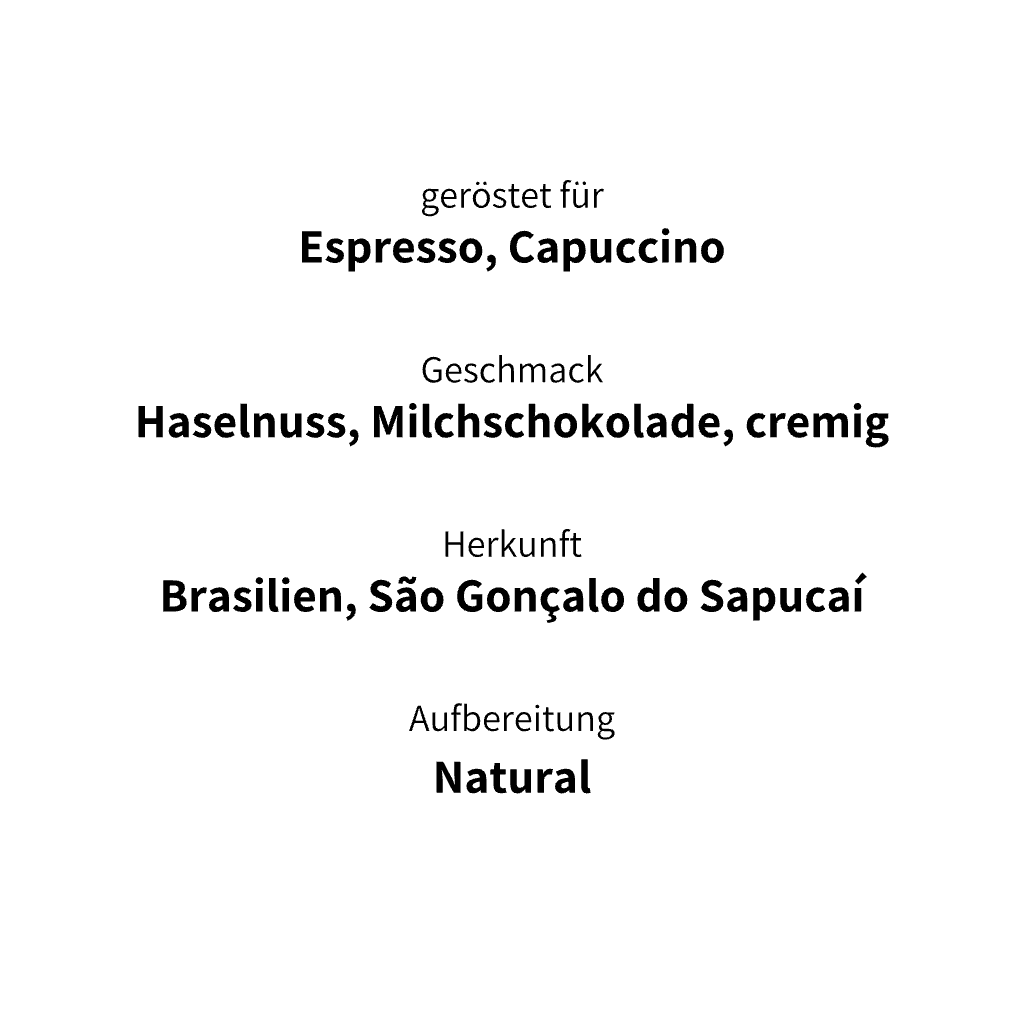
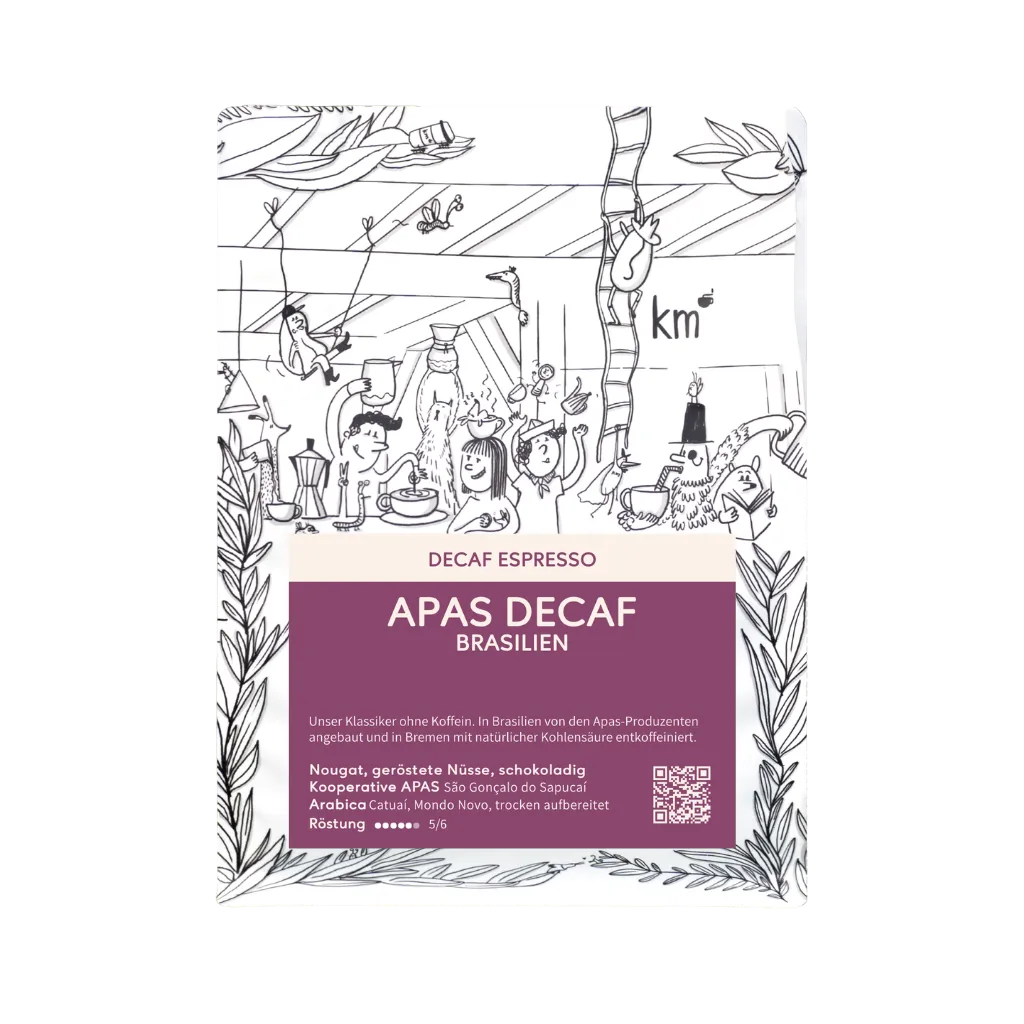
That is also our position, and we have an answer to it on the shelf. Those who want the coffee and don't need the caffeine now have a real choice. According to our figures, a cup of decaffeinated coffee contains 1.4 to 3.6 mg of caffeine, compared to 80 to 138 mg in filter coffee. The 2025 study showed that 100 mg four hours before sleep had no measurable effect. At three milligrams, you don't need to think about the time anymore.
How decaffeinated coffee is made, what four methods there are and what of it remains measurable in the cup is in the article on decaffeination methods. What it tastes like, why it ages faster and extracts differently, in the main article on decaffeinated coffee. You'll find our decafs in the decaf collection.
By the way: caffeine is itself a bitter substance. Those who want to know where bitterness in coffee comes from and what part of it doesn't depend on caffeine will find that in our article on bitterness in coffee.
To listen to
Conclusion
Caffeine blocks adenosine, it does not provide energy. On average, it breaks down by half in five hours, though individually this takes two to ten hours, and a gene is involved in this. For sleep: 100 mg are unobtrusive even four hours before bedtime, 400 mg still affect the night from twelve hours away. Withdrawal is a recognized diagnosis and begins with just one cup a day. Dependence is not, neither according to ICD-11 nor DSM-5.
And that one should wait 90 minutes in the morning before consuming caffeine, because we release cortisol first anyway, Reichert sees as untenable. In daily coffee drinkers, the cortisol response to the morning dose disappears after five days anyway.
From the conversation with Carolin Reichert, it became clear that almost every blanket statement about caffeine falls apart as soon as you look at individual effects. What remains is the mechanism. And the realization that we know less about the world's most well-known psychoactive substance than its routine use would suggest.