






















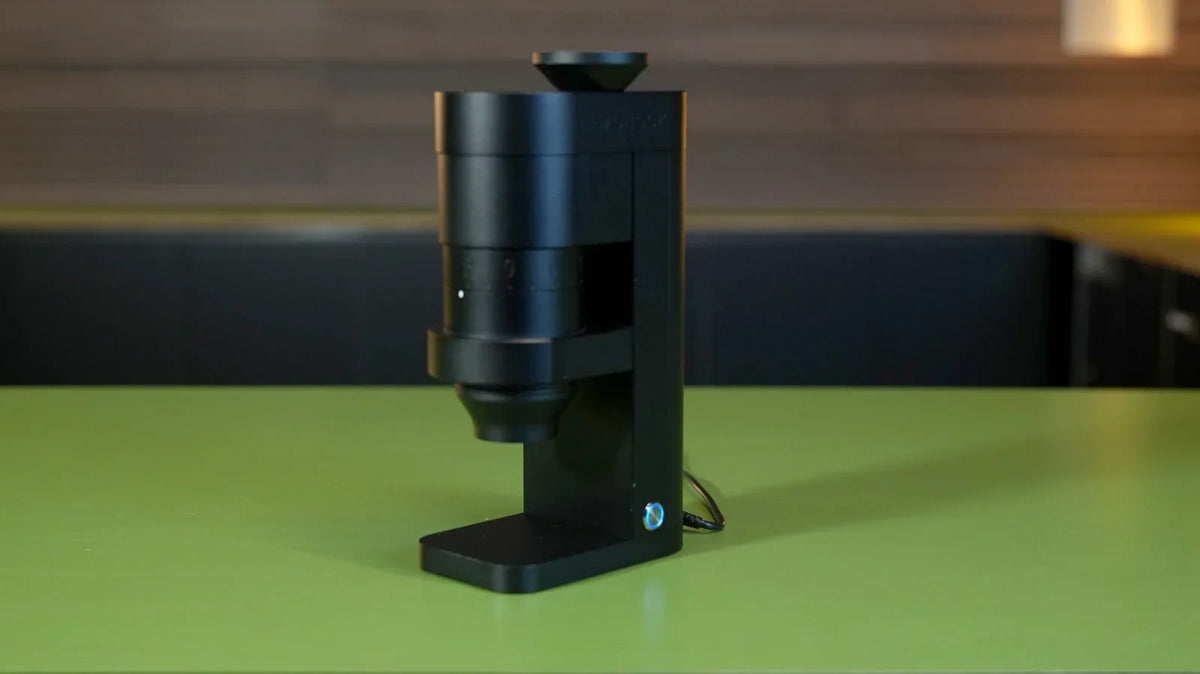

The Femobook A68 is a single-dosing grinder with a 68 mm conical burr set that costs around 750 euros and was surprisingly often requested by you for testing. There are some positive videos about this grinder online, though most are a bit older. All the more reason to run through the A68 methodically: What does it do well, and what doesn't it do well?
Fair warning: We have a somewhat different opinion than many voices online. There's hardly a grinder that does everything very well, and fortunately hardly one that does everything poorly. With the A68, the picture is particularly split. In the measurements, it racks up top results across the board: retention, consistency, repeatability, all excellent. And then comes the espresso.
As always, we bought the grinder ourselves to guarantee neutral testing.

Design and workmanship: just under 6 kilos of aluminum
The A68 is small, but not lightweight. It weighs 5.7 kg, with an aluminum housing that's genuinely well made. At 10.6 cm wide, 16 cm deep without the plug, and just under 30 cm tall, it takes up very little space on the counter. The plug sticks out a bit in the back, so you should factor that in when setting it up.
The bean hopper is a bit small. A few millimeters more in diameter would have been nice.

What we notice when handling it: The burr set has some play. The cone doesn't sit as tight as we're used to from other grinders. That makes the excellent repeatability we see later all the more surprising. More on that below.
Burr set and technology: 68 mm cone with stepped adjustment
The heart of the A68 is a conical burr set with a 68 mm diameter, driven by a 200-watt DC motor. The grinder runs at a slow speed of 60 revolutions per minute. The grinder has no speed control.
Femobook has a large product range: there are models for filter coffee and, for example, the battery-powered A4Z version. The A68 is supposed to do both, espresso and filter coffee. In this test, we focused on espresso, and you'll find out below why we deliberately left out filter coffee in the video.

The grind adjustment is stepped, not infinitely variable. And it's one of the most pleasant to use we've experienced on a grinder in a long time. One click changes the extraction time by a maximum of two seconds, usually by one. With our recipe of 18 g coffee and 45 g espresso, grind setting 0.1 gave 27 seconds, one click finer brought 29 seconds. That lets you dial in precisely, with the tiniest steps and minimal changes in the cup. We think Femobook's solution to this with a 68 mm conical burr set is really well done.
Operation: good with water spray, a mess without it
We need to distinguish two scenarios here. If you spray a few drops of water on the beans before grinding—that is, if you use RDT—operation is good. Little static, the coffee lands in the cup, the workflow is fine.
Without water, the ground coffee builds up incredible static. Michel experienced the biggest mess around a grinder that he's seen with any grinder. The coffee sticks to the cup, it hangs in the cone below—there's literally coffee everywhere. The process then goes: grind, blow a bit, turn the cone so the grounds go down, tap to get it out, tap again to make it fall. By the time the coffee is in the portafilter, we've really worked for it.
The result: water spray isn't a recommendation for the A68, it's a requirement. You weigh your 18 g, 12 g, or 9 g, spray it in the cup with a small spray bottle, and put it in the top of the grinder. That's sensible with many grinders and no big deal. With the Femobook, it's a necessary step. And there are pricier grinders where that's also necessary.
During cleaning, the A68 shows its best side. Lots of magnetism, tool-free disassembly: one piece off, next piece off, pull up, done. If you want to clean out your burrs regularly, there's hardly any effort involved here.
Grinding speed and noise: 12 seconds for 18 grams, 81.6 dB
For 18 g, the A68 takes 12 seconds. In 10 seconds it grinds 17.3 g. For a conical grinder of this size, that's absolutely fine and fast enough for daily use.
During operation, we measure 81.6 dB(A) at 20 cm distance. That's just above the threshold where we start calling a grinder rather loud. It's not quiet, but it's not disturbingly loud either.
Grinding temperature and consistency: 0.05 g standard deviation
The first sample is at 31.8 °C; after five consecutive grindings with 20 seconds rest between each, the temperature rises to 33.2 °C. That's mild warming, no thermal problem. Even if you grind several espressos in a row, you don't need to worry about heat-sensitive light roasts.
The consistency is outstanding. Over five grindings with 18 g input each, 17.9 to 18.0 g land in the cup, with a standard deviation of 0.05 g.
Retention: 0.1 gram, but only with water spray
The retention is what the A68 does best. Temporary retention: 0 g. Permanent retention: 0.1 g. Absolute: 0.1 g. That's a top value. It's a cone, and practically nothing stays in that cone. When you remove the lower cone, 0.1 g of coffee clings to it; we count that as permanent retention, and there's nothing more than that.

However, this value only applies when operating with RDT. Without water spray, as described above, you have to put in real effort to get the coffee out of the grinding cone. If we counted everything that remains stuck to the grinding cone without help as retention, the value would be substantial. With water spray, retention isn't an issue; every portion is fresh, bean switching is possible at any time. Without water spray, you lose this advantage entirely.
Grind setting repeatability: back to the same point after adjustment
In the adjustment test, we move from our espresso setting to ristretto, then to café crème, and optically back to the starting mark. The main peak for the starting sample T4 is at 323.7 µm and for the return sample T7 at 323.9 µm. That's practically identical. The fines peak goes from 40.8% to 39.0%, and the x50 value shifts from 209 µm to 231 µm.
If you switch back and forth between espresso and a coarser setting, you land back at the same recipe when returning and don't need to recalibrate. Given the play we felt in the burr set, we would have expected larger deviations even in the main peak.
Particle distribution: main peak 324 µm, fines peak 41%
We analyze the particle distribution in cooperation with ZHAW using the Retsch Camsizer X2. In the espresso setting (T4), we measure an x50 of 209 µm, a fines peak (portion below 100 µm) of 40.8%, and a main peak (60% peak width) of 324 µm.

The main peak is broad. Not the broadest we've ever measured, but clearly above the 300 µm mark and also above the roughly 320 µm threshold where we start to get concerned. What does a broad main peak mean? A large portion of particles is in the target size range, but not exactly there—instead scattered to the left and right of it. These particles extract differently, and that brings an unfocused image to the cup. We call that a scattered espresso.
Add to that the fines peak. 40.8% of particles are smaller than 100 µm, that's a high value. We also see many fines in very good grinders with a narrow main peak. There, they're needed to build enough resistance in the gaps between uniform particles. But the A68 doesn't have those gaps. The grounds form a broad, ragged particle carpet, and on top of that come the finest particles. In the portafilter, that shows up as a clogging pattern: the puck seals up, and the flow slows down toward the end instead of speeding up.
A conical burr set often has a tendency toward a somewhat broader main peak, but not to this extent. We know cone grinders that do this significantly better: the Option-O Lagom Casa and also the Niche Zero don't deliver a super-narrow main peak, but really solid coffees.
Tasting: heavy body, no sweetness, lots of bitterness
For the tasting, we ground our dark roast, the Compadre. Even the shot pulls unusually. At the beginning, three grams per second shoot out, then the flow slows down instead of speeding up. Normally, the puck breaks open as the shot progresses and the flow accelerates—dramatically with light coffees, slightly with medium to dark roasts.
In the cup: Sweetness is missing. The body is there, but as heavy, clumsy weight, not as elegant fullness. The positive, creamy texture that this coffee actually brings is gone. The espresso is unstructured, muddy, and incredibly bitter, with a dry aftertaste. Michel sums it up: "This is the worst Compadre I've ever drunk in my life."
Filter coffee with the A68
The A68 is supposed to do filter coffee too. In the video, we skipped it because of the particle distribution. Our test brews of filter coffee, however, confirmed the picture. Sure, you can brew filter coffee. But in our view, the quality promise isn't kept. The coffees lacked clarity and each had an unpleasant dryness in the finish.
Conclusion: top results on paper, disappointing in the cup
The measurements speak for the Femobook A68. The particle distribution speaks against it, and it has the final word.
Strengths: Retention of 0.1 g absolute, a top-tier achievement. Consistency of 0.05 g standard deviation and very good repeatability after adjustment. Stepped grind adjustment with the finest increments, tool-free cleaning, small footprint.
Weaknesses: Broad main peak and high fines content, which lead to a scattered, bitter espresso. Without water spray, massive static and a mess on the counter. Noticeable play in the burr set.
Who is it for? Honestly, we find it hard to name a target audience. If you're looking for a compact, well-made single-dosing grinder, you'll get exactly that. But an espresso grinder ultimately has to make good espresso, and our sample didn't do that with our dark roast. If you mainly drink light, fruity coffees, you should steer clear of the A68.
Value for money: At around 750 euros, there are conical grinders that convince us much more in terms of taste.
Test results: Femobook A68
Assessment according to the KM test protocol for espresso grinders. All measurements taken by us. * Measured with RDT (water spray). Without water spray, significantly more coffee remains in the grinding cone, and usability also declines. Particle distribution doesn't have its own row because it shows in espresso potential.
Technical specifications at a glance
| Specification | Value |
|---|---|
| Price | approx. 750 euros (as of October 2026) |
| Burr set | 68 mm, conical |
| Operating mode | Single dosing |
| Motor | 200 W DC, 60 rpm |
| Grinding speed | 17.3 g / 10 sec; 12 sec for 18 g |
| Noise level | 81.6 dB(A) |
| Grinding temperature | 31.8–33.2 °C (first to last sample) |
| Absolute retention | 0.1 g (0 g temporary, 0.1 g permanent) |
| Consistency (std dev) | 0.05 g over 5 × 18 g |
| x50 espresso (T4 / T7) | 209 µm / 231 µm |
| Main peak (T4 / T7) | 323.7 µm / 323.9 µm |
| Fines peak (T4 / T7) | 40.8% / 39.0% |
| x50 ristretto (T5) / café crème (T6) | 163 µm / 319 µm |
| RPM control | No |
| Weight | 5.7 kg |
| Dimensions (W × D × H) | 10.6 × 16 × approx. 30 cm (without plug) |
| Special features | stepped grind adjustment, tool-free disassembly, magnetic dosing cup |
As always, we tested this grinder according to our KM protocol and bought it ourselves. This test was not requested by Femobook.



