






Static charge in ground coffee is to blame when the grounds don't slide into the portafilter or dosing cup, but instead stick to the grinder body or the chute. This occurs primarily with single-dosing grinders, but even grinders with bean hoppers sometimes have static issues. However, static charge doesn't just cause a messy workspace; it can also negatively affect espresso extraction. But a simple method can help: a spray of water on the beans before grinding.
This technique is called the Ross Droplet Technique (RDT) and was introduced in 2005 by David Ross on the Home-Barista forum. It has since been refined, and scientific studies on the subject have been published. In this article, you will learn how to apply RDT, the studies behind it, and how static charge is generated.
How RDT works
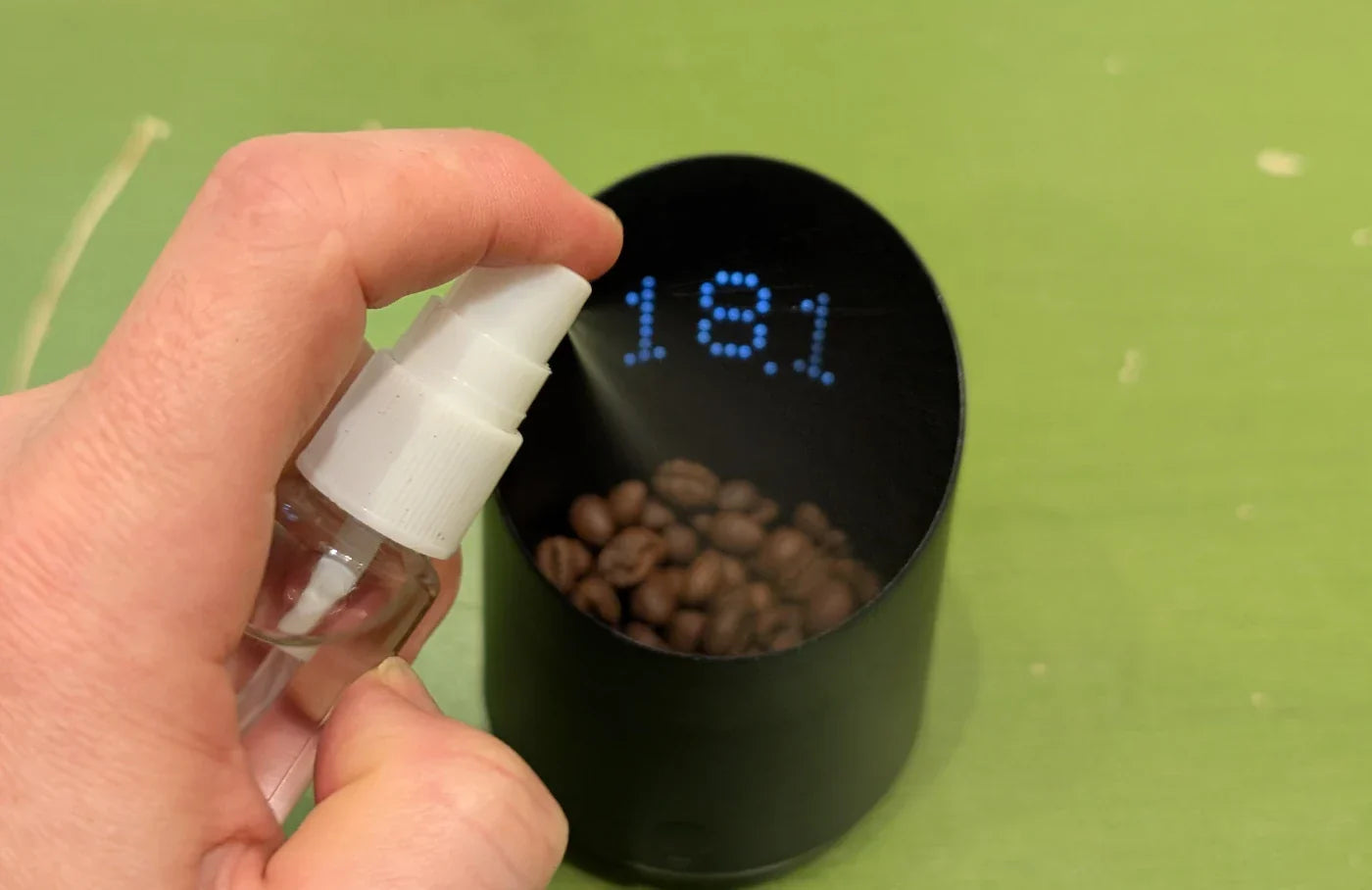
- After weighing the coffee in the dosing container, 2-3 drops of water are added.
- A spray bottle is best for distributing the water evenly.
- The container is shaken slightly to distribute the water over the beans.
- Then, you can start grinding.
Studies show that 0.1 - 0.2 g of water per 18 g of coffee is enough to significantly reduce static charge. As a result, less coffee remains stuck in the grinder, and the ground coffee is distributed more evenly.
Why does static charge occur?
The static charge during coffee grinding is caused by two main mechanisms:
- Triboelectrification: Friction between coffee particles and grinding burrs generates an electrical charge.
- Fractoelectrification: The breaking of coffee beans causes charge separation at the fracture points.
This charging causes fine coffee particles to adhere to larger particles, forming agglomerations (clumps). The different charges (positive and negative) cause the particles to attract one another, resulting in electrically neutral aggregates. This leads to an uneven density of the coffee bed—creating areas of high density and areas with high retention, which complicates even extraction.

Influence of coffee variety, roast level, and humidity
- Moisture content of beans: Beans with less than 2% moisture tend to have a negative charge, while moister beans are more likely to have a positive charge.
- Roast level: Darker roasts generate stronger negative charges than lighter roasts.
- Particle size: Smaller particles (<100 μm) tend to have a negative charge, while medium-sized particles (100-300 μm) are more positively charged.
- Ambient humidity: Higher air humidity (>60%) reduces static buildup.
Scientific findings on RDT
- Reducing static buildup leads to fewer coffee deposits in the grinder.
- Fine coffee particles remain better distributed, making the extraction more homogeneous.
- However, the evidence regarding improved extraction is inconclusive. Some experiments show increased extraction, while others have found no significant differences.
The most comprehensive study to date by Méndez Harper et al. (2024) showed that moisture is a central factor in static buildup. Beans with less than 2% moisture content tend to have a negative charge, while moister beans are more likely to have a positive charge. This explains why different roast levels exhibit different levels of static charge.

Is RDT safe for the grinder?
A frequently discussed point is whether water in the grinder can cause long-term damage. However, studies and practical reports suggest that the small amount of water evaporates quickly and leaves no moisture residue. Furthermore, many roasteries industrially add up to 5% water per kilogram of coffee—significantly more than the 1 - 1.5% used in RDT (0.1 - 0.2 grams per 18 grams of coffee).
Conclusion
RDT is a simple and effective method for reducing static charge during grinding. It ensures a cleaner workspace, more even distribution of ground coffee, and can positively impact espresso extraction. While scientific studies have yet to provide definitive proof of improved extraction, the practical benefit for many home users and professionals is clear: Less static charge means more control over the grinding process and a more pleasant coffee preparation experience. And when it brings more joy, you can taste it in the cup afterward.
Sources and further reading:
- "Moisture-controlled triboelectrification during coffee grinding" by Joshua Méndez Harper, Connor S. McDonald, Elias J. Rheingold, Lena C. Wehn, Robin E. Bumbaugh, Elana J. Cope, Leif E. Lindberg, Justin Pham, Yong-Hyun Kim, Josef Dufek, and Christopher H. Hendon
-
"A study of espresso puck resistance and how puck preparation affects it" Jonathan Gagné, Coffee ad Astra
-
"Assessing the impact of RDT on espresso extraction" by Jeremy and Joe from Socratic Coffee
-
"BETTER WAY TO GRIND COFFEE: Deep Dive on New Hendon Paper" by Lance Hedrick