






















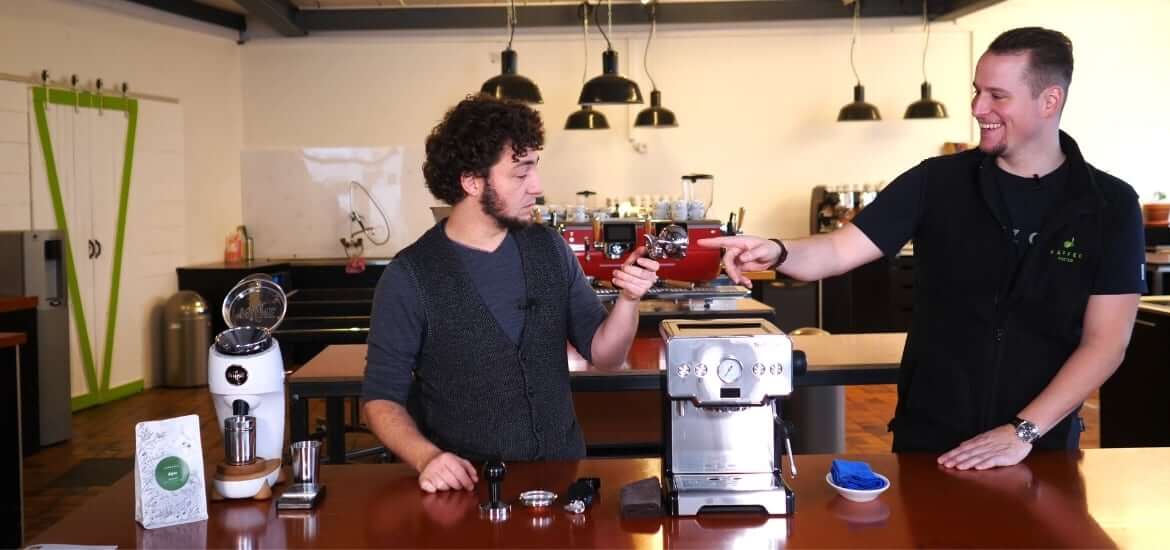

The Satrap Espresso XA is an espresso machine that is sold in Coop supermarkets as well as in Coop DIY and hobby stores. In the Kassensturz espresso machine test, it was the test winner. We took a closer look at the Satrap XA and summarize here what this device, which costs 249 francs, can deliver.
Test and tips for the Satrap Espresso XA
Our concern as a Kaffeemacher is to help espresso machine users get better results from their machines. We find this particularly important and interesting for cheaper espresso machines. The more expensive an espresso machine is – and we test machines that cost 1000, 2000, or 3000 francs – the more we expect the espresso machine to deliver. The cheaper an espresso machine is, the more a test report becomes supplementary to instructions with tips and tricks to get everything out of a coffee machine.
That's how we approached it with the Satrap Espresso XA. We really like some things about the Satrap Espresso XA. And correspondingly motivated, we tackled the biggest construction sites of the espresso machine to work out how you can overcome them.
Accessories and workmanship: Tamper crown
Three accessories or features set the Satrap Espresso XA apart positively. The tamper is not only well suited for its price class. It closes cleanly with the basket in the portafilter, has a solid metal base, and is therefore perfect for leveling and properly compacting the coffee grounds. We wish such a tamper on many a dual boiler espresso machine costing over 1000 francs.
The portafilter is equally impressive. The basket is 58mm, which is a standard size for professional espresso machines and machines with a Faema E61 group head. Actually, the same applies here as for the tamper. The portafilter would cut a good figure on an espresso machine costing well over 1000 euros without loss of quality. The 2-spout or 1-spout outlet can be unscrewed and replaced.
While we don't consider pressure gauges to be real help in adjusting the espresso machine, we like the time display. It gives the barista a sense of how long the espresso has been running. We discuss in the "Adjusting the espresso machine and grinder" section why this can also lead to confusion. Nevertheless, a timer is generally helpful and anything but standard in the price range below 300 CHF.

As positive as the tamper, the portafilter, and the time display have to be mentioned, the rest of the espresso machine is a contrast program. Cheap plastic everywhere – you might say appropriate for the price. However, it's unfortunate that the tested model was already the second one that dripped from the steam wand during espresso extraction.
Otherwise, the machine is compact at 35.5 cm in length, 31.9 cm in width, and 38.4 cm in height. The water tank can be removed and refilled. Important: use softened water with all espresso machines!
Espresso quality like Russian roulette
We made good espresso with the Satrap Espresso XA. Unfortunately, however, we did not get consistent results with all tricks and tips. The machine's biggest problem is temperature stability.
What we can say reliably: before extracting an espresso, at least 5 seconds of water should be drawn. If not, the temperature during espresso extraction will definitely be too high. However, it's unfortunately the case that it often shoots above the desired target temperature even with water extraction. For preparing espresso, the perfect brewing temperature is around 93 degrees Celsius. Depending on the coffee selection, this varies slightly up or down. But we're talking about a deviation of 1–2 degrees Celsius.
The Satrap Espresso XA is not only different every time with its starting temperature, but also with its ending temperature. In some extractions we measured temperature fluctuations of up to 15 degrees.

The temperature curve of the Satrap Espresso XA is impressively inconsistent.
In terms of extraction and taste, this amounts to a game of Russian roulette, where bitterness and acidity alternately blow you away. Low temperatures greatly strengthen perceived acidity. High temperatures promote unpleasant bitterness. In both cases, there's a lack of balancing acidity.
Furthermore, the fluctuating temperature also affects extraction speed. This is normally adjusted via the grind setting, which we discuss in the following section.
Adjusting the espresso machine and grinder
The Satrap Espresso XA has a time-based control. This means it stops the water extraction after a settable and thus predetermined time. By default, the espresso machine stops after 25 seconds.
Such a control is actually more advanced than many controls on more expensive espresso machines, e.g. in the dual boiler segment. These don't stop automatically at all; instead, they are manually stopped after time X or extraction volume Y by users.
So actually, the Satrap Espresso XA delivers more than other espresso machines here. However, this can especially lead to confusion when following classical adjustment instructions and guides or when users haven't completely internalized the principle of adjusting the grinder and espresso machine.
- A good grinder is a prerequisite for being able to make decent coffee with the Satrap Espresso XA at all.
- A scale is essential for controlling the extraction volume, and that's for every extraction.
The Satrap Espresso XA comes without a double-walled basket. A double-walled basket allows the use of pre-ground coffee. Normally, the flow rate of the espresso is adjusted via the grind setting of the grinder. Since pre-ground coffee is already ground and can no longer be adjusted, the resistance in the double-walled basket takes over the task of extending the brewing time of the espresso.
Explanations for adjusting an espresso grinder usually go like this: set the grind so that the espresso runs for about 25 seconds to achieve a volume of about 20 ml/g in the cup.

Unlike a Delonghi Dedica EC 685 or a Solis Barista Perfetta Plus, the Satrap Espresso XA doesn't stop after 20 ml/g in the cup, but after 25 seconds. If the grind setting of the grinder is chosen too coarse, the cup fills much too quickly. The machine will still stop after 25 seconds. The cup is then full or overflowing. If the grind setting is chosen too fine, hardly any drops are in the cup after 25 seconds. The consequence is the same as with a machine with volumetric stopping. The grinder must be set correctly. However, the approach is different and requires a more consistent and uniform control of the volume in the cup with every extraction.
Steaming milk for cappuccino with the Satrap Espresso XA
If you like to drink cappuccino or latte macchiato, you're better off with the Satrap Espresso XA than those who prefer to drink espresso. Because while the espresso rarely ever tastes the same as the previous one, you can steam decent milk foam with the espresso machine if you use the small pitcher (0.35 liters).
And when you pour milk foam onto an espresso, the espresso quality doesn't play the biggest role anymore.
Conclusion on the Satrap Espresso XA espresso machine
The Satrap Espresso XA is labeled on the packaging as a lever machine, even though it isn't a lever machine. A lever machine would be a fully automatic coffee machine or a manual lever machine like the Flair or the manual rotary espresso apparatus Aram.
The discrepancy between packaging and content runs throughout the machine. While the tamper and portafilter make us jump for joy, the temperature inconsistency gives us the creeps. While we find the timer control instead of volumetric control interesting, we wish it for a more advanced machine and consider it problematic in the entry-level segment.
That's why we can hardly recommend the Satrap Espresso XA for making espresso, except for further processing into coffee liqueur or cappuccino. Some extractions will be delicious and you can drink the espresso neat. Often, however, the American double latte variation will be the best solution for neutralizing bitterness and acidity.





