


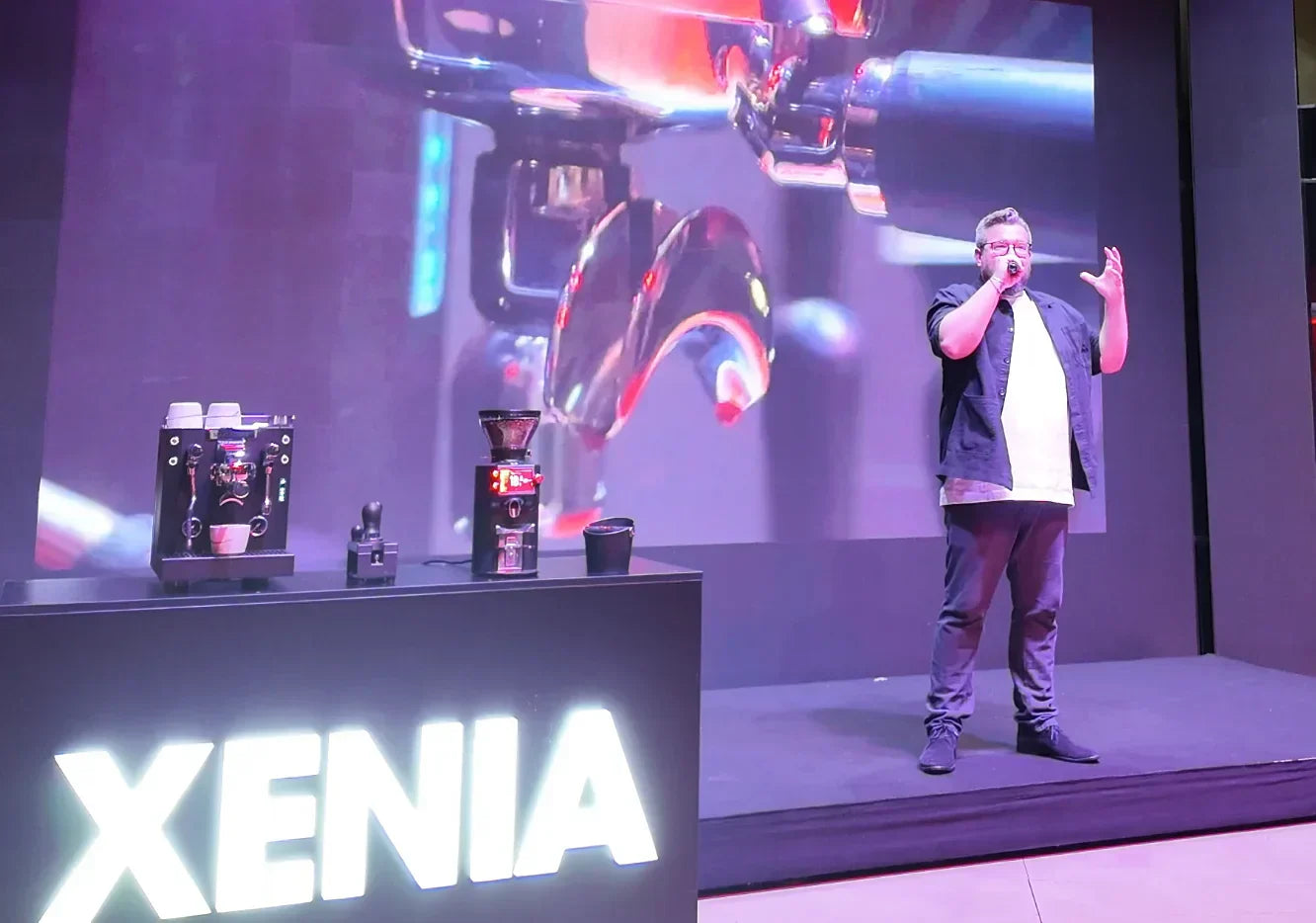

With the acquisition of Xenia Espresso, Mahlkönig has not only added a new product, but an entire machine platform to its portfolio. The new Mahlkönig Xenia and the accompanying E64 WS Home grinder mark the company's entry into the home espresso segment – with a focus on precision and synchronization.
More on the topic of synchronization between grinder and espresso machine in this article: Grind-by-Sync: Grinder and machine in dialog – revolution or expensive toy?
The machine: Mahlkönig Xenia Dual boiler
The Xenia is based on the well-known dual boiler concept by Holger Dreißig. Technically, it remains a standalone system with well-thought-out details. Inside, two stainless steel boilers do the work – one for brewing, one for steam. Both can be controlled independently. Additionally, the machine features an actively heated brew group, which brings it up to operating temperature much faster.
A three-point heating system ensures stable temperatures even with multiple shots in a row. The Xenia is equipped with a specially developed brew group that promises precise electronic control with high energy efficiency.
Additional features such as programmable heating cycles, an espresso-only mode for energy saving, or individually adjustable pressure and flow profiles underline the modern approach.
From minute 27:46 we show the Xenia in the Host video.
The grinder: Mahlkönig E64 WS Home
Alongside the machine, Mahlkönig is introducing the new E64 WS Home. For the first time, it brings grind-by-weight technology with an accuracy of 0.1 g (manufacturer specification) to the home market – and that under 1,000 euros. At its heart are 64 mm burrs, electronically controlled grind adjustment, and a load cell. The goal: reproducible results without manual readjustment.
The abbreviation WS stands for "weight & sync" – and points to the decisive innovation. In combination with the Xenia, a networked system emerges in which grinder and machine communicate with each other.
Grind-by-Sync: Machine and grinder in dialog
With so-called grind-by-sync, the Xenia measures key parameters during the shot – such as flow, time, and extraction behavior – and sends this data to the grinder. If the extraction deviates from the target values, the grinder automatically adjusts the grind size.
This marks Mahlkönig's entry into a new phase: the combination of grind-by-weight, electronic grind adjustment, and machine syncing is the technology of the hour in the home segment, though on prototypes it has only worked for two other manufacturers so far – namely Quick Mill in collaboration with Eureka and nunc.
Summary
The combination of the Xenia as an open, sensor-based machine and the E64 WS Home as a precise, networked grinder forms a well-thought-out ecosystem. Whether the interplay actually performs as smoothly in practice as the presentation promises remains to be seen. Functionally speaking, however, the package is a consistent step forward – and a clear signal that the home market is increasingly moving towards integrated systems.
One more thought on the classification: the Xenia promises to be a significantly more fitting counterpart in terms of synchronization than the Quick Mill espresso machine in the Tio setup with the Eureka grinder. While in the Italian pairing, the change to the next espresso shot is triggered by adjusting the grind size, the Xenia can theoretically also influence the shot during extraction if it measures higher flow.
Whether and how the control is intended here and how well the pairing works will only be revealed by a detailed test. We're looking forward to it – and are curious to see.
Xenia, Germany: Stoll Espresso*, Espressopool*
E64 WS, Germany: Stoll Espresso*, Espressopool*, Lücke-Technik*
*We recommend specialist partners we know do good work and provide reliable service. When you order through our affiliate links, you don't pay more, but we receive a small commission – which we invest directly in new test equipment.