





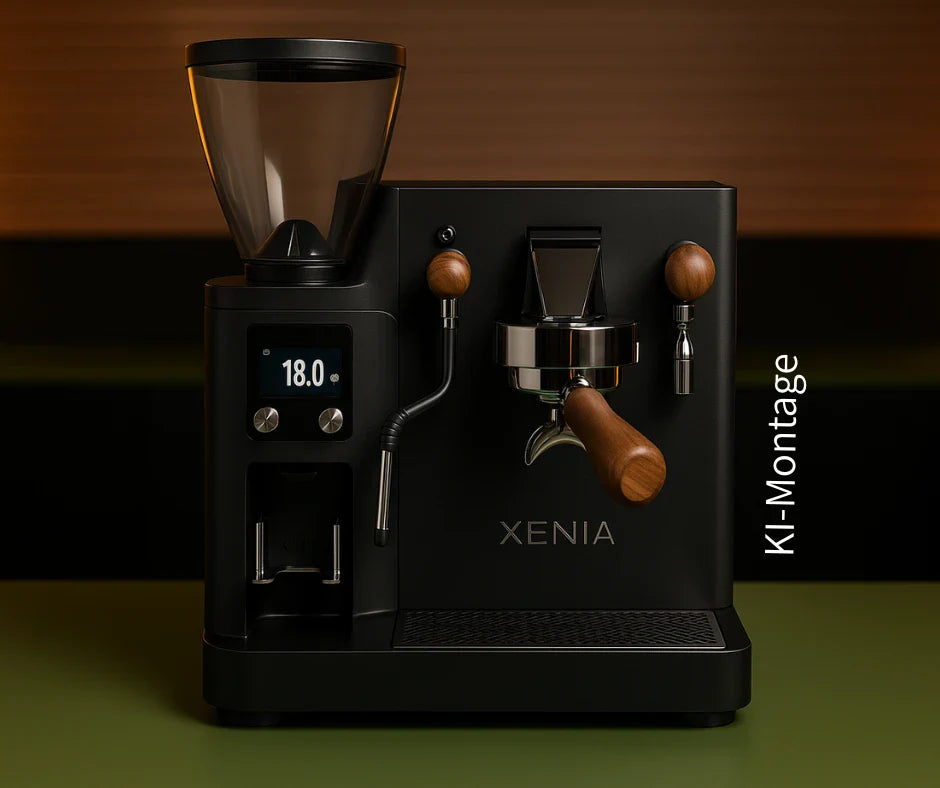

A small manufacturer of high-quality espresso machines is being acquired by one of the largest grinder companies in the world: The Hemro Group (including Mahlkönig) has purchased Xenia Espresso. An acquisition with symbolic power for the changes in the espresso machine market.
What happened?
Since May 23, 2025, Xenia Espresso has officially been part of the Hemro Group. This makes the German machine company part of a global corporation that was previously known primarily for coffee grinders. The Hemro Group unites brands such as Mahlkönig, Ditting, Anfim , and HeyCafé under its umbrella. Now, with Xenia, an espresso machine manufacturer joins them—one that has established itself in the home barista world with dual-boiler concepts, open interface technology, and an extremely loyal community.
A bold step with clear goals
Holger Dreißig, the founder, inventor, and innovator behind Xenia, has sold his baby. The acquisition took place as a voluntary integration into a significantly larger company, an idea that Xenia "has been open to and positive about for a long time." In the future, Holger Dreißig will primarily take on responsibility for development—a smart move for someone who says of himself that he prefers developing over running large-scale marketing.
This decision deserves respect. It takes courage to hand over the company you built and focus on what you do best. For Xenia, the new structure can open up many opportunities in terms of sales, marketing, etc., in order to realize the vision even better while simultaneously enabling scaling.
A sign for the market?
The acquisition marks more than just a merger of two companies. It is an expression of a shift in the market. The boundary between grinder and machine manufacturers is blurring. Companies have long been thinking in terms of systems. The big questions are: How well do the grinder and espresso machine work together? How can the interaction become simpler, more intuitive, and smarter?
Xenia was early to adopt open communication between the machine and third-party devices—for example, via a web interface or connection to the Beanconqueror App. Hemro/Mahlkönig, in turn, had recently introduced a gastro synchronization system, which was initially focused on collaboration with La Marzocco gastro espresso machines. Now a new attempt could follow. This time for the home market.
Why it all makes sense
The home coffee market is facing a change. The fully automatic machine market is three to four times larger than the portafilter market in German-speaking countries. That is a huge slice of the pie that portafilter manufacturers would like to have a piece of. More and more manufacturers are aiming their developments at the transition from fully automatic coffee machines to portafilters. They are making an offer that integrates convenience elements of the fully automatic machine into manually operated portafilter espresso machines. In this way, manufacturers are paving the way to make the step from a fully automatic machine to a portafilter easier.
We see this goal in machines like the Maro, which provides feedback after each extraction on how to readjust the grinder if the extraction was too fast or too slow. It is similar with Ligre or even the compact machines with integrated grinders from Sage or DeLonghi. The biggest step is promised by the German startup nunc., which promises a grinder-machine ecosystem with complete integration.

What does the partnership bring Hemro/Mahlkönig?
Above all: know-how. Holger Dreißig built Xenia, developed it, tested it again and again, and turned it into a brand. He has dealt intensively with all aspects surrounding the development of espresso machines and thought beyond industry standards. Temperature stability, energy efficiency, and open interfaces (via HTTP/web interface) have been areas of research applied at Xenia for years. Dreißig is an espresso machine tinkerer whose professional roots, however, are in IT.
Added to this is a strong focus on the community and an almost legendary configurator. Every Xenia is built individually on request. "Made in Germany" is not a marketing promise at Xenia, but lived practice.
Mahlkönig gears up for the future
What if the market actually develops in the direction of synchronized systems and a traditional grinder manufacturer only has individual grinders in its range? Then it becomes difficult to position oneself.
In recent years, I have tested 80 espresso grinders. One of these grinders came from Mahlkönig and was developed specifically for the home market. To put it politely, Mahlkönig not only underestimated the home market, but completely missed its potential.
At the same time, we see that this market in particular has experienced strong growth since Covid. The Mahlkönig x54 was a late response to this development. This summer, the manufacturer is presenting another grinder for the home sector with the Mahlkönig x64 SD, providing an answer to the growing single-dosing market.
Mahlkönig/Hemro has obviously woken up and recognized the potential of home espresso preparation.
The acquisition of Xenia fits the picture.
A clever move for both sides
This acquisition makes sense for several reasons:
- For Xenia: They gain the resources of a globally active group of companies, but keep their identity—that is the idea. Although production, purchasing, and marketing processes will change, "a lot of Xenia Espresso is to be preserved."
- For Mahlkönig/Hemro: They gain expertise in a promising segment and can offer a complete system from a single source.
- For the market: A central aspect of the acquisition is the planned development of a synchronized system that could revolutionize the home coffee market.
What comes next?
The integration is complete; now the work begins. Marcel Lehmann and Adrian Schürmann were registered as managing directors of Xenia as of May 30, 2025. Holger Dreißig takes on development activities and has authorized signatory power together with a managing director or other authorized signatories.
We can be excited to see what products will emerge from this connection. The potential is huge—from the further development of existing Xenia machines to completely new, synchronized systems.
Conclusion
This acquisition is more than just a deal—it is a statement. In a time when the boundaries between fully automatic machines and portafilters are blurring, Mahlkönig is positioning itself for the future. Holger Dreißig has made a courageous decision that opens up new perspectives for his company without losing its brand identity.
We are looking forward to the first fruits of this partnership. If all goes well, we could soon enjoy systems that combine the best of both worlds: the precision of Mahlkönig grinders and the innovation of Xenia espresso machines.
Chapeau, Holger! We wish you and the entire team all the best for this exciting journey.