






















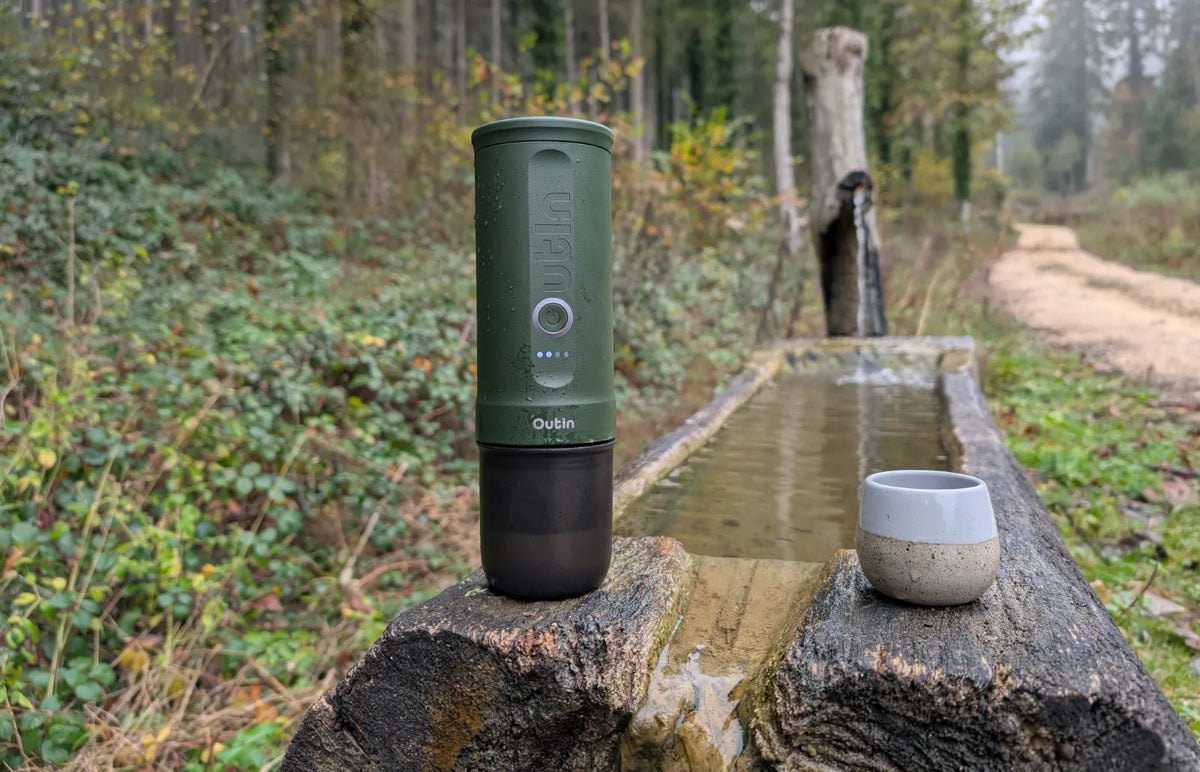

The idea behind the mobile espresso maker OutIn is compelling. OutIn solves the problem of all mobile espresso makers. Finally, we no longer have to carry a kettle or gas stove with us or search for hot water elsewhere. Because OutIn has an integrated kettle. A 7500 mAh battery charged via USB-C has enough power to heat cold water several times and build up enough pressure. In theory and marketing announcements. We took a closer look at the practice. Unfortunately, we arrived at quite different results.
The best mobile espresso idea
Hot water is one of the main challenges when making espresso on the go. That's why many manufacturers don't address the hot water issue at all and leave it to the brewer. They then need a kettle, gas stove, or fire.
Not only is heating the water a challenge for mobile espresso brewers, but also heating up the entire brewer! Preparing coffee outdoors is a topic in our detailed outdoor coffee article and video.
OutIn doesn't leave us with the challenge of boiling water; instead, it integrates a small kettle into the brewer. It's supposed to be enough to heat the brewing water 5 times, depending on the water volume and cold of the water. We're already at one of the manufacturer's slightly exaggerated marketing announcements. 5 heating cycles really only works if you use the minimal amount of water. And even then with some compromises. There are several other marketing claims we can't support, which we'll discuss further down in the article.

OutIn Temperature Reality
According to the manufacturer, the espresso brewer should brew at 92 degrees. In our tests, we reached 90 degrees in the upper chamber only once. That was when using just 40 ml of water. At larger water volumes, we stay at temperatures between 85 and 88 degrees in the heating chamber. With larger quantities like 70 ml, the temperature is 85 to 86 degrees. We tested these results with our OutIn and cross-checked them with temperature values from two other models.
In reality, we must expect much lower brewing temperatures, as the brewing water loses temperature on its way from the heating chamber to the coffee by transferring heat to the material.
The lower brewing temperature manifests itself in the espresso flavor, which especially with lighter roasts emphasizes the coffee's acidity. We therefore recommend specifically selecting espresso roasts for the Nano that match this flavor.
The lower temperature can of course be avoided if the brewing water is boiled externally, for example with a kettle. Then we recommend using temperatures above 95 degrees. This heats the brewer and provides good brewing temperatures, ideally between 92 and 94 degrees. This way you solve further problems or promises of the brewer.

Marketing vs. Reality
Perhaps it's the fashion of this time to announce the highest numbers as loudly and strikingly as possible. We only address this topic if it really stands out. OutIn communicates in line with this trend – but as soon as the brewer is tested, some announcements fall apart:
| Marketing Promise | Measurement Result & Test Reality |
|---|---|
| 200 seconds heating time | Only applies to the minimum water volume. At 70 ml water, we measure 4:30 minutes. |
| 5 heating cycles per battery charge | Achievable only with minimum fill. At full capacity, there are significantly fewer cycles. |
| 20 bar pressure | Marketing figure without added value. For espresso, 6 to 9 bar is ideally needed at the coffee puck. |
| 92 °C brewing temperature | In the heating chamber, real values are usually only 85–88 °C; even lower at the coffee. |

So much (more) potential!
What we've described should in no way give the impression that we consider the OutIn espresso maker a bad product. We think it's brilliant! With the right roast that works well with lower brewing temperatures, the OutIn delivers exactly what we want from a mobile espresso brewer:
That's an absolute game-changer and makes the OutIn Nano the most flexible and best manual espresso brewer for numerous applications. In theory, you can brew coffee almost anywhere with it, since the heating happens automatically and a cup captures the espresso directly – whether in a kayak, in a cable car on the mountain, while camping, or on the go in a car.
The brewer itself could be even better with two small adjustments:
Note: The brewer consumes more power during heating than can be supplied via USB-C in parallel. It is therefore not suitable for continuous mains operation.

Delivery Package and Quality
The OutIn espresso brewer makes a robust and high-quality impression. In its basic version it weighs under 700 grams and at 23 cm tall and 7 cm in diameter is quite compact.
The standard delivery package includes a small brewing chamber for 5–6 grams of coffee, a capsule chamber, and a shower head. A small measuring cup also serves as a tamper. All these accessories are made of black plastic.
Those who want to get the most out of it should go for the Basket Plus Set with stainless steel tamper and 16–17 gram basket. Working with the larger brewing chamber and the attractive small tamper makes handling much easier and significantly increases the overall impression of quality. 16 grams of coffee powder in the brewing chamber means at a 1:2 ratio ultimately a true 32 grams of double espresso in the cup!
Links & Equipment
*This is an affiliate link to Amazon. If you order through it, it doesn't cost you any more. We receive a small retention, which we use for further test equipment. Thank you!



