


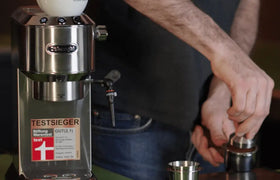

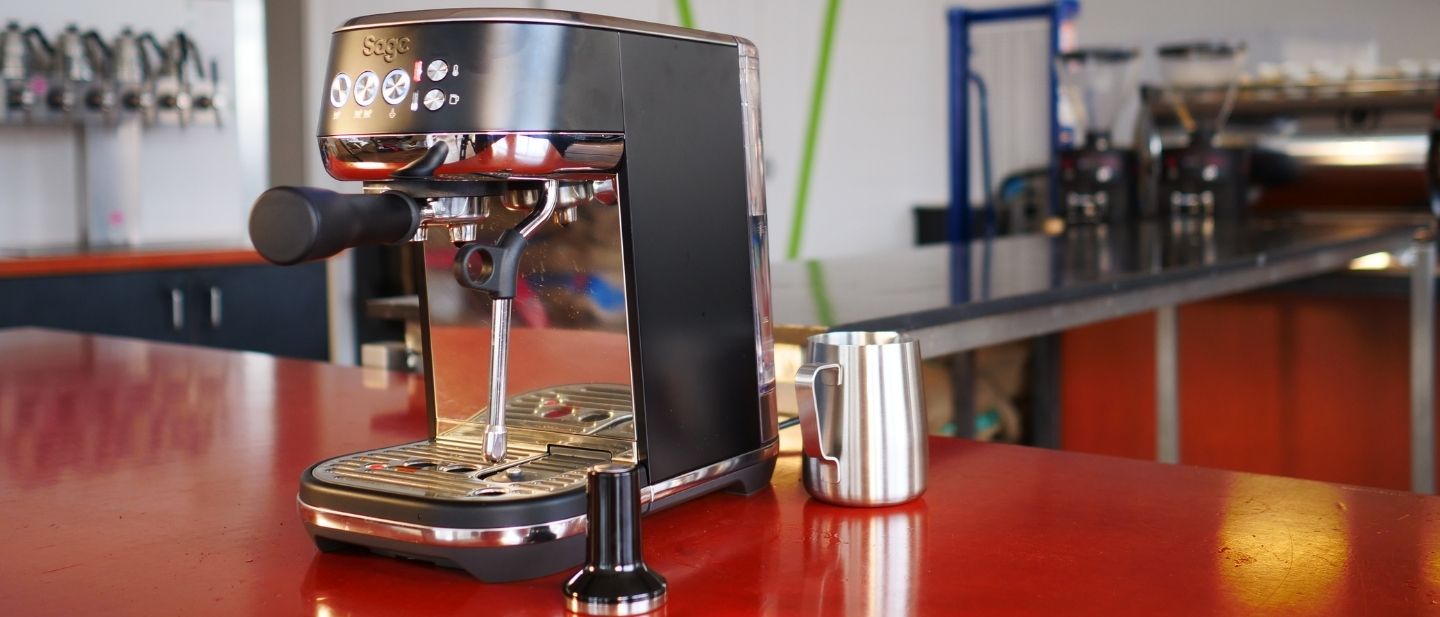

The Sage The Bambino Plus is the smallest entry-level espresso machine made by Sage. Sage? Yes, the brand known as Breville in other parts of the world, marketing identical hardware under a different badge. The Sage Bambino Plus belongs to the thermoblock espresso machine category. True to form for thermoblocks, the Bambino Plus is up to temperature and ready to pull shots in around 3 minutes. Priced at roughly €330 / CHF 330, the Sage Bambino Plus sits squarely in the budget segment of our thermoblock round-up test.
As with all thermoblock units, a few critical questions arise regarding the Sage Bambino Plus:
Power Consumption
If low energy usage is top of mind when shopping for an espresso machine, the Sage Bambino Plus is a stellar contender. Our energy testing setup is identical across all reviews: we monitor draw using a smart adapter from MyStrom.ch. Following a 5-minute warm-up, we pull 5 double espresso shots. After letting the machine sit on standby for two additional hours, we pull one final double shot. At that point, total power draw stood at just 0.08 kWh. For context: the Ascaso Steel Duo PID, also a thermoblock machine operating in Eco Mode, consumed 0.28 kWh over the same period.
Compared to heat exchanger (HX) espresso machines, these numbers are miniscule. The most efficient HX units in our tests were the Xenia Espresso and the Bezzera BZ10, both drawing 0.48 kWh, while the Bezzera Magica S trailed the pack at 0.72 kWh.
Small, Compact, Lightweight, and Plenty of Plastic
The Sage Bambino Plus is compact, space-saving, and a true lightweight at just 7 kg. Light weight isn't inherently a dealbreaker if a machine features suction feet or a weighted base. Unfortunately, the Bambino Plus has neither. When locking in or removing the portafilter, you have to use your free arm to brace the entire chassis. It’s inconvenient, particularly because you can't really leave cups resting on the top tray—you constantly need that surface to hold down the machine while locking in the portafilter handle.
Measuring 31 cm in height, 32 cm in depth, and 19.5 cm in width, this machine fits into virtually any kitchen nook. But keep in mind: it requires a dedicated standalone coffee grinder to operate, which needs to be factored into your counter space calculations.
The drip tray is also diminutive. We strongly recommend doing a short flush after every shot to clean the shower screen. After two to three shots plus flushes, the tray is already full. While a tiny red pop-up float indicates water levels, if it’s floating at maximum capacity constantly, it isn't particularly helpful.
The black housing accents on the Sage Bambino Plus are molded plastic. The plastic itself has a solid, decent tactile feel, but at the end of the day, it's still plastic. On the upside: unlike heavy-duty stainless steel HX boilers, there are no sharp metal edges to worry about.
First-Class Milk Frothing Performance
Where the Sage Bambino Plus truly shines is steam performance. The milk frothing capability on this machine is unmatched in its price bracket. With impressive steam pressure, this compact unit easily powers through a large 0.6-liter milk pitcher—something several dual-circuit heat exchanger machines failed to do!
It's a genuine joy to use. For beginner home baristas, the steam delivery doesn't scorch the milk too quickly, giving you ample time to incorporate the milk and roll it into a silky whirlpool (microfoam rolling phase) to break down any stray surface bubbles.
Even better: the Sage Bambino Plus features an Auto-Steam hands-free option. A temperature sensor built into the drip tray grid monitors pitcher temps and adjusts auto-frothing output accordingly. You can pre-select three milk temperature levels and three microfoam density settings. We recommend selecting the middle setting for both; the resulting microfoam texture for latte art is genuinely impressive.
Sage proves what is technically possible with thermoblocks when it comes to steam. If only that same level of precision engineering had been applied to brew temperature stability…

Espresso Disasters — When Brew Temp Fluctuates Wildly
What comes out of the portafilter during espresso extraction is a real disappointment. Unfortunately, it's rarely enjoyable. For starters, the included pressurized (double-wall) filter basket prevents you from properly dialing in a grinder. Pressurized baskets are designed to create fake crema from pre-ground, stale commodity coffee, not for extracting freshly ground specialty coffee. From the top, the basket looks normal with a mesh of holes leading into an internal floor. However, that floor drains through a single micro-pinhole measuring roughly 0.3 mm. The espresso is forced through this hole, creating artificial aeration that mimics real crema (see our in-depth blog guide on espresso crema). Fine-tuning grinder settings or achieving an even extraction is virtually impossible under these conditions.
Using standard unpressurized (single-wall) precision baskets from our Coffee Academy lab, we re-tested the machine's extraction behavior. **Regrettably, swapping the basket did not significantly improve cup quality.** The primary culprit is the erratic temperature control of the Sage Bambino Plus.
The golden standard for espresso extraction sits around 93 °C (199 °F). Quality espresso machines hold this target brew temperature flat throughout the entire shot. The Sage Bambino Plus does not.

At the start of extraction, water temp spikes violently to at least 98 °C (208 °F)—in several test runs, we registered spikes up to 102 °C (215 °F). It then plummets down below 85 °C (185 °F). That is a massive temperature swing and something we rarely see to this extreme. Tasting the cup reveals two jarring defects: the scorching initial spike introduces an harsh, astringent bitterness and a dry mouthfeel, while the sudden drop down to low temperatures blasts the palate with sour, underdeveloped acidity. Overall, the coffee extracts unevenly.
It's a shame, but for pure espresso preparation, we cannot recommend this machine.
Verdict on the Sage Bambino Plus
The Sage Bambino Plus is a fantastic milk frothing unit. Unfortunately, it falls flat as a pure espresso maker. It's tough to understand what Sage’s engineering goal was here. Perhaps focusing on outstanding auto-steaming performance was a deliberate choice: adding frothed milk to espresso covers up sourness and astringent bitterness quite well, with milk sugars bringing the cup back into balance.
Our dream setup? Transplanting the auto-steam performance of the Sage Bambino Plus directly into the exceptional espresso platform of the Ascaso Steel Duo PID. That would be the ultimate thermoblock machine.