



Thermoblock portafilter espresso machines heat up in minutes rather than half an hour, use a fraction of the electricity required by a boiler espresso machine, and often cost less than half the price. The trade-off for a long time was temperature stability: where a boiler maintains an inert mass of hot water, a flow-through heater must bring each shot to temperature from scratch.
We have been testing this machine type since 2019. Over this period, we have measured machines whose temperature fluctuates by 7.6 degrees across five shots — and others that stay within a single degree, outperforming almost every heat exchanger machine. Both were thermoblocks. That is precisely the point of this page: the build type tells you very little. The execution tells you everything.
Thermoblock, Flow-Through Heater, Thick-Film Heater: Clarifying the Terms
Flow-through heater (instantaneous water heater) is the umbrella term. It refers to any system that heats water on demand as it flows through, rather than storing it in a boiler. Anyone searching for "flow-through heater espresso machine" almost always means a thermoblock, although technically the term covers a broader range of designs.
In a thermoblock, water flows through a pipe integrated into a metal block, usually aluminum. The block is heated by a heating cartridge and transfers its heat to the pipe. Some manufacturers mill channels directly into the block, while others insert a continuous coiled pipe and call the result a thermocoil. In everyday use, you won't notice a difference, but it explains why Sage, De'Longhi, and Decent name their systems differently.
The thick-film heater is the newer variant of the same principle. Instead of heating an entire block of metal, a thick-film heating element sits directly on the water-bearing surface. The thermal mass is even smaller, allowing the control system to react faster. Sage calls this ThermoJet; the Dutch manufacturer Ferro Techniek refers to the identical components as Flow Through Heaters. Why we consider this to be the most exciting development in recent years is detailed in our article The Era of the Thick-Film Heater Has Begun.
And because the question arises regularly: the heat exchanger in a dual-circuit machine is also functionally a flow-through heater. The brewing water does not sit directly in the boiler; instead, it flows through a tube routed through the steam boiler, reaching brewing temperature along the way. The difference lies in the heat source: in a dual-circuit machine, a boiler heats the tube, whereas in a thermoblock, a metal block provides the heat. Read more about this in our Dual-Circuit Heat Exchanger Comparison.
Four Design Types, All Called "Thermoblock"
This is where it becomes practically relevant. What a manufacturer markets as a thermoblock can represent four distinct design approaches, which ultimately dictate whether you will have to wait between brewing your espresso and steaming milk.
| Design Type | How It Works | Practical Impact | Examples |
|---|---|---|---|
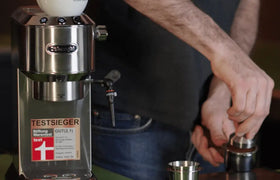
| Single Thermoblock | One block for both brewing and steam | Switching required; waiting time in both directions | Ascaso Dream PID, De'Longhi Dedica, Solis, Smeg |
| Dual Thermoblock | Two separate blocks: one brews, one steams | No switching required, no temperature drop afterward | Ascaso Steel Duo PID, Quick Mill Luna & Cassiopea, Graef Contessa |
| Thick-Film Heater | Heating element directly on the water-bearing surface. (Not a "thermoblock" by our strict definition) | Fastest heat-up time, most precise temperature control | Sage Bambino & Barista Pro, Zuriga, Maro, Roxy |
| Hybrid Design | Flow-through heater brews, boiler steams | Steam performance like a dual boiler, with matching power consumption | Quick Mill Sunny, Ascaso Baby T, Ligre Youn, WPM Primus |
The Graef Contessa represents a special case: it houses three thermoblocks — one for coffee at 900 watts, one for steam at 1,400 watts, and a third 150-watt unit dedicated solely to keeping the group head warm. Conversely, KitchenAid advertises two sensors rather than two heaters for its Artisan 5KES6503; internally, it uses a single thermocoil.
What We Measured
We connect every machine to a power meter and run the exact same testing protocol. A cold machine is heated up until the portafilter reaches 92 degrees Celsius on the first shot — how long this takes is determined by the machine itself, not by a stopwatch. This is followed by five double shots lasting 26 seconds each with a one-minute pause in between. Before the first shot, a five-second flush is performed, followed by a two-second flush before each subsequent shot. Afterward, we execute the identical series once more: once with the steam system enabled and once without. At least six hours elapse between test runs to ensure the machine is completely cold. The full procedure is detailed in Our Power & Energy Consumption Protocol.
| Machine | System | Heat-up to Ready | Heat-up + 5 Shots With Steam |
Without Steam | Standby / Warmkeeping per Hour |
|---|---|---|---|---|---|
| KitchenAid Artisan 5KES6503 | Thermoblock | Not documented | 0.045 kWh | — | 0.030 kWh |
| Quick Mill Luna | Dual Thermoblock | 7:25 min | 0.112 kWh | 0.082 kWh | 0.048 kWh |
| Ascaso Steel Duo PID | Dual Thermoblock | 5:00 min | 0.129 kWh | 0.093 kWh | 0.109 kWh |
| Ascaso Steel Duo PID Plus | Dual Thermoblock | 10:00 min | 0.144 kWh | 0.085 kWh | 0.124 kWh |
| Quick Mill Sunny | Hybrid | 10:00 min | 0.246 kWh | 0.082 kWh | 0.215 kWh |
Measurements according to KM protocol. The heat-up time is included in the table because it represents the single largest energy item and varies significantly between machines — we heat until brewing readiness is achieved, rather than for a fixed duration. Standby values are extrapolated to one hour: for Luna, KitchenAid, and both Ascaso models from a 5-minute window; for the Sunny from a 20-minute window. For comparison from our thick-film tests: Zuriga E2 Gen 2 at 0.058 kWh, Maro Model 1 at 0.06 kWh. Boiler-based machines typically range between 0.2 and 0.5 kWh.
Without steam, all models are tightly clustered between 0.082 and 0.093 kWh — even though the Sunny takes twice as long to heat up as the Ascaso Steel Duo PID. The variance emerges almost entirely from the additional power needed for milk frothing.
This is demonstrated most clearly by the Sunny itself, where the exact same machine was measured twice with identical heat-up times: 0.246 kWh with the steam boiler enabled versus 0.082 kWh without. The steam boiler triples power consumption, placing the machine in the energy usage realm of a traditional boiler system. On the two Ascaso models, where a second thermoblock operates instead of a steam boiler, the energy penalty for steam is between 40 and 70 percent.
Heat-up times vary, and initial heating is the largest single energy consumer. The Ascaso Steel Duo PID Plus appears less efficient at 0.144 kWh than the older Steel Duo PID at 0.129 kWh — however, it was heated for ten minutes instead of five. Looking strictly at the energy used during the five shots themselves, the Plus consumes 0.063 kWh versus 0.075 kWh for the older model, and per minute of heating it draws 0.008 kWh instead of 0.011 kWh. It is therefore more efficient across both metrics, even though the unadjusted total column suggests otherwise. Directly clean comparisons can only be made when evaluating the exact same machine with and without steam enabled.
When Turning Off Beats Warmkeeping
From these exact measurements, a practical figure emerges that is far more useful in daily life than raw consumption data: the exact point at which keeping the machine warm becomes more expensive than turning it off and reheating it from cold later.
| Machine | With Steam | Without Steam |
|---|---|---|
| Quick Mill Luna | 1 hr 14 min | 40 minutes |
| Quick Mill Sunny | 43 to 48 minutes | — |
| Ascaso Steel Duo PID Plus | 39 minutes | 25 minutes |
| Ascaso Steel Duo PID | 30 minutes | 19 minutes |
| KitchenAid Artisan 5KES6503 | 16 minutes | — |
For the KitchenAid, switching off makes economic sense after just fifteen minutes, whereas the Luna can be left idling for over an hour before reheating becomes cheaper. If you spread three espressos across a morning, shutting down saves money on one machine, while leaving the other powered on is more economical.
The same qualification applies here: this threshold compares measured heating energy against standby consumption, and initial heat-up times differ between units. The two Ascaso models are therefore not directly comparable with each other on this metric alone. However, as a rule of thumb for your own machine, the number serves as an excellent guide.
The Internal Design Leaves Its Fingerprint on the Power Profile
When analyzing power draw curves, we discovered a diagnostic pattern we hadn't previously exploited. The difference in peak wattage between test runs with and without steam enabled corresponds almost exactly to the rated power of the secondary heating system.
| Machine | Peak Power w/ Steam | Peak Power w/o Steam | Difference | Manufacturer Spec |
|---|---|---|---|---|
| Ascaso Steel Duo PID | 1,966 W | 1,066 W | 900 W | Two thermoblocks |
| Ascaso Steel Duo PID Plus | 1,917 W | 1,054 W | 863 W | Two thermoblocks |
| Quick Mill Luna | 1,495 W | 964 W | 531 W | 600 W + 1,000 W |
| Quick Mill Sunny | 1,400 W | 1,008 W | 392 W | Thermoblock + steam boiler |
On the Luna, the measured difference aligns almost perfectly with the manufacturer’s specification of 600 watts for the second block. On both Ascaso units, the delta is approximately 900 watts, matching the rating of a full secondary thermoblock. On the Sunny, the difference is only 392 watts — because it doesn't use a second flow-through heater, but rather a boiler heater that pulses intermittently to maintain pressure.
Cross-verification is provided by the Graef Contessa. We measured a peak draw of 2,450 watts. Graef specifies its three internal blocks at 900, 1,400, and 150 watts respectively. Total sum: 2,450 watts.

Thermoblock vs. Boiler — What the Design Really Dictates
The core heating mechanism does not automatically dictate how a machine performs. Temperature quality is determined by PID control tuning and sensor placement, not by the marketing label. What the fundamental architecture actually dictates comes down to three factors:
1. Heat-up time. Here, flow-through heaters possess an undisputed, massive advantage: 3 to 10 minutes versus 20 to 30 minutes for most traditional boilers, and even faster for thick-film systems.
2. Energy consumption. As shown above, a flow-through heater draws significant power only while water is actively passing through. A boiler must continuously maintain a large reservoir of water at temperature around the clock.
3. Thermal headroom and flow capacity. This represents the primary inherent limitation. A boiler acts as a thermal flywheel; an instantaneous heater does not. When pulling shots in rapid succession, the control system must calculate energy input on the fly for every single shot — and this is precisely where machines diverge. The Quick Mill Luna registered a standard deviation of 2.77 degrees Celsius in our testing protocol, with a maximum variance of 7.63 degrees. That was the most inconsistent thermal result we have ever recorded under this protocol. By contrast, the Ascaso Steel Duo PID stayed within a tight 0.75-degree deviation. Both are dual-thermoblock machines. Furthermore, at high flow rates, flow-through heaters are physically limited by the maximum wattage of their heating elements and may struggle to transfer sufficient energy to the water fast enough. For this reason, we conduct tests using measuring devices optimized specifically for espresso flow rates. If your routine consists primarily of long coffees or high-flow turbo shots, a flow-through system may reach the physical limits of its heating capacity.
Almost more critical than shot-to-shot consistency is whether the temperature shown on the digital display matches the actual water temperature hitting the coffee puck. On the Quick Mill Sunny, we measured an offset discrepancy of 4 to 5 degrees Celsius; on the Ascaso Steel Duo PID, 2 to 4 degrees. The Ascaso Dream PID, meanwhile, arrived with an offset error under one degree. If you don't know your machine's true temperature offset, you don't know what temperature you are brewing at — though you can always adjust based on taste: excessive sourness generally indicates a brew temperature that is too low (often below 90 °C). You should increase the set temperature even if the display already reads 93 °C. Conversely, if the coffee tastes unpleasantly bitter or astringent, the water may be too hot — a condition often visible as steam sputtering from the group head. Dialing the temperature down will restore balance.
A professional calibration by a specialized dealer can help identify the exact offset between target display temperature and actual brew temp. On machines equipped with an E61 group head, an aftermarket group thermometer can also provide valuable guidance.
The Real Bottleneck: A Cold Portafilter
A thermoblock reaches target temperature in three to ten minutes. The heavy brass portafilter does not. Unlike an E61 group head, which is continuously heated by circulating hot water, many thermoblock designs feature a cold piece of brass hanging off the front of the machine. The coffee then encounters 93-degree hot water and a room-temperature portafilter.
For context: a thoroughly preheated portafilter reaches well over 80 °C — so hot that it is uncomfortable to touch. To solve this, some manufacturers install dedicated heating elements directly inside the group head to warm both the group and the portafilter quickly and efficiently. If your machine lacks this feature, you can use the following steps to help bring your portafilter up to temperature quickly:
Some manufacturers address this engineered limitation directly: the Ascaso Dream PID features a dedicated portafilter heater; the Graef Contessa incorporates a third thermoblock exclusively for the group head; and the Zuriga employs a 600-watt heating element embedded directly in the group. This architectural attention to detail is often what separates different price tiers.
Steaming Milk on a Thermoblock
Thermoblocks produce steam differently than boiler machines, which is why many home baristas struggle when transitioning to them. In a steam boiler, water sits at the bottom while pressurized steam collects at the top, delivering immediate, continuous power. In a thermoblock, water is pumped sequentially over the heated element, delivering steam in pulsing bursts. Additionally, steam wand designs vary considerably, particularly in budget price brackets.
Swiss Vice Barista Champion Michel Indelicato tested milk frothing side-by-side on four thermoblock machines. His key practical takeaways:
Two machine-specific tips that make a dramatic difference: on the De'Longhi Dedica, do not set the pannarello wand sleeve to "Cappuccino", as it draws in uncontrolled air; ideally, remove the outer plastic sleeve entirely. On the Quick Mill Orione, remove the outer plastic tip as well — it produces coarse, soapy foam, and milk bakes onto the threads underneath.
The widespread claim that thermoblocks are universally weak at steaming does not hold up under objective testing. In our protocol, the Quick Mill Sunny frothing cycle completed in just 24 seconds — matching dual-boiler speeds. The WPM Primus operates in a commercial league of its own. However, the majority of entry-to-mid-range thermoblocks do exhibit the characteristics described above.
Overview of Thermoblock Machines We Have Tested
| Machine | System Type | Test Year | Key Findings |
|---|---|---|---|
| Ascaso Steel Duo PID | Dual Thermoblock | 2021, Updated 2022 | Standard deviation 0.75 °C; ready in 3 to 5 minutes |
| Ascaso Baby T Plus | Hybrid | 2022 | Steam power matching commercial dual boilers |
| Quick Mill Luna | Dual Thermoblock | 2024 | Most energy-efficient dual-system tested, but poorest temperature consistency |
| Quick Mill Evo 70 | Thermoblock, PID | 2021 | Stable thermal corridor between 93 and 95 °C |
| Quick Mill Orione 3000 | Thermoblock | 2023 | Reaches 93 °C only after an 8-second pre-flush |
| Solis Barista Perfetta Plus | Thermoblock, PID | 2020 | Strong milk foam performance; brew temperature settles low at 82 °C |
| Solis Barista Gran Gusto | Thermoblock | 2021 | Briefly touches 95 °C, then drops below 90 °C |
| De'Longhi Dedica EC685 | Thermoblock | 2021 | Most affordable entry-level machine we can recommend; overshoots target temp |
| Sage Bambino Plus | Thick-Film Heater | 2021 | Exceptional automated milk frothing value for the price |
| Sage Barista Express Impress | Thermoblock | 2024 | Workable compromise between portafilter control and bean-to-cup ease |
| Sage Barista Pro | Thick-Film Heater | 2019 | Integrated grinder design; extremely fast startup |
| Sage Barista Touch | Thick-Film Heater | 2023 | First-class milk foam; brew temperature runs high and fluctuates |
| Smeg ECF01 | Thermoblock | 2021 | High-grade retro exterior in an entry-level plastic frame |
| Satrap Espresso XA | Thermoblock | 2020 | Severe temperature swings up to 15 degrees |
| Decent DE1 | Thermocoil, Dual Heater | 2019 | Advanced pressure and flow profiling; zero boilers |
| Ligre Youn | Hybrid | 2025 | Flow-through heater in brass block + 0.8-liter steam boiler |
| Maro Model 1 | Thick-Film Heater | 2025 | Standard deviation 0.516 °C; whisper-quiet at 48.8 dB |
| Roxy Espresso | Thick-Film Heater | 2024 | Ready in 2:50 min; 14 consecutive shots within a 1-degree window |
| Zuriga E2 Generation 2 | Thick-Film Heater | 2024 | Ready in 2 minutes; ultra-low 0.058 kWh consumption |
| Sage Oracle Jet | Thick-Film Heater | 2025 | Top-tier heat-up speed; shot temperature stability falls short |
Ascaso Dream PID
We tested this machine in 2021, when it retailed for around €1,100 / CHF 1,150. It serves as the ultimate proof of how capable a well-engineered single thermoblock can be: set to 95 °C, it delivered brew water between 94.75 and 94.0 °C, with an offset under one degree and less than one degree of variance across sequential shots. Thermal performance matched top-tier boiler machines while drawing power for only a fraction of the heat-up duration.
The compromise occurs when steaming milk. A single block responsible for both brewing and steaming imposes operational delays: a 40-to-45-second wait to reach steam temperature, followed by a surge of initial power that wanes during the rolling phase. After frothing, the block remains at 98–99 °C, rendering the next espresso shot scorched unless thoroughly flushed.
For purists drinking straight espresso, it is an exceptional machine. For those frequently alternating between espresso and milk drinks, a single block presents a workflow bottleneck; seeking out a dual-element system is strongly advised.
Other Flow-Through Models on the Market
We have not yet formally benchmarked the models listed below in our lab. They are included here to provide a complete market picture based on verified manufacturer schematics.
| Manufacturer | Model | System Type | Approx. Price |
|---|---|---|---|
| Ascaso | Dream PID, Steel Uno PID | Thermoblock, PID | €1,399 – €1,599 |
| Ascaso | Baby T Zero & One | Hybrid w/ 2.5L service boiler | From €3,499 |
| Quick Mill | Cassiopea | Dual Thermoblock, Non-PID | Approx. €799 |
| Quick Mill | Stretta, Retrò, Orione | Thermoblock | From €449 |
| Quick Mill | Pegaso, Pegaso PID | Thermoblock w/ Grinder | From €699 |
| Quick Mill | Sunny | Hybrid w/ 1.6L steam boiler | From CHF 1,499 |
| De'Longhi | Dedica Style, Arte, Maestro, Duo | Thermoblock | €139 – €299 |
| De'Longhi | La Specialista (All variants) | Hybrid / Thermoblock | From approx. €320 |
| Graef | Contessa ES1000 | Triple Thermoblock, PID | Discontinued |
| Graef | Estessa, Batessa | Dual Thermoblock | €1,799 – €2,199 |
| Graef | Dicianova ES1100 | Thermoblock, heated group | Approx. €1,300 |
| KitchenAid | Artisan 5KES6503 | Thermoblock, Fixed PID | €333 – €449 |
| Smeg | ECF02 | Thermoblock | Approx. €399 |
| WPM | Primus | Hybrid w/ pre-heat boiler + 2 thermoblocks | Approx. €1,980 |
| Zuriga | E2, E2-S | Thick-Film Heater | From CHF 1,480 |
| nunc. | Espresso Machine | Dual Thick-Film Heater | Pre-order |
Approximate pricing as of August 2026 based on manufacturer and specialist retail data. Not exhaustive.
Brands That Do Not Build Thermoblocks
A query we receive frequently: "Does Lelit, ECM, Profitec, Rocket, or Bezzera make a thermoblock machine?" No. Traditional Italian manufacturers stick exclusively to boilers. The popular Lelit Anna, for instance, houses a 250 ml brass boiler, not a flow-through heater.
Gaggia similarly does not manufacture thermoblocks; the Gaggia Classic line uses a small brass/aluminum boiler. Flow-through heating is primarily championed by De'Longhi, Sage, Ascaso, Quick Mill, Graef, and modern innovators such as Zuriga, Maro, and Roxy.
Sage (Breville) is unique in offering both flow-through technologies across its lineup. The Barista Express, Express Impress, Duo Temp Pro, and Infuser feature a standard thermoblock (which Sage calls a Thermocoil). The Bambino, Bambino Plus, Barista Pro, Barista Touch, and Oracle Jet employ a thick-film heater (branded as ThermoJet). The flagship Oracle Touch and Dual Boiler utilize traditional boilers. Sage claims ThermoJet draws up to 32% less energy than its own Thermocoil system.
Frequently Asked Questions
How long does a thermoblock take to heat up?
Depending on the machine, 3 to 10 minutes to reach brewing readiness. Thick-film heaters accomplish this in 2 to 4 minutes. Note that the portafilter requires additional time beyond what the ready light indicates.
Is a thermoblock inherently inferior to a boiler?
Not inherently. We have benchmarked thermoblock systems with temperature variance under 1 °C, and others with swings exceeding 7.6 °C. The determining factors are PID tuning, sensor placement, and whether active heating is applied to the group head and portafilter.
What is the difference between a thermoblock and a thick-film heater?
A thermoblock heats a metal block that transfers heat into an embedded pipe. A thick-film heater places the heating element directly onto the water-bearing surface. Reduced thermal mass allows near-instantaneous heat-up and faster PID response, but requires more sophisticated sensor monitoring.
Can you make commercial-quality milk foam with a thermoblock?
Yes, but technique must be adapted. Use a small 350 ml (12 oz) pitcher, position the tip near the wall to create a vortex, and blend the stretching and rolling phases. Dual-system machines steam far more capably than single-block units.
Is a thermoblock suitable for milk drinks?
If you prepare multiple milk drinks daily, a dual thermoblock or a hybrid machine with a dedicated steam boiler is strongly recommended. With a single-block system, waiting for steam transition and flushing the system afterward creates a workflow bottleneck.
Which machine architecture best suits my needs?
This depends less on budget than on drinking habits. For 1 to 2 espressos daily with minimal waiting tolerance: a thermoblock or thick-film heater. See our Espresso Machine Architecture Guide for a full comparison. For daily milk drinks or back-to-back shots: a Dual Boiler or Heat Exchanger. For straight espresso on a tight budget: a Single Boiler.
Conclusion
Thermoblock technology has evolved from a budget compromise into a highly competitive espresso architecture. Our lab measurements confirm both extremes: machines that outperform traditional heat exchangers in temperature consistency while consuming one-fifth of the electricity, and poorly tuned units where actual brew temperatures remain a guessing game.
For straight espresso drinkers, modern thermoblocks offer zero-compromise performance with unmatched energy efficiency. For those frothing milk regularly, selecting a machine with a dedicated secondary steam system is essential to avoid workflow frustration. Those seeking ultimate temperature precision with instantaneous startup should look directly at modern thick-film heater designs.
To learn how to dial in your machine step-by-step — including dose, grind size, and troubleshooting — consult our Comprehensive Espresso Guide. For an overview of all machine types and test results, visit Espresso Machines Tested.
We operate a coffee academy and training center in Basel and the Ruhr valley. Through barista courses, videos, and research articles, we share everything we learn along the coffee value chain. Having managed our own coffee farm in Nicaragua for eight years, roasting our own coffee, and operating three cafes in Basel, we bring practical, hands-on experience to every test we conduct.