




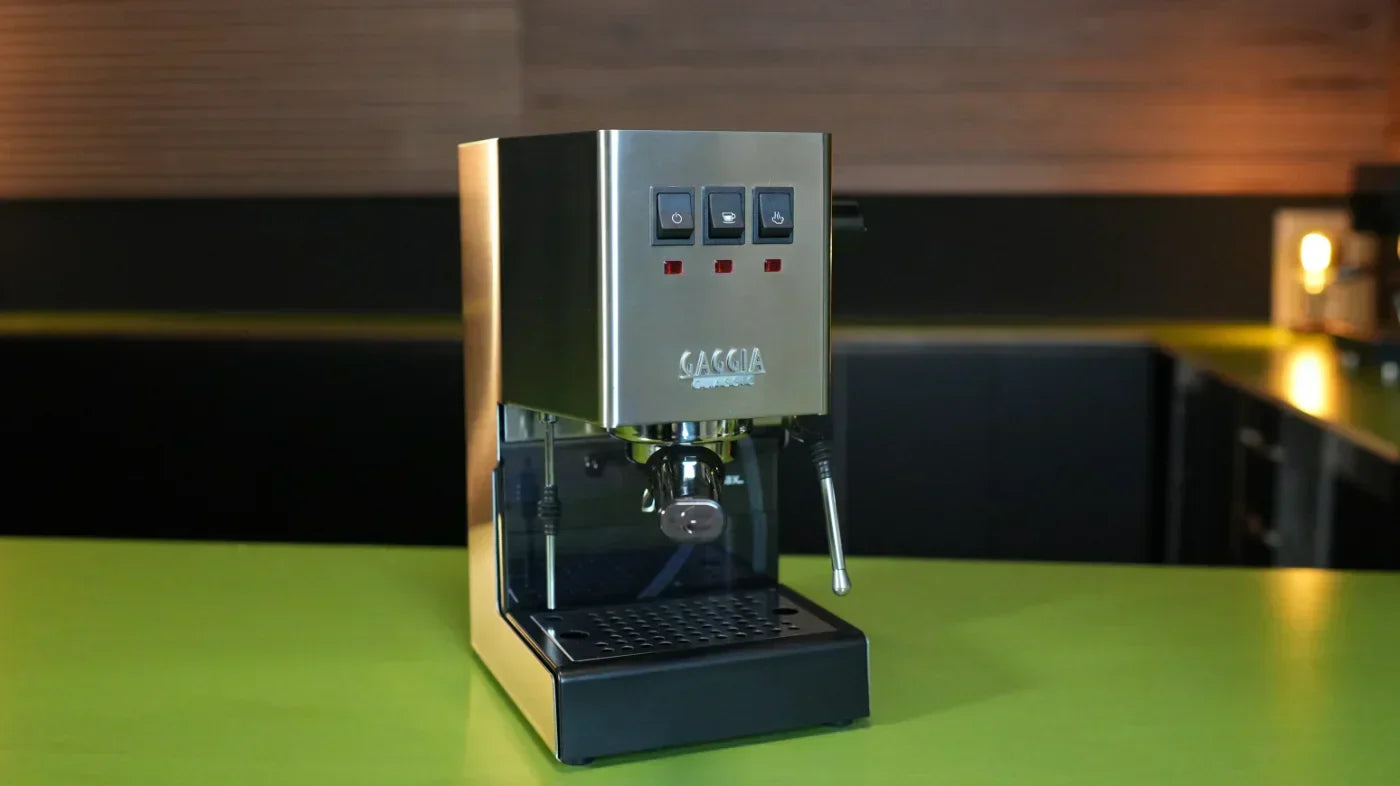

The Gaggia Classic Evo Pro E24 is one of the best-selling single boiler espresso machines of all time – and has been for years. For 480 euros (Germany) or 419 CHF (Switzerland), you get a compact, solid machine with a metal portafilter, an over two-liter water tank, and a community that has developed countless mods and upgrades. The problem: Out of the box, the machine does not deliver convincing temperature values. The good news: We will not only show you where the issues lie – but also how you can get significantly more out of the Gaggia Classic with a few simple tricks.
As always, we bought the machine ourselves and tested it according to our standardized test protocol v2.3. Especially with "more affordable" espresso machines, however, our goal is also to provide you with methods that make your machine better. We have done this with the Gaggia Classic Evo Pro E24, building on our temperature tips that we developed for the machine years ago.
Design & Build Quality
Score: 6.5/10
The Gaggia Classic Evo E24 is small. 21 centimeters wide, 36 centimeters high, 26 centimeters deep - with the plug just under 28.5, with the portafilter around 36 centimeters. Fits on any countertop. It weighs 8.1 kilos. That is enough for a stable stance and light enough to move around.
Regarding the materials, we see a mix: metal housing with bent sheet metal, sharp edges in some places - especially on the drip tray, where we actually cut ourselves. The gap dimensions show some variations: three millimeters at the dial on the bottom, half a centimeter at the top. Everything is built with a bit of play. But overall, the build quality is solid. The buttons have a real pressure point, no alibi switches. They will last.
Positively surprised: The drip tray holds 600 milliliters at this compact size. Some significantly larger and more expensive machines could learn a thing or two from this. And the water tank holds over two liters. That will last quite a while.
Important: The Gaggia Classic Evo Pro E24 does not work with a standard 58mm portafilter because the bayonet is thicker and slightly offset diagonally. However, you can insert our KM Pro Baskets into the portafilter, for example.

Temperature Management: And how to control it
Score Standard: 2.0/10 | Score with flushing routine: 5.4/10
Temperature is the central issue of this machine. The Gaggia Classic E24 is a single boiler with a brass boiler and a pressure stat. No PID, no temperature setting, no offset. The machine heats up and you have to take what comes.
And what comes, we measured with the Scace 2 directly in the portafilter.
Test 1: Standard protocol – just turn it on and start brewing
Five double espressos at 1-minute intervals, after 15 minutes and 40 seconds of heat-up time. Just how many will probably use the machine in everyday life.
| Shot | Average Temperature |
|---|---|
| 1 | 95.8 °C |
| 2 | 91.7 °C |
| 3 | 90.6 °C |
| 4 | 89.7 °C |
| 5 | 88.2 °C |
The first shot is at 95.8 °C. That is way too hot. At this temperature, the coffee gets burnt and extremely bitter. The brew group has built up so much heat during the heat-up time that the first water reaches almost boiling level.
After that, it flips to the opposite. The temperature drops from shot to shot. By the fifth shot, we are at 88.2 °C – well below the target range of 93 °C. This means under-extraction: sour, thin, bodyless espressos. The difference between the first and the settled shots is 6.2 °C – that is the worst category in our protocol.
In the WBC stress test (14 shots in quick succession), it becomes even more drastic: a temperature window of 8.5 °C. For comparison: professional machines manage under 1 °C. That is not the intended use case for this machine, and we can clearly state it as such.
| Cluster | Score | Max |
|---|---|---|
| A1 Cold Start | 0.0 | 3.3 |
| A2 Consistency | 0.0 | 2.0 |
| B Intra-Shot | 2.0 | 2.7 |
| C WBC Stress | 0.0 | 2.0 |
| Total | 2.0 | 10.0 |
The only bright spot: Within a single shot, the temperature curve is relatively stable (2.0 out of 2.7 points). The problem is not what the machine does during the shot – but that it starts at the wrong level and drops from shot to shot.

Test 2: Improved flushing routine – how to get more out of it
Now it gets exciting. Because with two simple adjustments, the picture changes dramatically:
- Before the first shot: flush for 7–8 seconds (instead of not at all or just 2 seconds)
- Between shots: wait 1.5–2 minutes (instead of 60 seconds)
Why does this work? With a single boiler without temperature control, heat builds up in the brew group during the heat-up time. If you then flush for 5–10 seconds, you drain this overheated water. You can see this too: At the beginning it hisses, as literally boiling or near-boiling water comes out of the group as steam. That is far too hot. When it flows evenly, you are in the good range. The longer waiting time between shots gives the small boiler the urgently needed regeneration time. In the standard protocol, 60 seconds are not enough – the boiler cannot keep up.
| Shot | Standard | Improved | Difference |
|---|---|---|---|
| 1 | 95.8 °C | 91.5 °C | −4.3 °C |
| 2 | 91.7 °C | 92.3 °C | +0.6 °C |
| 3 | 90.6 °C | 90.1 °C | −0.5 °C |
| 4 | 89.7 °C | 90.5 °C | +0.8 °C |
| 5 | 88.2 °C | 91.6 °C | +3.4 °C |
Here is the direct comparison with an optimized first shot: we manage from 95.8 °C down to 91.5 °C. As a result, the shot is right and the machine is no longer overheated. The difference to the average is now only 0.8 °C instead of 6.2 °C. This is how you personally manage the jump from "Inadequate" to almost "Very good" in the cold start category.
The fifth shot: from 88.2 °C up to 91.6 °C. Instead of a too cold, under-extracted straggler, you achieve a shot almost on the level of the first ones. A 3.4 °C improvement with just 30 seconds more patience.
Particularly impressive: The intra-shot curve on the fifth shot with waiting time shows only a 0.44 °C fluctuation over 25 seconds of extraction. That is an almost perfect straight line during the shot. This is the technical ideal and achieves full points.
The Gaggia Classic can deliver stable temperatures – if you give it enough time.
| Cluster | Standard | Improved | Change |
|---|---|---|---|
| A1 Cold Start | 0.0 | 2.7 | +2.7 |
| A2 Consistency | 0.0 | 0.0 | ±0.0 |
| B Intra-Shot | 2.0 | 2.7 | +0.7 |
| C WBC Stress | 0.0 | 0.0 | — |
| Total | 2.0 | 5.4 | +3.4 |
From 2.0 to 5.4 points – that is an improvement of +3.4 points purely through adjusting the technique, without spending a single cent.
What remains as a weak point?
The consistency between shots (A2) remains at 0 points – shots 3–5 fluctuate around 1.5 °C, because Shot 5 is significantly higher due to the longer waiting time. This is not a tragedy in everyday life, but it shows that the machine relies on your time management.
The temperature level is around 91 °C instead of 93 °C. Without a PID, you can't change that. With a PID kit like the Gaggimate, this could be corrected. We will also provide modding guides for this in the future.

15 minutes heat-up time?
Yes, unfortunately we cannot avoid this long waiting time. We were also surprised, but the machine needs this time. If you start the procedure earlier, you will be below the target temperature, which we aim for at around 93 degrees.
Espresso Quality
Score: 3.0/10
The espresso potential is directly coupled to the temperature management – and that depresses the score. Technically, there are no profiling options: no flow control, no pre-infusion, no pressure profiling. The machine brews with what the pressure stat delivers and at 8 to 9 bar.
But: If the espresso is dialed in right – and that absolutely happens with the correct routine – then blindly, it is indistinguishable from what a 10,000 euro machine puts in the cup. That sounds provocative, but it's true. With the Gaggia Classic, you might hit the sweet spot on 4 or 5 out of 10 shots. A more expensive machine does 9 out of 10. But the good shots are qualitatively equivalent.
So what distinguishes the Gaggia Classic from a 3,500 euro machine? Not the basic capability but the consistency. More expensive machines stay focused in the target range and don't fluctuate up and down. Parallel frothing is possible with much more power. And with ten shots in a row, the more expensive machine hits the mark on nine.
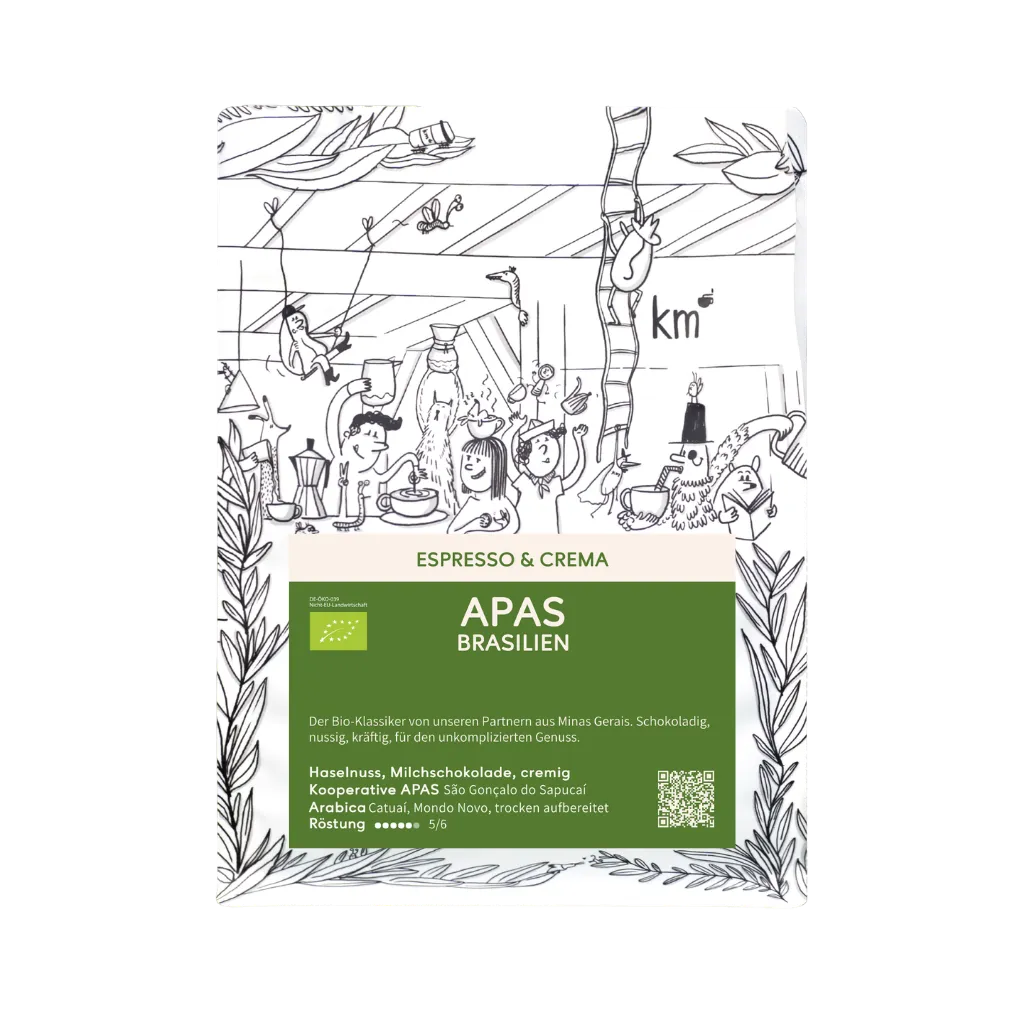
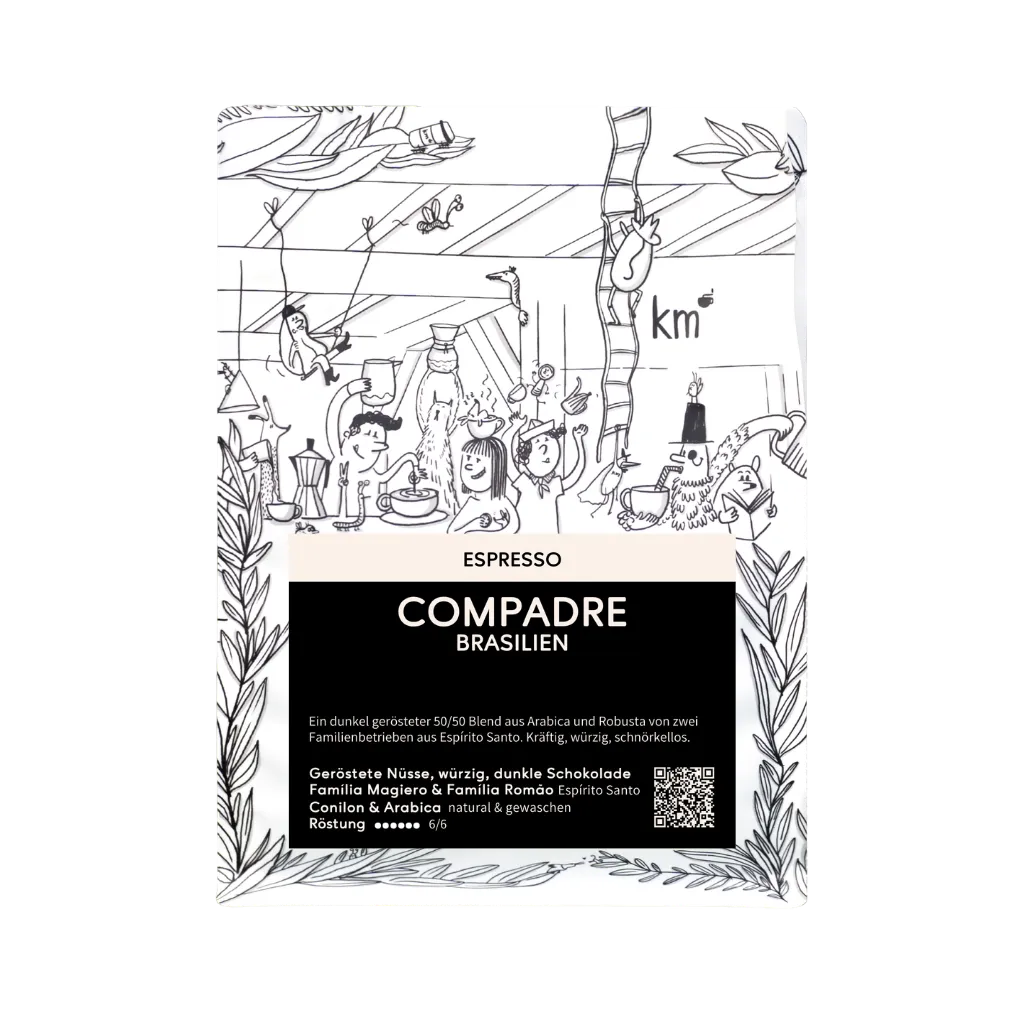
Our recommendation for coffee selection: Stronger roast profiles. The machine is at around 91 °C when you flush. This puts you in a good target range for espresso with darker roasts. Light specialty espressos, which often require precise temperatures and not infrequently temperatures around 93 °C, are not its strength. In our test, we brewed with the Compadre - a bold profile that works very well with this machine.

Power Consumption
Score: 9.0/10
The Gaggia Classic really clears the board here. For heating up plus a double espresso, it draws merely 0.067 kWh – of which 0.058 kWh is for heating up and only 0.009 kWh for the shot itself. Typical for a small single boiler that only has to heat a tiny boiler. 9 out of 10 points, well deserved.
Interestingly: You wait 15 minutes for the machine, but barely consume any power. The heat-up time is long for the small boiler, but the energy requirement for it is negligible.
Milk Froth & Steam
Score: 4.8/10
Frothing is very doable, but it requires practice and rhythm. As a single boiler, the boiler first has to heat up to steam temperature after the espresso shot; this takes around 60 seconds. Then you have another 60 seconds for the actual frothing.
First hurdle: Condensation water. Around 8 milliliters come out in the first one to two seconds. Therefore, purging the steam wand beforehand is mandatory. Then you have solid power initially, which you absolutely must use. The pitcher must be tilted heavily so that the stretching phase and rolling phase occur simultaneously. After 15 to 20 seconds, the power drops. It picks up slightly again, but with larger pitchers, you won't achieve any deep vortex with this.
The result: creamy, pleasant milk froth. Very important: After frothing, flush well and wait one to two minutes before brewing again.
Workflow & Usability
Score: 7.0/10
Here, the Gaggia Classic scores with simplicity. One button for espresso, one button for steam, two indicator lights. That's it. No menus, no settings, no display: turn on, wait, brew.
The water tank holds over two liters and is easily removable. The drip tray is generous with 600 milliliters. The portafilter locks in cleanly. There is neither volumetrics nor time control. You press the button, the machine brews, you press again. Anyone who wants to work precisely needs a scale under the cup.
What's missing: there is no cleaning program, no shot timer, no dosing option. Expected for this price range.

Accessories
Score: 4.0/10
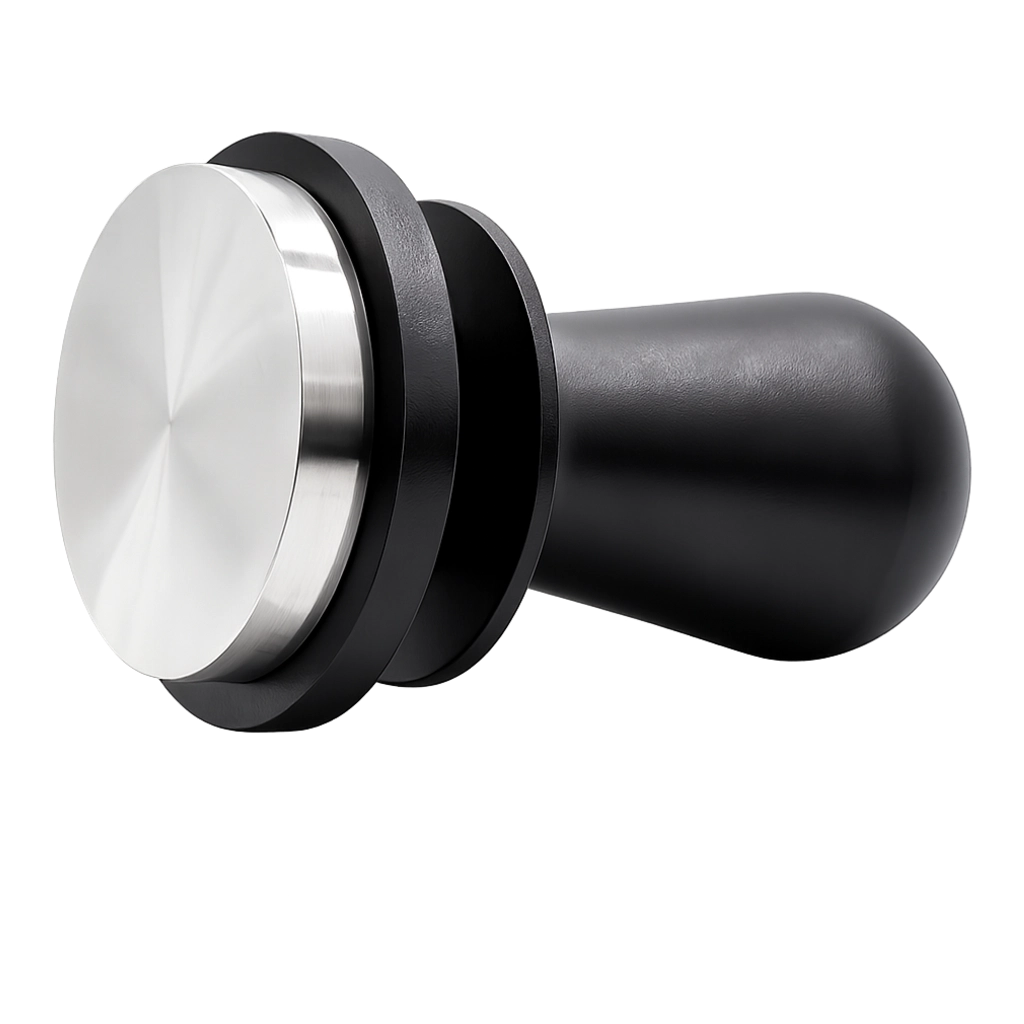
Included in the box: portafilter with double spout, double basket, single basket, and a tamper. The basket is cheap. We recommend an early upgrade with a cleanly perforated pro basket. The tamper fits flush in the portafilter, but is otherwise more suited for hanging up your coat. It is once again one of those cheap plastic tampers that takes away the joy of the drink before you even prepare the espresso. But: It is included, you can start right away.
Noise Level
Score: 2.0/10
69 decibels, which makes it rather loud. Just a typical vibration pump. It acts how it acts. If you want to brew quietly in the morning while the rest of the family is sleeping, you're out of luck.
Volume Potential / Catering
Score: 0.5/10
The Gaggia Classic cannot handle the WBC protocol. Pulling 14 shots in quick succession makes no sense with this single boiler. A direct water connection is not intended, and it also lacks the steam endurance for continuous use. That is not its area of application.
Practical Tips for Everyday Use
Based on all measurements, here is the optimal workflow:
Heating up: 15 minutes. After 15 minutes, the portafilter is at 65–70 °C.
Before the first shot: Flush for 7 - 8 seconds until it no longer hisses. This removes the overheated water. When it flows evenly, lock in and brew.
Between shots: Do not rush. Wait at least 1.5–2 minutes. Unlock, flush briefly for 1–2 seconds, then to the grinder, prepare the coffee, tamp – this makes the 45–90 seconds pass almost by themselves.
Coffee selection: Stronger roast profiles. The machine sits at around 91 °C – perfect for darker roasts. Light specialty roasts are not its strength.
Frothing: After frothing, flush well to stabilize the temperature again and wait one to two minutes until the next espresso. The boiler needs to recover from the steam operation.
Don't forget the grinder: This machine needs a solid grinder. If everything fluctuates – temperature, grind size, dose – it becomes hard to reproduce good results. Something has to give the setup stability. In the single-dosing segment, there are very good options for 250–300 euros.
Conclusion: Honest, compact – and good with the right method
Overall Score: 4.8/10 – Compromise | Price-Performance: 7.0/10
The Gaggia Classic E24 achieves 4.8 out of 10 points in our test, placing it in the "Compromise" quality class. Without the right method, this machine simply does not deliver convincing results.
But exactly here lies the opportunity: With the improved flushing routine, the temperature score alone increases from 2.0 to 5.4 points without spending a single cent. The machine is extremely efficient (9/10 for power), more compact than almost any other, solidly built for its price, and operation couldn't be simpler.
Most importantly: the fundamental technology of the machine has potential and can be improved or temperature-surfed. And thus, the Gaggia Classic Evo Pro E24 opens many doors into the world of espresso.
Who is this machine for? For beginners who are willing to dive into the subject. Who want to find their rhythm with the machine. Who understand that flushing is not an option but a requirement, and who will pair it with a solid grinder.
The espresso you get out of this machine with the right handling is impressive. Not every shot will be perfect, but the good shots are qualitatively on par with what a machine costing ten times as much delivers.
And for those who want even more: PID kits like the Gaggimate get significantly more out of this base. We will also publish modding guides in the future, as the Gaggia Classic is one of the best platforms to upgrade step by step.
You have to get to know each other, find your rhythm. And that is perhaps the most exciting part of it all.
Technical Specs at a Glance
| Feature | Value |
|---|---|
| Price | 480 EUR (GER) / 419 CHF (CH) |
| Boiler Type | Single boiler (Brass) |
| Heat-up Time | 15:40 minutes |
| Power Consumption | 0.067 kWh (Espresso mode) |
| Brew Temperature | ~91 °C (measured, with flushing routine) |
| Power | 1,100 W |
| Weight | 8.1 kg |
| Water Tank | 2.1 liters |
| Drip Tray | 600 ml |
| Pump | Vibration pump |
| Dimensions (W×D×H) | 21 × 26 × 36 cm |
| Noise Level | 69 dB(A) |
| Special Features | Pressure stat, no PID, no offset, no profiling |
Gaggia Classic Evo Pro E24
Review Summary, Protocol 2.3 (January 2026)🛠️ Recommended Specialized Partner for the Gaggia Classic E24
Germany: Stoll Espresso
We recommend specialized partners whom we know offer good work and reliable service. For orders placed via our affiliate links, you do not pay more, but we receive a small commission – which we invest directly into new testing equipment.

All measurements conducted according to the Kaffeemacher test protocol v2.3. Temperature measurement with Scace 2, power measurement with Christ CLM1000 Professional. Rating based on the 3-cluster scoring model.