






















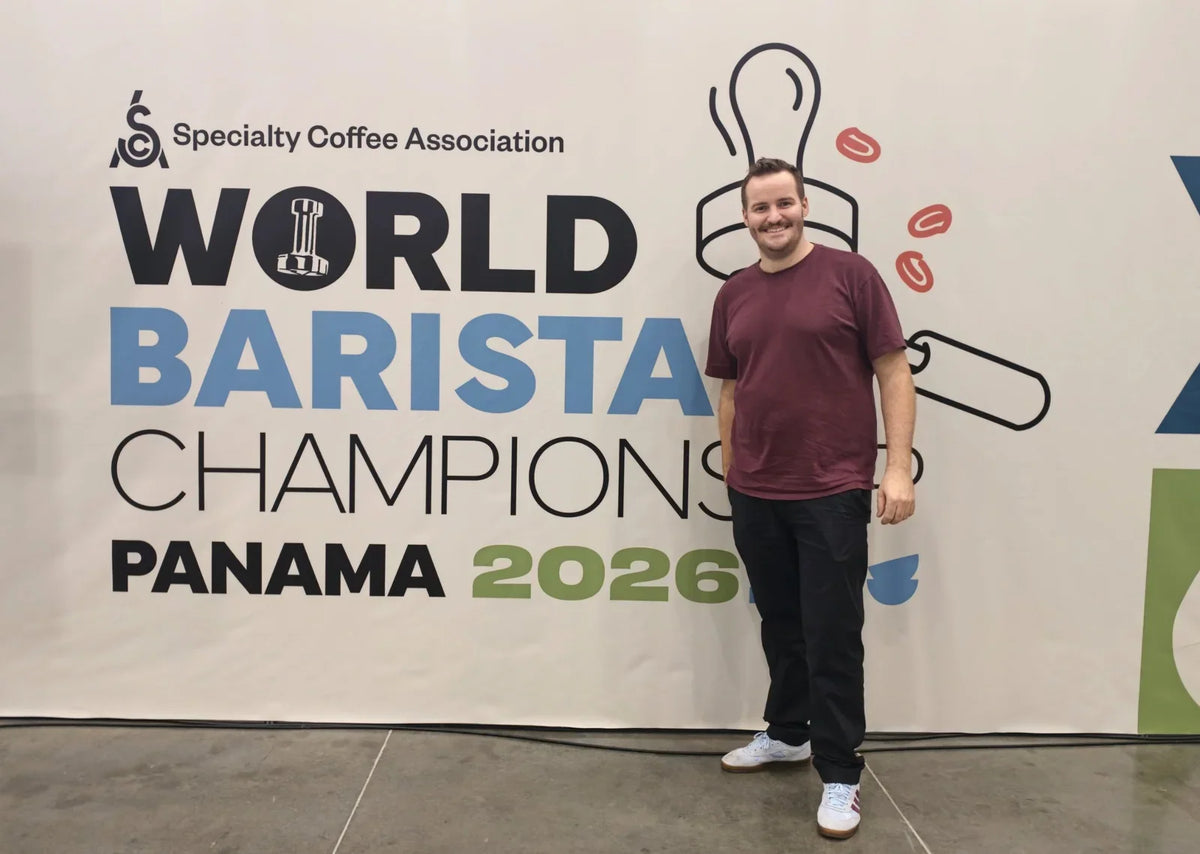
Felix Hohlmann at the Barista World Championship 2026: 25th place in Panama City

Place 25 of more than 50 national champions: That is the result of Felix Hohlmann at the World Barista Championship 2026 in Panama City. Felix competed as a two-time German Barista Champion, after 2024 in Busan it was his second world championship. It was not enough for the semifinals. We are still satisfied, and so is Felix. Why is explained below. First, it's all about his presentation: the two coffees, the milk, the signature drink, and the question that his 15 minutes revolved around.
Barista World Championship 2026 in Panama City: Format and Result
The World Barista Championship took place this year for the first time in Central America, as part of the World of Coffee Panama. A fitting location: a large portion of the coffees that have won world championship titles in recent years come from Panama.
You may know the format from our articles on the German Championships. In 15 minutes, participants prepare four espressos, four milk beverages, and four signature drinks. Four sensory judges evaluate each beverage, and there are also technical judges who assess technique and cleanliness. In round one, all national champions compete, the best 16 advance to the semifinals, and six of those make it to the final.
Felix took the stage on Friday in round one and placed 25th.
Felix's Presentation on Video
"Am I Good Enough?" The Theme of the Presentation
Every World Championship presentation has a theme that ties the three courses together. Felix chose a question that has followed him since his first competition: Am I good enough?
"Am I good enough? Yes, always. But in every moment there is more I can learn."
Felix is the youngest of four brothers. As the youngest, you want to keep up with the older ones, and to this day he is very competitive in games. He learned early on that losing a game and being worth less than the older brothers are two different things.
This distinction came back to him in 2013, at his very first competition, the Swiss Brewers Cup. Felix was so nervous that he ground the coffee for his AeroPress far too fine. So fine that the carafe shattered on stage. It felt like he wasn't good enough. But he was, Felix says today. He just didn't yet know where his room for growth lay. Since then, he has competed year after year, now at more than 20 competitions.
Both coffees in the presentation tie back to this story. Felix has worked with both farms before, and both have asked themselves this exact question since then.
Espresso: Geisha 1931 from Geisha Village
In 2015, at one of his first barista championships, Felix used a coffee from Geisha Village. The farm in western Ethiopia is owned by Rachel Samuel and Adam Overton. They ventured into the wild forests around Gori Geisha, where the Geisha variety originally comes from, and collected seeds to replant on their own farm. The name Geisha 1931 recalls the year Geisha was first collected in this region.
"The coffee was beautiful back then, the coffee today is outstanding," Felix said on stage. Because the farm has improved year after year.
The championship coffee comes from the Oma block at around 2000 meters. After selective harvest, the cherries were floated and then dried as natural for 28 days. At the beginning, the cherries lie in a thin layer so they don't over-ferment. Over time, the layer gets thicker. This slows drying and brings high sweetness and clear floral notes.
Felix listed these flavor notes for the espresso to the jury:
Along with medium, citric acidity and medium body with silky texture.
Normally you ask the jury to stir the espresso before the first sip. Instead, Felix used a technique he developed on the way to the 2024 World Championship in Busan. Together with researchers from the University of Freiburg, he found that gently swirling the cup prevents polymers and lipids in the espresso from clumping. The espresso tastes fuller and creamier as a result. Read more about this and how to try it at home in the article Coffee Waving: Improve Espresso with Vibration.
Milk Beverage: Nitro Natural from Maguta Estate in Kenya
For the milk beverage, Felix went back in thought to the 2013 Brewers Cup. Back then, he had a washed Kenya in his equipment, and a classically washed Kenya was the standard for years.
David Maguta, also known as David Ngibuini, is asking the same question on his farm Maguta Estate in Nyeri as Felix: Is a traditionally washed Kenya still good enough? He began experimenting, first with a CM washed, then with a Nitro Natural. Felix used this Nitro Natural for his milk beverage.
The cherries of varieties SL28 and SL34 are placed in a sealed tank flushed with nitrogen for six days after harvest. Then they dry for 25 days on African raised beds. The nitrogen prevents oxidation and retains tropical fruit flavors in the coffee.
What's exciting is the milk. Felix used a blend of two components:
95 percent lactose-free milk from Schwarzwaldmilch, freshly imported to Panama and concentrated to half its volume by freeze concentration. This removes water from the milk in the form of ice. Sugar, protein, and fat remain behind, making the milk sweeter and giving it more texture.
5 percent coconut-oat drink from ROA. The coconut note bridges the tropical flavors of the Kenya.
Felix froths the mixture only to 50 °C to preserve the fruity flavors of the coffee. The flavors in the glass:
Signature Drink: Geisha with Grape Juice and Kombucha
The signature drink is the creative part of the presentation. Felix wondered how he could transform the fine structure of the Geisha Village espresso into something completely new. The ingredients:
Along with medium tartaric acidity.
Both coffees were roasted on a drum roaster. The Geisha Village 14 days before the event, in 9 minutes to 190 °C end temperature, for maximum sweetness and balance. The Kenya 15 days before, in 10 minutes to 189 °C. The short Maillard phase emphasizes the tropical fruit notes so they stand out against the milk.
Our Equipment on the Championship Stage
In Panama, our new pressure tamper had its first use on a big stage. Felix wanted a tamper he wouldn't have to think about during competition. We developed it according to his specifications. The bearing plate rests on the basket edge and keeps the tamper straight. Two springs ensure that each shot is tamped with 8 to 10 kilograms of pressure.

KM Pro Pressure Tamper 58.55 mm
Dual-spring system · 8 to 10 kg of pressure · for all 58 mm baskets
Price in shopFelix also frothed the milk with equipment from our own house: with our KM milk jugs, which he developed together with Michel and which we use in our cafés and courses.

Place 25: What the Jury Feedback Tells Us
Felix is very satisfied with his performance, and we as a team are too, with both the performance and the placement. After the round, there was a debriefing with the jury, and the feedback was differentiated enough that we learned a lot from it.
Felix was praised above all for his technique. His flavor descriptions for espresso and milk beverage were precise. With the signature drink, on the other hand, we lost points; it received a lower overall rating.
Then there are the points for taste. Felix's espresso was rated as good, meaning three points. It didn't quite reach very good, which would be four points. Because each beverage is rated by four judges, with espresso and milk beverage, every step between three and four points counts fourfold. These are exactly the points we were missing for the semifinals.
The presentation itself ran very smoothly, technically everything was perfect, and Felix felt comfortable on stage. We received a lot of positive feedback from people close to us and from strangers.
One point from the debriefing stayed with me: Felix was quite reserved during his presentation. He didn't deliver a high-energy show that goes full throttle from the first moment. He was calm, friendly, and assured, and he was entirely himself. Many people really appreciated that, and I found it very strong too. You saw Felix as a person and felt that a personality was up there on stage showing itself. That fits his presentation's theme.
Maybe a different style of performance would have left a different impression with the jury. But it was Felix's presentation, and it was honest. I am convinced it was exactly the right choice to do it this way because it was so very him.
Conclusion
Place 25 at the Barista World Championship 2026, a technically clean presentation, and feedback we can work with. The difference to the top 16 came mainly from the signature drink and the step from good to very good in espresso and milk beverage. Felix ended his presentation with a sentence that also rings true for us as a team:
"'Good enough' is not a finish line and was never a label for who we are. It is the point where the comfort zone ends and progress begins."
You can find all previous titles and world championship placements of our team in the overview Kaffeemacher Titles, Medals, and Top Placements.



