












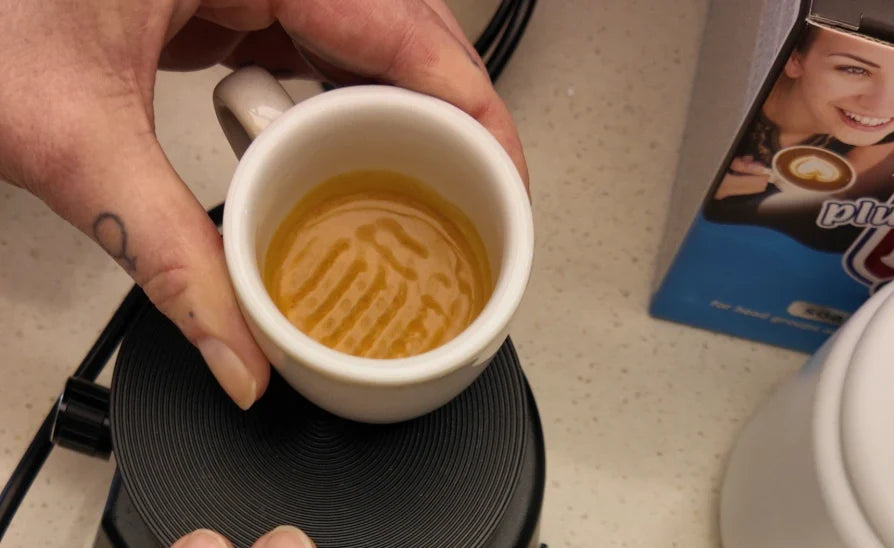

While preparing for the World Championships in Korea, Felix discovered that he could improve the texture of espresso using vibration. Initial studies, made possible with the support of Prof. Chahan Yeretzian (ZHAW Coffee Excellence Center) and Prof. Stefan Salentinig at the Université de Fribourg, confirmed some of our hypotheses.
In the video linked above, Professors Stefan Salentinig and Chahan Yeretzian explain the initial findings of our studies.
Espresso is not stable after extraction. Through vibration, the coffee enters a state that results in many small particles remaining separated for longer, and fewer larger particles forming in the espresso emulsion. This has positive effects on the texture, which we have repeatedly been able to demonstrate in numerous blind tastings with professional sensory experts AND consumers.

Until now, coffee research has mainly focused on the state before extraction (cultivation, roasting, particle distribution, distribution, tamping) as well as the phase during extraction (pressure, flow rate, headspace, etc.)
Felix's findings open a new door to post-extraction. Espresso is not stable. It is highly likely that the espressos we have drunk in the past tasted good or bad based on how the espresso was treated after extraction.
Stirring has always been a recommendation for mixing espresso after extraction. Stirring does indeed have an effect that is similar to vibration. However, stirring is by no means as intense and, above all, not as precise as vibration.
Vibrating espresso at home: here is how!
In this video, Felix shows how he processes the espresso using vibration. Unfortunately, it wasn't enough for Felix to make it to the next round at the World Championships. However, with the espresso vibration method, he has opened a door that is now being tested and confirmed worldwide. We know of professional baristas and scientists who are exploring coffee vibration, also known as Coffee Waving.
We are planning a more in-depth research project to support this finding and to find out more precisely which intensity, frequency, and duration of vibration are best suited for processing espresso.