






















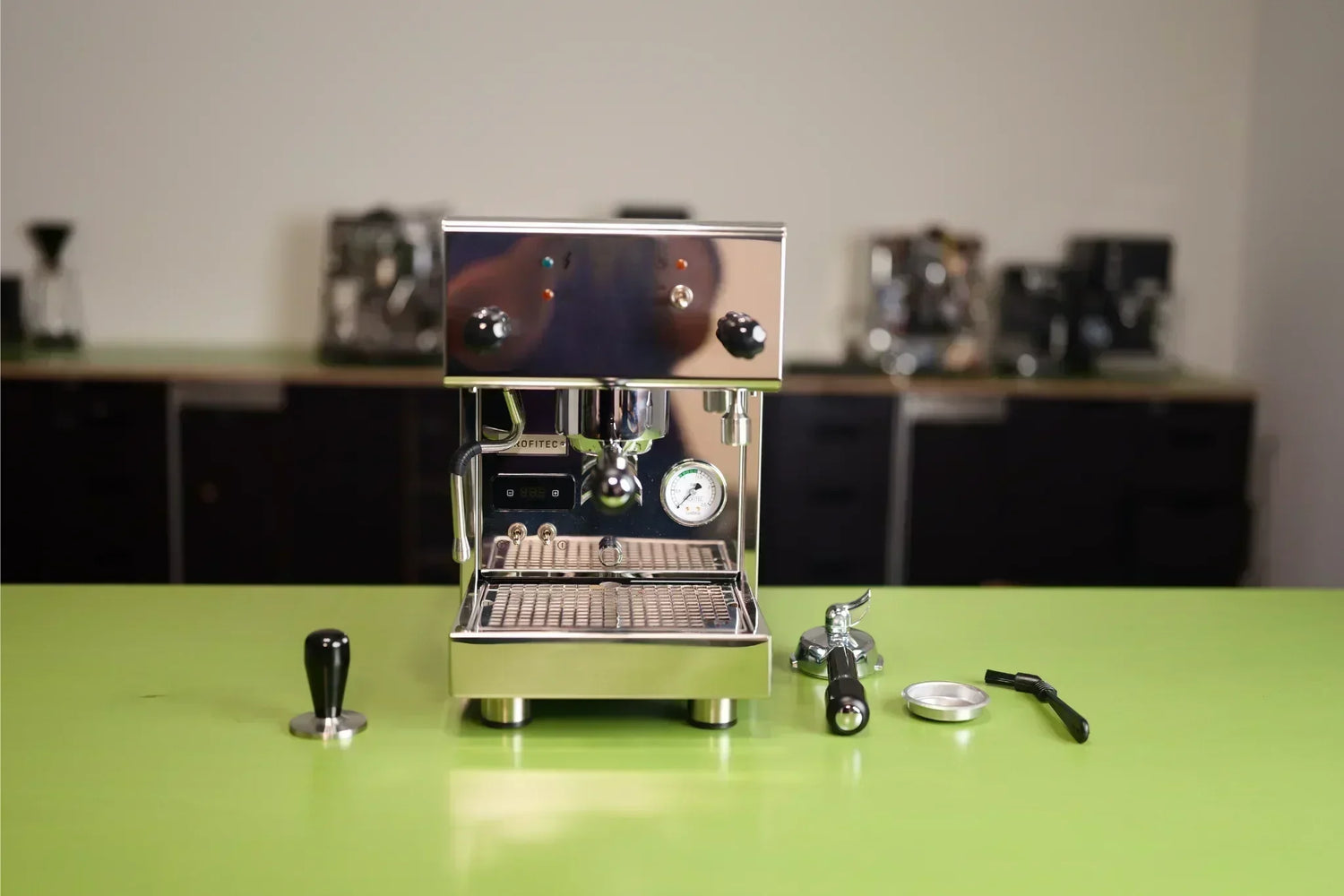

The Profitec Pro 300 slots into an interesting group of dual boiler espresso machines for entry-level users. We have tested the Profitec Pro 300 extensively and present our results in our test video.*
Price and Classification
At around 1,400 euros or CHF 1,600, the Profitec Pro 300 is among the most affordable dual boiler espresso machines on the market. Dual boiler espresso machines feature two typically independent boilers that can be individually adjusted for temperature. Unlike heat exchanger espresso machines, this allows independent milk steaming while espresso can be pulled simultaneously. Both heat exchangers and dual boilers have exceptions to this rule, but the Profitec Pro 300 is not one of them.
During machine warm-up, we do notice some dependence. However, this does not negatively affect steaming performance. The 0.4-liter brew boiler and the 0.75-liter steam boiler are among the smallest we have tested in dual boilers. So it remains to be seen how performance is in steaming, espresso brewing, and the important temperature stability.
Buy Profitec Pro 300
The following specialty retailers distribute the Profitec Pro 300 and we can recommend purchasing from these businesses. All offer the possibility to adjust the machine's offset.
Note: These are affiliate links. If you order through one of these links, you don't pay a cent more – but we receive a small commission that we invest directly into new test equipment.
We continue to search for competent partners in the DACH region for you.
Size, Weight, and Accessories
The Profitec Pro 300 espresso machine has a height of 38.8 cm and a width of 25.5 cm. We measure a depth of 41.5 cm (47.5 cm with the portafilter locked in). The total weight is 19.0 kg.
The brew group of the Profitec Pro 300 sits relatively low. Between the drip tray and the spout, only 7.8 cm of space remains. This is very little, especially when an espresso scale is to go under the cup. A scale is essential for correctly dialing in a good espresso. Only very thin scales fit under the cappuccino cup, otherwise it must be awkwardly threaded through. 3 to 5 millimeters more clearance would be worth its weight in gold.

The included Profitec tamper has a fairly thin base but fits flush into the included baskets (gap of only about 0.4 mm). A single-shot and double-shot portafilter are included. They look high-quality, although the baskets are not precision baskets. The steam boiler's pressure gauge and steam wand also make a good impression.
We find some sharp edges, for example on the drip tray or on the side ventilation slots. Nevertheless, the material thickness and overall impression are good compared to other machines in this price range.
The positive appearance is complemented by a 2.7-liter water tank that is easy to remove. It's a plus that you don't need to awkwardly thread hoses here—an advantage compared to the similarly priced Lelit Elizabeth.

Warm-up Time and Temperature Stability
Those who like to enjoy an espresso shortly after switching on will appreciate a fast warm-up time. This is typically not the strong suit of dual boilers, as they usually showcase their strengths through thermal retention and stability. However, the Profitec Pro 300 manages to reach operating temperature in about 15 minutes. On the first pull, we already measure a good 91 to 92 °C at a set brew temperature of 93 °C.
When multiple shots are pulled at one-minute intervals, the machine slightly overshoots. We measure a standard deviation of 1.32 on the KM protocol and 1.28 on the WBC protocol. This could be better, but it's absolutely within the range of this price class. Very pleasing is that we measure hardly any offset: At a set 93 °C, the machine shows an average brew temperature of 93.26 °C on the WBC protocol (seconds 4 to 25 of extraction).
Interestingly, you only achieve this warm-up performance if the steam boiler is switched on. If it's off, the target temperature is reached only after more than 25 minutes. The waste heat from the steam boiler within the machine's body thus makes a decisive contribution to heating the brew group.
"The waste heat from the steam boiler has an influence on the temperatures of surrounding components. As a result, when the steam boiler is switched off, the desired brew temperature is reached a few minutes later. A slight adjustment of the offset by qualified technicians can compensate for the temperature difference when the steam boiler is off."
Without the steam boiler, we recommend a warm-up time of at least 25 minutes. In the diagram, you can clearly see that at 25 minutes of warm-up, the temperature remains stable during shots.

Measurements were taken using both the WBC protocol and the KM protocol. The measurements are recorded with the Scace 2 58mm measurement portafilter, a K-type sensor, and a PCE-T 330 data logger. The measurement sequence proceeds as follows:
- Check the temperature of the water in the water tank (target: 20 °C ± 2).
- Warm up for 25 minutes or defined time with measurement portafilter locked in.
- Unlock and flush for 5 seconds.
- Lock in and extract for 25 seconds.
- Keep locked for 15 seconds, then unlock and rest for 45 seconds.
- Flush for 2 seconds and extract for 25 seconds.
- Repeat this process 5 times in total.
Energy Consumption of the Profitec Pro 300
The Profitec Pro 300 has very low energy consumption. Even with the steam boiler switched on, we achieve excellent values of only 0.20 kWh including warm-up time and 5 double shots. A single double espresso including warm-up time uses only 0.16 kWh.
If we don't switch on the steam boiler, we save even more energy since the 0.75-liter steam boiler doesn't need to be heated. For a double espresso, consumption is then only 0.08 kWh. For five double shots, we measure 0.119 kWh. This puts the Profitec Pro 300 on par energetically with modern thermoblock espresso machines—outstanding performance!

Making Espresso
Making espresso with the Profitec Pro 300 works wonderfully. Combined with a good grinder, we achieved excellent extractions with high consistency. The vibration pump ensures a slow pressure build-up, so the first drops flow into the cup after about 8 to 10 seconds. Extractions are thus somewhat calmer and moderately longer in duration.
The temperature is sufficiently stable. After longer standby periods (from 30 minutes with steam boiler), we recommend a flush of 6 to 8 seconds.
The Profitec Pro 300 lacks features like active pre-infusion or integrated flow rate control, but it reliably delivers exactly what you'd expect from a solid dual boiler—including simple PID temperature control on the front.
A particularly practical detail is the "Last Shot" protection: When the water in the tank is running low, the machine doesn't abruptly stop the brewing process but lets the current espresso run to completion. This saves the home barista's nerves tremendously!
Steaming with the Handbrake On
Parallel to espresso brewing, you can steam milk with the Profitec Pro 300. The steaming performance in factory condition is decent but requires some patience. Unfortunately, the steam boiler temperature cannot be directly adjusted via the PID display since it only controls the brew boiler.
Those who want more steam power can open the housing (unscrew four screws) and carefully adjust the internal pressostat. Additionally, some home baristas report good experiences by replacing the steam wand with a model that has different hole count.
In factory settings, the machine takes 58 seconds to heat 300 ml of water from room temperature to 60 °C. This is a rather slow value.

Conclusion on the Profitec Pro 300
The Profitec Pro 300 is an overall successful and no-frills entry-level dual boiler machine. In addition to the extensive network of specialty retailers in the DACH region, the dual boiler scores especially with its extremely low power consumption, solid build quality, and straightforward operation.
Steaming performance out of the box is relatively modest, but can be adjusted via the internal pressostat if needed. It's a shame that the clearance height under the portafilter is so low (only 7.8 cm), which makes it difficult to use tall cups together with an espresso scale.
If you're looking for a reliable, energy-efficient, and long-lasting dual boiler machine, you'll be able to make excellent espressos and delicious cappuccinos with the Profitec Pro 300.
Supplementary Measurement Graphics


* Note: In an earlier video version, it was incorrectly claimed that the boilers were uninsulated. The boilers of the Profitec Pro 300 are insulated, which is also reflected in the very low energy consumption.





