





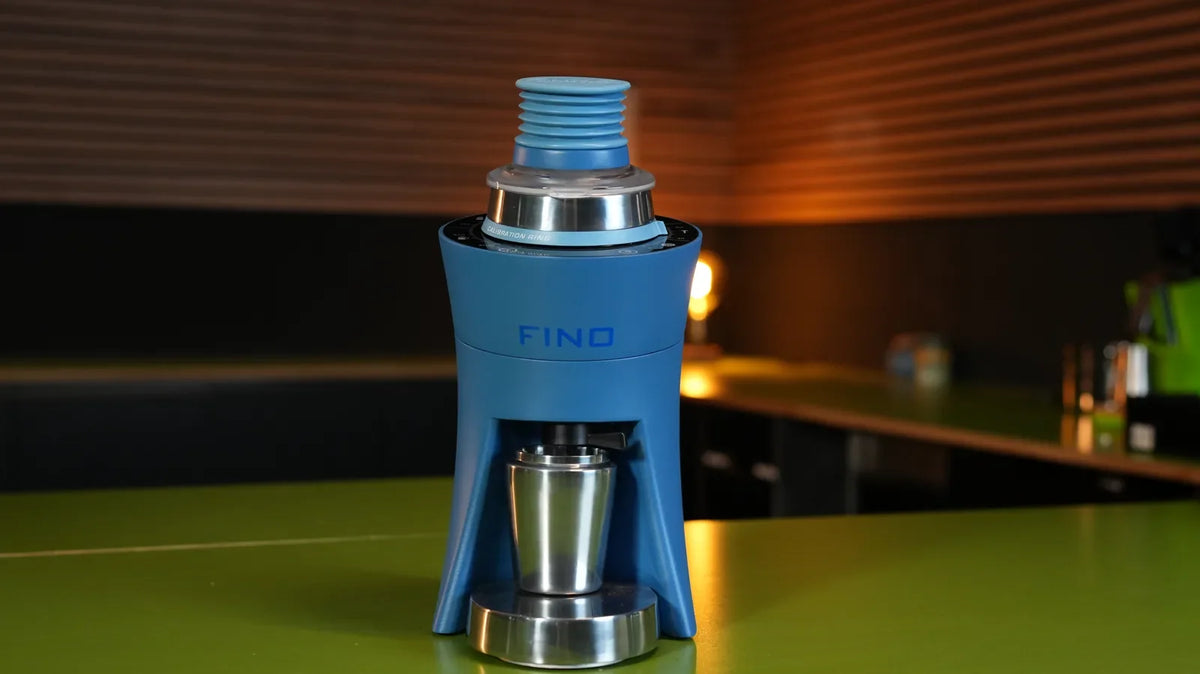

After grinding, a mere 0.3 grams of coffee remains in the Compak Fino Scale. This exceptionally low retention is one of the best values across our testing database of over 100 coffee grinders. The Fino is a single-dosing grinder featuring 63 mm conical burrs, built by Spanish manufacturer Compak.
In the past, Compak made a name for itself primarily with affordable commercial grinders. Entering the home single-dosing market represents a shift in direction, and our review concludes that it is a solid effort. The Compak Fino delivers where it counts.
We first spotted this model about three years ago at HOST in Milan, but it has only recently hit the market. It comes in two versions: with an integrated scale for around €790, and without a scale for around €599 (as of September 2026).
And that brings us to the core question of this review: Why does a single-dosing grinder need a scale mounted after the grinding process?
A Penguin That Jumped Into the Ceiling Too Often
The Fino looks unlike anything else in our test lineup. We bought the blue version, and Michel and I couldn't quite agree on the design in the video: somewhere between a penguin in a tuxedo and a fruit juicer. It's a matter of taste. Build quality, on the other hand, is beyond debate. The housing feels premium, nothing wobbles, and there are no visible production seams. Weighing 7 kilograms, the grinder stands rock solid on the countertop.

The spec sheet lists a height of 308 mm when closed and 405 mm with the lid flipped open. The Scale version stands slightly taller at 34.5 cm. Measuring 16 cm in width and 23 to 24 cm in depth (including the cable), it fits under most kitchen cabinets—but only when closed.
Included in the box are a cleaning brush, a screwdriver, a cloth, and a bellows. The bellows fits snugly into the chute and doesn't fall out—something that regularly annoys us on other grinders. A few pumps of the bellows easily clear out any remaining grounds. The dosing cup, with its rounded bottom shape, strongly resembles the cup from the Niche Zero. It works well and fits cleanly over a 58 mm portafilter.
However, at 250 grams, the dosing cup is very heavy. Other cups in our test field weigh under 80 grams and do the exact same job. A small amount of static charge accumulates inside the cup. Give it a tap underneath, stir/fluff the grounds, invert it into the portafilter, and you're done.
Attentive observers will notice other design and construction similarities to the Niche Zero as well.
63 mm Conical Burrs at 270 RPM and a Dial That Brings Joy

Inside runs a conical burr set with a 63 mm cone diameter, powered by a 280-watt geared motor operating at 270 RPM. There is no RPM control; speed is fixed.
The grind size adjustment is the single best feature of this grinder. You turn the outer ring; the scale is stepless and marked with fine lines spaced so closely that a single line shifts extraction time by roughly one to two seconds. This allows you to hit your espresso target with high precision. We recently tested a grinder four times the price of this one that performed much worse in this department. Thank you for that, Compak.

One limitation must be noted, which can cause initial frustration: Out of the box, the finest setting was too coarse for espresso. We had to reset the zero point via the calibration ring. This is intended in this design and is quick to do, but it shouldn't be necessary and can confuse inexperienced home baristas.
15.4 Grams in 10 Seconds and 78 Decibels
For 18 grams, the Fino takes 14.3 seconds, which equals 15.4 grams in 10 seconds. This makes it one of the slower single-dosing grinders in our testing database. This is due to the low RPM and is the flip side of what ends up in the cup. However, grinding speed is usually negligible for home use.
In return, the Fino is quiet. We measured 77.9 decibels at 20 cm distance during continuous operation. Under 80 decibels is a good value for a grinder, and the sound pitch remains pleasantly deep without harsh motor whines.
Grind Temperature & Consistency: No Thermal Issues
Before testing, coffee beans were stored at 21.4 °C. Across five consecutive grinding runs with 20-second pauses in between, ground coffee temperatures ranged between 26.3 °C and 30.7 °C, averaging 28.4 °C. More important than the average is that temperature barely rose across the series. The grinder does not heat up, meaning you don't need to plan cooling breaks even with light roasts and frequent grinding.
For dosing consistency, we measured a standard deviation of 0.11 grams across test runs. That is very good. One detail is interesting: Using RDT (Ross Droplet Technique)—spritzing water on the beans before grinding—slightly increased the variance to 0.148 grams, whereas vacuuming the grinding chamber reduced it to 0.055 grams. The Fino doesn't need water spritzing for dosing accuracy, though it still helps against minor static in the cup.
0.3 Grams Retention: One of the Best Values We've Ever Measured
Absolute retention sits at 0.3 grams. Of that, 0.2 grams is temporary retention (exchanged with each grind) and 0.1 grams remains permanently inside the grinding chamber. We only gathered that 0.1 grams after thoroughly scraping out every particle.
That is top-tier performance in this category, largely due to its physical construction. Conical burr setups simply have fewer nooks where ground coffee can get trapped, allowing grounds to fall straight through. In practice, this means when you put 18 grams in, the coffee that comes out at the bottom is actually your coffee. And if you grind a decaf after an espresso, you carry over only 0.3 grams from the previous dose. Nobody can taste that. That is precisely what single dosing is meant for.
Because so little stays behind, the grinder doesn't need to be opened and cleaned weekly. Once a month with regular use is enough—or twice a month with very dark roasts, as oily beans leave residue in the chamber that oxidizes faster. Disassembly is relatively straightforward: the spout detaches magnetically, you unscrew the outer adjustment ring, and a hex bolt grants access to the cone. You need a screwdriver, but with the included tool, it takes only a few minutes. Using a grinder cleaner occasionally doesn't hurt either.
Single-Dosing Performance and the Question About the Scale

We input 18 grams, and at most 0.2 grams less comes out at the bottom. That is a great value, and the grinder clears itself empty on its own—using the bellows is optional, not mandatory.
And that brings us to the scale. It sits below the spout, connected to nothing, controlling nothing. It simply displays how much coffee landed in the cup. On a grinder that retains only 0.3 grams, this is information you don't really need, because with single dosing you weigh the beans beforehand anyway.
The scale could be used to weigh whole beans before loading, saving you an external scale on your countertop. We tried it and felt that it doesn't justify the €200 price premium. Michel wouldn't pay that extra amount, and neither would I.
Buy the version without the scale and invest that extra money into better coffee beans, accessories, or a better espresso machine, while using a small, reliable external scale.
Grind Size Repeatability: 4 to 5 Seconds Variance
As nice as the scale dial looks, it doesn't deliver what it visually promises. We dialed in an espresso at setting 30: 18 grams in, 45 grams out in 25 seconds. Then we adjusted to Ristretto, then to Lungo, and finally returned visually to the exact same marking. The extraction ran in 20 and 21 seconds—4 to 5 seconds faster than before. The x50 value confirms this: 210.8 microns on the initial espresso versus 238.5 microns after returning.
The reason lies in the thread mechanism. The adjustment ring works like a screw, which inherently requires mechanical tolerance (play) to rotate. In espresso, we operate in a burr gap range of roughly 80 to 100 microns—the thickness of a sheet of paper. A variance of two or three microns alters extraction time by several seconds. In practice: when switching between recipes, always approach your target setting from the same direction (e.g., passing a fixed point at 50 first). And expect to make a minor adjustment after changing recipes.
Particle Size Distribution: 40 Percent Fine Peak and a Narrow Main Peak for a Conical Burr
We analyze particle size distribution together with the Coffee Excellence Center at ZHAW using a Retsch Camsizer X2. At our espresso setting (T4), we measured an x50 of 210.8 microns, a fine peak (<100 µm) of 40.4%, and a main peak of 252.6 microns.
A fine peak of 40% is high. In practice, this means more extraction resistance, more body, and the need to grind slightly coarser than on a grinder with fewer fines. At the same time, a main peak of 252.6 microns is narrow for a conical burr set. Conical grinders often produce significantly broader distributions, and anything under ~300 microns extracts evenly enough in espresso to taste balanced.
This combination has a clear direction: it excels with medium to dark roasts where body and sweetness are paramount. If you want light specialty roasts with maximum clarity, other grinders suit that style better. The Fino can grind light roasts without issue, but the cup profile will be slightly more body-driven and less articulate.
The other test samples show that the grinder covers a wide range: on Ristretto (T5), x50 drops to 187.8 microns with 41.6% fines; on Lungo (T6), it rises to 297.2 microns with fines dropping to 33.7%.
In the Cup: Solid Sweetness, Integrated Acidity, Medium Body
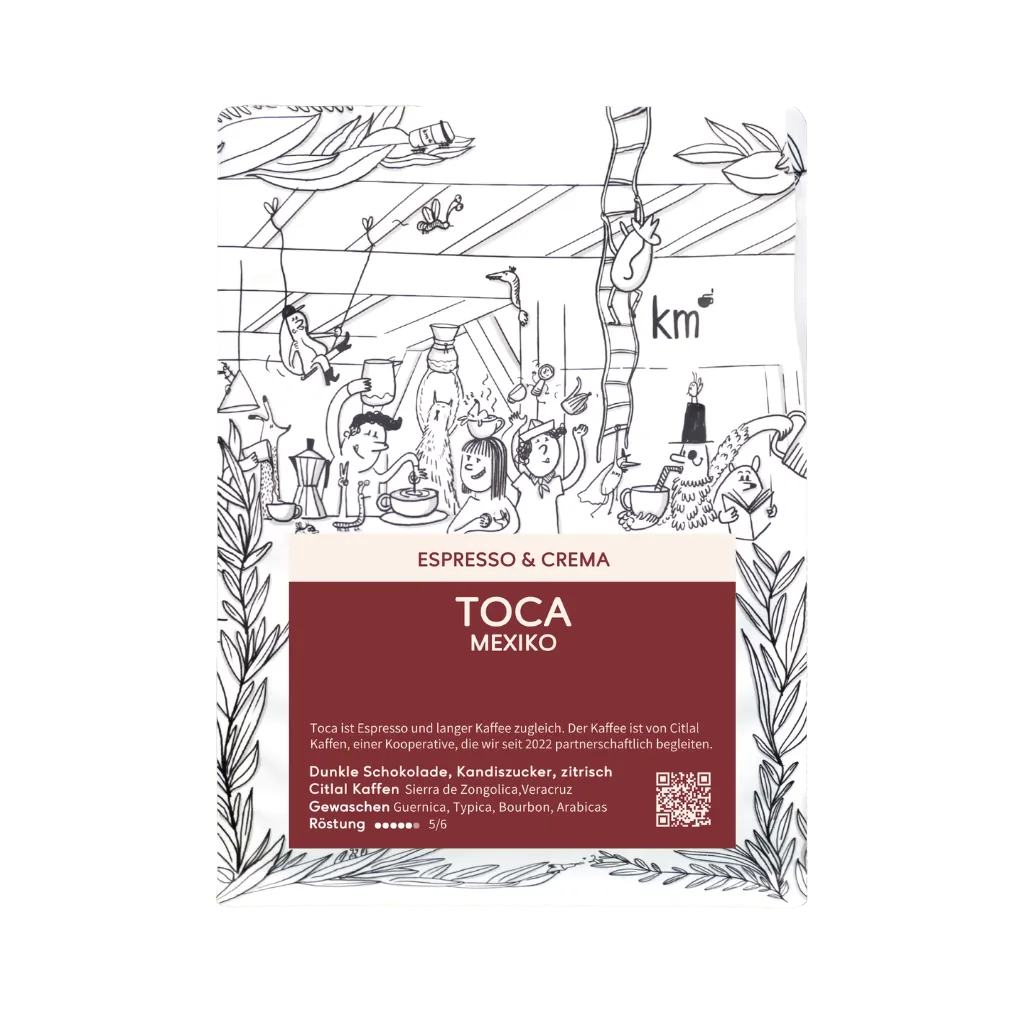
We tasted using Toca from Mexico. The espresso exhibited medium body, noticeable yet well-integrated acidity, and rounded sweetness. Our test classic, Apas Espresso, also performed well.
"This reminds me very much of what I know from the Niche Zero, with a touch more clarity."
That sums it up well. The Fino doesn't extract the most delicate, complex nuances out of light specialty beans, but it reliably delivers a solid, full-bodied espresso and is forgiving during dial-in. For exploring various coffee roasts, that is a great characteristic.
Verdict: Who the Compak Fino Is For
The Compak Fino is a high-quality, smooth-running single-dosing grinder that delivers great espresso once properly dialed in. Dialing in itself is its main area for improvement.
Strengths
- 0.3 grams absolute retention—one of the best values in our testing database
- 77.9 decibels, making it one of the quieter grinders
- Very fine, stepless grind scale with 1 to 2 seconds of extraction time shift per mark
- Dosing consistency of 0.11 grams, no thermal buildup over multiple runs
- Build quality and tactile feel that suggest long durability
Weaknesses
- Slow: 14.3 seconds for 18 grams
- Grind size repeatability shows 4 to 5 seconds variance after recipe changes
- Out of the box, the finest setting was too coarse for espresso; zero point had to be recalibrated
- The scale adds a €200 price premium for information not required in single dosing
Who is it for? Anyone who brews an espresso in the morning and another in the afternoon, likes switching between coffees, and values fresh grounds without stale retention. Medium and dark roasts are its home, and it is forgiving of minor dial-in errors.
Who is it NOT for? Anyone who grinds many espressos back to back (it is too slow for that), or those who demand maximum flavor clarity from light specialty roasts.
Value for Money: At around €599 without the scale, you get a burr set with minimal retention, one of the best grind scales in its class, and European manufacturing. Some grinders are cheaper for entry-level setups, but for what is built in here, the price is fair. At around €790 with the scale, it is not.
The Fino is a grinder that will accompany your coffee journey for years to come.
Test Results: Compak Fino Scale
Evaluated according to the KM Espresso Grinder Test Protocol. All measurements gathered independently.
Technical Specifications
| Feature | Specification |
|---|---|
| Price | approx. €599 (without scale) / approx. €790 (Scale), as of September 2026 |
| Burrs | Conical burrs, 63 mm |
| Motor | 280 W geared motor, 270 RPM |
| Operating Mode | Single Dosing |
| Capacity | 40 g (hopper chute), 65 g dosing cup |
| Grind Adjustment | Stepless, calibration ring, fine scale markings |
| Grinding Speed | 15.4 g / 10 sec (14.3 sec for 18 g) |
| Noise Level | 77.9 dB(A) |
| Grind Temperature | 26.3–30.7 °C across 5 runs (average 28.4 °C) |
| Absolute Retention | 0.3 g (0.2 g temporary, 0.1 g permanent) |
| Single Dosing Variance | 0.2 g |
| Consistency (Std Dev) | 0.11 g |
| x50 (Espresso, T4) | 210.8 µm |
| Fine Peak (Qf <100 µm) | 40.4 % |
| Main Peak (60% Peak Width) | 252.6 µm |
| RPM Control | No |
| Dimensions (H × W × D) | 308 × 165 × 240 mm closed, 405 × 165 × 240 mm open (Scale version 345 mm high) |
| Weight | 7 kg |
| Key Features | Anti-popcorning lid, magnetically detachable spout, anti-static system, bellows included |
As always, we purchased this grinder independently. This test was not sponsored or requested by Compak.