






How do I find the best hand grinder?
In the coffee hand grinder market, there's a wide range of no-name products for €20 up to grinders that cost several hundred euros. We want to help you identify the right hand grinder for you.
In this article, we'll also discuss the hand grinders available in our online shop, but the criteria and tips we discuss are also generally applicable to other hand grinders.
Which hand grinder is right for me?
Choosing the right grinder depends largely on what coffees you drink and which brewing method you use. Espresso, filter coffee, French press, or Moka pot.
As a general rule: the finer the required grind size, the higher quality the hand grinder and grinding mechanism must be. Fine espresso grind sizes are, so to speak, the champions league.
This also means that the more espresso capability you want, the higher the purchase price.
Important factors for using a hand grinder are also build quality, durability, everyday practicality, and the grinding mechanism.
Build quality and durability of hand grinders
In 2020, we conducted a large test of hand grinders in the under €100 range. Many of the various grinders we tested are no longer available today. During the test, we also noticed that some hand grinders showed signs of deterioration right from their first uses.
Tip: ask the seller before purchase whether they offer spare parts or repairs for the grinder they're offering.
What is the best hand grinder grinding mechanism?
You will find different materials from which hand grinder grinding mechanisms are made. In the hand grinder sector, we haven't found a convincing ceramic grinding mechanism in our tests so far.
All manufacturers of high-quality hand grinders like Comandante, Timemore, Etzinger, and Kinu rely on stainless steel grinding mechanisms.
A look at the grinding mechanism types of electric grinders shows that ceramic grinding mechanisms are sometimes used here and not exclusively grinding discs made of stainless steel.

The shape of the grinding cones used in hand grinders varies from manufacturer to manufacturer, as manufacturers each develop their own patents and have these produced by large grinding mechanism manufacturers.
The everyday practicality of hand grinders
The right ergonomics
A very important factor is the everyday practicality of a hand grinder. Even if a hand grinder manages to achieve the correct grind size for your preferred brewing method, that doesn't mean the grinding will be easy to do.
Many of the very cheap grinders, for example, have a very thin crank, which doesn't allow ergonomically comfortable grinding. Thus, everyday practicality is not given and the grinder quickly collects dust in the cupboard because it's simply not fun to use.
Grinding speed
The second important factor in daily use is speed - how long it takes until the beans are ground.
As a rule, you won't find any information from the manufacturer or seller on this. The reason is that it's not uncommon for a hand grinder to need more than 5 minutes for 18g of espresso-fine ground coffee. It's important to note that the most transparent method to specify grinding speed is the number of required crank turns. How fast you turn is, however, very individual.
Tip: Ask about the number of turns required for an espresso grind size.
Which hand grinder for espresso?
For preparing espresso, very fine ground coffee is a requirement. It is therefore essential that the hand grinder can grind fine enough.
ATTENTION: this is not the case with every hand grinder (even if manufacturers sometimes advertise this).
Additionally, it's important that grinding is easy to do. This means ergonomics, ease of operation, and grinding speed must form a functioning overall package.
Tip: Look for hand grinders that provide both a setting recommendation for espresso AND a turn count or time specification for a standard amount of beans (18g).
Adjusting grind size on a hand grinder
Almost all hand grinders work with a click system. Thus, the challenge is to find the right click setting for your desired brewing method in combination with the coffee you use.
Sounds complicated, but with the right information and guidance, it's not that difficult. Generally speaking, the smaller the click number, the finer the ground coffee. However, you should not use the lowest click levels, as the grinding mechanism could wear out faster due to grinding (as the grinding discs touch each other).

What grind size for espresso?
Adjusting the hand grinder for espresso follows these steps:
- What click recommendation does the grinder manufacturer provide for espresso? That's a good starting point, but it's quite possible that this isn't yet the setting for "your" espresso.
- What is the desired extraction ratio? A standard recipe, for example valid for our APAS espresso, is 1:2.5 in 25 seconds. This means that from 18g of ground coffee, you get 45g of beverage in the cup for a double espresso (for two single espressos, place two cups underneath and accordingly get 2x 22.5g as a result). The whole thing in 25 seconds.
- If the espresso runs too fast in the portafilter machine, the grind size must be adjusted finer. If the espresso runs too slowly, the ground coffee must become coarser, so you increase the click number.
- If you can't hit a recipe exactly, click level 7 is too fine, but click level 8 is too coarse, then you have two options: With some grinders, the click wheel can be positioned between two click levels. If that doesn't work, you can work with 0.5-1g more coffee and adjust the ratio accordingly. This provides somewhat more ground coffee in the portafilter, which also reduces the flow rate.
Tip: Ask the seller for the recommended grind size setting for your brewing method
What grind size for filter coffee?
Adjusting the hand grinder for filter coffee follows these steps.
What click recommendation does the grinder manufacturer or seller provide for your filter coffee method?
From the AeroPress, via the classic V60 hand filter to the press pot, i.e. the French press, an increasingly coarser grind size is required.
The seller or grinder manufacturer should provide click recommendations for these grind sizes.
Which hand grinders do we sell?
We deal intensively with the topic of hand grinders every day. Based on our experience, we have compiled our hand grinder range.
There are many coffee hand grinder manufacturers and even more different models, we have consciously decided on the selection we offer because we want to make your decision easier. From our point of view, it doesn't make sense to offer dozens of hand grinders - that would only complicate the decision further.
The current range:
The Timemore C2 and Timemore Slim Plus are no longer produced by Timemore, so we have expanded our range with the two successor products Timemore C3 ESP Pro and Timemore Slim 3.
Tip: All mentioned Timemore hand grinders are from the Timemore Chestnut series. You will occasionally find the designation Timemore Chestnut Slim 3 or Timemore Chestnut C3 Pro. This is the same hand grinder as listed above.
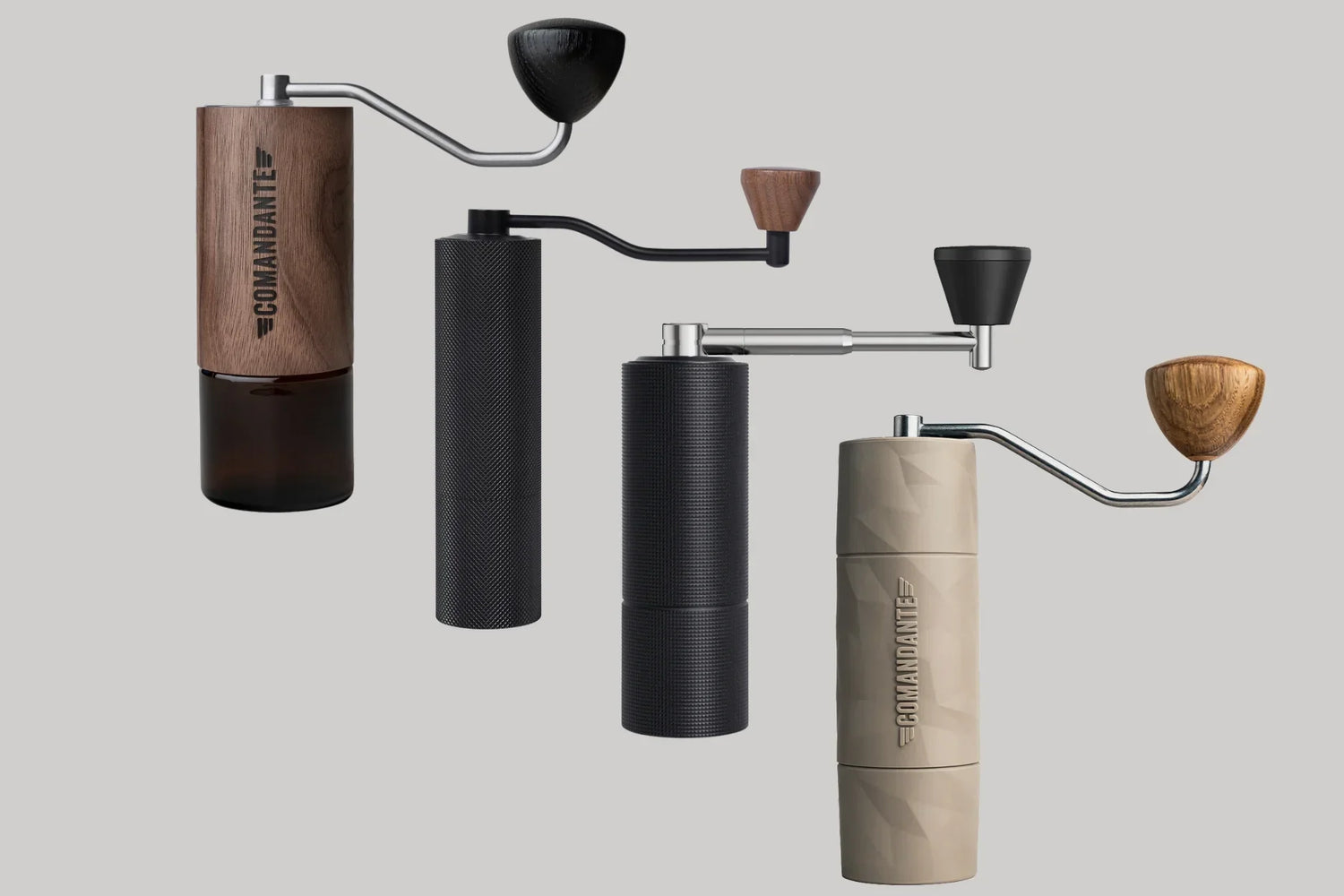
Our hand grinder range
These four hand grinders cover a wide range of coffee options.
The Timemore C3 ESP Pro offers a very strong price-to-performance ratio with good build quality.

The Timemore Slim 3 offers an excellent price-to-performance ratio, is made from a single piece of aluminum, and impresses with design and quality.

The Comandante C40 MK4 is a high-quality hand grinder from the premium segment and is produced in Germany.

With the optional RedClix upgrade, the Comandante C40 MK4 can make very fine adjustments in the espresso range. In terms of adjustability of a precise grind size, the Comandante C40 MK4 with the RedClix upgrade achieves a perfect score.

The latest hand grinder in our range is the Comandante X25 Trailmaster. Here too, the Red Clix axis can be installed. The grinding characteristics are comparable to the Comandante C40 MK4.
The Trailmaster is particularly suitable for outdoor use. We took a closer look at this grinder in this video.