






















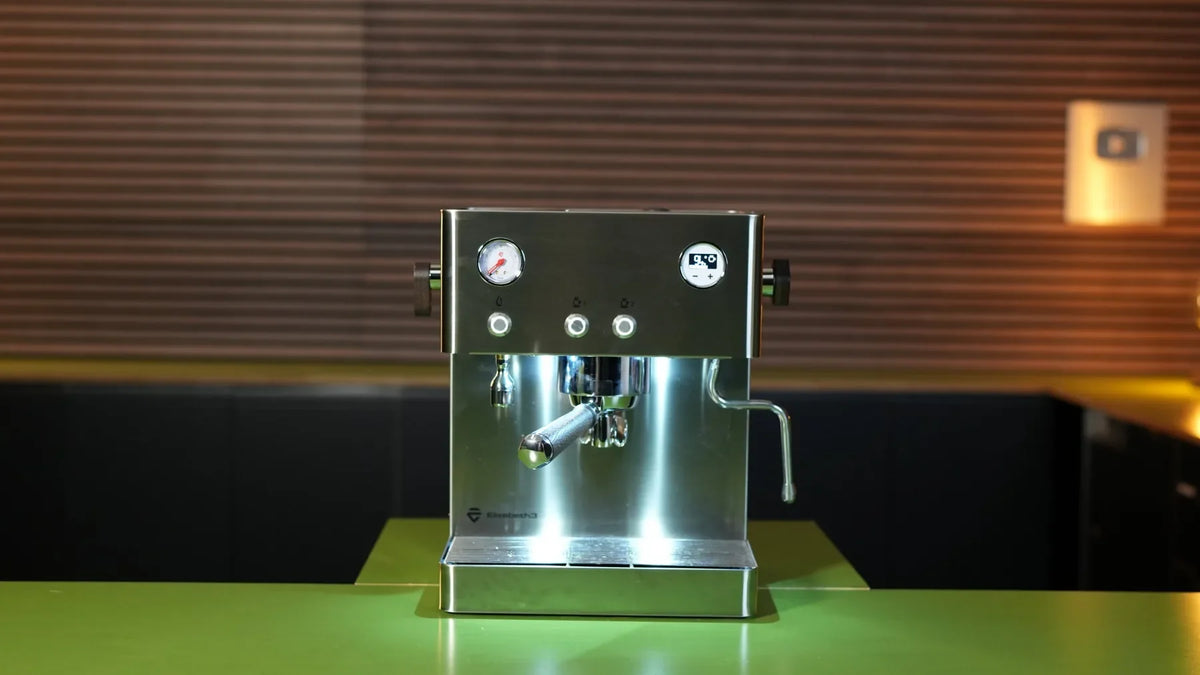

We liked the Lelit Elizabeth in our first test. Now Lelit has followed up: the Elizabeth 3 is a dual boiler for 1,650 euros that controls pressure and flow in two ways. With the Pagaia, the small wooden lever on the side, you can adjust the flow by hand during extraction. Additionally, you can save a pressure profile with up to five stages on two buttons. This makes extractions repeatable, and that hasn't been available at this price point before.
We measured the Elizabeth 3 according to our test protocol 2.3.2 and ran the old Elizabeth through the same protocol again in parallel. So you can compare both machines directly. The central question: What does the new control deliver in the cup, and what does the smaller brew boiler cost?
We didn't buy this machine. We received it before the official market launch so we could test it in time, and at that point Lelit couldn't yet send us an invoice. This doesn't change our testing process — we test independently and conscientiously as always.
Because we want to maintain our neutrality by paying for each test machine, we're donating the purchase price of 1,650 euros to the "Fazenda da Cachoeira" institute in Brazil. It does cultural and educational work in the field of regenerative agriculture, conducts knowledge transfer in collaboration with universities, and carries out projects on integration and empowerment.
We already tested the old Elizabeth thoroughly. You can find the test of the Lelit Elizabeth with the new measurements here, and we explain how the lever works on the Victoria and Mara in our article on Lelit Pagaia.
What's new: Pressure profiles, Pagaia, and a smaller brew boiler
At first glance, the Elizabeth 3 looks like the old one. It still weighs 15 kilos and at 38 centimeters wide, 38 centimeters tall, and 36 centimeters deep it's almost a cube. But there's been quite a bit of change inside. The brew boiler has shrunk to 0.2 liters, the steam boiler stays at 0.6 liters, and the water tank holds 2.5 liters.
The real innovation is the pump control. Lelit regulates the vibration pump via pulse-width modulation—that is, by how much power goes to the pump. A pressure sensor simultaneously measures how much resistance the coffee puck puts up against the pump. The technology is based on Sage patents, the company group that Lelit now belongs to. You see the result on the display: during extraction, the machine shows the pressure on the coffee and the set profile.

Build quality: Wood instead of plastic, and very quiet at 56 decibels
In the first test with the old Elizabeth, we criticized the steam knob as cheap and unattractive, and many of you then built your own knobs from wood or 3D printer. That's now taken care of. The steam knob, portafilter handle, tamper, and Pagaia are all made of the same wood, and everything feels significantly more high-quality. The water tank cap also sits in a small guide now. Lelit also uses rubber buffers as usual, so there's less rattling.
You notice this during brewing. At 56 decibels, the Elizabeth 3 is very quiet, and especially with a pressure profile the pump purrs rather than hums. In our rating, that's an 8.
It's not entirely without compromises. The stainless steel sheet is relatively thin and has a slightly sharp edge in one place, and you can see every fingerprint on the brushed stainless steel. Michel would therefore go for the black version because the finish looks more high-quality and shows fewer marks. Black and white cost 50 euros more. Overall, we rate the quality at 8.
Pressure profiles: Five stages per button
Each of the two extraction buttons can store its own profile with up to five stages. For each stage, you set the pressure in half-bar increments and the duration. You don't need a complicated app—programming is done via the familiar Lelit display.
You don't have to use all five stages. If you set the second stage to 30 seconds, stages three through five won't be used because no extraction lasts that long. For everyday use, often just a gentle wetting of the coffee puck followed by brewing at 8.5, 9, or 7.5 bar is enough. If you like, you can store a manual lever profile with all five stages that ramps up to 9 bar and then drops a bar every few seconds.
The display is the same one Lelit has been using for years. It takes a bit of finesse, but once you know the logic, you'll get the hang of it quickly. Michel found saving the profiles intuitive. Besides that, there are settings for steam temperature, you can turn off the steam boiler, and you can adjust the lighting.

Pagaia: Control flow by hand during extraction
Do you even need the lever if the machine saves profiles? Yes and no. With the Pagaia you start the extraction right at the side and then respond to what you see and what the display shows for pressure. That's handy if you want to try a recipe from the roaster without saving it first, or if you just want to control it freely by hand.
The lever is even more useful when a shot goes wrong. In our test, an extraction ran too fast toward the end, even though we'd already adjusted the grind finer. With the Pagaia we slowed the flow and ended up at 22 to 23 seconds. At 9 bar the coffee probably would have rushed through in 19 seconds. More expensive machines with flow control like the Maro do this automatically and call it Smart Profiling. Here you do it yourself. There is one limitation: you have to start the extraction at the lever. If you start via the button, you can't switch to the lever mid-extraction.
Whether you really need both, we weren't entirely agreed on as a team. For one of us, electronic control alone would have been enough if the machine were 200 euros cheaper. The other appreciates the lever precisely as a tool to rescue individual shots. However, the lever can't be combined with an electronically saved profile.
Espresso: Robusta with profile, 18.5 grams in the basket
For the first espresso, Michel deliberately chose something unexpected: a pure, washed Robusta from India called Bharath. 18.5 grams in the double basket. He brewed it with a profile: eight seconds at 3 bar to fully wet the coffee puck, then 8.5 bar for the remaining 17 seconds, with 45 grams in the cup.
In the cup it's very strong, with a peaty, dark note reminiscent of black bread. The baskets are the usual stamped ones—solid, but not a highlight. If you want to upgrade, grab a conical basket that goes straight down, like our KM Pro Baskets.

Brewed in test: Bharath, espresso from India
Washed Robusta from Bharath Belliappa, with warm cocoa, marble cake, and creamy texture.
Technically, the Elizabeth 3 has a lot of potential. We rate the profile control at 2.5 out of 3.5 points and the hardware at 1.5 out of 2. With it, you can brew a strong Robusta just as well as a very light roasted competition coffee. Temperature is a limiting factor, which we'll get to in a moment. The bottom line for espresso potential is 6.5 across all extractions. If you know how to work with the Elizabeth 3, you'll still get everything out of each extraction. For that, you should know how the temperature behaves on the second and third extractions.
We explain how to set grind and brew ratio in general in our guide to making espresso.
Temperature: 93.6 °C on first extraction, then 2 degrees less
With temperature, the Elizabeth 3 has taken a step back compared to its predecessor, probably also because of the smaller brew boiler. You can brew with it very precisely. It becomes problematic only when you make many extractions in a row and don't know how the machine behaves. That's why we spent a lot of time with the new Elizabeth to examine its behavior in detail for you.
We measure with Scace directly in the portafilter, each time at a set 94 °C. In the KM protocol we pull five double espressos at one-minute intervals. The first extraction after 20 minutes is at 93.6 °C, so only 0.4 degrees below the setting. From the third extraction on, the Elizabeth 3 settles at 91.6 to 91.8 °C and doesn't drop further.
Our rating is based on the protocol with one-minute intervals. If you give the machine two minutes between extractions, it becomes much more consistent: all five espressos are then within 0.9 degrees, between 91.4 and 92.3 °C. That's easily manageable at home. Serve the espresso, prepare the next one, and with single dosing two minutes are over in no time.
With one or two espressos you're in good territory anyway. When guests come and you make more extractions in a row, give the machine two minutes between shots. Then temperature stays stable from cup to cup.
| KM protocol | Extraction 1 | Extraction 2 | Extraction 3 | Extraction 4 | Extraction 5 | Range |
|---|---|---|---|---|---|---|
| Old Elizabeth, 20 min., 1 min. pause | 84.82 | 84.40 | 87.26 | 89.79 | 93.42 | 9.02 |
| Old Elizabeth, 25 min., 1 min. pause | 90.71 | 92.52 | 93.60 | 94.01 | 93.64 | 3.30 |
| Elizabeth 3, 20 min., 1 min. pause | 93.60 | 92.38 | 91.79 | 91.64 | 91.75 | 1.96 |
| Elizabeth 3, 20 min., 2 min. pause | 92.27 | 92.10 | 92.10 | 91.44 | 91.35 | 0.92 |
All values in °C, average per extraction across seconds 5 to 25, set to 94 °C. The row with two-minute pause deviates from the standard protocol and shows our recommendation for everyday use.
The step back becomes clearer in the WBC protocol—that's 14 extractions at short intervals with parallel milk steaming. Here the Elizabeth 3 starts at just under 95 °C and ends up just under 90 °C. The temperature window is 5.5 degrees. The old Elizabeth holds the first eleven extractions between 92.8 and 94.6 °C and only breaks down at the end. So the Elizabeth 3 is not built for catering with many extractions in a row.
In temperature rating, the first extraction—which hits almost exactly—gets full points. We deduct for the drop across five extractions, for the slight rise within each shot, and for the WBC test. Together that gives a 5.9.
Heat-up time: 20 minutes to stable temperature
The Elizabeth 3 is somewhat faster than its predecessor, but it's not really quick. With the old Elizabeth we figure 25 minutes based on the retest, with the new one 20 minutes. Only then do the extractions deliver the temperature we described above. We also measured after 15 minutes: the five extractions at 93 °C setting only ranged from 88.4 to 89.2 °C. That's consistent, but roughly four degrees too cold.
In other tests you read about nine minutes, and that's what Lelit states too. Lance Hedrick tested that in his video with one extraction and got 89.6 °C at a 90 °C setting. We don't dispute that. The machine heats at full power for the first good eight minutes, and a single shot can certainly work after that. Our protocol asks about a series of extractions, though, and that's still noticeably too cool after 15 minutes.
We ran a series at 93 °C setting after 15 minutes, and the temperature averaged 88.66 °C. If Lance had set his machine higher than 90 °C, he probably would have seen that it doesn't reach temperature after 10 or 15 minutes.
The Elizabeth 3 needs 20 minutes to be properly warmed through for multiple extractions in a row. By the way, our power measurement also explains pretty well why the machine reaches 88 to 90 °C quickly but then doesn't reach 93 °C fast: after about eight minutes it stops heating at full power. Lelit has left heat-up speed on the table there.
Anyone looking for a machine that's ready after just a few minutes won't find that in the Elizabeth 3. Film heaters and thermoblocks are significantly faster. So the Elizabeth 3 gets a 4 for heat-up time. But once it's up to temperature, it stays reasonably stable, especially if you follow our temperature tip.
Milk steaming: 300 ml in 30 seconds to 60 °C
Surprisingly a lot has changed with steaming, even though the steam boiler stayed the same size. The Elizabeth 3 steams faster and with more pressure than the old one. It brings 300 milliliters of milk from 8 to 60 °C in 30 seconds. That's snappy, but not so fast that it gets difficult. You just need to hold the pitcher slightly at an angle to get good rotation. About 4 milliliters of condensation come out of the wand before steaming—it's insulated and doesn't feel that hot.
It's not a catering machine here either. After the third or fourth steaming in a row the power noticeably drops off. We don't rate that negatively because the machine is intended for home use. The steaming quality gets a 7.8. You can find the right milk pitcher for latte art in our shop.
Metering: Time control instead of flowmeter
The two buttons work with time control, not a flowmeter. You could argue whether a flowmeter wouldn't have been nice. But a flowmeter that also delivers precisely with changing pressure profiles doesn't exist for 1,650 euros—that quickly costs significantly more. Even pricier machines that claim to do it often fail at that.
If you work consistently and have set the machine up once, time control dispenses water solidly. That's not really metering in the strict sense, though. Our recommendation: control with an espresso scale. Pure time control in our rating gives a 3.
Power consumption: 0.075 kWh in espresso mode
We explain how we measure in our power measurement. For the rating, with dual boilers what counts is the economical espresso mode—heating up and one espresso with the steam boiler off. The Elizabeth 3 uses 0.075 kWh here, and that's a very good value for a dual boiler. With steam boiler on it's 0.154 kWh for one espresso and 0.172 kWh for a cappuccino, so about double.
The curve shows where the power goes. With steam boiler on, the machine heats at full power of around 990 watts for about eight minutes, using 0.126 kWh. After that, the PID holds temperature with just short pulses, and the remaining twelve minutes to the first extraction cost 0.019 kWh. Without steam boiler, the full-load phase is over after 2 minutes and 20 seconds, and after 20 minutes 0.068 kWh is on the meter—less than half.
Because both boilers are small, the consumption for a dual boiler stays manageable even though heat-up time is long. The second ten minutes of heat-up time needed for stable temperatures costs just 0.016 kWh with steam boiler on. During brewing, the heater kicks in briefly after each extraction—one espresso uses 0.007 kWh without steam boiler and 0.009 kWh with. If you have a coffee early, at noon, and in the evening, it's better to turn the machine on 20 minutes beforehand instead of keeping it warm all day. Keeping it warm costs 0.084 kWh per hour with steam boiler, 0.045 kWh without. That gets an 8 in our rating.
If you only drink espresso, turn off the steam boiler. Heat-up and the first espresso then use only half the power. One note from our measurements: in our temperature run without steam boiler, the extractions at 94 °C setting were around 90 °C, so about 2 degrees lower than with steam boiler on.
Accessories and operation
The tamper was always good at Lelit, and that continues. At 58.55 millimeters it closes flush with the basket without any noticeable gap. It comes with a cleaning kit, a blind basket, baskets in various sizes, and optional taller rubber feet. As usual with Lelit, there's only one portafilter with a double spout. The spouts are close enough together to fit most espresso cups. We really like this Lelit portafilter, by the way, because the espresso pours so nicely to the front—like a hazelnut-creamy stream into the cup—which looks almost as pretty as a bottomless portafilter. We rate the accessories at 8.
As always, a water filter is included. It removes the total hardness but leaves the alkalinity, so the flavor is somewhat neutralized. For coffee, we don't recommend this type of filtration. You are protected from limescale, though.
The drip tray with 1,200 milliliters helps in everyday use, and the water tank is easy to remove. The water level, however, is hard to see. The manual explains programming well and to the point, but doesn't go into depth. We got one of the first machines with an English manual. Lelit is generally not very transparent in its manuals, even though the machines often allow more adjustment than described. We rate usability at 7.

Elizabeth 3 or old Elizabeth?
The new Elizabeth is a different machine. It reaches stable temperature faster, steams more powerfully, is quieter, and can save pressure profiles. In exchange, it loses more temperature than the old one when making many extractions in a row. If you mostly drink one or two espressos a day and like the idea of profiles, the Elizabeth 3 is better. If you regularly pull many espressos in a row, check out our dual boiler tests with larger brew boilers.
KM Rating
0 – 100
At 61.7 out of 100 points, the Elizabeth 3 lands in the "Good / Standard" category. That sounds more sober than we felt about the machine during testing, and there's a reason: Our protocol rates the entire package. Weak individual scores in metering, heat-up time, and catering potential pull the average down, while pressure profiles only flow partially into espresso potential. That's why the calculated value-for-money rating also comes in at 5.1, just above market average.
Conclusion: Pressure profiles for 1,650 euros
Would we recommend the Elizabeth 3 to our best friend investing 1,650 euros in an espresso machine? Michel's answer came without hesitation: "Absolutely yes!" That's still a lot of money. But a dual boiler with electronically controlled, saveable pressure profiles hasn't been available at this price point before. Previously that was only possible if you built flow control onto a machine yourself, or if you went for significantly pricier machines like the Sanremo You.
The weaknesses are clear. 20 minutes heat-up time, time control instead of true metering, and a small brew boiler that loses temperature with many extractions in a row. Add thin sheet metal where every fingerprint is visible. If you give yourself two minutes between extractions at home, you get stable temperatures with an error margin unusually small for Lelit.
The Elizabeth 3 makes good espresso, steams adequately, and lets you play with pressure profiles if you want. But you can just as easily brew at 9 bar, and the coffee tastes good that way too. We've summarized which machine type generally suits you in our espresso machine buying guide.
No time for the whole video? We've condensed the key findings into ten minutes:
You can get the Lelit Elizabeth 3, for example, from Stoll Espresso*, our recommended workshop for Lelit.
* Affiliate link: If you buy through this link, we receive a small commission. The price doesn't change for you.
Technical specifications at a glance
| Feature | Lelit Elizabeth 3 |
|---|---|
| Price | approx. 1,650 euros (stainless steel), approx. 1,700 euros (black, white), RRP, as of October 2026 |
| Type | Dual boiler with PID |
| Boiler | Brew boiler 0.2 l, steam boiler 0.6 l |
| Pump | Vibration pump with pulse-width modulation and pressure sensor |
| Profiling | 2 buttons with 5 pressure stages each, Pagaia lever for manual flow control |
| Metering | Time control |
| Heat-up time | 20 minutes (measured) |
| Brew temperature | 93.6 °C on first extraction, 91.6–91.8 °C from extraction 3 (set to 94 °C) |
| Power consumption | 0.075 kWh heat-up + espresso without steam, 0.154 kWh with steam; standby 0.045 / 0.084 kWh per hour |
| Noise level | 56 dB |
| Water tank | 2.5 l |
| Drip tray | 1.2 l |
| Dimensions (W × H × D) | 38 × 38 × 36 cm |
| Weight | 15 kg |
| Portafilter / Tamper | 58 mm / 58.55 mm |
We didn't buy this machine ourselves because it wasn't available before the market launch. We're donating the purchase price to a social organization in Brazil. We discussed getting the Elizabeth 3 early with Lelit at the trade show booth in Brussels.



