






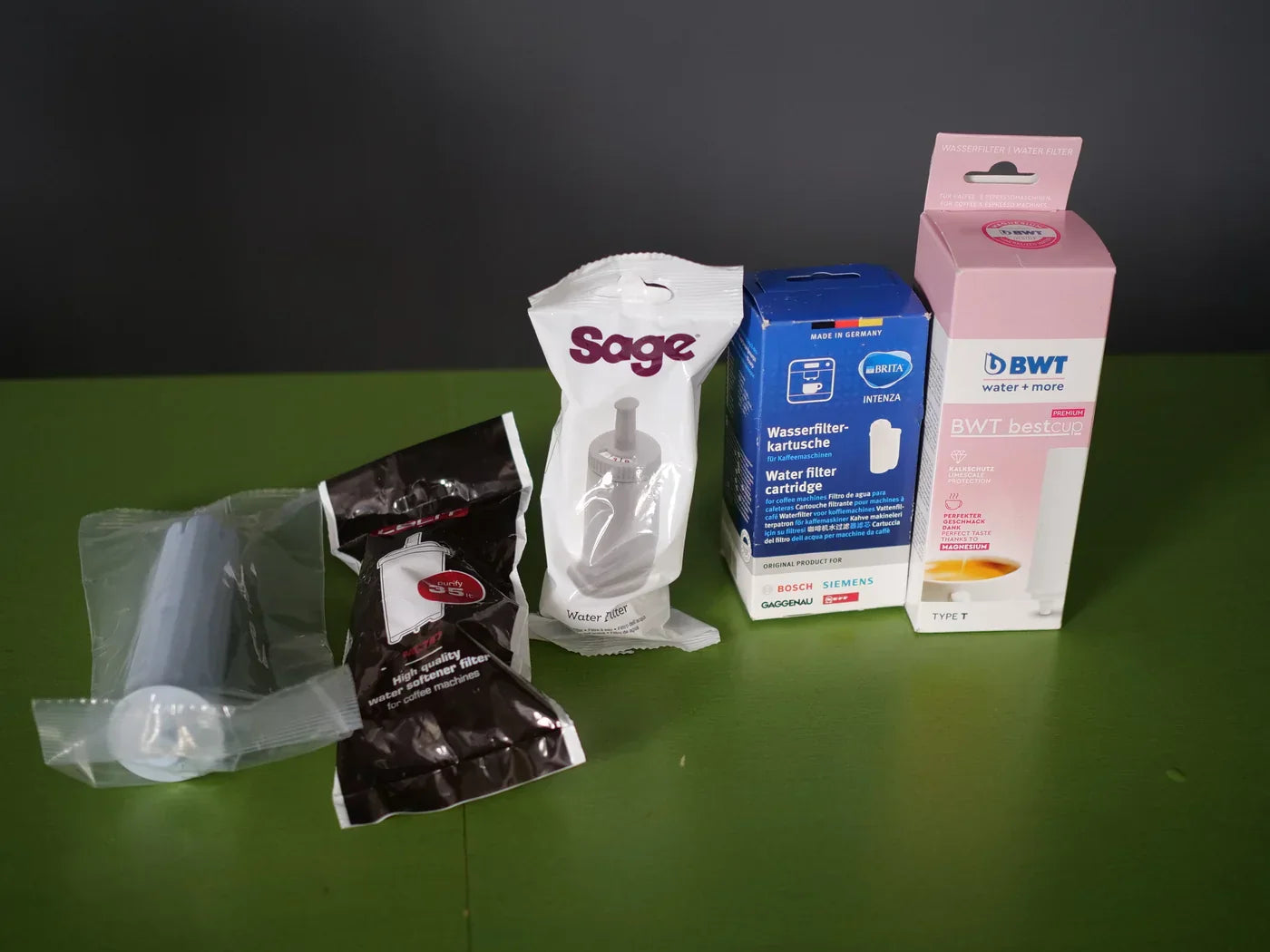

Many espresso machines and fully automatic coffee machines feature plug-in connections for water filter cartridges. But are these pluggable filter cartridges any good? We tested 5 models and summarized the results in a video about plug-in water filters from BWT, Brita, Jura, Lelit, and Sage.
The importance of water for preparing coffee
Water plays a central role in preparing coffee. This comes as no surprise, since every coffee beverage consists of well over 90% water. Nevertheless, for a long time, the focus was primarily on machine protection rather than the impact of water on taste. Conveniently, water that tastes good in coffee is also water that protects machines. We recommend the following hardness levels for water.
Perfect water for filter coffee:
Total hardness: 2 – 3 °dH
Alkalinity: 1 – 2 °dH
Perfect water for espresso:
Total hardness: 3 – 6 °dH
Alkalinity: 2 – 4 °dH
In our detailed water article, we have covered the reasons and basics of water chemistry in depth. There, we also provide tips on methods for testing water at home and what the limits of filtration are. Another article is dedicated to filter water pads. We are currently working on a test of water filter pitchers.
Water filter cartridge test results
The following summary of test results shows how the various water filter cartridges perform. For the test, the filter cartridges were first prepared as recommended by the manufacturer. Subsequently, one liter of water was pumped through the filter and measured. This was followed by five more liters and another measurement, then another five liters and another measurement. Finally, 10 liters were pumped through the filter and measured again.
Measurements were taken using a drop test kit for hardness as well as a conductivity meter.

Results in German degrees of hardness = dH.
Special pump for measuring filter cartridges
Normally, filter cartridges are inserted into the water tanks of coffee machines. The water is pumped by the coffee machine through the filter cartridge and then heated. Measuring the water after it has been heated would not have given us usable results, as heating causes changes to the water.
Therefore, we used an external pump, where we could regulate the flow rate to match the flow speed of espresso machines.
Does the source water matter?
The tests were conducted with water having an inlet hardness of 13° total German hardness and 11° dH alkalinity. The filter performance was consistent even with water hardness levels up to 25° German hardness. In principle, the filters provide their filtration performance up to the target value. However, the lifespan of the filters is significantly reduced when harder water is used.

Are water filter cartridges recommended?
3 out of 5 filters delivered good results throughout the entire test process. The filtration performance is also better than, for example, that of tabletop water filters. Just a small preview of the results of our tabletop water filter test.
The Jura Claris filter plays to its strengths once a few liters have passed through the canister. Overall, however, it does a good job, enables good coffee, and protects the coffee machine at the same time.
The Brita Intenza also achieves good target values, especially after a flow of 5 liters. Conclusion: good for coffee and machine, definitely also strong for filter coffee because it tends to be in the softer range.
The BWT Best Cup water filter remains slightly too hard. It is slow to get going at the beginning, and even after some flow, the values only just scratch the target range, even if a good hardness window is briefly reached after 6 liters of flow.
The Lelit MC747 is not a decarbonizer but a demineralizer. It removes magnesium and calcium from the water but leaves the alkalinity as is. This protects the espresso machine, but does not prepare the water well for brewing delicious coffee. The Lelit filter is not well-suited for preparing sensorially high-quality coffee.
The Sage filter picks up speed after about 11 liters flushed through and then brews good water on the softer side. This filter can be installed in espresso machines such as the Sage Barista Pro or Sage Barista Touch. The water values are also very well-suited for brewing filter coffee.
If you would like to find out more about the perfect water for coffee, you can find all our articles on the topic here.


Was ich dir empfehlen kann ist das Brita-Testkit. Am besten einfach nach dem Filter messen (Wasser welches aus der Maschine kommt, abgekühlt). Dann weisst du ganz genau wo du stehst:
https://kaffeemacher.de/products/brita-testkit-zum-test-der-wasserharte?srsltid=AfmBOorM7dLgob7eeURhQrFOFU9CWhoHgT3m_OMR9kT_2Mre3lk3ETS1

Mein Wasser hat leider bis zu 19 ° dH...
Bin sehr besorgt um meine Maschine, würde es Sinn machen, beispielsweise doppelt zu filtern?
Also erst einen Tischwasserfilter benutzen, und dieses Wasser dann in den Tank zu gießen, in welchem ein Steckfilter steckt?
Meine Odee wäre dann, den Tischfilter relativ oft zu tauschen, und den Steckfilter natürlich dementsprechend seltener und in eher als Notfalllösung anzusehen, falls der Tischfilter etwas zu alt wird...
Oder wäre das Wasser dann zu weich und der Kaffee schmeckt auch nicht mehr?
Vielen Dank Euch für die tolle Arbeit!!

Dazu musst du dir keine Sorgen machen. Wir haben auch selber Maschinen mit Steckfilter im Einsatz und noch nie Probleme mit beschädigten/ undichten Leitungen gehabt.
Grüsse
Andrea


Das sind beides gute Filter. Kannst dir wirklich aussuchen, was für dich einfacher geht

Liebe Grüße Nadine


Seit Kurzem besitze ich eine Bezzera unica. Und da bei uns das Wasser sehr hart ist, möchte ich gerne mit einer Filterkartusche etwas dagegenhalten. Nun hat aber die Maschine zwei Schläuche - geht das überhaupt?
Und gäbe es in der Schweiz eine Alternative zu volvic (habe ein Problem mit diesem Nahrungsmittel-Riesen…)
Liebe Grüsse
Claudia hat


sehr interessanter Test. Da der Brita-Steckfilter ganz gut abgeschnitten at, habe ich meine Profitec mit dem ECM-Adapter umgerüstet. Nun gibt es zum Brita Intenza einige „no-Name“-Alternativen, wollte aber die aber nur ausprobieren, wenn ich die resultierende Wasserqualität - OK, wenigstens die Härte - mit einfachen Mitteln testen kann. Habt Ihr einen Tipp, wie man das zuhause ohne Umbau hinbekommt? Wenn das Wasser durch die Boiler durch ist, kann man - korrigiert mich bittte - keine sinnvolle Messung mehr vornehmen.
Grüße,
Jochen

Ich habe mir vor kurzem auch den Traum einer Siebträgermaschine erfüllt, eine Profitec Drive. Aktuell betreibe ich sie mit gekauftem Wasser mit einer Härte von 3.03°dH. Bei Leitungswasser von 9,5°dH macht es ja tatsächlich Sinn einen Filter zu nutzen um Leitungswasser zu verwenden. Jetzt meine Frage: Sind die angebotenen Filter von ECM (Preis 20€/Stück) identisch zu den Standard Brita Intenza Filtern,die ich schon für unter 10€ bekomme, oder bin ich als Profitec/ECM Besitzer auf die teuren von ECm angewiesen? Und kennt einer den Unterschied zwischen „Intenza“ und „AquaAroma Crema“? Die sehen ja tatsächlich auf den Bildern Baugleich aus.
Über eine Antwort von euch würde ich mich freuen

With BWT there is an adapter (BWT Bestcup Adapter) for connecting the filter to the water intake pipe of a lot of espresso machines (e.g. Gaggia Classic), but I cannot find anything similar for Brita Intenza. Do you have any suggestion? I imagine for your tests you just used some glue.. but that's not very practical for real use-cases.. :P
Follow-up question: does it matter if the filter is put down horizontally in the water tank versus vertically?
Thanks!
Exactly, unfortunately we only did this with glue and not with an adapter. Unfortunately, we don't currently know of any dealers for the Brita Filter Adapter. Regarding horizontal or vertical, it is best to ask the retailer directly. Greetings Pascal

Vielen Dank für die tollen Infos und Tests!
Ich betreibe eine Bezz. Magica S in Wien (tendenziell mittelhartes Wasser) und überlege gerade welche Lösung in Punkto Wasser hier am geeignesten wäre. Hätte den Tischwasserfilter von Brita im Blick oder überlege einen Durchlauffilter im Wassertank zu verbauen. Habt ihr damit Erfahrunge gemacht? Einerseits mit der Montage dieser Adapter (zB www.espressissimo.de/zubehoer/wasserfilter/1789/filter-kit-zur-installation-von-durchlauffiltern-fuer-bezzera-maschinen-mit-e61-bruehgruppe) und andererseits mit dem Wasserfilter Nical 125, der in diesem Zusammenhang in einigen Shops immer wieder angeboten wird?
Vielen Dank für Eure tolle Arbeit und schöne Grüße aus Wien!

Habt ihr schon Langzeittests machen können, wie viel so ein Filter filtert? Die Angabe von 3 Monaten ist ja eher nichtssagend.
Danke für euren tollen Content

Habe ich da etwas übersehen, meine Lelit hat den klassischen alten Wassertank mit einem Saugschlauch ?

Auch wenn die Frage in ähnlichen Varianten nun mehrfach gestellt wurde, war die Antwort mir bislang nicht präzise, daher stelle ich sie nochmal genauer:
1. Was ist eure Empfehlung, wenn man eine Lelit Mara X hat? Sind die inwiefern sind die Filter mit anderen Maschinen kompatibel (an sich müssen die ja nur irgndwie unten im Tank fest gemacht werden und ein Schlauch daran muss daran befestigt werden können, oder?
Bislang war aber die Antwort, soweit ich das richtig verstanden habe, "Tischwasserfilter". Korrekt?
2. Eine explizite Handlungsempfehlung wäre wahrscheinlich für alle nützlich, die nicht eine der zu den getesteten Filter kompatiblen Maschinen besitzen. Das hat mir jeweils im Fazit von diesem Video als auch vom Tischfilter-Test gefehlt.
In jedem Fall ein großes Danke, dass ihr dieses Wissen mit uns teilt!
Einen Tischwasserfilter lässt sich einfach bei jeder Maschine, so sehen wir ihn als gute Lösung bei der Lelit.
Vielleicht können wir bei einem weiteren Test noch mehr in dieses Thema eingehen. Gruss Pascal

Viele Grüße

ich habe eine Espressomaschine mit Ansaugschlauch im Tank (Isomac Venus). Ohne größere Umbauten sind da wohl nur Ansteckfilter möglich. Habt Ihr da einen Tipp, welcher geeignet ist und gut funktioniert?
Gruß, Walter

werdet ihr noch ein Video zu Festwasser-Filterkartuschen machen?
Liebe Grüße
Navid

Würdet Ihr bei der Ascaso Steel Duo PID einen Steckfilter empfehlen? Wenn ja, welchen? Oder besser einen Tischfilter?
Gruß Michael


Gruss Pascal


Ein durchaus interessante sowie spannende Analyse mit dessen grundsätzlich positiven Ergebnissen ich so nicht gerechnet habe.
Ich persönlich hätte den Filtern nicht so viel zugetraut.
Wünschenswert wäre jedoch eine „Nachtestung“ des Brita-Filters „AquaAroma Crema“.
Der „AquaAroma Crema - Filter“ ist m.W. nach nahezu baugleich mit dem bereits getesteten Brita-Filter „Intenza“.
Wobei der „Intenza bis zu 50l Wasser filtern kann und nach 2 Monaten getauscht werden müsste; so die Aussage von Brita-Deutschland.
Der „AquaAroma Crema“ hingegen hat eine Filterkapazität von bis zu 220l, je nach Einstellung der Aroma-Stufe am Ring des Filters, in Abhängigkeit der Wasserhärte.
Preislich sind diese beiden Filter ungefähr identisch.
Und dies macht es aus meiner Sicht interessant, um
1. ggf. Kosten sparen zu können bzgl. des Wechselintervalls.
2. ggf. den Aromaring des Filters bewusst auf „C“, für hartes Wasser ab 13,5° dH zu stellen, um eine bessere bzw. höhere Filtrierung zu erreichen sowie die Wasserhärte in der Maschine noch weiter senken zu können?
Über ein kurzes feedback hierzu freue ich mich.
Viele Grüße
Frank


Danke für den ausführlichen Test, sehr informativ!
Ich habe eine Bellezza Inizio R Leva, die hat keinen Schlauch im Tank sondern an der Ansaugung unten im Tank einen Einsteckmechanismus. Leider weiß ich nicht welche Einsteckfilter kompatibel sind (habe auch in der Anleitung nichts gefunden).
Könnt ihr mir da weiterhelfen welche Marken passend sind?
Vielen Dank!


Danke für eueren ausführlichen Test. Ich habe mir jetzt selbst geholfen, indem ich mir einen Adapter für den Brita Intenza Filter gedruckt habe. So kann ich diesen nun in meiner Lelit Mara X V2 verwenden, ohne ständig auf die Lelit Filter zurückgreifen zu müssen.
https://www.thingiverse.com/thing:5729254
Viel Spaß damit

Liebe Grüsse Mike
freut mich, wenn dir mein Adapter gefällt. Ich hatte eigentlich nicht vor das Ganze zu verkaufen. Schon alleine wegen Kontaktaufnahme, persönliche Daten, etc. Hast du ggf. jemanden in deinem Freundeskreis der dir sowas drucken kann? Oder du machst einen Auftragsdruck. Wenn dir mein Adapter gefällt freue ich mich natürlich immer über eine kleine Spende für guten Kaffee. =)

habt ihr vielleicht Infos dazu wie sich die Vorgängerfilter des Sage Filter schlagen ( Bestehen aus einem zweitiligen plastikhalter und einem Filterfließkabsel mit Granulat), wie sie noch bei dem Gastroback Modellen verwendet werden. ?
So sehen die Filter aus
https://www.amazon.de/GASTROBACK-97765-Gastroback-Wasserfilter-wei%C3%9F/dp/B00884VTWS/
und das ist der Halter dazu
oberer Teil
https://www.sageappliances.com/eu/de/parts-accessories/parts/sp0001838.html?sku=SP0001838
unterer Teil
https://www.sageappliances.com/eu/de/parts-accessories/parts/sp0020026.html?sku=SP0020026
Ist vermutlich zwischen Patrone und Filterkissen einzu sortieren. Das Granulat wird mit der Zeit das Tankwasser auch schon filtern /enthärten.
Habt ihr vielleicht auch mal getestet ob die Patronenfilter im Tank liegend eine Auswirkung auf die Wasserhärte hat zb nach 3 Tage Im Tank liegend, einen Einfluß auf die Härte hat.
Blickwinkel viele Boilermaschienen haben einen ca. 2 Lieter großen Wassertank.
Mit Spülen und Dampf werden max 150ml Pro Espresso entnommen, bei < 3 Espresso am Tag, dan würde Eine patrone >4 Tage zeit haben das wasser zu enthärten.
Ganz ausgefallen wäre natürlich noch ob die abnehmende Wassermenge im Tank den Effekt der Enthärtung noch verstärkt ?
Grüße
Wasserhärte in °dH: 8
Wasserhärte in °fH: 14,286
Hallo. Habe bei mir o.g. Wasserhärte. Verwende eine Lelit Mara X.
Brauche ich überhaupt ein Filter?
Würde dir schon empfehlen dein Wasser zu filtern um die Maschine vor Kalkablagerungen zu schützen. Gruss Pascal


interessantes Thema - vielen Dank!
Ihr schreibt beim Lelit Filter, welcher die GH stark reduziert aber die KH recht hoch lässt, dass dieser die Maschine schützt aber der Kaffee dann eben nicht schmeckt.
Ich dachte eigentlich immer, dass gerade ein hoher KH der Grund für einen starken Kalkausfall sei.
Das ist also nicht der Fall wenn der GH stark reduziert wurde?
@24:50
Kann die KH alleine eigentlich irgendwie mit _anderen_ Filtern/Tauschern reduziert werden?
Klar - Pärchen... ja aber beim GH geht es ja auch.
Ein Langzeittest um die Standzeiten zu vergleichen wäre interessant.
Und das Thema Hygiene, BWT empfiehlt z.B. die Kartuschen der Tischfilter einmal wöchentlich für drei Minuten in kochendes Wasser zu legen.
Danke und Grüße,
Martin

Welchen Wasserfilter würdet ihr für eine Delonghi Dedica empfehlen? Wir haben in unserer Region (Würzburg, Bayern) hartes Wasser, ca. 20dH.

Gruß, Stefan
Also ist die „Schlauchseite“ die „Eingangsseite“ der Steckfilter?

Die Karbonathärte hatte ich bisher überhaupt nicht im Fokus - das wird jetzt auch mal gemessen.
Wir haben hier Wasserhärte von 21° dH und im Haus einen Wasserenthärter verbaut der auf etwa 6° dH reduziert, weniger wurde nicht empfohlen da das Auswirkungen auf die Wasserrohre im Haus haben könne.
Für Espresso scheint das ja soweit ganz gut zu sein.
Gibt es auch Empfehlungswerte (Wasserhärte/Karbonathärte) für langen Kaffee (zB aus dem KVA)?
Viele Grüße,
Thomas


Hätte dies auch gern in dem Test gesehen, die Befüllung ist etwas aufwendiger, aber es lohnt sich preislich definitiv.