




The Sanremo YOU is a high-end dual-boiler espresso machine. The espresso machine has an extensive range of features and allows pressure control via a rotary pump. We have tested the Sanremo You and share our findings in this video. And one important question has been lingering from the start. Does this machine replace the La Marzocco GS3, which stood in our tester Michel Indelicato's home for many years? We explore this and many technical questions in this article and test video.
Sanremo YOU in a nutshell
The Sanremo YOU is a high-end dual-boiler espresso machine. It combines a 0.5-liter brew boiler for espresso with a 1.0-liter steam boiler—both made of stainless steel—and dispenses with the classic thermosyphon E61 technology. Instead, it relies on a PID-controlled, heated brew group (58 mm) without a heat exchanger, which allows for extremely precise temperature control. A volumetric rotary pump handles pressure build-up; the highlight: the rotation speed is variable, meaning pressure and flow profiles can be controlled precisely. Various parameters can be adjusted via a spacious display on top of the machine (from brewing temperature and volume to timers and auto-off times). The machine has a modular design and is optimized for maintenance—many components are easily accessible. With its dimensions (W×D×H: approx. 33×50×40 cm) and weight of ~32 kg, it ranks in the compact professional category. The build quality feels premium; the housing and casing are predominantly made of metal, which leaves a robust impression.
Water tank or plumbed-in
The YOU can be operated with the internal water tank (approx. 2 liters) or be permanently connected to a water line—even both in parallel is possible. A drain connection for the drip tray is also available, which increases comfort, especially during extended use. This makes the machine not only recommended for ambitious home baristas but also, thanks to its power reserves and equipment, worth considering for offices, catering, or small catering businesses. Sanremo itself markets the YOU as a flexible professional machine in a compact format.
Price and scope of delivery
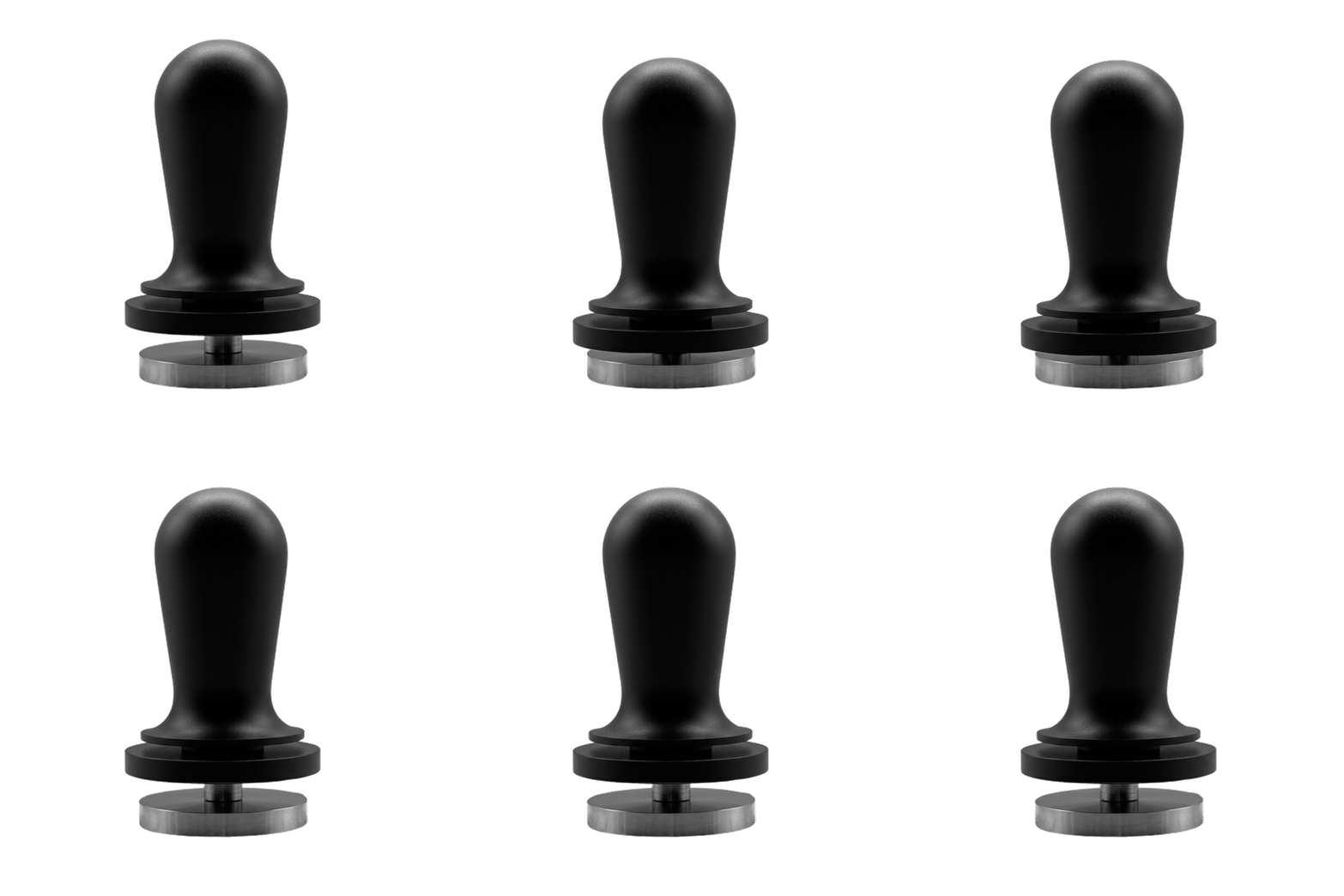
The machine is in the upper price segment (~€5,000). The scope of delivery includes two 58 mm portafilters (double spout and bottomless), matching baskets, a tamper, and cleaning accessories. The included tamper is functional, but a higher-quality tamper (e.g., our Kaffeemacher Tamper) feels better in the hand. Overall, the accessories are solid—neither disappointing nor extraordinary—and cover the basics.
Buying the Sanremo YOU
The following specialist retailers sell the Sanremo YOU, and we recommend purchasing from these companies. All of them offer the possibility to recalibrate the machine's offset.
Germany:
Austria:
We are looking for specialist partners for you whom we know offer good work and good service, and we are in close exchange with the aforementioned dealers. The links are so-called commission links. If you order via one of these links, you won't pay a cent more—but we receive a small commission, which we invest directly in new test equipment.
We are still looking for competent partners in the DACH region for you.
Technical details and operation
With the YOU, Sanremo pursues an innovative technical approach: the brew group and brew boiler are heated separately and PID-controlled to keep the temperature pinpoint accurate. Unlike classic E61 brew groups, water does not circulate permanently; instead, the heavy brass brew group is brought to temperature electrically. The heating system reacts quickly and precisely to fluctuations. In practice, this means the temperature set on the display is reached very reliably in the portafilter—the initial temperature offset was only approx. 0.5 °C in our test. We were even able to fine-tune this minimal offset via a hidden settings menu (Sanremo allows technicians to adjust the offset value ex-works). With a correctly adjusted offset, the YOU brews exactly at the target temperature—deviations are practically imperceptible.
Controlling the pump allows pressure profiles to be called up manually or programmed. There are modes for constant pressure (e.g., classic 9 bar) or constant flow, as well as freely definable profiles with pressure ramps and drops. In the test, we experimented with various profiles: from gentle pre-infusion with low pressure to fast flow profiles for "turbo shots." All settings are made via the display on the top and a rotary knob. The menu navigation is logical but requires some getting used to—the Sanremo YOU is clearly aimed at experienced users who enjoy tinkering. For beginners, the wealth of options might seem overwhelming at first. While there are no superfluous gimmicks, one should be prepared to engage with the subject matter (temperature, pressure, flow) to fully utilize the potential. According to the manufacturer, an app connection is planned but is not yet available (as of this test).
A positive aspect is the convenient standby mode: The machine can switch itself off automatically after a defined time or switch to an energy-saving mode—good for safety and the electricity bill.
In terms of usability, the YOU convinces with thoughtful details: the brew buttons or the rotary knob react promptly, and the display is large and easy to read. The current boiler and brew group temperature are shown, as well as brew volumes and times. Creating your own pressure profiles via the menu requires some practice—an accompanying app would be desirable here to make configuring complex profiles easier. Nevertheless, after a short familiarization period, it is possible to create profiles or control them manually. Those who prefer to brew espresso without much technical effort can also simply operate the YOU like a classic machine: It has a brew button that can also be used to simply run at a constant 9 bar pressure if required. In this respect, you are not forced to change parameters every time—you can, but you don't have to. In everyday life, we often used a standard profile and only fine-tuned it for specific coffees.

Temperature stability: new reference values
Temperature consistency is the great strength of the Sanremo YOU. In our lab test, we measured the machine according to both the Kaffeemacher protocol (individual shots with breaks) and the demanding WBC protocol (14 shots in rapid succession). The result: No machine on our table has been as stable as the YOU so far—neither in moderate operation nor under full load.
In the WBC stress test, the brewing temperature remained remarkably constant across all shots (standard deviation: only 0.36 °C). The curves of the individual shots are practically on top of each other—proof of the excellent temperature control. The YOU also shone in the normal brewing scenario (with heating phase and pauses between shots): The deviation between the set temperature and the actual temperature in the filter basket was less than 1 °C after a short warm-up time. Even the first espresso after a 10-minute warm-up time came out of the brew group at almost full temperature. The subsequent shots showed no significant fluctuations at all. We have rarely experienced anything like this before. For comparison: with many dual boilers and E61 machines, the first shot often looks much cooler than the following ones—not so with the YOU.
The question of temperature offset was important for us: How big is the difference between the displayed target temperature and the actual brewing temperature in the coffee puck? Here we could give the all-clear—after a minimal correction, it fit perfectly. An offset of about 1 °C was set ex-works; we adjusted it to 0.5 °C in the service menu. As a result, the display practically matched reality (e.g., 93 °C target resulted in about 92.8 °C actual). This value remained stable both at the beginning of the shot and towards the end. The YOU reaches its target temperature at the start of the shot very quickly and keeps it stable until the pump is switched off. The temperature curve of every espresso in our test was like a board—no sagging, no overshooting. That impressed us.
As a small conclusion on temperature, we can state: Here, the Sanremo YOU plays in the absolute top class. Even more expensive catering machines or designated competition machines rarely show such consistent performance. Home baristas will love the reproducibility—once the parameters are found, espresso after espresso can be extracted at the same temperature. For our rating, this means almost full marks in this category.

Heat-up time and energy consumption
The Sanremo YOU is not a quick sprinter when heating up—despite modern technology, the heavy brew group needs some time until everything is thoroughly warmed through. Although the machine signals readiness visually after only about 5 minutes (the boilers are then up to temperature), you should really let it heat through for longer. In our tests, it took approx. 15 minutes until the brew group, portafilter, and boiler were stable at temperature. You shouldn't start any serious shots before that ("Please don't brew an espresso after 5 or 7 minutes!" was our credo in the test and also in daily practice). After a quarter of an hour, however, the YOU is fully ready for use—still faster than all traditional E61 dual boilers (which often need 20–30 minutes). Tip: Those who want to save time in the morning should use the programmable switch-on time or a timer. Michel, for example, let the machine preheat while brushing his teeth in order to be able to get started right away.
With and without steam boiler: A special strength of the YOU is the option to switch off the steam boiler if required. Via a switch/option, you can let only the espresso boiler heat up. This has a significant effect on energy consumption and heat-up time.
The table clearly shows the differences: Without the steam boiler, our machine was ready for operation in ~15:00 min and consumed only approx. 0.08 kWh until it was ready. With the steam boiler switched on, it took just as long (~15:12 min), but the energy consumption was around 0.22 kWh—almost three times as much. Here it becomes clear that the 1-liter steam boiler needs a lot of energy to be heated up. In pure espresso operation, however, the YOU is at the level of efficient thermoblock machines. A single espresso shot incl. preheating, for example, only consumes about 0.09 kWh (without steam boiler). With the steam boiler, it is around 0.23 kWh for the first espresso (because the boiler is heated up too). Once you have the boiler hot, only approx. 0.014 kWh are needed for every further espresso—a negligibly low value.
In continuous operation, a similar picture emerges: The machine draws about 72 Wh per hour in idle mode (~90 °C boiler temperature maintenance) with the steam boiler switched off. With the steam boiler activated, idle consumption rises to around 131 Wh per hour. This means that over the day, the energy hunger of a permanently switched-on YOU adds up significantly, especially if the steam part is running along. Those who primarily drink espresso and only occasionally froth milk can save electricity significantly by switching off the steam boiler. This means about 50% or more savings in everyday life. Our measurements show that after about 1 hour of idle time, the machine (brew boiler only) consumes as much energy as a re-heat from a cold state would require (~0.08 kWh).
Summarized
Heat-up time ~15 minutes until full stability—that is absolutely fine given the massive brew group.
Energy consumption: very low in espresso mode, moderate to high in dual-boiler mode. This duality reflects a common goal conflict: maximum steam power costs energy. Sanremo cleverly bypasses this problem by giving the user the choice to switch off the steam part when not in use. We find this solved in an exemplary manner. In our assessment, the YOU therefore receives good values in the area of energy efficiency (for a dual boiler)—whoever wants to can operate it extremely sparingly.
Steam performance and milk drinks
Despite the relatively small 1-liter boiler, the Sanremo YOU doesn't need to hide when it comes to steam power. In the test, the machine produced dry, powerful steam with ~1.2 bar boiler pressure. Frothing milk is successful quickly: cappuccino quantities (~120 ml milk) were perfectly frothed in just under 10 seconds. The two-hole steam wand is well-placed and allows precise control of the milk vortex. Several milk drinks in a row didn't make the YOU break a sweat—after five milk portions frothed in succession, no significant pressure drop could be detected. Here, the professional tuning pays off. Parallel use of the brew group and steam wand is also possible without any problems thanks to the separate boiler system: during the espresso shot, you can froth milk at the same time without the brewing pressure collapsing.
For home baristas, this means: If you want to serve several cappuccini in a row at a family celebration, you are well equipped with the YOU. In a small café or at a catering event, the machine can also hold its own—but one should consider that there is only one brew group. Although the frothing performance per cup is excellent, the overall speed is limited by the single group (one barista, one espresso after another). For the intended area of application (home, office, small events), however, we see no restrictions at all in steam and milk performance. We particularly liked that the steam boiler—once heated—maintains a very constant performance. In the endurance test, ~0.9 bar minimum pressure was measured over 10 minutes of continuous steam output, which proves that sufficient reserves are there even with longer frothing.
From a purely technical point of view, the YOU could even handle small catering quantities. Sanremo itself states that the machine is intended for coffee roasters and professionals as a demonstration device—the performance reserves are designed accordingly high.
Design, workmanship, and maintenance
The Sanremo YOU presents itself in a simple, modern design. The housing is angular with rounded edges; the front is dominated by the brew group, the control unit mounted on it, and the spout underneath. It is striking that the massive machine "floats" due to the high and slanted supports. This gives the machine a certain elegance despite its size.
The machine is available in various color variants (including stainless steel, white, black); our test device in stainless steel/black looked very high-quality. Gap dimensions and material thicknesses are exemplary: nothing wobbles, nothing rattles. The drip tray sits stably, but is significantly smaller than the drip tray of a La Marzocco GS3. A small point of criticism:
Behind the facade, the YOU convinces with its maintenance-friendly design. Sanremo has arranged the components modularly: boiler, pump, electronics—everything has its place and is comparatively easily accessible. According to the manufacturer, special emphasis was placed on easy maintenance. In the test, we took a look inside: after removing a few screws, the housing cover can be removed. Underneath, a tidy interior presents itself. The wiring is routed cleanly, and important assemblies are not built-in or hidden, but directly accessible. For example, the rotary pump is easily accessible at the front. Overall, the layout is more reminiscent of a catering machine than a typical household machine—robust and uncomplicated. Although, of course, everything looks compressed due to the size. This suggests high durability. Sanremo also advertises that all materials used are designed for continuous operation and undergo strict quality controls. In the field, there are already reports from users who have been using the YOU daily for several years and notice no problems at all (no leak, no electronics failure, etc.). That makes one optimistic.
Cleaning is also easy thanks to the features: The machine has an automatic cleaning program for the brew group (backflush function at the push of a button). With a suitable cleaning solution (e.g., coffee fat solvent powder), the brew group can be cleaned conveniently. The included blind filter insert and brush round off the cleaning setup. Here, too, you notice: the YOU wants to be used and be easy to care for at the same time.
Espresso in the cup: taste and practice
Technology is one thing—but how does the espresso from the Sanremo YOU taste? The short answer: Excellent, provided the barista knows what they are doing. The machine allows for incredibly consistent and reproducible shots. In our test, we tried out various coffees, from light fruity roasts to classic espresso roasts. A complex coffee from our own farm was particularly exciting: the Doña Margarita Espresso. This coffee shows very different flavor profiles with different profiles. With the YOU, we were able to fully utilize the profiling potential: A shot with a higher flow rate (flow profile) emphasized the lively citrus notes and the slight mandarin sweetness of the Doña Margarita, while a shot with longer pre-infusion and lower pressure produced a denser texture and more chocolate tones. It felt as if we had two different coffees in the cup—just by varying the pressure profile. This gave us a lot of joy and impressively demonstrates how finely the extraction can be tuned with this machine.
It should be noted: The YOU provides the prerequisites for excellent taste—the user has to extract it. Factors such as grind size, distribution in the basket, and tamping, of course, still come into play. However, the excellent temperature stability and pressure control make it much easier to find the sweet spot of a coffee and hit it repeatedly. Once the right settings were found, our espressos were consistently balanced and delicious. The reproducibility is top—shot for shot very similar, which is worth its weight in gold, especially for tastings or for dialing in different coffees.
The machine also fully convinces in terms of taste in conventional use (without unusual profiles). In the standard 9-bar mode, the YOU produced very balanced espressos. We could not detect any off-flavors that might stem from instabilities—bitterness due to overheating or acidity due to cooling did not occur. Compared to Michel's previous machine (also dual boiler, but with significantly less control technology), the espressos from the YOU tasted clearer and more nuanced. Especially with more difficult coffees (light roasts), the YOU was ahead.
Flow and pressure profile control compared to Decent & Maro
The flow and pressure profile control of the Sanremo YOU seems somewhat outdated compared to modern machines like a Decent DE1 or the Maro Model 1. While these high-end devices offer the user almost unlimited possibilities for profile design—with numerous phases, fluid transitions, and intelligent, event-based controls—the YOU is limited to a static three-phase profile. There is a pre-infusion, extraction, and post-infusion phase, which are each programmed with fixed parameters (pressure and either duration or volume). This relative simplicity of profile control makes the YOU seem technically obsolete next to the more flexible competing models.
A significant point of criticism is the lack of fluid transitions between segments. The YOU only knows abrupt pressure jumps instead of smooth modulation. For example, after the pre-infusion time, the machine suddenly jumps to the pre-defined main pressure instead of gradually ramping the pressure to the target value. Likewise, the reduction to the post-infusion pressure occurs without an adjustable ramp: the pump simply drops from, say, 9 to 4 bar as soon as the final phase begins. Such hard transitions noticeably distinguish the YOU from the finely tuned profile curves of a Decent or Maro and do not seem state-of-the-art overall.
Especially the post-infusion phase in the programming appears technically questionable. For the last, say, 15 ml of water output, a fixed pressure is simply specified with which the pump continues to run stubbornly. Towards the end of an extraction, however, the flow naturally decreases and the puck loses resistance—ideally, one would then let the pressure fall gently. The YOU, on the other hand, pumps in the post-infusion at a constantly set pressure until the defined remaining quantity has passed through. It does not adapt to the actual puck behavior but maintains the post-infusion pressure regardless of possible channeling effects or resistance changes. This rigid procedure can lead to inconsistent results and misses the actual purpose of precise profile control at the end of the shot.
Another difference to the profiling systems of the Decent or Maro is the lack of event-based phase changes. With the YOU, transitions cannot be linked to conditions such as reaching a certain pressure or flow—they occur exclusively according to a specified time or volume. Modern machines, on the other hand, allow, for example, ending a phase as soon as either a defined pressure or a defined flow is reached (depending on what happens first). One looks for such intelligent changes in the YOU in vain; the profile runs strictly according to schedule instead of reacting to the extraction process. In practice, this means: if the conditions change (for example due to a different grind size or coffee), the YOU still pulls through its unchanged program. It does not "know" when the puck is fully saturated or begins to slacken—an adaptive intervention as with Decent or Maro does not take place. The user must then manually adjust the profile again because the machine itself does not provide dynamic regulation.
A positive aspect, however, is the manual profile control via the paddle on the front of the YOU. With this, an individual pressure profile can be driven manually in real time—comparable to the operation of a manual lever machine, but implemented electrically via the rotary pump. Via the paddle, the barista controls the pump pressure and thus directly the flow rate during the shot. This "pressure surfing" feels very direct: you can almost react to the extraction process by feel and thus create a desired profile. Once you have created a successful shot in this way, the driven pressure curve can even be saved and stored as a profile. In this way, the YOU combines an analog, direct operating experience with digital reproducibility—something that is definitely a unique selling point in this machine class.
Nevertheless, the paddle does not replace modern profiling logic. The most precise recipes are still best created via the digital input mask. A manually recorded paddle profile is ultimately just a static three-phase program—merely based on an "experienced" progression instead of purely theoretical requirements. Complex automations or intelligent triggers (as offered by Decent & Maro) are missing here. Although manual profiling offers an excellent practical reference and promotes understanding of extraction, for maximum reproducibility and fine-tuning, you cannot avoid working in the YOU's menu. In other words: The paddle is a welcome extension, but not a full-fledged substitute for the sophisticated profile control one expects from truly modern espresso machines.
New software update and connection to Beanconqueror
As of May 27, 2025. Sanremo has followed up with the YOU and is reacting to feedback from the community with a new beta software update. We were already able to test it extensively and summarize the most important changes here.
Better overview and detailed presentation thanks to Beanconqueror
Probably the most significant innovation of the beta version is the connection to the popular Beanconqueror app. This enables extensive and detailed visualization of all relevant brewing parameters: flow rate, pressure curve, brewing temperature, and the weight in the cup are displayed clearly and precisely. It is precisely this visual depth that the original display of the YOU lacked. Particularly positive: The app now allows a brew-by-weight function, which makes it possible to control shots precisely to the gram. This makes brewing much more comfortable and reproducible.
New modes and improved usability
With the new software (firmware version 3.01 Beta), the menu navigation and operating elements have been significantly revised. The user interface now seems clearer, more intuitive, and allows profiles to be named meaningfully. Where there were only cryptic numbers before, coffee recipes can now be saved with meaningful names.
The YOU now distinguishes between two modes: a standard mode, which is particularly useful for uncomplicated operation in smaller catering or catering situations, and a pro mode, which offers home baristas full control and detailed graphics. In standard mode, the control remains reduced to a few basic functions, while in pro mode, all brewing parameters and graphics are displayed.
Profile control extended by blooming function
Another innovation concerns profile control: The beta version adds a blooming function, which is integrated as a fourth instance into the profile progression. This allows for an initial, gentler saturation of the coffee cake before the actual extraction begins.
However, criticism remains appropriate: Although the update allows for a bit more flexibility, decisive features such as fluid transitions (ramps) at the end of the extraction are still missing. A gradual pressure drop (for example from 8.5 to 4 bar) is not adjustable—the transition remains abrupt. We urgently wish for improvements here for the final version.
More direct pump control
The rotary pump has been revised in terms of software and now reacts much more directly and precisely. The immediate response behavior during manual profiling with the paddle has been noticeably improved, which makes operation more pleasant and intuitive. This immediate feedback was a frequently expressed wish of the community and was fortunately implemented.
Conclusion on the beta version
The beta version including Beanconqueror connection definitely brings the Sanremo YOU to a higher level. Especially weight control and improved operation are real added values. Nevertheless, there is still room for improvement: Important aspects such as exit strategies and finer pressure transitions have not yet been solved satisfactorily.
Currently, the new version has not yet been officially released—the final roll-out is expected to take place in the summer. We are keeping an eye on the development and are curious to see whether Sanremo can fully exploit the still-existing potential. Until then, Beanconqueror offers an excellent addition that already gets significantly more out of the YOU.
Conclusion and classification of the Sanremo YOU
In the test, the Sanremo YOU proves to be one of the most powerful single-group espresso machines that we have ever had in our lab. Sanremo has succeeded here in the balancing act of packing professional technology into a home-barista-suitable housing. The YOU offers an impressive list of strengths:
- Temperature stability: Reference class—it hardly gets any better. Consistency and control at competition level.
- Pressure/flow profiling: Freely designable and practical, ideal for those who love to experiment. Not as flexible as Decent or Maro, but still very advanced and with an abundant range of features.
- Workmanship: Robust, durable, maintenance-friendly. A machine for life.
- Flexibility: Tank or plumbed-in, steam boiler switchable, timer/standby—adapts to needs.
- Performance: Brew and steam power range from home use to semi-professional applications.
We face the few weaknesses of the machine relatively calmly: The heat-up time of ~15 minutes requires some planning (but is quite common in the context). Operation is more complex than with simple machines—you have to want to engage with the subject matter. The YOU is less suitable for absolute beginners, but it is not aimed at them anyway. The price of more than €5,000 is high, but measured against what is on offer, it is fair: you get practically a commercial machine in a mini format. Only those who attach absolutely no value to the profiling functions and just want to "pull espresso" might find cheaper alternatives, but they cannot keep up in terms of temperature/pressure stability. And those who wish for the complete flexibility of adaptive profiles as well as condition management for the transition into an infinite number of brewing phases are better advised with machines like the Decent or Maro.
Finally, we classify the Sanremo YOU in our rating category "high-end dual boiler"—as a new benchmark device for home baristas with professional ambitions. The YOU is also highly interesting for specialty cafés that are looking for an additional high-quality 1-group machine (e.g., for training or as a reserve). Michel, in any case, has found his new favorite piece: "This thing is so much fun that I'm happy to overlook the small drip tray." 😄

Overall conclusion: The Sanremo YOU is a direct hit for everyone who wants to brew top-quality espresso at home without making any compromises in technology and control. It combines the best of the world of professional machines with the demands of demanding home baristas. In short—perhaps the new "endgame" in the domestic espresso kitchen. We are thrilled and award the Sanremo YOU a place right at the top of our recommendation list.