






In 2018, we stumbled upon the first espresso machines with thick-film heaters. By 2024, thick-film heater technology has arrived on the espresso and coffee machine market as Flow Through Heater, Fast Through Heater, or ThermoJet. Thick-film heaters have not only overtaken the thermoblock in terms of performance and flexibility, but they are increasingly putting pressure on manufacturers of traditional boiler-based espresso machines.
In 2018, we tested the Sage Bambino from the Australian manufacturer Breville, which operates in Europe under the name Sage Appliances. The machine was impressively fast to reach temperature, but left something to be desired in terms of temperature stability. Shortly after, the Sage Barista Pro was on our test bench, and that was when it became clear: the potential of thick-film heaters is enormous.
Both machines were equipped with a thick-film heater from the Dutch company Ferro Techniek. While Sage introduced its “thick-film heaters” with the trendy marketing name “ThermoJet”, the heating elements are called Flow Through Heaters by the manufacturer itself. How the “Flow Through Heater” works, which machines it is now found in, and what this means for the market is the topic of this article.
Maro, Zuriga, Sage and Co.
What do Maro, Zuriga Generation 2 and Unica have in common with the Sage Bambino and Sage Barista Pro? They share a heating technology: the thick-film heater. And they are in good company. After all, the Tone filter coffee machine, the Aiden Precision Coffee Maker, or the ETNA milk system also rely on the thick-film heater. The list of manufacturers opting for thick-film heaters from Ferro will soon be expanded by two more innovative espresso machines: Roxy Espresso and nunc.
Ferro Techniek
What an amazing success story this Dutch company from Gaanderen in Gelderland has to tell. The company specializes in thick-film heating elements printed on metal substrates, offering tailored solutions for various industries. Ferro is part of the Otter Control Group and manufactures in the Netherlands, Hungary, the UK, China, and in southern China in collaboration with Otter. About 50 employees work at the headquarters in Gaanderen, with another 80 at Ferro Electronics in Budapest. The Otter Group has approximately 1500 employees worldwide.
The story of the Ferro Flow Through Heater really took off in 2013. The manufacturer put together a “developer kit” that contained everything needed to build prototype applications. In addition to the FTH MK2, this kit included a pump, a flow meter, and a control board. This kit was ordered by around 100 companies.
It is interesting to note that Ferro had already developed an older version of the FTH, the so-called “FTH MK1”, back in 2007. However, this could only process a maximum of 2.5 bar of pressure and was therefore used in machines with coffee pads. For brewing espresso, pressure standards of up to 15 bar are required, depending on the pump.
The “FTH MK2”, which is suitable for espresso and can also generate steam for frothing milk, was completed as a proof-of-principle in 2010. FTH production was then ramped up in 2015, with Sage/Breville as a first mover playing a central role in the success story of the thick-film heater.

Power measurement protocol of the Maro Model 1 as recorded by us.
What are the strengths of the thick-film heater?
The thick-film heater has several advantages over boilers and even thermoblock systems.
Fast heat-up times:
The low thermal mass of the FTH enables extremely fast heat-up times, as only a small amount of water needs to be heated. The Maro Model 1, for example, only needs 4 minutes to reach operating temperature. The Zuriga E2 Generation 2 heats up in just 2 minutes. The thick-film heater is ready even faster in both cases. It is the slower thermal elements—like the portafilter—that lag behind the Flow Through Heater.
Energy efficiency:
FTH systems are more energy-efficient than boilers because they heat on demand. This avoids wasting energy by keeping large quantities of water hot. The Zuriga E2 Generation 2 reaches a peak value of 0.058 kWh for 5 double espresso extractions, including the heat-up time. The Maro Model 1, the Sage Bambino, and others are equally efficient. For comparison: many boiler-based espresso machines use 0.2 to 0.5 kWh for 5 espresso extractions including the heat-up time.

Precise temperature control:
The flat design and direct heat transfer of the FTH allow for very precise and rapid water temperature control. This is of critical importance for espresso extraction, as temperature fluctuations can negatively affect the taste of the coffee. The Maro Model 1 sets new standards here and, after just 4 minutes, is already one of the three most precise espresso machines in terms of temperature stability that we have ever measured. This comparison also holds up against boilers that have been heated for a longer period and have reached thermal equilibrium. Interestingly, it is possible to adjust the temperature rapidly both upwards and downwards. With boiler espresso machines, cooling down, in particular, is a lengthy process due to the high thermal mass.
The FTH comes standard with an NTC sensor that measures the temperature in the water channel.
Peak performance during heat exposure:
The true potential of thick-film heaters is revealed during steam generation. The heaters are ready for use within seconds.
Frequency suitability:
The performance of the Maro espresso machine with its 2300-watt FTH shows that the technology is, in principle, also suitable for the catering industry. We observed no loss in performance during either the WBC temperature protocol or frothing.
Compact design:
The small size and flat design of the FTH allow for the development of more compact espresso machines or the integration of the FTH into the brew group, for example, to heat the portafilter. Ferro offers a flat 60W thick-film heater specifically for the group, which can be integrated into the brew group of a portafilter espresso machine.
No wait time for temperature:
The thick-film heater is ready for immediate use. It requires virtually no preheating time. It is the other components, such as the portafilter, supply pipes, and brew group, that first need to be brought up to temperature.
Less limescale:
Ferro states that less limescale builds up in the thick-film heater. Reasons for this could be that no standing water remains in the thick-film heater. In any case, unlike many boiler espresso machines, independent descaling of the thick-film heater is possible.

How do thick-film heaters work?
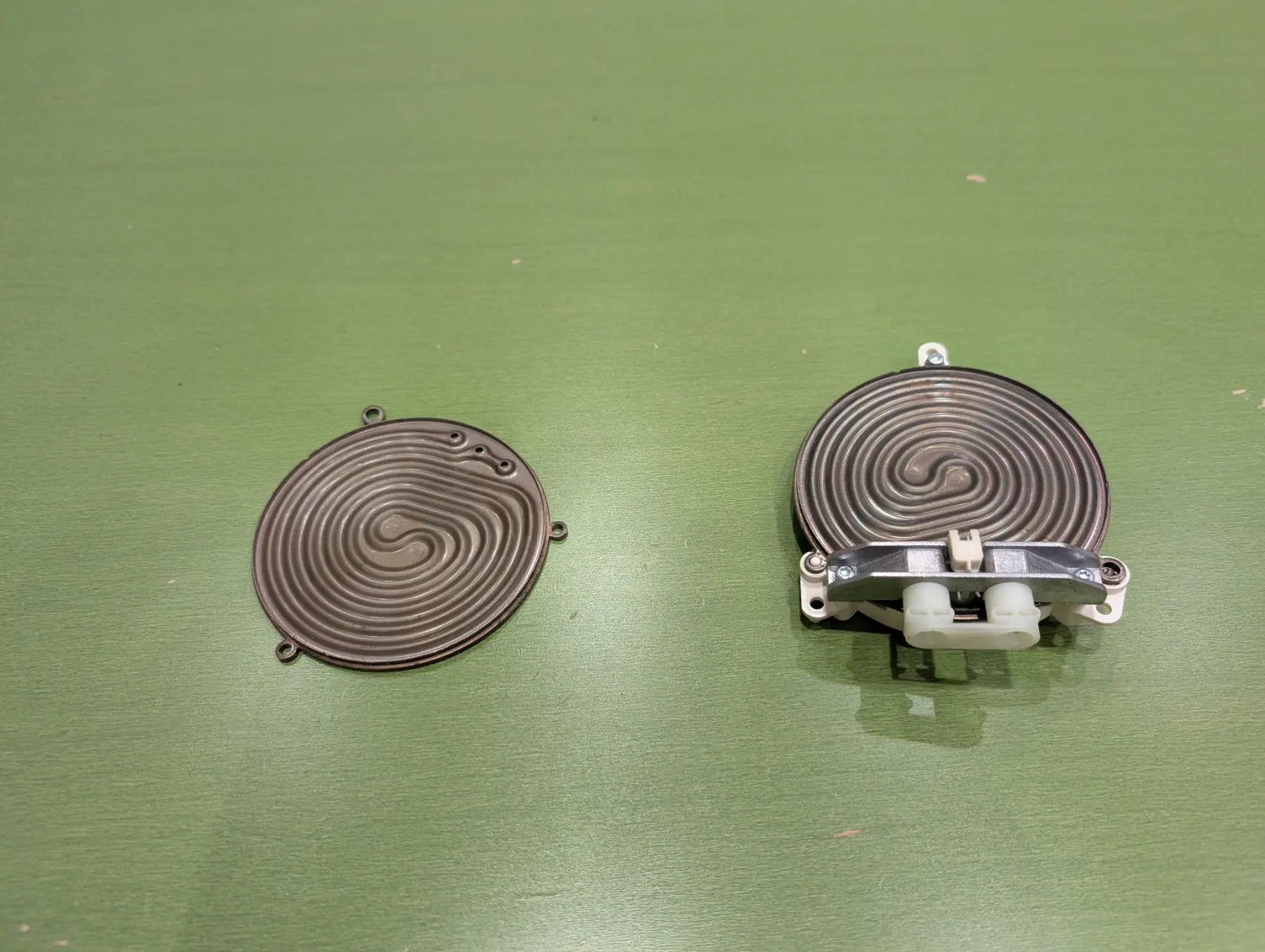
As a rule, the water to be heated flows through a channel integrated into the substrate of the thick-film heater. This channel can have various shapes to optimize the flow of water and maximize heat transfer.
Here are some important points regarding the construction of the channel:
- Material: The channel is usually made of the same material as the substrate, typically stainless steel.
- Shape: The channel can have a simple tube shape or feature more complex geometries to influence water flow and generate turbulence.
- Integration: The channel is integrated into the substrate using special manufacturing processes, e.g., deep drawing.
- Sealing: After the channel is manufactured, the inlets and outlets are sealed to prevent water leakage.
- Connection: The inlets and outlets of the channel are connected to the water supply and drain lines of the device in which the FTH is used.
Integrating the channel into the FTH substrate ensures direct and efficient heat transfer from the heating element to the water. The shape of the channel can be designed to optimize the flow rate and turbulence of the water, which contributes to faster and more uniform heating.

Integration and control of temperature sensors
We have already checked many of the above-mentioned espresso machines for temperature stability. While some manufacturers achieve very precise temperatures, temperatures fluctuate significantly in others. The thick-film heater allows for very precise control and measurement of the temperature. However, a very good control loop is necessary to achieve precise temperatures.
The integration of temperature sensors and the associated precise control are decisive aspects for the optimal functioning of thick-film heaters (FTH). They enable precise monitoring of the temperature and dynamic adjustment of the heating power to keep the desired temperature constant.
As a standard, an NTC temperature sensor is housed in the water channel to record the temperature of the flowing water as accurately as possible. There are various placement options. This method offers the highest accuracy but requires waterproof encapsulation of the sensor.
Alternatively, the sensor can be attached to the surface of the substrate near the channel. This method is simpler to implement but may lead to lower measurement accuracy.
A control loop is used to regulate the heating power, which compares the measured values from the temperature sensor with the setpoint and adjusts the FTH heating power accordingly.
Modern FTH systems often use microcontrollers to take over control. These allow for highly precise and flexible regulation of the heating power depending on various parameters, such as:
- Water temperature: The microcontroller monitors the water temperature in the heating channel and adjusts the FTH heating power so that the desired temperature is reached and maintained.
- Water flow rate: In some applications, such as in coffee machines, the water flow rate can vary. The microcontroller accounts for these fluctuations and adjusts the heating power accordingly to ensure the desired outlet temperature.
- Time-dependent control: In some applications, it may be necessary to vary the water temperature over a certain period. The microcontroller can precisely control these time-dependent temperature profiles, e.g., to create optimal brewing conditions for different types of coffee.
The integration of temperature sensors and microcontroller-based control enables highly precise and flexible temperature regulation in FTH systems.
This makes these systems an ideal solution for applications requiring fast and accurate heating of water or other liquids, such as in coffee machines, kettles, and industrial processes.
Different systems, different FTHs
Even among the espresso machines we have tested, we have encountered different Ferro Flow Through Heaters. While the Maro uses the strongest possible 2300-watt element for our circuit, the Sage Bambino makes do with the FTH II 1500 W. Zuriga, in turn, uses a 1400-watt model for steam generation and brewing, as well as a 600-watt model in the group for heating the portafilter.

Challenges and future prospects
The precise control of FTH presents a challenge because they react very quickly, and temperature fluctuations can occur if the control is not optimally tuned. Unlike a boiler, there is almost no thermal mass to help stabilize the target temperature.
This requires sophisticated sensor technology and control engineering. We see that this is not always successful, especially with some early models from Sage/Breville. Sage deserves a great deal of credit for the effort put into integrating this technology into the mass market. While fluctuations were to be expected with the first models like the Bambino and Barista Pro due to the new application of the technology, there was plenty of time to make development steps. However, our initial tests of the Sage Oracle Jet indicate that there is still room for improvement.
Meanwhile, other manufacturers like Zuriga and Maro demonstrate the enormous potential that thick-film heater technology holds for espresso machines. The technology is versatile and is suitable for heating brew water, generating steam, and for heating the brew group and portafilter.
I am convinced that a new era in the espresso machine market has begun with the thick-film heater. Especially for home espresso machines, the thick-film heater offers exclusively advantages over boiler systems.
It may be different in a professional catering context, although we are excited to see the first uses of thick-film heaters there as well. Tone is working on developing a professional espresso machine with a thick-film heater, and the performance of the Maro is, in principle, also suitable for catering. The machine only lacks a direct water connection and drain. The performance of the thick-film heater was stable even at high frequency and during the execution of the WBC protocol.
Machines with thick-film heater
This list is being updated. If you find more machines with a thick-film heater, please write to us in the comments:
- 2019: Sage/Breville Bambino (FTH II 2300W)
- 2018: Sage/Breville Bambino Plus (FTH II 2300W)
- 2020: Sage/Breville Barista Pro
- 2021: Sage/Breville Barista Touch
- 2022: Unica Pro (FTH II 1800W, to be clarified)
- 2022/23: Tone filter coffee machine
- 2024: Sage/Breville OracleJet
- 2024: Maro Model 1 - (FTH II 2300W)
- 2024: Aiden Precision Coffee Maker
- 2024: Zuriga Generation 2: (FTH II 1400W)
- ETNA milk system
- Tone espresso machine (prototype presented at Host 2023. Launch date still unclear)
- Roxy Espresso
- nunc. coffee
- datum.coffee