






















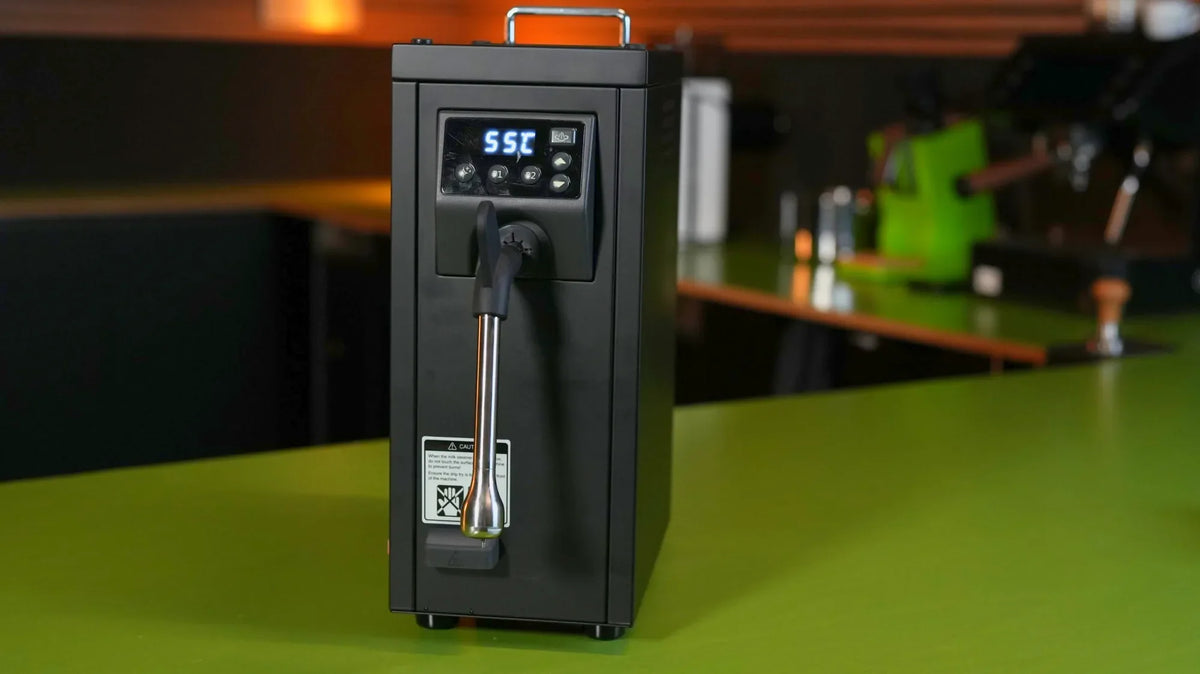

More and more espresso machines don't have a steam wand, perhaps yours either. A single boiler, for example, often makes a very good espresso, but steaming milk is either time-consuming or not intended there. For exactly this gap, there are now standalone steam wands—devices that do nothing but produce steam. The WPM MS-130T is such a device. It costs around 450 euros, works with a thermoblock, and has a temperature sensor in the wand that shuts off the steam as soon as the milk reaches its target temperature. Michel Indelicato, vice-barista champion from our team, steamed with it, took measurements, and poured latte art. We wanted to know how much power it has, how much water ends up in the milk, and whether we can recommend it to you.
Size and Construction: 35 × 35 × 14 cm and just under 7 kg
"Small device" was a bit understated. At 35 centimeters deep, 35 centimeters tall, 14 centimeters wide, and just under 7 kg, the MS-130T has the size of a chunky grinder. For a device that essentially consists of a water tank, a thermoblock, and a steam wand, that's a lot of bulk.
Opinions differed on this point. Next to an espresso machine at home, it looks very bulky. The counterargument came quickly anyway: others put a thick air fryer in their kitchen, which also isn't particularly aesthetic and probably runs less often. The housing is simple enough to seem timeless, and the display looks like an old alarm clock from the nineties.
The material quality is a different league compared to the Morning Dream, which we also tested and which feels more like a capsule machine with its plastic housing. The MS-130T is cleanly made, and we found no sharp edges. The water tank holds 0.8 liters. In the small drip tray sits a small float that's meant to warn of overflow.

Technology: Thermoblock, one-minute heat-up time, 4 bar
After one minute, the MS-130T is hot. That's fast for a thermoblock, even though a thin-film heater like in the Morning Dream is ready almost instantly. In return, the WPM has 4 bar of pressure available. However, you shouldn't compare this value one-to-one with 4 bar on an espresso machine, because there it would be the pressure in the steam boiler, and with 4 bar boiler pressure the milk would fly around your ears. Here the pressure comes from a pump that generates the steam. In practice, the performance is on the level of a good to very good home machine whose steam boiler stands at 1.2 to 1.4 bar.
Using the buttons, you select a target temperature between 40 and 90 degrees. This also works for hot chocolate or other drinks that should be hotter than a cappuccino.
Steam Power: 60 Degrees in 35 Seconds
We always measure steam power the same way: milk at refrigerator temperature, about 8 degrees, is brought to 60 degrees without air incorporation so the value remains comparable. The MS-130T needs 35 to 36 seconds for this. If you draw air while steaming, you're at the 30-second mark. That's good, really good.
A commercial machine that does this in 15 seconds is faster. Michel feels comfortable in a range of 30 to 35 seconds where you can texture the milk in a controlled way. There's more than enough power for clean circulation, almost too much, actually. After one or two seconds the milk is rotating, and Michel even had to pull back the pitcher with only minimal tilt because the circulation was so vigorous. His only wish would be a setting to reduce the power for a single serving. But you can balance this well through the positioning of the pitcher.
Condensation Water: 17 Grams per 250 Grams of Milk
Thermoblocks and thin-film heaters often have the problem that a lot of condensation water comes out when first switched on. With the MS-130T, we catch 1.6 grams on the first purge, so practically nothing. The steam is, if you can say so, bone dry. Michel likes to dampen his cloth with the first purge on espresso machines, and that simply doesn't work here.
What's more important is how much water gets into the milk during steaming. From 250 grams of milk we get 267 grams, so we've added 17 grams of water. That's just under 7 percent. We know around 10 percent from many home machines; the Morning Dream comes to about 20 percent with its thin-film heater and higher temperature setting.
Once an espresso machine developer told me point-blank that they deliberately chose a boiler because a thermoblock fundamentally brings too much water into the milk. The MS-130T is proof to the contrary.
Taste: Sweet, Creamy, Concentrated
Because barely any water is added, the milk doesn't get diluted. You retain its sweetness and texture, and you can taste that. We steamed pasteurized milk of biodynamic quality, and the pure milk foam was already sweet and creamy. In the flat white with our Apas espresso, a malty drink with a nice hazelnut note ended up in the cup that tastes exactly like a milk drink that everyone likes.
A small side thought for gastronomy: There are still establishments that serve UHT milk. If you want to improve your milk drinks, you should start there first.
Temperature Sensor: Shut-off Accurate to ±1 Degree
Two buttons can be assigned their own temperatures. Michel saved 60 and 55 degrees because he likes to steam milk to 55 degrees, sometimes even just 50. The milk stays sweeter that way, the foam doesn't get so dry, and the coffee comes through better. At world championships we've been seeing this trend toward lower milk temperatures for a while now. Our German barista champion Felix Hohlmann, who represented Germany at the 2026 WM in Panama, also steamed at 50-degree milk temperature.
We measured the shut-off temperature with our own sensor. The deviation was ±1 degree, which is very precise for milk. You can see the sensor as a small pin at the tip of the steam tip.

Plus there's a cleaning button that purges the wand. That takes a relatively long time, but purging once before and once after steaming is a good idea anyway.
Automatic Steaming: Place Pitcher and Let Go
With the temperature sensor you can simply put the pitcher under the wand, not touch it again, and let the device make the milk foam by itself. Important: Position the wand not exactly in the center, but slightly to the side, and according to Michel's experience with our pitchers rather toward the handle than toward the spout (see also in the video). It takes a bit of courage the first time because you feel like it's about to splash out. But that didn't happen in our tests.
The steaming result is really impressive. The foam is reproducible as long as you maintain the same position, and it reliably lands at the right temperature. Beginners often steam too hot. For our latte art courses we find the steamer exciting: when the machine does the steaming, participants can focus entirely on pouring and at the same time experience how the target texture of good milk foam looks and feels when steaming. How the pouring itself works is shown in our guide to latte art at home.
Learn Latte Art in Switzerland
Don't want to practice pouring alone? In our coffee schools we offer latte art courses; in Switzerland, for example, the course for home baristas. To the latte art course
But the auto mode has its limits. With a small pitcher for a single espresso macchiato, the wand ends up well outside the milk at the end. Even for a single cappuccino, the roughly 200 milliliters that the auto mode works cleanly with is actually too much. The device is made more for two servings in auto mode; for a single serving you're better off steaming by hand. By the way, we steam with our own milk pitchers: the small one was designed by Felix Hohlmann, German barista champion, and the large one by Michel, because the two prefer different spout shapes and Michel likes to pour with the large pitcher while Felix prefers the small one.
Oat Milk: Shut Off at 50 Degrees
The MS-130T also works with oat drink. We programmed a button to 50 degrees for this: hold the button, count down to 50, release, and a brief signal confirms the setting. Even though the display looks like it's from 1995, the operation is self-explanatory. With oat drink we pull less air and let the device shut off earlier, which shortens the steaming time. The foam is a bit more liquid, so you have to pour more carefully, but that's often the case with milk alternatives anyway. The result was definitely top-notch.

The Weakness: a Stiff Steam Wand
The biggest criticism of the steamer for us is the inflexible wand. The steam wand moves only stiffly and has little range. Once it's in position, it stays there, but threading in the pitcher isn't entirely simple because the rotation radius is very limited. For hand steaming we recommend pulling the wand all the way forward or leaving it all the way up. Then you have enough space and only need to tilt the pitcher slightly.
Smaller points come up too. In auto mode you can't set whether you want thicker or thinner foam; the result is always at latte art level. If, for example, you want classically thick cappuccino foam, you have to steam by hand. Also not so nice: the large steam wand surface hides somewhat whether it was really wiped completely clean due to its shape.
Gastronomy and Catering: More as Backup
We found the question interesting whether the MS-130T makes sense in a small gastronomic setting. We know situations where a one- or two-group espresso machine can't keep up with the steam because seasonally there are many lattes macchiato or a lot of hot chocolate. Without a fixed water connection and without a drain hose, we don't see it as a permanent fixture in gastronomy despite its potential, even though the 0.8-liter tank manages quite a bit. As a backup, however, the steamer makes sense. If you're planning a catering where nothing can fail, you might carry this steam wand in the car alongside the espresso machine in the future.

Conclusion
The WPM MS-130T is a large box with a display that conveys little aesthetic elegance, but impresses with its performance. After a minute the steamer is ready, brings milk to 60 degrees in 35 seconds, adds less water at 17 grams per 250 grams of milk than many home machines, and shuts off accurate to ±1 degree. The foam is sensational, and you can pour latte art in any quality with it, whether by hand or in auto mode. The weaknesses lie in the stiff wand, the auto mode that demands too much milk for a single serving, and the lack of influence on foam consistency when you're not steaming by hand.
Who should get one? Anyone who has a really good espresso machine without a steam wand, like a single boiler that's spot-on temperature-wise, and who eventually realizes that they do want cappuccino or flat white. Instead of a new machine, a separate steam wand is enough, and it looks great next to a larger espresso machine. Next to a Roxy the steamer and machine then compete over which one is actually bigger. At around 450 euros though, the steamer isn't cheap—that's a bit more than the Morning Dream at around 400 euros. But you get more power, better materials, and significantly less water in the milk. We've written down which machine actually suits you in the espresso machine buying guide.
Technical Data at a Glance
| Feature | Value |
|---|---|
| Price | approx. 450 euros (as of October 2026) |
| Heating system | Thermoblock |
| Heat-up time | approx. 1 minute (measured) |
| Pressure | 4 bar via pump |
| Heat-up 8 → 60 °C without air incorporation | 35–36 seconds (measured) |
| Condensation water on first purge | 1.6 g (measured) |
| Water intake | 17 g per 250 g milk, just under 7% (measured) |
| Accuracy of shut-off temperature | ±1 °C (measured) |
| Temperature range | 40–90 °C |
| Memory locations | 2 |
| Water tank | 0.8 l |
| Dimensions (W × H × D) | 14 × 35 × 35 cm |
| Weight | just under 7 kg |
| Power | 1,450 W (manufacturer specification) |
As always, we purchased this device ourselves. This test was not requested by WPM.



