




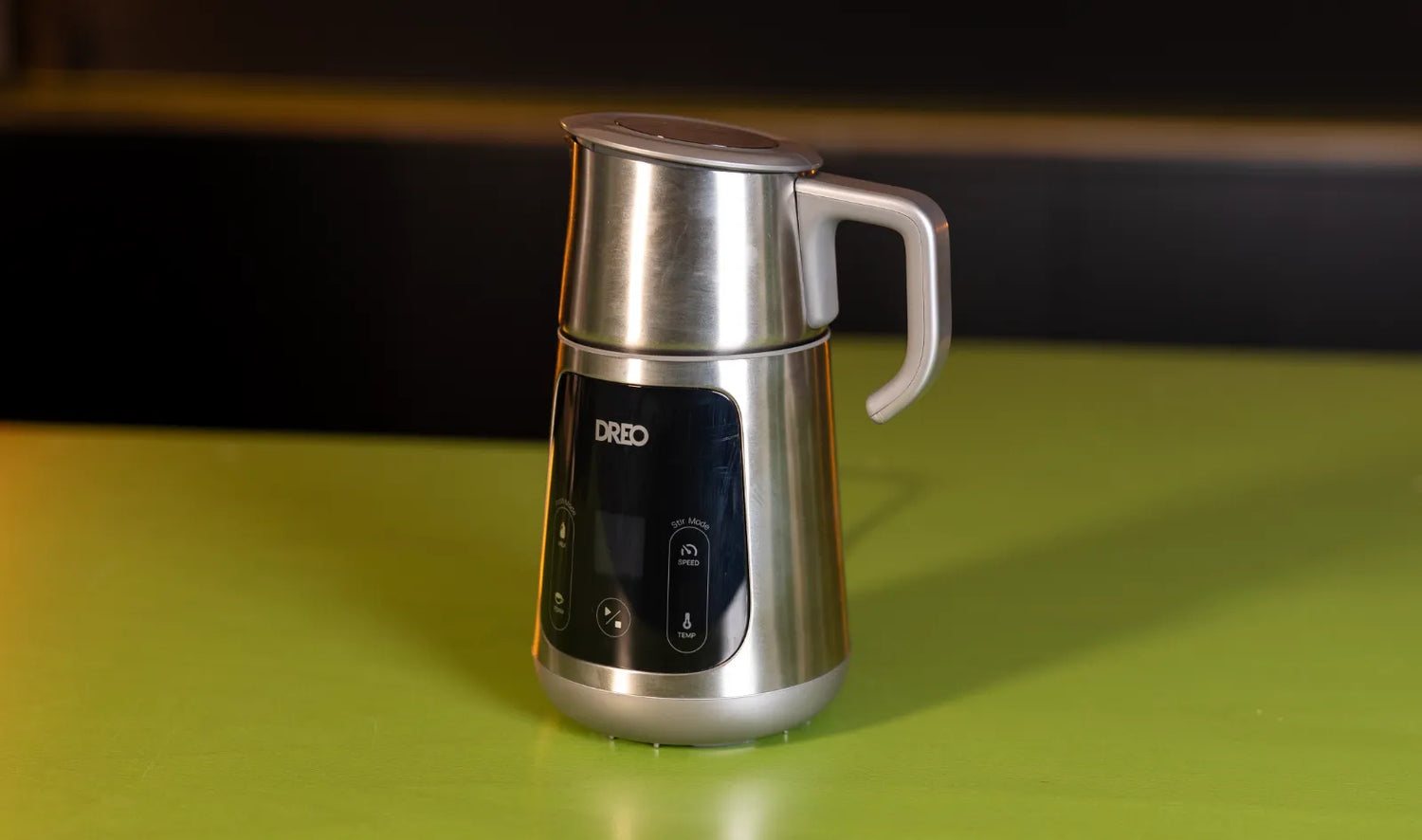

Good milk frothers are interesting! We wanted to know: is the DREO BaristaMaker Milk Frother any good? Because if so, it opens up countless possibilities for preparing cappuccinos with latte art.
Perhaps you have a manual espresso brewer at home like the Flair, the 9Bar, or a Picopresso? Who hasn't stood in front of one, feeling frustrated, wanting to make a cappuccino for a friend? Maybe you also have a single-boiler machine like the Quick Mill Carola because you don't drink milk yourself? The DREO could be the answer. And even next to a Moka pot, the DREO milk frother could cut a fine figure, if… well, if the milk foam works.
Microfoam of varying creaminess
The DREO essentially has two main areas of application, although only one is of interest to us. It can froth milk and milk alternatives, and it can heat and mix milk. Mixing and heating is intended for things like preparing hot cocoa. The practical thing about DREO is that the milk doesn't burn because it is constantly being stirred.
For us, however, it is primarily the milk frothing function that is interesting, which can be set on the left side of the BaristaMaker. There are four different foam levels:
- Thick
- Cold
- Cappuccino
- Latte
- Flat White
While Thick, Cappuccino, Latte, and Flat White produce thinner foam in descending order, “Cold” allows you to froth cold foam, which has an airy texture not suitable for latte art.
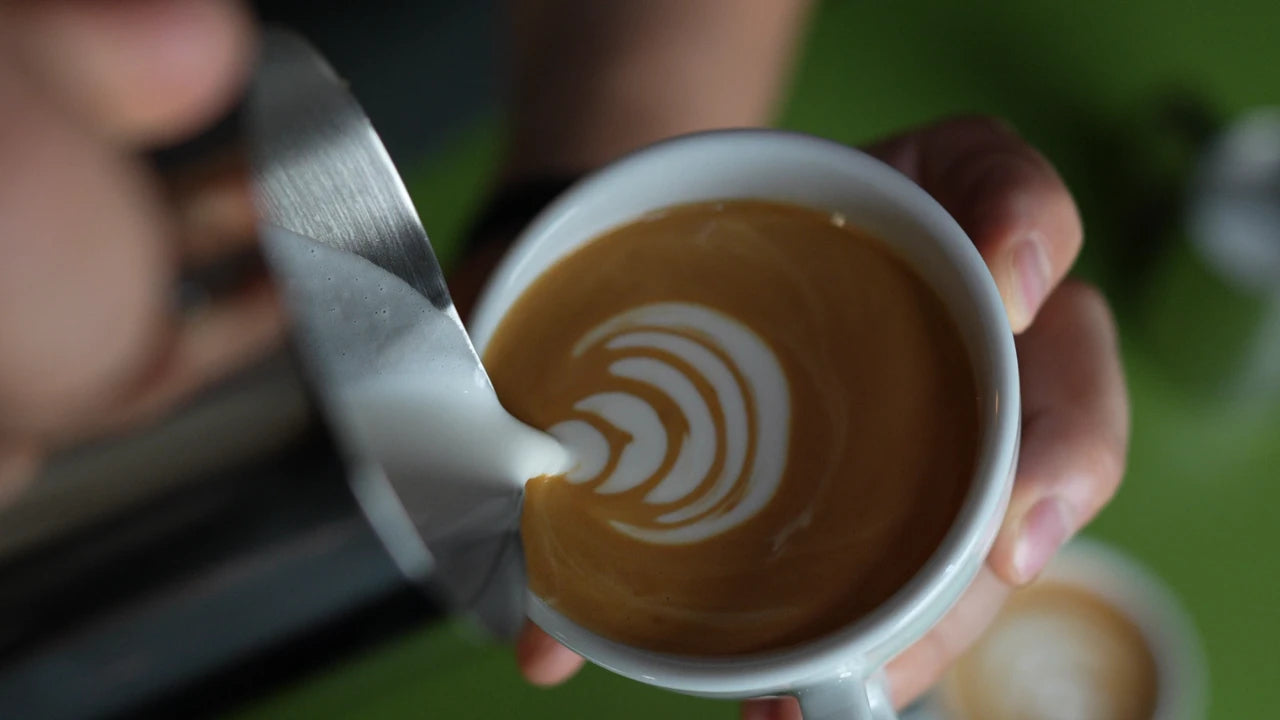
There is no golden rule for which foam thickness to use. Generally, we can say that all levels produce excellent microfoam. It is very silky, creamy, and shines with a smooth surface when poured as a cappuccino or flat white. The quality of the milk foam is excellent.

Frothing tips and recipes
Depending on the choice of milk and the quantity, we recommend different frothing levels. You absolutely have to try this out for yourself with your own milk or milk alternative.
Basically, we can say that for larger quantities of milk over 200ml, firmer frothing (Cappuccino or Thick) worked better for us. We also chose thicker foam levels for oat milk.
With 150ml of cow's milk frothed on the Cappuccino level, however, the foam was almost too thick, and we would advise against frothing it too intensely.
You can find a list of good oat milk here.
In general, according to the manufacturer, the following milk alternatives can be frothed:
- Milk
- Almond
- Oat
- Coconut
- Soy
- “Half and Half”

Milk temperature
After extensive testing, we concluded that the milk is consistently heated to 64 to 67 degrees Celsius. In our view, this is at the upper limit of what we would recommend. Such a temperature is not too hot; however, sometimes frothed milk can turn slightly dry in flavor at temperatures above 65 degrees, causing it to lose some sweetness.
It is important for us to emphasize that we have likely tested the first DREO unit with a Schuko plug and 220/230 volts for the European market. It is not unlikely that the device could still be slightly recalibrated for this region.
Our YouTube test colleague Aramse tested the DREO BaristaMaker with 120 volts for the American market and found the temperatures to be a bit too low. We are curious to see how the DREO performs when it is rolled out in Europe.
At the moment, we would advise not to close the included lid, as the DREO heats up an additional two to three degrees higher when closed. Also, the milk pitcher should be removed from the heating plate immediately after heating.
The DREO is currently not yet available in Europe but can be pre-ordered via Amazon*.

The big 'but': frothing time
The DREO has largely convinced us. The only drawback is the slow frothing time compared to a classic espresso machine. 3:30 to 3:45 minutes is required for heating and frothing.
- The slowest espresso machine we have tested so far has a frothing time of about 1 minute and 45 seconds.
- Many classic machines take between 45 and 75 seconds.
- Faster machines froth in 20 to 40 seconds.
- The DREO takes three minutes for this.
However, this is offset by the fact that espresso machines themselves need to heat up first. If we start the DREO BaristaMaker in parallel with the preparation process for brewing with the Flair or after 4 minutes of brewing time with the 9Bar, our milk foam is likely ready by the time the espresso is in the cup.
If you want to learn how to pour and froth for latte art and cappuccino yourself, check out our Latte Art classes!
Wishlist for the future
Nevertheless, we are adding a slightly faster frothing time to our wishlist. However, that goes to the bottom of the list. At the top, we write that we would like to be able to set the temperature when frothing milk. That shouldn't be too difficult anymore. The function is already implemented in the DREO for the mix mode. If that could now be applied to the frothing capability, that would be a dream.
💡Do you want to learn how to pour latte art on a cappuccino? We explain how it's done here.
Cleaning is a big plus
Cleaning the DREO BaristaMaker is simple and practical. The removable pitcher, which in theory could also be used to pour latte art, can be removed and washed in the dishwasher. That is very practical. The same applies to the other parts such as the impeller attachment for microfoam and the disc attachment for "frothy foam".
Since the handle of the integrated pitcher is relatively bulky and the spout doesn't guide the milk well enough, we used our own pitchers for pouring latte art. Our barista trainer Michel Indelicato developed his own pitcher, which he used in our tests.

Energy measurement
The power consumption of the DREO is 0.0239 kWh for heating 240 ml of milk. This is generally higher than the measured value for frothing milk with a portafilter machine (San Remo YOU: 0.0213 kWh, Ascaso Steel Duo PID: 0.0118 kWh). However, if you include the heating process, the power consumption of espresso machines is far higher than the DREO (San Remo YOU: 0.2431 kWh, Ascaso Steel Duo PID: 0.06612 kWh). But, of course, we don't just want hot milk; we want to drink cappuccino. The most economical combination here would be: switch off the machine's steam boiler and froth the milk with the DREO.
If we compare dual-boilers, heat exchangers, or thermoblocks with the DREO, heating milk with a milk frother is more efficient than heating the steam boiler.
Conclusion: DREO BaristaMaker Milk Frother
We have a very positive impression of the DREO milk frother. Above all, the result—the milk foam—is truly excellent and knows no limits for your latte art!
Yes, the frothing process takes time. But if the espresso is being prepared or the espresso machine is heating up during that time, this does not seem like a real obstacle to us.
Adjustable temperature settings for milk frothing would be desirable. Slightly colder frothed foam is often sweeter and goes well with many coffees!
We really like the dishwasher cleaning option. The removable pitcher, however, is a bit bulky, and the entire frother itself is quite large, measuring 13.5 cm in width and 24.5 cm in height.
The name is also somewhat unwieldy, which in the English original is the DREO BaristaMaker Milk Frother. But the short form fits well, too. We will simply affectionately call our milk frother DREO.
Where to order and affiliate link
As always, we bought this test device ourselves, directly in the USA. DREO can now be pre-ordered via Amazon. According to the manufacturer, delivery in Europe is planned for later this year.
Attention: make sure to order a version for Europe with 230 V and alternating current.
* This is an affiliate link. If you order the DREO via this link, it won't cost you anything extra. However, we receive a small commission, which we reinvest into test materials.