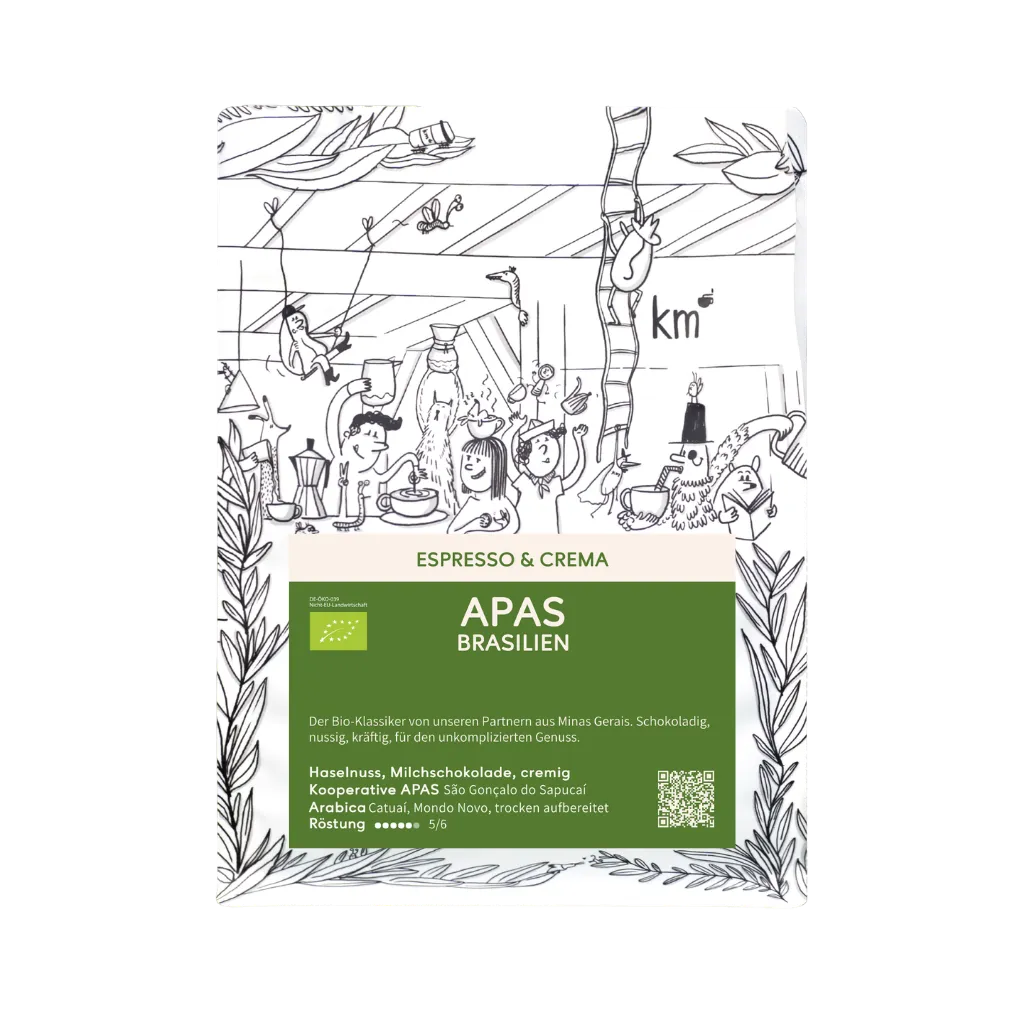

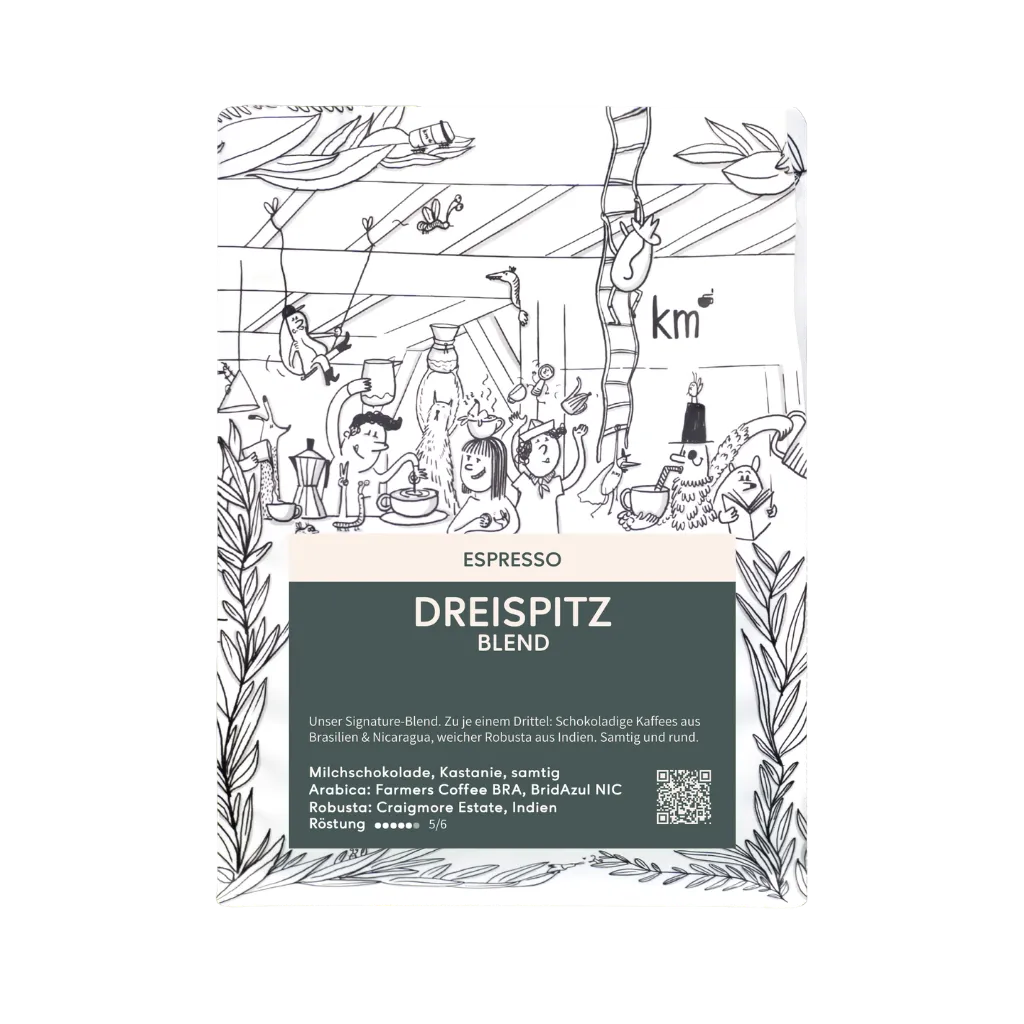
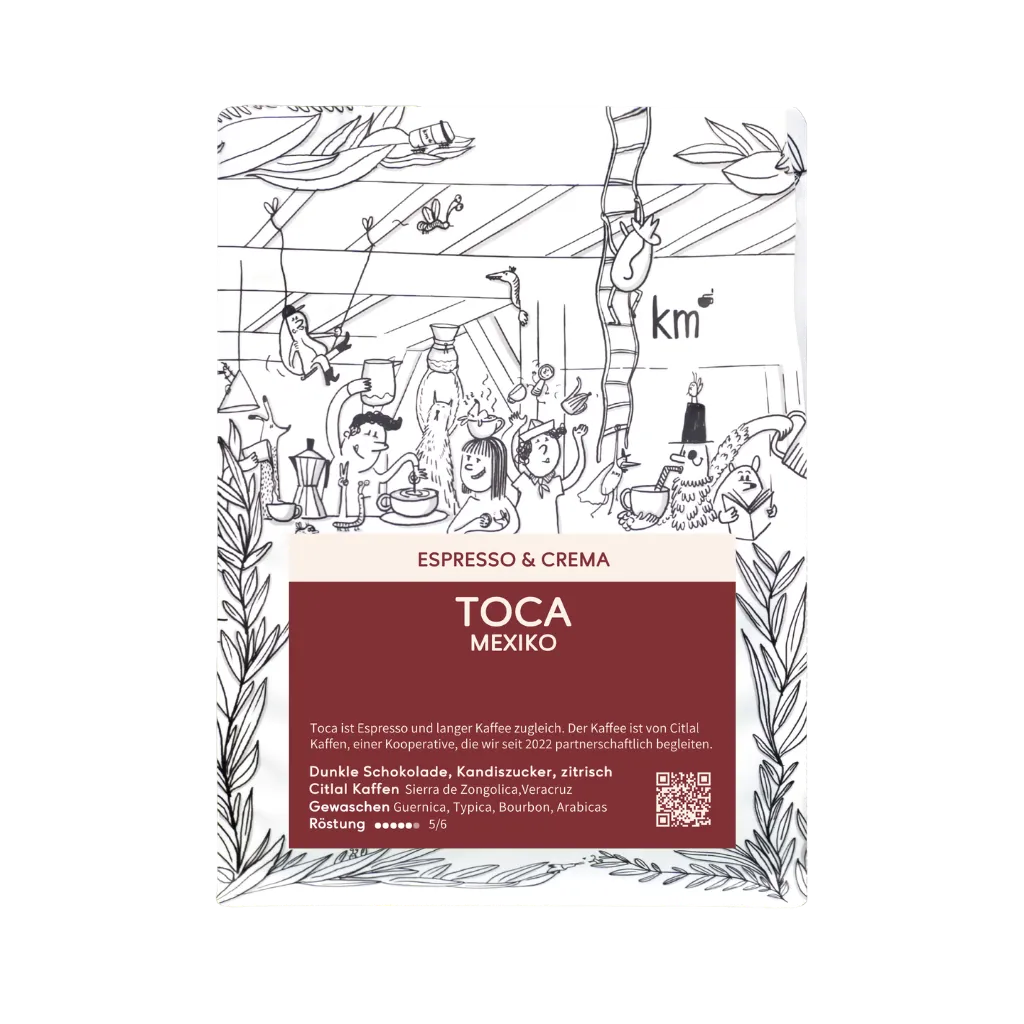

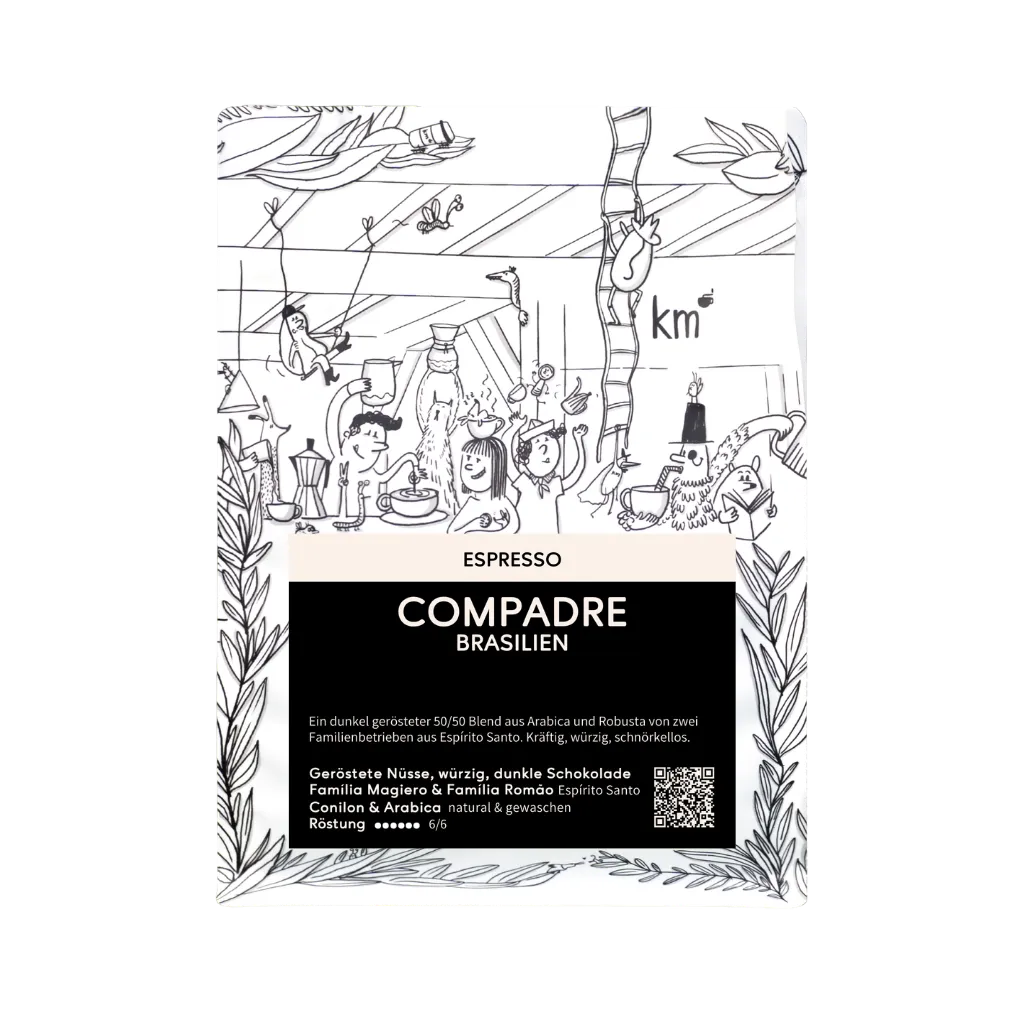


We have new coffee packaging. We conducted a lot of research for this and co-developed the bag ourselves. Our current solution keeps the coffee fresh for even longer and produces fewer emissions. Packaging is a continuous process of optimization, which is why we continue to develop in this area as well. Here, we describe everything we have learned, which packaging is sustainable, and what you can look out for when buying coffee.
In an ideal world, we wouldn't need packaging. In our coffee cosmos, however, we ship more coffee than we physically sell in our two cafés in Basel. For our purposes, packaging is a must to be able to ship the coffee at all, to preserve its quality, and to guarantee food safety.
At the same time, packaging serves as a carrier of information: a brand design leaves a lasting impression, and via the labels, we can describe the coffees, convey their stories, and whet the appetite for enjoyment.

Our "new ones" - 250g and 1000g made from mono-material: 60% renewable raw materials based on mass balance, 30% recycled plastic based on mass balance, and 10% new plastic.

When we look at packaging in the world of coffee today, we see a wide variety of perspectives, especially in the specialty coffee industry, regarding what coffee packaging can and should do.
We see pragmatic approaches in packaging that simply do exactly what they are supposed to - make the coffee transportable. We see approaches where it is more about pure design: especially when a lot of material is used. And then we are seeing more and more ideas on how packaging can be made at least recyclable, but even better, circular.
In the best of all worlds, there would be packaging that addresses all the mentioned criteria:
airtight, pleasant to hold, circular, and stylish.
With this idea, we started on a long learning journey. It is not yet finished, but we have been able to develop a clear image and a clear stance on what properties good coffee packaging must have, and what makes no sense to us.
We have a focus on continuous improvement in everything we do. Sustainability is also the focus for our packaging.
How high are the environmental emissions of coffee packaging?
In the total calculation of our emissions from 1kg of roasted coffee to the moment a coffee bag leaves our roastery, the packaging itself accounts for just about three percent of the total emissions.
In our case: the packaging amounts to "only" 3% of coffee emissions
In the first chart, we look at the emissions we cause at the Basel roastery. In 2023, all packaging used accounted for 16.7% of all roastery emissions.

Emissions of Kaffeemacher:innen roastery in Basel, 2023

The figures refer to the 22/23 harvest at Santa Rita, Nicaragua.
We know exactly where we have the biggest levers to reduce emissions in a coffee chain: in cultivation, and not in the coffee packaging. But: where we are, we can bring about rapid change with what we know. And that is why we must also constantly improve the packaging.
One aspect that we do not want to ignore when developing sustainable packaging is the look and feel. The emotions we experience when we see, hold, and feel specific packaging influence our purchasing decisions.
And that is sometimes somewhat absurd:
- Paper-like packaging can suggest that the roasted coffee is sustainable, even if there is no connection. The coffee could have been produced in a totally unsustainable way.
- The opposite is also possible: highly sustainably produced coffees are sold in aluminum packaging, which is by far the most environmentally harmful (see chart below).
So we were looking for packaging whose appearance matches the contents. Sustainable coffee must go into sustainable packaging.

Aluminum performs the worst in terms of emissions, but has the best freshness retention capacity. Design: Tobias Milz, dataset from ecoinvent
New packaging - a process and not a state
In November 2022, we wrote a blog about our new packaging, stating that it was now more sustainable. At that time, we switched from the widespread paper-plastic composite to mono-plastic, with the idea that bags made from mono-plastic would be recycled and we would thus have a better climate balance.

Our packaging upgrade from November 2022
Around the same time, we came across an article by the DIW and a sense of disillusionment spread. The thermal recycling of plastics causes approx. 2.7 kg of CO2e, which roughly doubles the emissions over the entire life cycle. Tobi then said casually:
“Well, that was a flop.”
And why exactly?
Because we used a lot of new material, so-called virgin material, based on fossil raw materials. The old and new packaging weighed the same, just under 13 grams. But the new packaging, which was indeed recyclable because it consisted of mono-plastic, used twice as much virgin material as the old packaging.
Learning 1:
The amount of material used is decisive for whether emissions are low. We are seeing more and more recyclable coffee packaging. That is actually progress, designing the packaging so that it can theoretically be recycled for another purpose. But: If only a small percentage worldwide (9%) is recycled and the rest is burned or ends up in the environment, is the idea then productive?
Anecdote:
We met an innovation manager from an energy producer for lunch.
“Don't make even more plastic”
was his input. His company burns household waste to produce district heating, steam, and electricity. However, he said that household refuse is now "too clean" because people are separating their plastic and packaging waste.
Household refuse now has too little combustible mass, so exactly that plastic and packaging waste must be added back for combustion so that the incineration actually works. Alternatively to plastic waste, the mountain of garbage is also sprayed with a petroleum derivative.
“But no recycling is also not a solution”
we heard from various corners that otherwise vehemently contradicted each other. There is, therefore, something of a consensus in science and industry that there must be recycling, but the whole system is still far too underdeveloped, and plastic consumption continues to rise.
Learning 2:
Recycling is not yet a functioning system. And yet we have to do it. The legal regulations are becoming stricter, recycling more widespread, and the pressure for change greater.
And yet we asked ourselves whether recycling fits for us, given that we use even more plastic in the process? Or do we work with packaging that doesn't even have to be recycled?
We set out on a search and conducted more than three dozen conversations with researchers, developers, manufacturers, recyclers, certifiers, other roasteries, and innovators. Our project was internally called: "the best of all packaging".
But we learned: the best packaging does not exist. It is always a snapshot and must be reviewed again and again.
We had an early exchange with a startup that can produce films from by-products of tofu production. It all sounded very good, but the development from the laboratory to larger quantities takes years. We are confident that in a few years, new materials for films will be in use and will also become available for the wider industry.
Learning 3:
We decide on a shape and the properties of the bag, but remain flexible regarding the use of the material. Tremendous progress is happening there right now.

Over more than a year and a half, we contacted a wide variety of material suppliers and had exchanges.
While we were on the lookout for revolutionary materials, we also questioned our requirements and our processes.
- Why do all bags have the same shape today?
- What sizes do we have? Do we need them?
- What are the processes for packing, sealing, and shipping?
- Are the existing dimensions the right ones for us?
- Which area has which wishes?
Through a community survey on Instagram, we realized that our coffees are generally consumed within eight weeks. Every coffee packaging needs a best-before date by law. We also provide one, but at the same time recommend orienting oneself by the roasting date and consuming the coffee after a few weeks and a maximum of two months.
Since we do not exhaust the best-before date, as is often the case with large-scale production for supermarkets where the coffee on the shelf is up to 18 months old, we can rethink the topic of barrier. We do not claim to have an excessively long shelf-life. The barrier of our bags should therefore keep coffee fresh for about three months, that would be enough. This saves on used material - as much as necessary, as little as possible.
The following additional research questions were raised:
How quickly does coffee age in the bag?
For this, we checked three different coffees from the same reference date for oxygen content over eight weeks.
How airtight is our current packaging?
When checking the oxygen content, it turned out that not all packs were equally airtight and we sometimes found up to 17% oxygen (out of a possible 21%) in the pack.
How do other packages on the market perform?
We analyzed coffee packaging from more than a dozen coffee roasteries and more than two-thirds had the same problem: the pack was not airtight.
How does coffee age in an "airtight" package?
Significantly slower: the coffee showed more character, more aromas, and generally seemed rounder
We learned through observations, tests, and many tastings. With the learnings from our pre-tests, we sought conversations with manufacturers. With every conversation, we learned more and quickly realized that most manufacturers need to rethink.
Those who are already working with new materials, however, still have capacity bottlenecks or lack authorizations for use with food, which complicates their scaling.
Facts and figures about our new bag
Our new bag is made of mono-material and is therefore recyclable. The old bag was not. In its composition, our new bag consists of
- 60% ISCC certified renewable raw materials using the mass balance method: tall oil, which is a by-product of paper processing
- 30% ISCC certified Post Consumer Recycled Plastic using the mass balance method: recycled plastic
- 10% virgin material, i.e., new plastic
In the sense of the mass balance method, we pay for more sustainable materials. These are mathematically present in the bag, physically if anything only marginally. Our packaging can therefore consist of 100% new plastic.
Green electricity and biogas work on the same principle: one pays for the alternative materials, which are then purchased by the manufacturer. One buys renewable products in terms of balance, but a mixed product comes out of the socket or the pipe.
In the following charts, we therefore assume a mathematical best-case scenario and a real-case scenario.
Best Case Scenario:
shows what emissions our bag would theoretically have if the 60/30/10 mixture were exactly like that in the bag. It shows the purely mathematical ideal value.
Real Case Scenario:
shows what emissions exist in the real case if 0% of the more sustainable materials are present in a bag.
The real-case scenario still performs better than the old bag because we use almost four grams less material.
The ecological footprint of our new packaging
New bag, theoretical Best Case Scenario: Material, production, disposal without recycling
If our bag is not recycled, we have total emissions of 92g CO2e per 250g bag.
New bag, theoretical Best Case Scenario: Material, production, disposal with 35% recycling
With plastics (PE and PP), which coffee packaging is usually made of, this is downcycling. The worldwide rate is 9%, in Germany approx. 35% becomes usable granulate.
Old bag: Material, disposal
Our previous bag, which will rotate to the new bag in April and May 2025, emits more. We are improving by almost 25%.
New bag: detailed calculation in the best-case scenario
Reality check - what really hurts and where it brings joy
The longer we have dealt with the topic, the more questions have arisen. At times, we felt like researchers or investigative journalists - but actually, we were in search of packaging for our coffee beans.
The packaging topic is complex and too often too tightly intertwined with technological backwardness and too lax legal trade instructions.
Minimal improvements were presented to us as a "world novelty," and what some titled as a "smart approach," we probably would have classified under common sense. The topic of packaging is emotional and pragmatic at the same time.
One can quickly get annoyed about the organic cucumber wrapped in plastic, but one cannot transport individual coffee beans. We must sharpen our focus on where packaging makes sense and which properties it really needs or does not need at all.
With these learnings, there were a few things that hurt, but also some that made us feel confident.
What hurts
Recyclable means nothing more than that it can be recycled. Which works better or worse depending on the material. Approx. 35% of the waste collected in the yellow bin becomes a usable raw material again.
The rest is burned, exported, or ends up in the environment.
Why is recycled material more expensive than virgin material?
- The processes are not as optimized as those for virgin material.
- Demand determines the price. Demand is high, and there is not that much available.
- If there is too little plastic in the trash, oil or plastic waste is purchased for incineration.
- Material composites cannot be recycled. This means they are burned. Which leads to a doubling of CO2e emissions.
What raises questions
- All packaging materials from the yellow bin do not get food approval.
- Just like (at the moment) "Ocean Plastic" → "Wild plastic" for other areas.
- Valves do not consist of 100% PP or PE but have a small PET film integrated and are thus not 100% recyclable.
- Worse than packaging waste is food waste or coffee waste.
What makes us confident
- New materials, young companies that are approaching the big industry players - things are happening.
- The EU Directive 94/62/EC on packaging and packaging waste "PPWR" is coming and demands the following points, which are particularly relevant for coffee packaging:
- The components of recycling packaging must be separable and recyclable as individual components.
- Material reduction: The weight and volume of packaging should be limited to the necessary minimum.
- Crucial for shipping: the empty space in packaging, filled with materials such as air cushions or foam, may make up a maximum of 50% of the total volume.
Checklist for good packaging:
- How long must my product be shelf-stable?
- How little packaging can I use?
- Packaging size vs. packaging content
- How do I inform consumers that they should dispose of the packaging correctly?
- What do we stand for and how does the packaging go hand in hand with that?
What brings joy: our new packaging partner
Our new partner for the coffee packaging is the company O.Kleiner based in Wohlen, Switzerland. We were looking for a partner who can cover both development and production. In various conversations, we approached the targets and together developed new packaging for coffee.

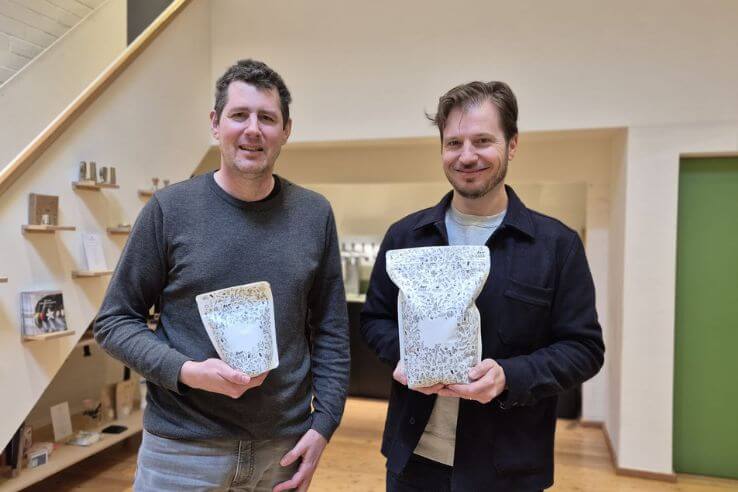
Andreas Platz from O. Kleiner (left) and Philipp Schallberger, Kaffeemacher GmbH (right)