




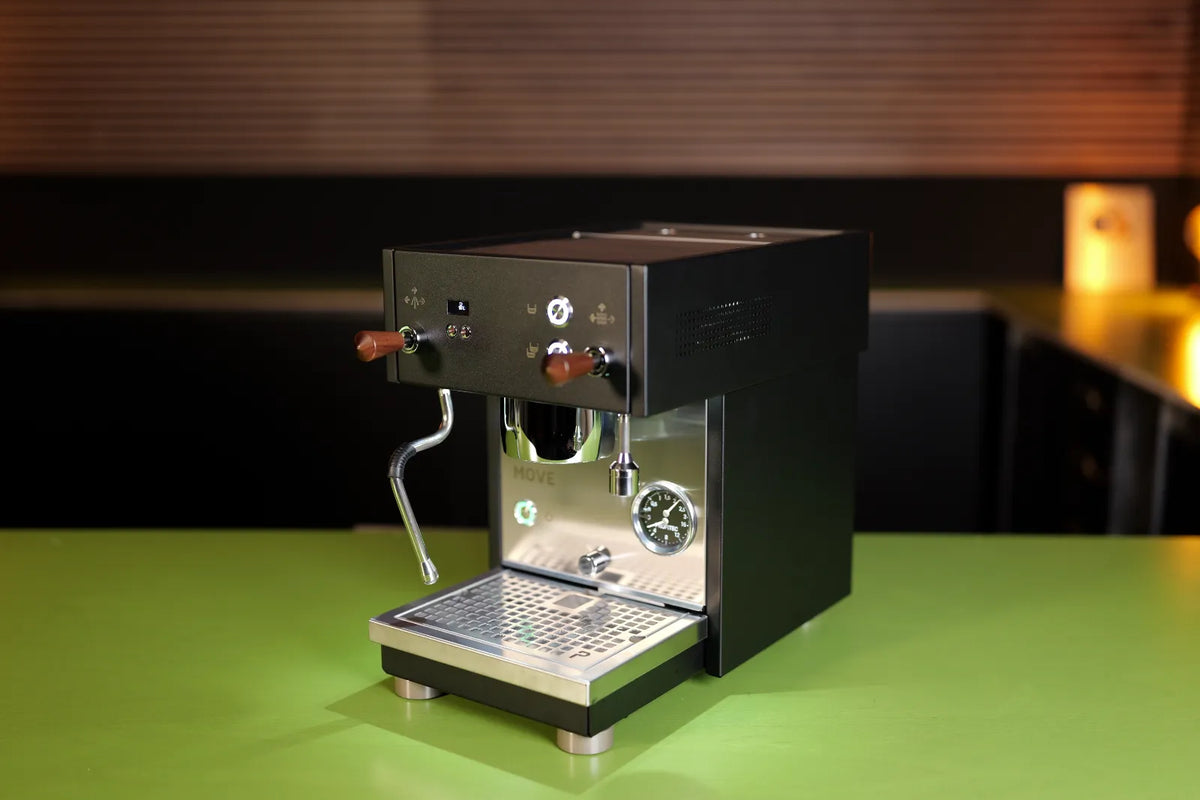

The Profitec Move is a revised version of the popular Profitec Pro 300 dual boiler espresso machine. It features a updated exterior, a crisp OLED display, smart workflow functions, and refined controls. A Fast-Heat-Up mechanism promises to accelerate warmup times and improve energy efficiency.

Profitec Move
Dual boiler espresso machine featuring a vibration pump, OLED display, pre-infusion, and an innovative 3-in-1 modular portafilter.
Build Quality and Materials
The Move makes a very high-quality impression right out of the box. Inside, we find proven, heavy-duty Profitec components. We love the aesthetics of our test unit, which features a powder-coated matte black stainless steel casing paired with American walnut handles. On a positive note, the drip tray is now finished in black as well, resolving a minor visual disconnect from its predecessor.
The toggle levers for steam and hot water activation feel sleek and function smoothly. The OLED display and control buttons are neatly integrated into the front panel. Combined with the new shot-timer buttons, they form a cohesive user interface. Both in terms of design and tactile feedback, the Move is a modern, elegant machine. The retrofitted manometer integrates seamlessly into this aesthetic.
The toggle levers are still a bit stiff on our unit, though we expect them to break in with regular use. The only minor defect: on the top rear corner, the folded stainless steel body panels don't align perfectly flush—a tiny nitpick on an otherwise stellar chassis.
| Dimension / Specification | Value |
|---|---|
| Weight | 18.0 kg |
| Dimensions (H x W x D) | 37.7 cm x 26.7 cm x 43.0 cm |
| Depth incl. portafilter handle | 51.0 cm |
| Drip tray to group clearance | 7.7 cm |
We rate the build quality and craftsmanship of the Profitec Move at 7 out of 10 points.
Warmup Time and Thermal Stability
The Profitec Move truly shines once it is fully up to temperature. Across both our Kaffeemacher testing protocol and the WBC temperature protocol, we measured exceptional thermal stability both during individual shots and back-to-back extractions. Specifically on the WBC protocol after an hour of runtime, we recorded a tiny standard deviation of just 0.82 °C. Across all 14 test extractions, the maximum temperature variance was only 4.52 °C between the highest and lowest points. At a PID target of 93 °C, the average temperature across all shots settled at a steady 92.11 °C.


Warmup Time in Detail
Where we disagree with Profitec is regarding actual warmup times. Profitec advertises a 10-minute warmup. In practice, however, the machine is far from fully thermally stable at 10 minutes. Even at the 17-minute mark, a Scace thermofilter registers just under 92 °C on the very first shot. Since a Scace device carries slightly more thermal mass than the included stock portafilter with its polymer spout, we consider 17 minutes to be the realistic warmup time.

Note that the Profitec Move—just like the Pro 300 before it—takes longer to warm up if the steam boiler is turned off: we measured 21 minutes to hit target brew temp without the steam boiler active.
Putting Brew Temperature into Context
The relatively sluggish warmup speed of the Profitec Move came as a surprise. With the ECM Synchronika II and the Profitec Go, the manufacturer demonstrated how a Fast-Heat-Up routine can drastically reduce waiting times. On the Move, however, that same system failed to perform as effectively in our lab tests.
We are a long way from a true 10-minute warmup, making Profitec's claim hard to endorse—at least if your goal is an initial shot temperature above 92 °C. In this context, the new polymer-spouted portafilter feels a bit like a workaround: while polymer doesn't absorb heat (and thus won't drag down shot temperature), it doesn't solve the slower thermal ramp-up of the brew water itself.
Profitec published a blog post addressing our temperature measurements. In our view, Profitec's own published data actually confirms our findings, though we differ on what qualifies as "fully ready":
Profitec's Definition: Claims readiness in ~9 minutes. At that mark, water temp on shot #1 hits ~88 °C. After flushing and pulling two more shots, shot #3 approaches 92 °C. Profitec considers a 4 °C deficit on shot #1 acceptable for readiness.
Kaffeemacher's Definition: We base our criteria on real-world workflow. After a brief warming flush, shot #1 must hit at least 92 °C (at a 93 °C PID target). Flushing is reasonable, but shot #1 must be hot enough to extract properly.
Energy Consumption and Power Measurement

Pulling a single espresso draws roughly 0.095 kWh. To keep comparisons consistent across machines, we use our benchmark metric of 5 double shots in sequence: the Move drew just 0.122 kWh, which represents an extremely efficient, economical result.
Volumetric Dosing: Timer-Based
The Move features time-based volumetric dosing with two programmable buttons. The pump runs for a preset duration. Depending on puck resistance, more or less liquid ends up in your cup:
Timed dosing is better than no auto-stop at all, but it isn't precise enough for gram-exact specialty espresso brewing. In practice, we recommend setting this button as a safety cut-off (e.g., set to 35–40 seconds) in case you get distracted during extraction.
Volumetric Dosing Score: 3 / 10 Points
Noise Level and Everyday Usability
The Profitec Move operates with a quiet, pleasant hum. Registering just 57 decibels during extraction, it is among the quietest vibration-pump machines we have ever tested, thanks to excellent pump dampening.
The display offers several handy settings and shortcuts:
We rate overall usability at a solid 7 out of 10 points (Noise level separately: 4 out of 5 points).
Included Accessories
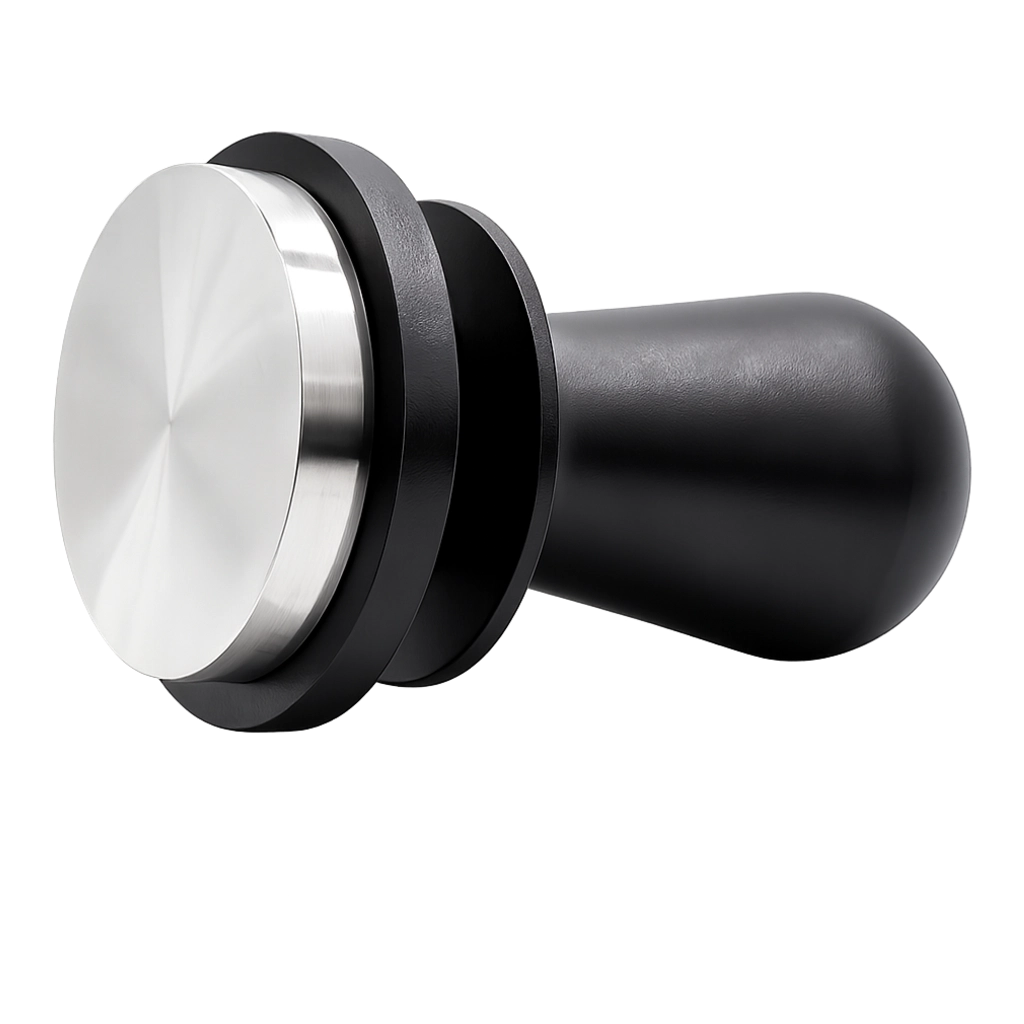
The Profitec Move ships with a generous accessory bundle:
Accessories & Equipment Score: 3.5 / 5 Points
Steaming Power and Microfoam
The Profitec Move isn't a commercial steam monster, but it produces very reliable texture. On our benchmark test, it took 50 seconds to heat milk to target temp (without manual aerating). Steam pressure is more than adequate to roll milk into a smooth vortex. The manageable speed is actually an advantage for beginners learning latte art.
The cool-touch steam wand prevents milk from baking on. Keep in mind: turning off the steam boiler increases brew group warmup time by roughly 2 to 4 minutes (totaling 21 minutes).
Latte-art-worthy microfoam is easily achieved. Due to slower boiler recovery, we rate steam performance at 5 out of 10 points.
Verdict: Profitec Move
The Profitec Move is a successful aesthetic and functional overhaul of the proven Pro 300 platform. Design, display workflow, menu controls, and quiet operation impress across the board. Once fully saturated with heat, it delivers rock-solid temperature consistency and delicious espresso shots.
Where it disappoints is marketing claims regarding warmup speed: instead of the advertised 9 minutes, it realistically requires 17 minutes before shot #1 exceeds 92 °C stably. If that isn't a dealbreaker for you, this is a sturdy, quiet, and reliable dual boiler that will serve you well for years.
Pros
Cons
| Category | Score |
|---|---|
| Build Quality & Materials | 7 / 10 |
| Usability & Workflow | 7 / 10 |
| Noise Level | 4 / 5 (57 dB) |
| Accessories & Equipment | 3.5 / 5 |
| Steam & Microfoam Performance | 5 / 10 |
| Volumetric Dosing Accuracy | 3 / 10 |
| Capacity & Catering Potential | 5 / 10 |
| Overall Score | 7.0 / 10 |