













In late 2020 we stumbled across a side note in Trabocca's newsletter that intrigued us. Trabocca, a Dutch coffee importer, announced that they would offer a coffee from their partner farm Suke Quto in Ethiopia which has been tracked with Blockchain technology. Every transaction the coffee has undergone from picking the cherries, selling the cherries, depulping, washing, drying, hulling, shipping – would be registered with a barcode in a Blockchain database.
Up to that point, I had never really seen Blockchain in action. It was a technology I could hardly grasp, mostly due to the fact that no product I have ever dealt with was linked to a Blockchain.
And then came Trabocca with their partner coffee from Suke Quto. A coffee we roast and serve in our bars these days.

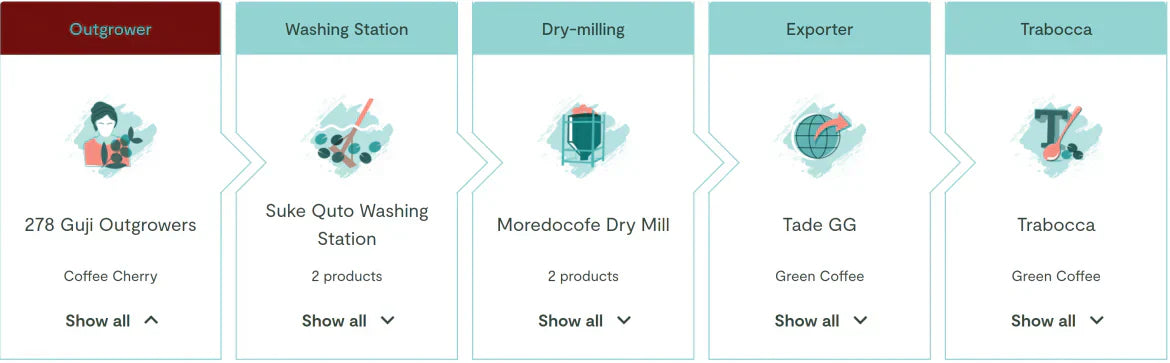
Have a look at their publicly accessible value chain for the Suke Quto coffee
Trabocca cooperated with Topl, a tech company that is “building a blockchain ecosystem to prove a business' ethical and sustainable business practices.”
What does Topl do? An overview of how Blockchain technology makes value chains more transparent - Download
If we look at the coffee industry, many actors claim that their business is based on ethical and sustainable business principles – including us. The tools we have at our disposal range from making the FOB price for coffee publicly available, and if possible the ex-farmgate price, to sharing the producer's story, fears, joys, and dreams, being approachable, and walking the talk – however, it is hard to apply metrics here.
What would you even measure, and how?
Mentioning paid prices for green coffee only has a meaning if you know the context, and stories about the coffee's background mean more if you really connect with the people on the other side of the value chain.
As for Trabocca, they decided to use Blockchain technology as a tool to prove their claims of paying a living income. With Topl as a technology partner, they tracked every transaction in the coffee chain from Suke Quto's 270+ farm members downstream to the arrival of the coffee in the warehouse in the Netherlands.
Their goal was to prove their claim of paying enough to farmers so that they earn a sufficient income to afford a decent standard of living for all household members – a definition for one of the most important benchmarks for green coffee prices for now and the future.
So, does Trabocca pay a living income now to the farmers of Suke Quto?
In their endeavour to make coffee “poverty-free” they use the latest technology, work with experts in different fields, and can bank on more than a decade of experience of work in rural Ethiopia. Yet still, it is tricky.
“We couldn't say for sure”
says Boaz Bosboom, Sales Director EMEA at Trabocca, and he emphasises that Trabocca is on the road to doing whatever is possible to guarantee a living income.

From Trabocca's booklet “The Journey of a Coffee”.
Trabocca's Journey of a Coffee Booklet - Download
Sander Reuderink, ex-Trabocca now with Topl, worked on the Suke Quto Blockchain project and made it clear that many things are not as easy as they may seem. In an interview with Fairfood he said:
Before we started the project, I calculated a price that would cover household expenses and cost of production. When the first data from actual transactions arrived, I realised how much I had underestimated the diversity of our farmers: where I had assumed an average family size of five, our dataset included families of up to thirty-six members! As a result, the data we had available on household expenses was not specific enough to make a solid claim about whether our farmers were able to earn a living income.
An additional complicating factor was that farmers are not selling all of their coffee to us. Often, families keep a share of their coffee in dried form to be sold on the local market later, much in the same way that we would use a savings account. This meant that a significant amount of coffee was invisible to us, and we had no idea how much income was earned from these sales, or from any other non-coffee related activities, such as breeding livestock or growing subsistence crops.
Was our price enough to cover the cost of production and household expenses, to allow farmers to reach a living income? The honest answer is that there is too much diversity between the farmers to draw that conclusion with the available data. For the coming season, we will need to develop partnerships to gather much more data about the cost of production and household expenses in the different sourcing regions in Ethiopia. Only then can we make coffee truly poverty-free!
What now?
In order to understand more about the challenges Trabocca faced, I talked to Boaz Bosboom. We talked about why they chose Blockchain technology to prove a claim despite the ongoing criticism regarding its high energy requirement, and if Blockchain really serves the purpose or if it is just attractive to use because investors find it attractive too?
In any case, Trabocca is a first mover in trying to prove a claim about paid living incomes to coffee farmers. The discussion has gained speed in recent months when Heifer International, Bellwether Coffee, and Sustainable Harvest announced their approach of a “Verified Living Income” – a pricing model that should help everyone involved in the coffee chain to make the right decision.
In these early days of walking the talk in terms of making prices publicly available, Trabocca set a new standard that will definitely help a lot in questioning other value chains in which we do not yet have access to such meticulous metrics.
Want to taste the coffee of the Suke Quto farmers? Here we go.