







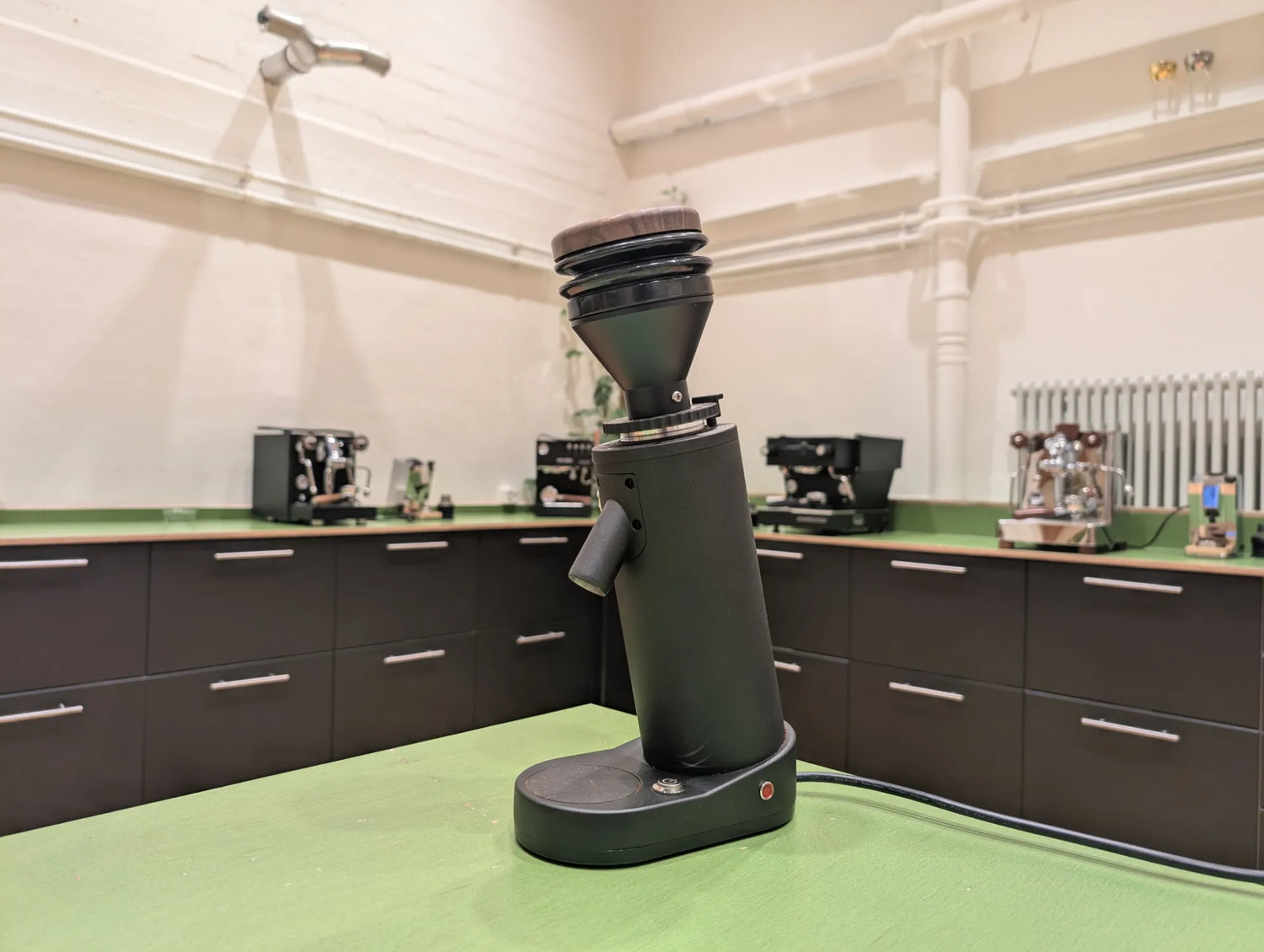

Small, chic, and most importantly, affordable – the Emil EM1 single dosing grinder might just be the most exciting entry-level espresso grinder on the market. It is a single dosing grinder, meaning it has no hopper and is filled one portion at a time. At a price of around €220, it is the most affordable grinder of this type we have tested so far – and it delivers a surprisingly high level of performance for the price. If you want to prepare good espresso at home without spending €500–1000 on a grinder, the Emil EM1 is likely made for you. In this review, we take a closer look at the design, operation, and – of course – the espresso quality. To start off: the value for money is outstanding; we haven't found anything better in this price range. But let's take it one step at a time.
Recommended specialist workshop for the Emil EM1 [Affiliate link]: Coffee24
We recommend specialist partners who we know provide good work and reliable service. You do not pay more for orders via our affiliate links, but we receive a small commission – which we invest directly back into new test equipment.
Design & Build
The Emil EM1 makes a good impression at first glance. Compact is almost an understatement: at only approx. 9.6 cm wide, barely 30 cm high, and 17 cm deep, it fits into even the smallest kitchen. Yet, it still weighs in at 2.6 kg. In fact, the build is reminiscent of a large manual grinder – as if a Comandante or Kinu had been given a motor. As a joke, our team said this grinder wanted to be a hand grinder in its “previous life.” Now it has a motor and saves us the cranking – definitely welcome in everyday life!
Visually, the EM1 combines various materials. The lid is made of walnut wood – albeit rather rustic in its finish, but hey, real wood! The bean hopper underneath is made of metal, which isn't standard in this price range. The housing and the grind adjustment ring are made of plastic; this is where you notice that corners had to be cut. All in all, however, the grinder feels high-quality enough. Sure, you shouldn't expect noble premium materials, but in the context of the price, the build is decent. Nothing rattles, nothing feels overly cheap. It stands stable and makes a robust impression – that's all you need for home use.
A small criticism regarding the design: the Emil has a red indicator light on the side that stays on as long as it is plugged in. This means that even when not grinding, a red light shines – basically like a mini nightlight in the kitchen. Some people barely notice it, but to be honest, it annoyed us. The grinder is either in use or it isn't; you don't need a permanent light as a reminder. Our workaround: unplug it if it bothers you – or use the grinder as a hallway nightlight 😉. Not a huge deal, but worth mentioning.
Function & Grinder
Inside the Emil EM1 works a 40 mm conical steel burr set. It is powered by a motor that makes the grinder rotate at approx. 750 rpm. On paper, this doesn't sound spectacular, but in practice, it turns out: the little one is a real sprint star. In our tests, it ground about 14g of coffee in 10 seconds – which is fast for such a small espresso grinder, especially in the single dosing range. A typical doppio dose of 18g of beans was ground in about 16 seconds. For comparison: other single dosing grinders in the entry-level class (e.g., the Varia VS3) often need 25–30 seconds or longer for the same amount. Speed is therefore one of its strengths.
This rapid grinding performance comes with a slightly higher noise level. Subjectively, the sound of the EM1 reminds one of a small kitchen mixer – a high-frequency hum that sounds more piercing than the deep drone of some larger grinders. We measured about 75 dB. In the quiet of the morning, this provides a brief wake-up call for everyone in the apartment. 😉 But let's be fair: 16 seconds of noise is easy to endure, and you won't find absolute whisper-quiet grinders in this price range. Overall, the noise level is within the normal range; sensitive ears should be aware, but most will be able to live with it, especially since the grinding process is over quickly.
Despite the speedy grinding, we did not observe any excessive heating of the coffee grounds. Even with several consecutive shots, the temperature of the ground coffee remained in the non-critical range (around 27 °C). This is important because hot coffee powder can cause a loss of flavor – so, all clear here. The EM1 produces cool coffee grounds, which is advantageous for consistent espresso results.

Single Dosing Performance
As a single dosing grinder, the Emil EM1 is designed for you to weigh and grind every portion fresh. The crucial criteria here are retention and reproducibility. Retention refers to the powder remnants that remain in the grinder after grinding. No retention is ideal, because then exactly what you put in at the top comes out – and old coffee doesn't spoil the next shot.
The EM1 excels in this discipline. In our test, with 18g of beans put in, we always obtained about 17.9–18.1g of coffee grounds. The deviations were on average just 0.1g – that's practically nothing! This minimally “stuck” residue is referred to as temporary retention. It amounts to about 0.1g here, which is an outstanding value. For comparison: even significantly more expensive single dosing grinders often leave 0.3–0.5g behind.
Besides temporary, there is also the permanent retention – deposits that accumulate over many grinding processes in corners and edges (essentially a coffee patina in the grinding chamber). The Emil holds its own here, too: it accumulates less than 1g of permanent residue on average, as long as you clean it reasonably regularly. That is so little that it hardly affects the taste. In short: what you put in at the top comes back out at the bottom. You always taste fresh coffee in the cup, exactly how single dosing should be.
The consistency from shot to shot is also top-class. We ground the same amount of beans several times in a row and achieved extremely uniform results. Neither does the grind amount vary noticeably, nor does the grind setting “drift” during operation. This means: once you have found the right grind setting for your espresso, you can be sure that the next shot will be very similar. For beginners, this removes a lot of frustration – nobody likes it when one espresso turns out perfectly and the next one suddenly runs completely differently. With the EM1, that basically doesn't happen as long as the bean dosage and operation remain constant.

Grounds & Espresso Quality
Let's move on to the most important part: How does the espresso taste that the Emil EM1 produces? The short version: It looks (and tastes) good! In our test, we worked with a medium-strength espresso roast. The very first shot surprised us with a lush crema and a powerful body. The espresso was full-bodied, chocolatey, and had a mild acidity – so far, so good. One of our testers took a sip and said with a wink: “Hot, brown, and liquid – it works!” Translated, this means: Yes, the espresso is absolutely drinkable and, above all, nicely powerful.
Of course, we tasted more closely and also verifiably checked what the grounds can do. The particle distribution of the coffee powder is an important factor for taste in grinders. Simply put: the closer the particle sizes are to each other, the clearer and more nuanced the espresso tastes. With the Emil EM1, our lab tests revealed a relatively wide particle distribution. There is a broad “main peak” in the middle range (average grain size approx. 330 μm) and a not insignificant proportion of very fine particles. This mix leads to some components of the coffee over-extracting slightly (the very fine ones) and others under-extracting slightly (the coarser ones). As a result, the espresso tastes intense and powerful, but you shouldn't expect fine fruit notes or the highest complexity. The aromas seem a bit “scattered,” as we said in the team – individual notes do not stand out crystal-clearly, but rather basic tones like body and roasted aromas dominate.
Now, you have to put this in perspective: we are naturally comparing this with high-end grinders that cost many times more. For an entry-level grinder, the results of the EM1 are fine. The espresso from the Emil tastes significantly better than anything you can get with pre-ground powder and easily surpasses the average espresso from many cafes. In direct comparison with a professional grinder for €2000, the EM1 loses out – no question. But nobody expects the perfect champion espresso from a €220 grinder. What it delivers is really good espresso with a great body and pleasant balance.
It is important to use the right beans: Light “Third Wave” espressos are outside of its comfort zone. Very fruity, light roasts could not be optimally represented by the EM1 in our test – it lacked finesse and the acidity came through a bit unevenly. Medium to dark roasts, on the other hand, are exactly its specialty. Chocolatey, nutty espresso blends or classic Italian roasts turn out wonderfully. So, anyone who likes drinking cappuccino, latte art, or powerful espresso will be happy with the Emil. For a sophisticated sensory journey of discovery into the world of Ethiopian single origins, there are more suitable grinders – but they also cost significantly more.

Operation & Cleaning
The Emil EM1 is simple and intuitive to operate. Since it has no bean hopper, you weigh the desired amount of coffee beans before each shot (e.g., 18g), fill them in at the top, and put the lid on. Then you press the on button – the grinder has a toggle switch on the side – and the motor starts up. As soon as grinding is finished (you hear when no more beans are being crushed), you switch it off. Alternatively, the EM1 stops on its own after about 60 seconds, but you never let it run that long since it's finished after at most 20 seconds.
The grind adjustment is done via a ring under the bean hopper. This ring is divided into fine increments, meaning there are noticeable clicks when adjusting. The gradation is sufficiently fine for espresso, but you have to look closely: one or two “clicks” change the espresso extraction time by several seconds. In our test, we still found the right point without any problems – simply approach the sweet spot slowly. The plastic ring could feel a bit more high-quality, but it serves its purpose.
As already mentioned, you should briefly activate the silicone bellows after or during the grinding process – this feature is called “blow-up” or exhaust hopper. By pressing the lid several times, air blows through the grinder and ejects the last coffee particles. In principle, this works like a small bellows and prevents deposits or static residue. This trick worked very well for us: once ground, press pffft a few times, and almost all the coffee powder ended up in the catch cup or portafilter. Better to grind into the dosing cup than into the portafilter, because otherwise, a lot often blows around.
Speaking of the catch cup: we have a clear point of criticism here. The Emil EM1 is supplied with an awkwardly cylindrical metal cup designed to catch the coffee grounds. Practical in itself – however, in our case, the cup promoted massive channeling. It sinks very deeply into the 58mm portafilter and creates a wide crater that cannot be reduced even with good WDT technique. As a result, the brew water runs through this hole too quickly, creating over- and under-extraction.
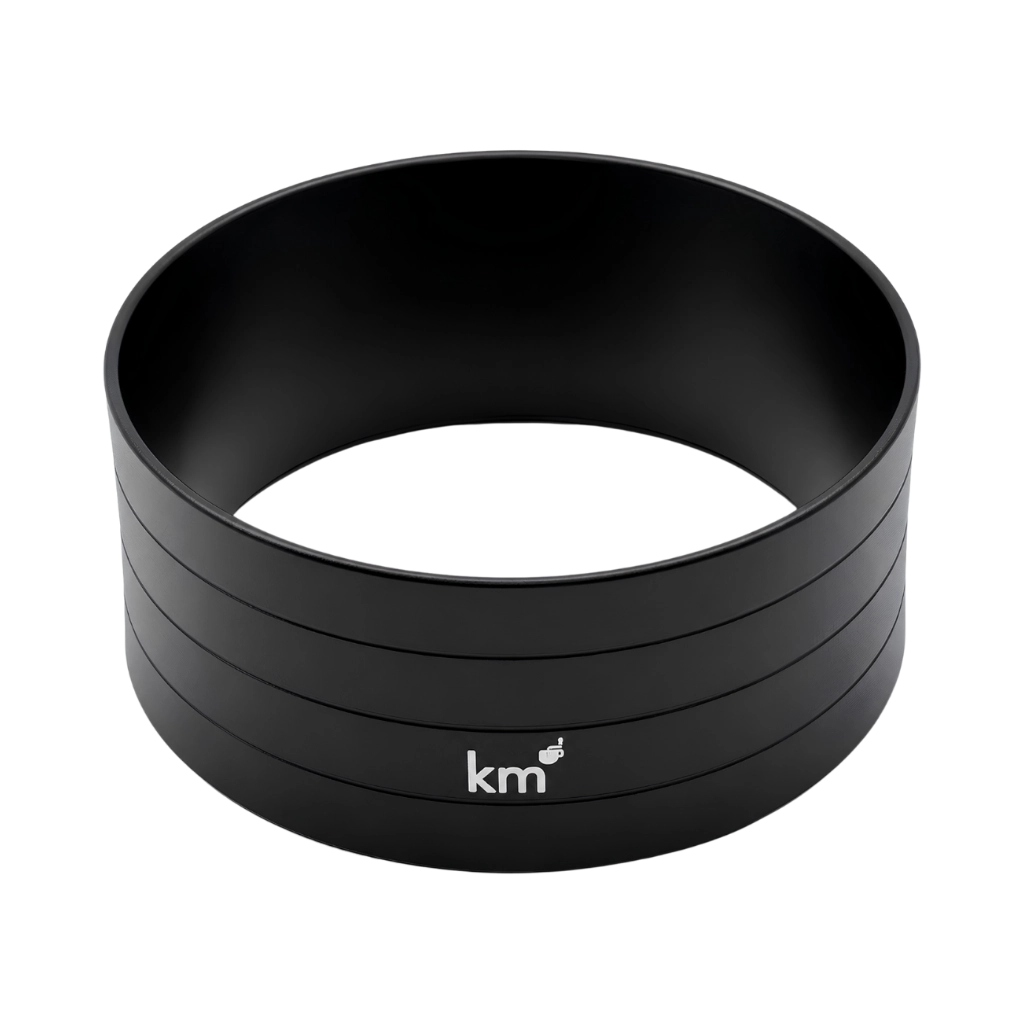
Our recommendation: either do not knock the supplied cup directly into the portafilter, but instead loosely pour the coffee from the cup into the portafilter. Or – even simpler – just use a different dosing cup. We even have a cup with a rim in our shop that sits exactly on the portafilter; such an accessory makes sense here if you want to avoid a mess. In case of doubt, any suitable cup or a folded piece of paper as a chute will do – the main thing is that the coffee gets into the basket without loss.
Cleaning the Emil EM1
Cleaning the Emil EM1 is uncomplicated. Due to the single dosing principle, there is little dirt anyway – hardly any coffee remains in the grinder. Nevertheless, it is worth cleaning the burrs every few weeks. For this, you can remove the bean hopper and the upper grinder unit in a few simple steps. We were positively surprised by how simple the construction is to disassemble. Loosen a few screws (not screwed on too tightly), and you can open the grinding chamber. This is doable even without great manual skills. A brush is sufficient to brush out coffee remnants. Since the Emil has no complicated angles or hidden corners with springs/flaps, you can reach everywhere easily.
In daily use, the grinder is convincing in its simplicity. Beans in, press button, coffee out – there are no bells and whistles. That is exactly what makes single dosing so attractive: no beans aging in the hopper, no remnants from yesterday mixing with fresh coffee. Every shot starts from zero, and you have full control. The Emil EM1 conveys this philosophy in a very beginner-friendly way. After a few days, you get the hang of it, and it becomes part of the morning ritual – a ritual that is really fun once you have brewed your first good espresso with it.
Comparison with Other Grinders
In the under €300 price segment, things are thin – in other words, there are hardly any competing models with similar equipment. The Emil EM1 stands here almost unrivaled and good. There are a few classic entry-level espresso grinders with a dosing container (hopper), but as a single doser, you currently mainly know models like the Varia VS3 or the DF64 (often more expensive), which each cost a good deal more. Let's briefly look at the Varia VS3 as a comparison, as it is often mentioned as an alternative.
The Varia VS3 costs about €320–370 depending on the version. It has a slightly larger 48 mm grinder and is overall built to a higher quality (lots of metal, chic design). In our tests, the VS3 delivered very good results for medium roasts and proved to be a robust grinder. However, it is significantly slower – the VS3 grinds just ~6–7g in 10 seconds, so less than half the speed of the Emil. The noise of the Varia is also deeper, but sometimes associated with an unpleasant tone (a slightly whining sound). In terms of taste, both do not differ much with darker roasts: the espresso is strong and balanced. With lighter beans, however, the Varia VS3 also quickly reaches its limits (its standard grinding cone is also designed for classic espresso profiles). For tech fans, the Varia offers optional different grinding discs for upgrading – the Emil cannot do this in this form; here you stick with the installed 40mm cones. Bottom line: The Emil EM1 doesn't have to hide from the VS3. Anyone who wants to invest less gets more speed for their money with the Emil. Anyone ready to add about €100–150 gets a slightly more noble feel and theoretically more upgrade possibilities with the Varia. Both grinders are excellent entry-level single dosers, and both have what it takes to make many espresso fans happy.
When considering the budget segment, our conclusion in comparison is: in its class (approx. €200–250), the Emil EM1 is currently unbeaten. You have to spend significantly more money to get noticeably better results or features.

Conclusion Emil EM1
Who should buy this grinder? From our perspective, the Emil EM1 is ideal for beginners and budget-conscious home baristas. If you are just starting with espresso at home or want to upgrade from a simple grinder, but the budget is small, go for it. The EM1 delivers fresh espresso without quality losses due to old coffee, it is easy to operate, and offers a consistency that is simply unmatched in this price range.
Why the Emil EM1? Quite simply: because you get really good espresso in your cup for little money. The value for money is outstanding – you get a single dosing grinder here with features that were unthinkable a few years ago in this price range (lowest retention, solid grinding discs, etc.). Sure, you shouldn't expect perfection. The EM1 is not a precision marvel for specialty geeks, and light espresso roasts are not its thing. It could also be quieter and made of solid metal – but then it would cost twice as much. For what it costs, it does great work: consistently ground coffee, simple handling, and reliable results.
We think the Emil EM1 is a fantastic start into the world of espresso. You can have fun with it for years, learn new things, and build up coffee knowledge. And when the urge to upgrade hits eventually, you sell it on (it will certainly find buyers) and move up to the next league. Until then, however, the following applies: with the Emil EM1, you can make first-class espresso at home today – without having to break your piggy bank. This little grinder is proof that good coffee doesn't have to be expensive.
In a nutshell: The Emil EM1 single dosing grinder is small, affordable, and damn good. In its price class, it sets the benchmark. For us, clearly the No. 1 recommendation for budget espresso grinders – because everyone deserves great espresso, even on a tight budget. Have fun grinding and enjoying!
What do you think about the Emil EM1?
- What do you find good and what less good about the grinder in everyday life?
- Did you have any difficulties with your model?
- What should we double-check on our model?
Through your feedback and your experience reports, our test becomes denser, more meaningful, and better. Thank you in advance!