


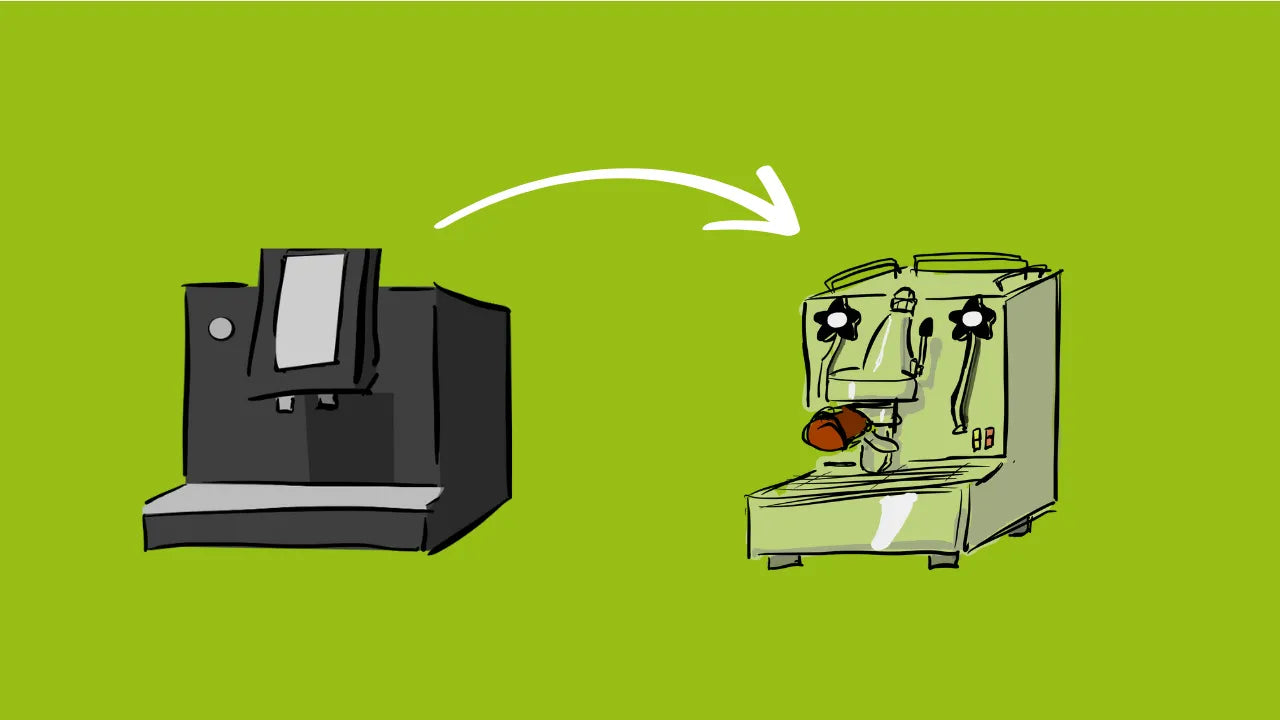

Automatic coffee machine or portafilter: a question that almost everyone asks sooner or later if they drink espresso seriously. Maybe you already have an automatic coffee machine at home. Maybe you're wondering whether the step to espresso machine is really worth it. And most importantly: is the effort worth it?
One thing upfront: we're not anti-automatic coffee machine. The automatic coffee machine absolutely has its place, in certain situations, for certain people. But when it comes to espresso quality, there's a clear difference. And it can be explained.
In this article, we'll look at both systems honestly: their real strengths and their real weaknesses.
Portafilter vs. automatic coffee machine: the direct comparison
Before we go into detail, here's the quick overview. Both systems have real strengths and real weaknesses.
| Criterion | Portafilter | Automatic coffee machine |
|---|---|---|
| Espresso quality | Very good (full control over extraction) | Good, approx. 70–75% achievable |
| Lungo / Coffee cream | Good (with adjusted grind size or Americano) | Very good (actual area of strength) |
| Milk foam | Very good, learning curve required | Ok – good, consistent without practice |
| Grinder | Freely selectable, your own decision | Built-in, often a compromise |
| Effort per cup | 3–5 minutes, craftsmanship required | Button press, quickly done |
| Cleaning | Visible and done in minutes | Automatic prompts, internally hard to access |
Why does espresso from the portafilter taste better?
When we prepare coffee, we extract from ground coffee everything that, together with the brew water, makes up our espresso. This process is called extraction. The more evenly the coffee is ground and the more evenly the brew water flows through the coffee, the better the result tastes.
With the portafilter, we see exactly what happens: we distribute the coffee in the filter basket, tamp it evenly, and lock it in. The brew water hits an evenly distributed, controlled coffee puck. With the automatic coffee machine (technically correct: piston coffee machine), the opposite happens.
The freshly ground coffee falls into the brew chamber and forms an uneven landscape of hills with air pockets and craters. The piston presses everything together. The water takes the path of least resistance and shoots through the gaps.
The result: over-extracted coffee tastes bitter, under-extracted coffee tastes sour. Both happen simultaneously in the same cup. What's missing is the density, the creaminess, what we call texture and body. That's exactly what you notice particularly clearly when you drink both side by side.
Add to that the grinder. Many automatic coffee machines have cheap conical burr grinders built in. With an automatic machine, you can't choose which grinder you use. With the portafilter, you can. And good grinders are available for little money.
Old coffee in the machine: the problem with retention
With most automatic coffee machines, there's a so-called retention space between the grinder and brew chamber: a path where already-ground coffee sits before it's even brewed. Modern machines have improved this, but often there are still one or two portions of pre-ground coffee on this path.
Freshly ground coffee loses most of its finest volatile aromas within minutes. In the humid, warm environment of the machine, this accelerates. The old coffee contributes to an unclean, bitter taste. Coffee oils begin to oxidize; in some cases, a slightly rancid note even develops.
For espresso grinders designed for portafilters, the industry has done a lot in recent years to minimize retention space.
Always discard the first shot of the day or use it for a milk coffee: this empties the retention space and you'll have significantly better quality on the second shot. The same applies after longer standby periods.
What really happens in the automatic machine
Coffee powder in the retention space. Humidity. Heat from the brew group. That sounds like cleaning work. And so it is. But much of the stubborn dirt doesn't sit where the automatic cleaning programs apply.
The automatic machine is a closed system. No automatic program really removes the oil residues from the deep paths between the grinder and brew group. Humidity and coffee residues: the perfect breeding ground for everything that makes coffee unappealing over time.
With the portafilter, everything is open. You see the dirt immediately, which creates the impression you'd have to clean constantly. But: the daily wash takes less than a minute. The deep cleaning every two to three weeks is done in five minutes.
When is the automatic coffee machine still the right choice?
That's the question we don't answer in most portafilter articles. Yet it's just as important.
If you mainly drink long coffees (coffee cream, lungo, drinks with a strength between filter coffee and espresso), then the automatic machine actually plays to its strengths. In a direct comparison with equal investment, the automatic machine makes a really good showing in long coffee. We've measured and tasted it ourselves: the coffee cream from a properly adjusted automatic machine is very good. Balanced, creamy, with nice strength.
If milk drinks are the focus, automatic milk frothing is a real argument. The quality that a well-adjusted automatic machine delivers from the nozzle takes hours of practice to achieve with the portafilter. If you make cappuccino and latte daily and don't want to deal with milk frothing technique, you'll do well with the automatic machine.
If you don't want to learn the craft (and that's a completely legitimate position), then the automatic machine is the more honest choice. The portafilter demands that you learn: adjust grind size, find brew recipe, read extraction. That's fun if you want it. If you don't, you won't be happy with it.
If you drink espresso alone and only need a single shot, the automatic machine has a structural advantage: it's optimized for short, individual shots. With the portafilter, we basically brew with the double basket: two portions simultaneously give better extraction. For individuals who want a quick espresso every morning, this is unnecessarily complex.
With a properly adjusted automatic machine and matching coffee, for example El Botón, which was specifically developed for automatic machines, you can make really good coffee. We estimate the potential at about 70–75% of what's possible with the portafilter. For long drinks and milk coffee, the gap is noticeably smaller.
How to make espresso with a portafilter?
Still sounds too complicated? Let's take a quick look.
If you're coming from an automatic machine: Start with a ratio of 1:2.5 to 1:3. Example: 18 g ground coffee → 45–54 g espresso in 25–28 seconds. The result is less concentrated than a classic espresso, but close to what you're used to.
You can learn everything about espresso preparation in a step-by-step guide.
The portafilter tastes different: brew ratio and concentration
The first time you drink an espresso from the portafilter after years with an automatic machine, you'll stumble. That's normal.
Espresso from the portafilter typically contains 7–9% dissolved coffee particles. With private automatic coffee machines, it's often only 3–5%. That sounds like a small difference. But it's not. Add to that the fact that many automatic machines are set by default to a higher water quantity: 8 g of coffee quickly becomes 35–40 g of espresso. With the portafilter, 8 g typically becomes 16–20 g, so significantly more concentrated.
The result is a denser, creamier coffee with more texture. Flavor practically explodes. That can be overwhelming if you're not used to it.
Our tip: work your way in slowly. 1:4 as a starting point is completely legitimate: you'll still feel the difference in body and uniformity of extraction.
Lungo or Americano?
If you like long coffees, you have two options with the portafilter. With lungo and café crema, the brew ratio is extended to 1:6 to 1:10: 10 g of coffee becomes 60–100 g of coffee. The grind size must be adjusted accordingly.
The more elegant option for long coffees is the Americano: 70–80 g of hot water in the cup, then brew a double espresso directly over it. The result is a balanced long coffee with nice crema, without having to adjust the grind size.
The grinder decides
The grinder is at least as important as the espresso machine. That sounds like a side note. But it's not. It's one of the crucial differences between portafilter and automatic machine: with the portafilter, you choose your grinder yourself.
Especially in the lower price segment, it makes sense to spend about as much on the grinder as on the machine itself. A good beginner setup:
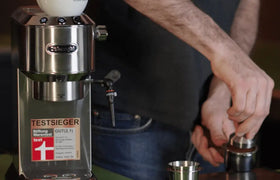
DeLonghi Dedica with a DF54, Varia VS3 or Emil EM1
Don't buy a system where machine and grinder are permanently connected. Otherwise you're bound to a built-in grinder again, just like with an automatic machine. Grinder quality is the compromise. If you're still thinking about a machine with an integrated grinder, our article on portafilter machines with grinder offers an honest assessment.
Cleaning the espresso machine
The short answer: it's done faster than you think. After that, you'll see that the machine is really clean.
Daily (under a minute):
Every two to three weeks:
All the details on proper cleaning of the espresso machine, including descaling and deep cleaning of the brew group, are in our detailed cleaning article for espresso machines.
The smart portafilter machine
Still too complex? There are now espresso machines that want to close exactly this gap between portafilter and automatic machine.
The Maro espresso machine guides you step by step through extraction in beginner mode. If the espresso runs too fast, it automatically reduces pressure and flow speed. After extraction, you evaluate the result together with the machine, and it tells you how to adjust your grinder.
The Ligre espresso machine offers similar support. Particularly exciting: the accompanying grinder is a grind-by-weight grinder that automatically measures the correct amount of coffee each time.
The machine from nunc is slowly entering the market and goes a step further: grinder and machine communicate directly with each other. If the espresso runs too fast, the grind size adjusts automatically.
The latest grinder from Mahlkönig, the Mahlkönig E64 WS, also aims in the same direction and offers guided grinding. It adjusts the grind size when espresso extraction was too fast or slow, and with its integrated scale, it always gives you the right amount.
These machines make getting started easier. But they're not necessary. What initially seems complicated becomes easy after just a few extractions.
Frequently asked questions
Is a portafilter really better than an automatic coffee machine?
For espresso: yes, definitely. The portafilter allows controlled, even extraction that's structurally difficult to achieve with an automatic machine. With long coffees and milk drinks, the gap is much smaller. A well-adjusted automatic machine makes really good coffee here.
How much time do I need daily for the portafilter?
For preparing a double espresso, about 3–5 minutes, cleaning included. The machine needs heat-up time, which depending on the model is between 3 minutes and 45 minutes. Modern beginner machines are often ready in less than a minute, so they signal. But be sure to let hot water run through the still-cold portafilter. With a timer outlet in the morning, you can also get "slow" machines to temperature on time.
Can I also make long coffee with the portafilter?
Yes, either as lungo/café crema (brew ratio 1:6 to 1:10, coarser grind size) or as Americano (70–80 ml hot water in the cup, double espresso over it). The Americano is actually one of the best long coffees you can make.
Do I really need a separate grinder?
Yes. Without a good grinder, no good espresso: that applies to the portafilter too. The grinder is at least as important as the machine. In the entry-level segment, we recommend spending about as much on the grinder as on the machine itself. Please don't fall for double-walled baskets as an alternative to the grinder. Better to stick with the automatic machine then!
Which coffee is suitable for the automatic coffee machine?
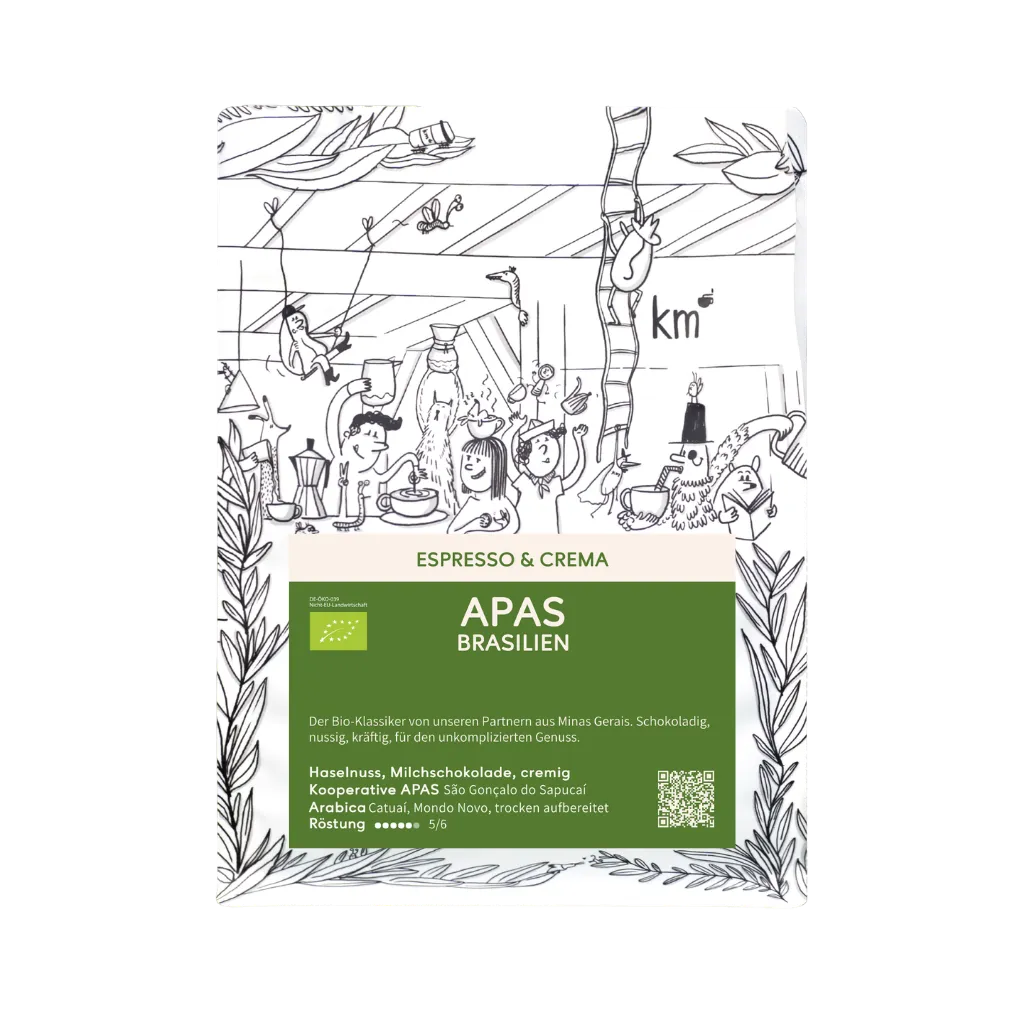
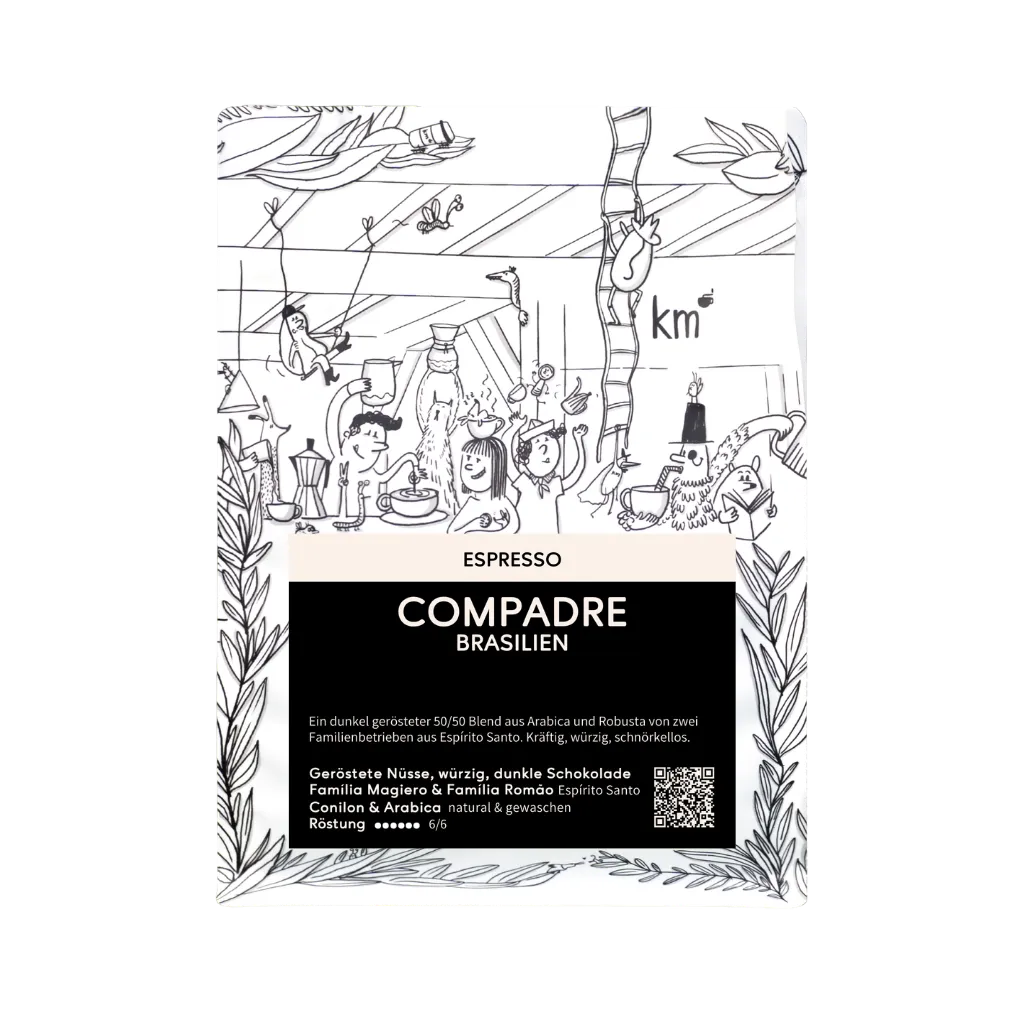
Medium to slightly darker roasts with clear balance: not too light, not too complex. The automatic machine brews at a slightly lower temperature than a portafilter, which with very light roasts can lead to sour extraction. We've developed El Botón, a coffee specifically designed for automatic machines: robust body, wide temperature window, works both as espresso and as coffee cream. But many of our customers also appreciate Apas or Compadre.
Is switching from an automatic machine to a portafilter worth it?
If espresso quality is important to you and you feel like learning a bit of craft: absolutely. If you mainly drink milk coffees or long coffees and just want something quick in the morning, you should honestly weigh whether the extra effort fits your daily routine.
Conclusion
Portafilter or automatic coffee machine? The honest answer: it depends on what you want from it.
For espresso, the portafilter makes a clearly measurable difference. The even extraction, the free choice of grinder, full control over brew ratio and grind size: that can't be replicated structurally. If you really want good espresso, there's hardly any way around the portafilter.
For long coffees and milk drinks, the automatic machine is stronger than many think. A well-adjusted automatic machine with the right