







The Moccamaster has an almost legendary reputation. It is appreciated for its design, workmanship and durability, as well as the quality of the coffee. This piqued our curiosity. We subjected the brewer to an intensive test. We tested 40 brews with different coffees, brewing ratios and quantities.
Our results are significantly more nuanced than the many positive online feedback. But let's take it step by step. As a Kaffeemacher, one thing is decisive for us above all: the quality of the coffee in the cup.
The following parameters are primarily responsible for this: the temperature of the brewing water, the distribution of the brewing water over the coffee, and the flow rate of the coffee water.
The choice of coffee and grind size are important, but cannot be influenced by the machine. Nevertheless, we provide tips for suitable coffees and an appropriate grind size.
Moccamaster Instructions – One Button for Coffee
Operating the Moccamaster KBG 741 is really straightforward. In this respect, the Moccamaster hardly differs from most other filter coffee machines. Insert the filter basket, weigh out the coffee, pour water into the permanently mounted water reservoir, and press the button to start. We wouldn't be a Kaffeemacher if we didn't refine these instructions.
We generally recommend rinsing the paper filter thoroughly with hot water. This reduces the paper taste that would otherwise overpower the coffee later. A positive side effect is that the coffee filter paper then adheres better to the edge of the filter holder. This reduces the likelihood of the paper filter folding inward and water bypassing it. You can't rinse too much water through, but 300 ml is a good amount.
Then add the correct amount of ground coffee. The correct dosage depends on the desired beverage amount. A good standard value is 60 grams of coffee per liter of water. We discussed this in more detail in an extensive blog post.
We initially made two brews. 18 grams of coffee and 300 ml of water, and 60 grams of coffee and 1000 ml of water. Each amount was weighed. We also weighed the water. We started the brew with a button press. We compared these two brews by taste.
18g and 300 ml vs. 60g to 1000 ml
In the comparative blind tasting of the two brews, the brew with the larger volume clearly performed better. Better meant in this case that the coffee tasted more balanced and homogeneous. It was also noticeably stronger, meaning more powerful in flavor. The 18g/300g brew had on one hand a slightly unpleasant acidity and on the other hand did not show the complexity and expected flavor notes of the coffee.
We adjusted the grind size of the 18g/300g slightly finer and made further brews. However, the result did not improve significantly. As you can see in Table 1, in particular the strength, meaning the concentration of dissolved coffee particles, was relatively low at just over 1.0% on average. This value can be measured with a refractometer. A desirable result is around 1.1 – 1.5% strength (TDS = Total dissolved solids), with the rest of the beverage containing water. Finer grind sizes normally increase the resistance in the coffee, resulting in slower flow of the brewing water and thus more intense extraction. However, we were unable to achieve significantly stronger brews with the coffee and water amounts used by refining the grind size.
| Grams | mg | Water | Output | Strength | Extraction | Brew Time | Drip Cycle |
| 18 | 11 | 300 | 250 | 1.06% | 14.72% | 02:02 | 01:13 |
| 18 | 11 | 300 | 264 | 1.04% | 15.25% | 02:04 | 01:08 |
| 18 | 11 | 300 | 264 | 1.02% | 14.96% | 02:00 | 01:09 |
| 18 | 11 | 300 | 260 | 0.98% | 14.16% | 01:55 | 01:08 |
| 18 | 11 | 300 | 255 | 1.08% | 15.30% | 02:05 | 01:10 |
Table 1.
The extraction target value is 18 – 22%. Extraction refers to the parts of the coffee bean that are extracted from it. If you achieve higher extractions, the strength in the cup is also more pronounced. These two values are therefore dependent on each other (see also blog post Strength and Extraction).
Table 2 shows the results of the 60g/1000g brew. Here we achieved stronger results with the same brewing ratio. The strength averages above 1.2% TDS and is thus in the target range. Correspondingly, extraction is also in the target range for two out of five brews. In theory, we could have increased extraction with a finer grind size. However, the drain in the filter was too slow and the water level at its maximum. A finer grind size would have caused the filter to overflow.
| Grams | mg | Water | Output | Strength | Extraction | Brew Time | Drip Cycle |
| 60 | 12 | 1000 | 887 | 1.21% | 17.89% | 04:33 | 03:32 |
| 60 | 12 | 1000 | 882 | 1.30% | 19.11% | 04:40 | 03:42 |
| 60 | 12 | 1000 | 896 | 1.12% | 16.73% | 04:21 | 03:27 |
| 60 | 12 | 1000 | 880 | 1.22% | 17.89% | 04:36 | 03:40 |
| 60 | 12 | 1000 | 886 | 1.23% | 18.16% | 04:33 | 03:33 |
Table 2.
The comparison of the brews shows that the Moccamaster's extraction yield is better with larger brewing volumes. This is mainly due to the distribution of water over the coffee cake. With a larger brewing volume, the brewing water better captures all coffee particles and washes them out more effectively. This is mainly due to the design of the brew head.
The Well-Intentioned Brew Head
Almost all classic filter coffee machines have the problem that the brewing water continuously drips onto the same spot in the coffee bed – usually right in the center. At this spot, the coffee grounds are strongly agitated with each drip and bubble and extensively extracted by the constant influx of water. Meanwhile, many other coffee particles at the edge of the coffee cake settle down comfortably and watch the extraction party in the center.

It doesn't take much to brew good filter coffee – except for even extraction. This is achieved when as many coffee particles as possible are in contact with water with equal intensity and for the same duration. Those who brew by hand practice exactly this technique. Evenly moisten and agitate everything – that makes delicious coffee.
Moccamaster understood the principle and developed a rod-style brew head with 9 holes. This is meant to distribute the brewing water evenly over the coffee bed. It should, but at least with the device we had, it doesn't work. The water flows into the brew rod and emerges largely from the front holes. Ultimately, where the water comes out plays a minor role, since the water below the brew head combines into a single, connected stream.
We changed the slope of the brew rod to rule out that it might be due to a slanted tabletop or similar, but we consistently arrived at this result.
The consequence is that the brewing water is extracted predominantly in the center and a larger part of the coffee bed is not evenly wetted. With larger water quantities – which is why the 60g/1000ml brew was better, this plays a minor role because a water bed forms on the coffee grounds anyway. But even in this case, extraction is not even.
This malfunction surprised us. The brew head with multiple outlets shows the right principle. However, the water distribution is not pronounced enough to bring about a noticeable improvement.

Improving Brews Through Agitation
When the brew head doesn't do what it should, the tricks of the hand brewer come into play. Simply stirring the coffee after about 20 – 30 seconds of brewing time leads to significantly better brewing results. If you repeat the stirring once the entire water amount has been added, the brewing results are noticeably more homogeneous and tastier.
| Grams | mg | Water | Output | Strength | Extraction | Brew Time |
| 60 | 12 | 1000 | 885 | 1.36% | 20.06% | 05:10 |
| 60 | 12 | 1000 | 881 | 1.31% | 19.24% | 04:58 |
| 60 | 12 | 1000 | 887 | 1.32% | 19.51% | 05:00 |
| 60 | 12 | 1000 | 884 | 1.35% | 19.89% | 05:02 |
| 60 | 12 | 1000 | 889 | 1.29% | 19.11% | 04:57 |
Table 3
Table 3 also shows a noticeably longer brewing time. This occurs because now all the coffee forms a resistance. By stirring at the end of brewing, rotation is deliberately generated, which draws the coffee particles at the edge into a vortex and keeps them spinning throughout a larger part of the brew.
Moccamaster Brewing Temperature
Generally, the brewing temperature should be constant. Exceptions prove the rule. There are coffees that simply taste best when brewed at 80 degrees. In my filter coffee courses, I almost always do this test: participants brew the same coffee at 50, 60, 70, 80, 90, and 100 degrees. There's a clear tendency that the coffee tastes best when brewed at 90 degrees. Again and again, individual coffees also perform well at other temperatures. A brewing temperature of 92 – 94 degrees is the most popular brewing temperature across all brews.

The Moccamaster brews very consistently – but slightly too high in temperature. It heats up incredibly fast. Already on the first brew of the day, it is ready to brew in less than 20 seconds and drips the first drops of water onto the coffee.
We measured the temperature directly at the water outlet. The first surge of water dripped onto the coffee at a water temperature of 60 degrees. However, this was only a few milliliters, which were probably cooled by heat exchange with the metal brew rod. Subsequently, the Moccamaster brews very precisely and consistently at 98 – 99 degrees at the outlet throughout the entire brewing cycle. The impact temperature is barely lower, as the brew head is close to the coffee. In other words: the brewing temperature is very high – rather too high for many coffees. These high temperatures tend to intensify bitterness in coffee.
98-degree brewing temperature is certainly an option for very clear and light-roasted coffees that inherently contain little bitterness and are very transparent. For the vast majority of coffees, however, this temperature is too high. It becomes particularly critical for all coffees that are not specialty coffees and tend to be dark roasted. A brewing temperature of around 90 degrees or less would be the best choice here.
Pulse vs. Continuous Brewing and Pre-Brewing
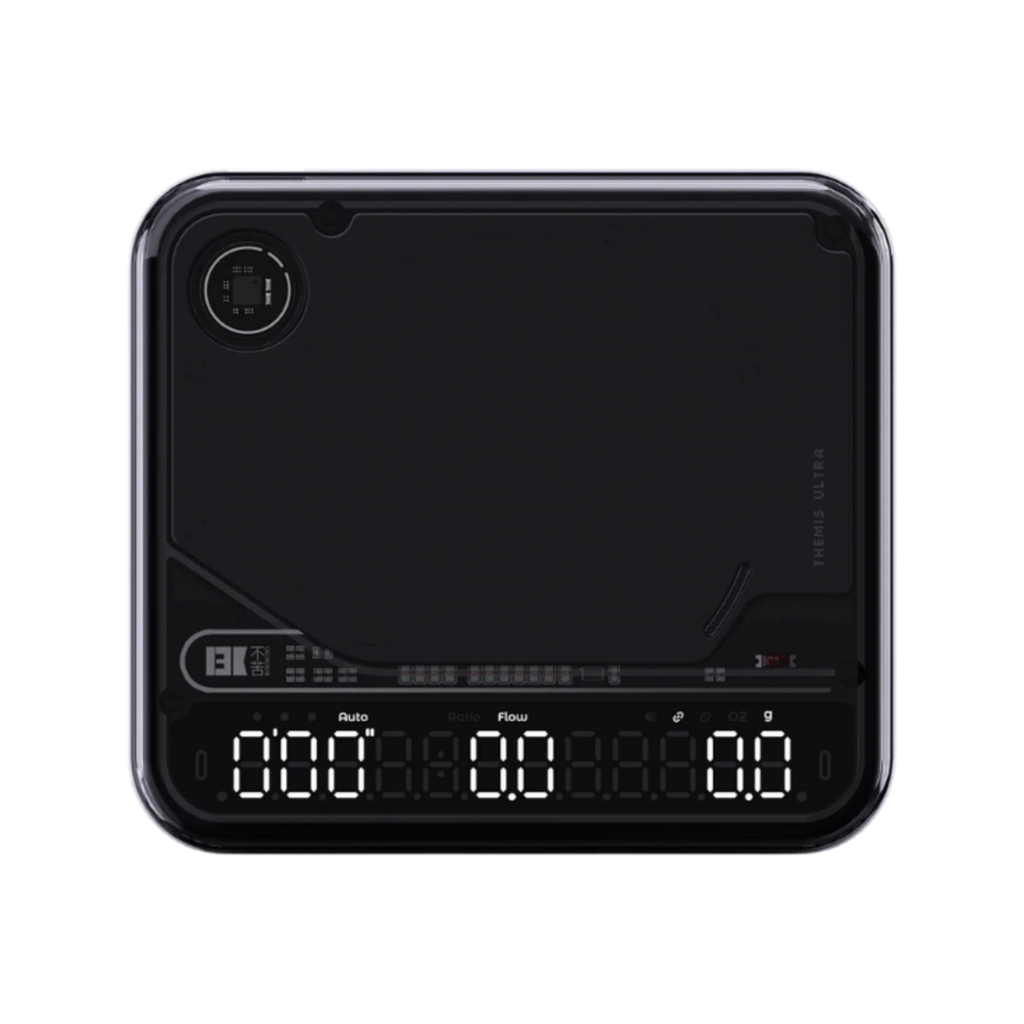
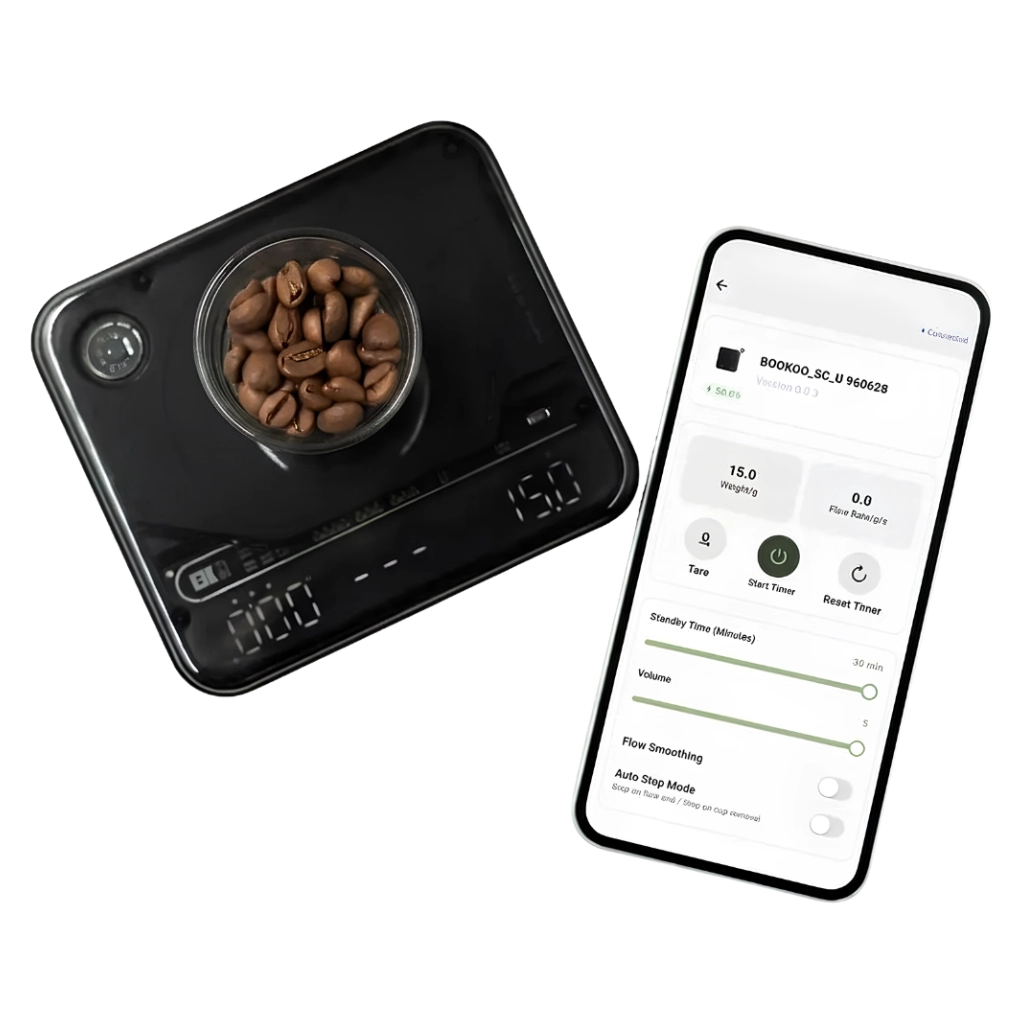
The Moccamaster brews continuously from the first to the last drop. Starting from the brew start, water is added in a steady flow. We tested the flow with the interesting scale from Black Mirror. The scale basically consists of two scales. It measures on the one hand the weight of water being added to the filter and on the other hand the amount of brewed coffee already in the carafe.


Continuous brewing is well suited to deliver consistent results from extraction to extraction. Pulse brews, also called surge brews, add water in bursts. A first burst serves as a pre-brew. Very little water is added here. The CO2 created by roasting can escape. CO2 is on the one hand not tasty and on the other hand its release causes agitation in the coffee cake. This so-called blooming makes sense especially with darker roasts, as these have bound significantly more CO2.
Another reason why we recommend using the Moccamaster especially for lighter roasts.
The following graphic shows two brews that we captured with the Black Mirror app. On the left was brewed with the Moccamaster, on the right by hand.
Conclusion and Outlook Moccamaster KBG 741
We tested the Moccamaster thoroughly. The Moccamaster is the third filter coffee machine we are testing in a series of coffee machines. Our background is manual brewing. The author was a Swiss Brewers Cup Master (filter coffee master) and multiple vice champion. The standard for good filter coffee is high – but not difficult to achieve. As mentioned at the beginning, some basic parameters must be met.
We examine automatic filter coffee machines because we expect that in the future, particularly the consistency across many consecutive brews can be better achieved by an automatic machine – with consistent quality.
The Moccamaster is not that machine yet. Compared to hand-brewed filter coffee, the Moccamaster delivers satisfactory to good results with light roasts and poor to satisfactory results with dark roasts.
Its temperature is very consistent – but unfortunately too high. The water distribution is well thought out, but doesn't work sufficiently in practice. The machine's biggest pro is its excellent workmanship and 5-year warranty.
These tests were conducted with our test device, which we purchased like all other test devices.