






The Lagom P64 from Option-O has built an excellent reputation over the last few years and is considered by many to be one of the best single-dosing grinders on the market. Its combination of high-quality craftsmanship, minimal retention, and high grinding consistency makes it an exciting option for demanding home baristas and professionals alike.
We have tested the grinder extensively over several months—in our home kitchen, at our coffee school, and in the lab. Our focus was to evaluate grinding quality, ease of use, and the quality of the espresso and filter coffee. The grinder has gone through our detailed test protocol. In doing so, we wanted to find out whether the Lagom P64 lives up to the high expectations and whether it represents a sensible investment for passionate coffee lovers.
In addition to the long video version, there is once again a short version as well as an English version of the test.
Craftsmanship and Design
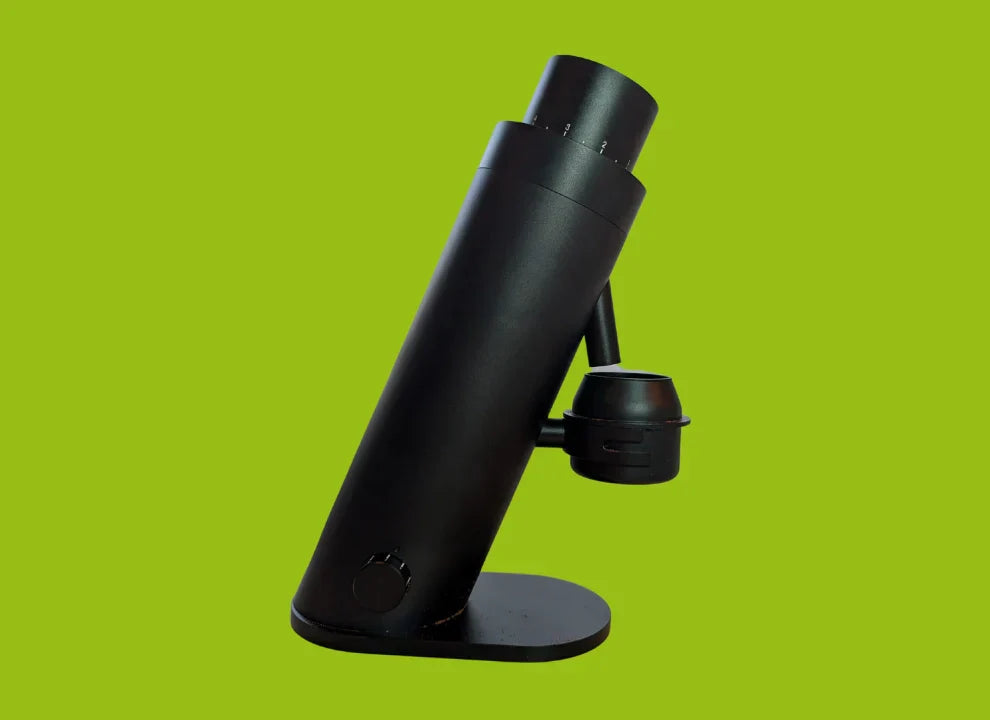
Even just by unboxing it, the Lagom P64 leaves a high-quality impression. The housing consists of solid, CNC-machined aluminum, which is impressive both visually and haptically. The grinder feels extremely robust, and it is a pleasure to use. The same applies to the included dosing cup and the dosing ring.
The in-house WDT tool, on the other hand, is rather crude and did not convince us.
With a size of 21 cm in depth, 13 cm in width, and 38 cm in height, it is compact enough to find space in even smaller kitchens. Its weight of around 7.8 kg ensures high stability, which is particularly important when grinding with single dosing. The design is kept minimalist, with clean lines and a modern aesthetic that blends well into various environments.
The grinder is available in the color variants black and silver.
As always, we bought our model ourselves in order to be able to evaluate it independently and neutrally.
Technical Equipment and Functions
The Lagom P64 is equipped with 64 mm burrs, which are available in several variants. Option-O offers its own burrs, but the grinder is also compatible with third-party burrs such as the variants from SSP.
Compatible burrs with which the Lagom P64 can be purchased directly:
- Mizen-Burrs 650 Omni: A proprietary development from Option-O that is described as a middle ground between both options and is well-suited for both espresso and filter coffee. Not tested by us.
- Mizen 64ES (Espresso): Developed for espresso. Tested by us and we liked it well for both filter coffee and espresso. Clear coffee, lots of sweetness, good body and a clear aftertaste as well as a narrow particle distribution in the main peak.
- SSP High Uniformity: These burrs were developed for espresso and offer a very tight particle distribution with a dense crema and intense sweetness. Not tested by us with the Lagom P64.
- SSP Unimodal: This variant is particularly suitable for filter coffee or light espresso roasts. It produces a cleaner flavor profile with higher clarity. Not tested by us with the Lagom P64.
Another technical highlight of the Lagom P64 is its brushless 300-watt DC motor (BLDC) with a variable speed of 300 to 1400 revolutions per minute (RPM). This allows for the grinding speed to be adjusted to different beans and brewing methods.
We performed our espresso test at 1000 RPM.

Grinding Quality and Consistency
Grind consistency is one of the most important factors in evaluating a coffee grinder. The test showed that the Lagom P64 delivers an exceptionally narrow and precise particle distribution in the main peak. This has a direct impact on the extraction quality and ensures repeatable results.
Especially for espresso, the grinder impresses with a narrow particle distribution and excellent reproducibility of the grind settings. Even small changes to the grind size have a measurable influence on the extraction time. This allows for very fine tuning of the flavor profile.
The grinder has stepless grind adjustment that is precisely adjustable. Fine-tuning the grind is easily possible, which is crucial for espresso preparation in particular. The grind reproducibility was good in both particle distribution and espresso extractions.
To test the grinder to its limits, we note the determined marking point on the burrs for a standard recipe. We then prepare a ristretto with a very fine grind and then a lungo with a coarser grind. In the fourth step, we reset the grinder to the starting mark and take a sample of the grounds, which we compare with the particle distribution of the original recipe.
In addition, we pull another espresso and observe whether the extraction time, strength (TDS), and calculated extraction remain constant. In both scenarios, we can certify the Lagom P64 with high precision in repeatability.
Despite the high speed, the temperature of the burrs remains stable during the grinding process. There is no noticeable heating of the grounds, which is a big advantage since a temperature above 40 °C in the grounds can lead to negative taste effects.
With six consecutive shots, we measured only 28.28 °C – an excellent value.
The taste proves the grinder right!
In addition to the good craftsmanship and the elegant design, the Lagom P64 convinced us above all with its very good flavor performance. We did not have to resort to SSP burrs for this, but instead used the in-house Mizen 64ES.
And what can we say? These burrs delivered fantastically—and not just in the espresso for which they were actually designed. They were also convincing in filter coffee.
We were able to determine this not only in terms of taste, but also based on the very narrow particle distribution in the main peak—a value that stands out significantly compared to many other grinders, especially those with 64 mm burrs.
Retention and Static Charge
Attention! The Lagom P64 can practically only be used meaningfully with a water spray. This technique is called the Ross Droplet Technique (RDT).
Since you weigh the coffee beans before grinding with single-dosing grinders anyway, it is no extra effort to add one or two sprays of water to the beans. This significantly reduces the static charge of the ground coffee.
Without RDT, the workflow with the Lagom P64 is problematic:
- High coffee loss, as coffee grounds stick to the grinder.
- Fluctuating results, with up to 0.4 g deviation.
- With an 18 g bean input, the output amounts fluctuated between 17.7 and 18.2 g.
With RDT, the deviation is reduced to a maximum of 0.1 g, and the grounds become more consistent.
Retention was also extremely low with 0.2 g of permanent retention. No temporary retention was detected. The grinder therefore grinds itself almost completely empty. It only requires tapping twice on the bean hopper. Because this works so well, a bellow is not necessary for the Lagom P64.

Usability
If RDT is not an obstacle for you, the grinder is very simple and intuitive to operate.
Two of the three included tools work very well:
- The dosing container has a wide opening and collects the grounds completely. If you then place it on the portafilter, the coffee powder is already evenly distributed. Since it only sinks in slightly, it does not tend to promote channeling.
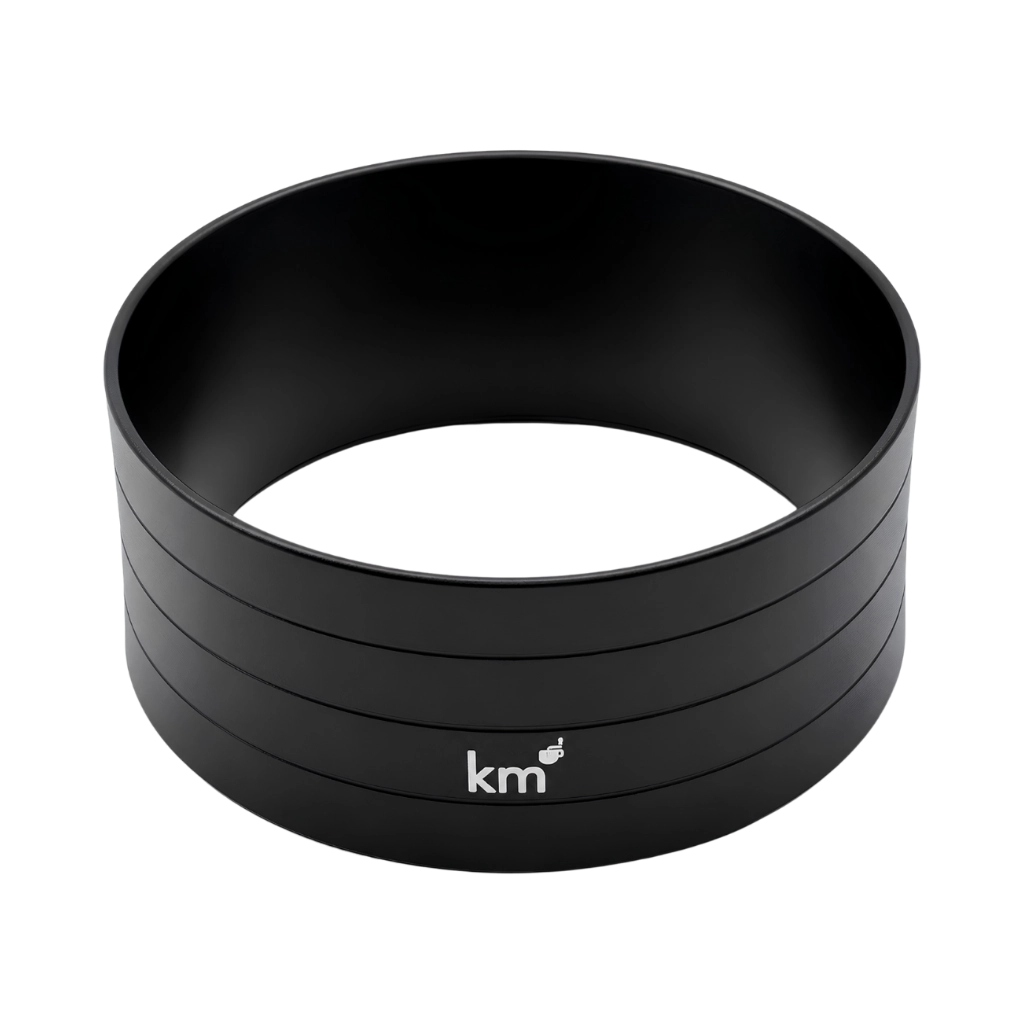
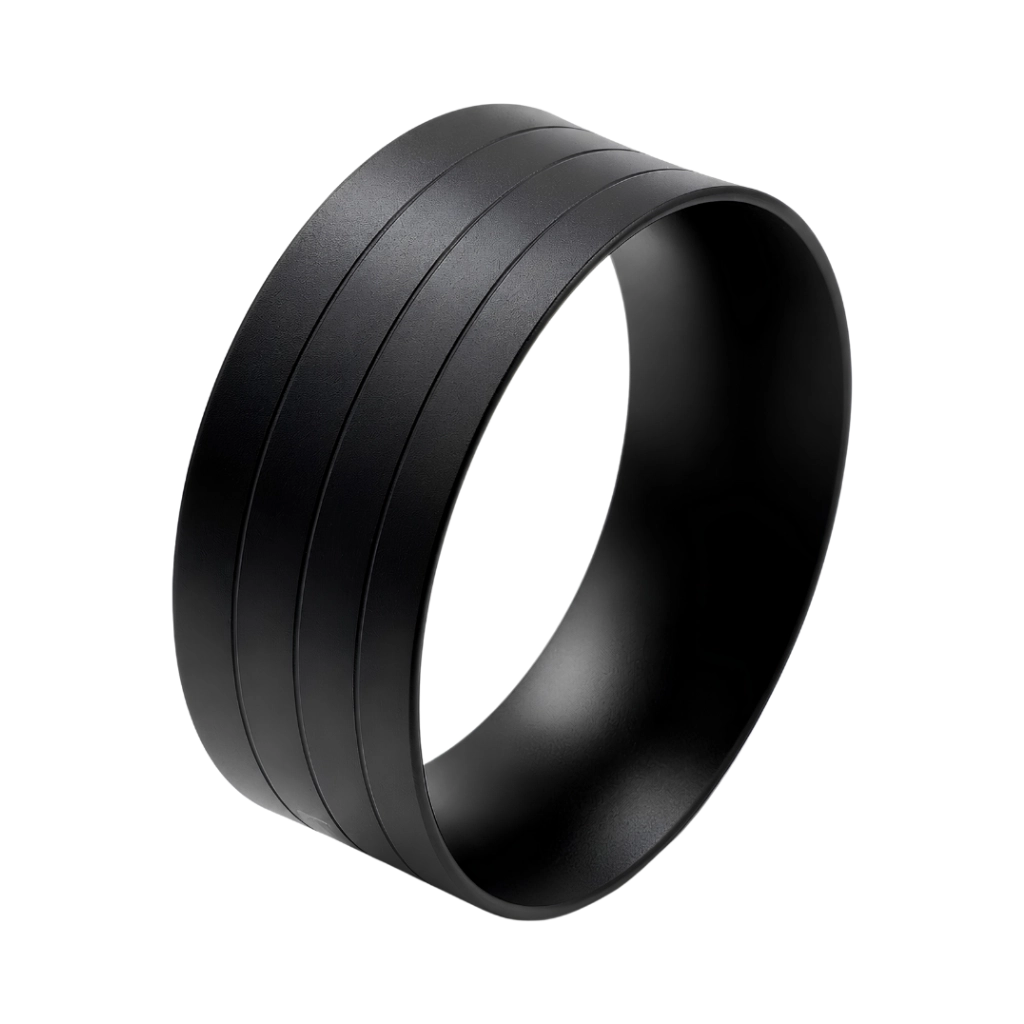
- The dosing ring allows for clean work. It is placed on the portafilter to better collect the grounds.
Without the dosing ring, some of the ground coffee falls to the side. The grinder's chute is relatively narrow, which leads to insufficiently distributed grounds and a high mountain of coffee.
With the dosing ring, the grounds remain completely in the portafilter and can be evenly distributed by simple tapping.
The dosing ring is high-quality and sits securely on most 58 mm portafilters thanks to embedded magnets.
The grinder also delivers good values in terms of speed. In 10 seconds, 24.8 grams are ground with continuous addition of beans. This value serves for comparability with grinders with a bean hopper, but is otherwise less relevant. What is relevant is that the grinder needs 12.6 seconds for 18 grams. That is a fast value.
The grinder is moderately loud at 83.8 decibels. However, the noise itself is a pleasant one. Especially with cheaper grinders, you often hear the motor of a grinder working. Not so with the Lagom P64. It runs round and smooth, and that is how it sounds.
WDT Tool – Not optimal
Also included in the scope of delivery is a WDT tool. However, the needles are very thick and too close together, so they do not optimally loosen the grounds.
For this reason, we did not use this tool in our workflow.
Cleaning and Maintenance
An outstanding feature of the Lagom P64 is the simple cleaning. Two hex screws need to be loosened, and you have access to the burr level.
This also makes it relatively easy to replace the burrs themselves. The tool-free construction allows for quick disassembly, which keeps regular maintenance and cleaning straightforward.

Price-Performance Ratio and Conclusion
With a price of around 1,800 Swiss francs, the Lagom P64 is undoubtedly a high-priced coffee grinder. The question of whether it justifies this price depends on individual requirements.
The grinder offers exceptional precision, thoughtful craftsmanship, and a good workflow for demanding users. Anyone looking for a grinder that works at the highest level for both espresso and filter coffee will make a long-term and worthwhile investment with the Lagom P64.
However, there are a few minor drawbacks:
- The static charge is problematic without RDT.
- The low speed can occasionally lead to blockages with lighter beans.
- Skip the included WDT tool.
Despite these points, the Lagom P64 remains one of the best coffee grinders on the market. For ambitious home baristas and professionals who value precision and quality, it is an excellent choice.
However, for those who do not like RDT, the grinder is not well-equipped. That is one reason why we do not use the Lagom P64 in our home barista introductory courses. We want to make coffee as simple as possible for all beginners.
The various third-party burrs expand the area of application and make it possible to adapt the grinder to different beverage and roast requirements.
And in the end, the most important criterion counts: the taste in the cup.
Here, the Lagom P64 with the Mizen espresso burrs convinced us—and not just in espresso, but also in filter coffee!