






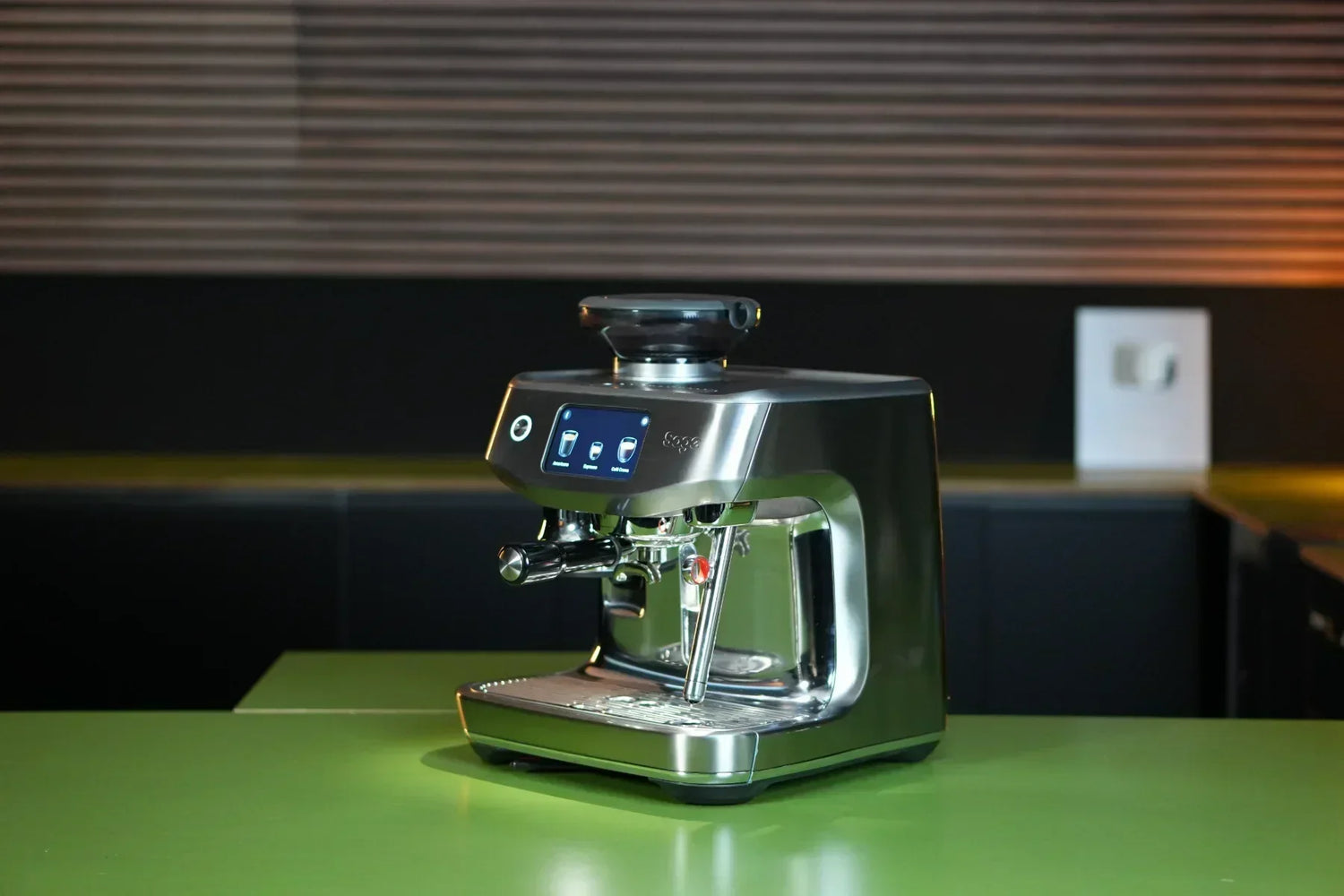

The Sage Oracle Jet espresso machine goes halfway toward being a fully automatic coffee machine. The Oracle Jet handles tamping just as it handles grinding. And tips help guide you through the workflow.
Our team of experienced baristas, trainers, and restaurateurs put the Oracle Jet through its paces for several months using two test units. The question is: Can this semi-automatic portafilter machine with an integrated grinder and modern features really make the transition from a fully automatic machine easier while delivering barista-level espresso quality?
At first glance, the equipment sounds promising: extremely fast heat-up time, automatic grinding and tamping, a touchscreen with beverage menus (including cold brew), and an automatic steam wand for microfoam. All this is packed into one compact device – but does it really work as well in practice as it does on paper? In this review, we cover this objectively, but with our usual charming wink.
Look forward to clear chapters on appearance and build quality, heat-up time & energy consumption, temperature performance, grinder, operation, espresso quality, milk frothing, the cold brew function – and finally, our conclusion with a rating.
Exterior and Build Quality
The Oracle Jet is obviously a Sage on the outside. Stainless steel look, cleanly designed housing, large water tank in the back – typical Sage. Nevertheless, it is noticeable that the Oracle Jet is positioned a step above the cheaper models (e.g., Barista Express/Pro), similar to the Sage Dual Boiler. We felt a higher-quality build: less plastic, more metal, no sharp edges – overall, everything seems solidly constructed. The machine weighs around 12 kg and is correspondingly stable. A practical detail: small rollers are built under the drip tray, so you can easily pull the 12 kg machine forward on the countertop to refill water or clean the back, for example. Such little things show that Sage has thought about everyday life.
The dimensions are considerable – about 42 cm wide, 38 cm deep, and 36 cm high – which is due to the integrated grinder and extensive features. The Oracle Jet is essentially a small fully automatic coffee machine in portafilter form and needs some space. On the positive side: the water tank holds 2.3 liters and can either be opened from the top (practical if there is little space under wall cabinets) or removed completely from the back. The drip tray is generously sized and equipped with a clever float that indicates "tray full." About 650 ml of liquid fits inside before it should be emptied – enough so you don't have to run to the sink after every pull. Thanks to a plastic support plate under the stainless steel grate, nothing splashes over easily when carrying it. Furthermore, a drawer for accessories (blind filter, brush, etc.) is hidden in the front behind the drip tray, as we know from Sage. In short: the build and design are well-thought-out and suitable for everyday use.
A big plus in this class: 58 mm portafilter diameter. Sage uses a standard stainless steel portafilter here with a double spout and a large double-cup filter basket. Unlike smaller Sage models (which often have 54 mm), we could therefore use our usual 58 mm tampers, filters, and accessories. The double filter basket is quite spacious – ~22 g of ground coffee fits inside, which the machine also suggests we use. For optimal reproducibility, Sage advises (and we agree) to mainly pull double espressos.
Our tip: If you only need one espresso, brew a double anyway and split it – the second espresso is guaranteed to make someone happy (offer it to the nice neighbor if in doubt 😉).
Overall, the Oracle Jet makes a high-quality impression. We rate the material quality at 6.5/10 points – solid, even if not fully at a professional level. The scope of delivery is complete: in addition to the machine including the integrated tamper, you save yourself the purchase of some extras. Included are, among other things, a knock box (knock-out container for the coffee grounds, very commendable!), a 58 mm portafilter with double basket, milk pitcher, water hardness test strips, water filter for the tank, and various cleaning utensils (cleaning tablets, small brush, small screwdriver).

Heat-up Time and Energy Efficiency
Let's come to a highlight of the Oracle Jet: the lightning-fast heat-up time. When first switching it on, we were almost disbelieving – after 3 minutes, the machine was ready for operation! That is record-breaking in the world of portafilter machines. By comparison: many classic dual-circuit or dual-boiler machines take 20–30 minutes, and some thermoblock machines still take 5–10 minutes. The Oracle Jet sets new standards here and is among the top 3 machines tested in our list with a 3-minute heat-up time. Sage calls the heating system ThermoJet® – it consists of two digitally controlled thick-film heating elements. One takes over the rapid heating of water for espresso or steam; the second is integrated directly into the brew head to bring the brew group up to temperature. This design explains the speed as well as the good energy efficiency: the heating elements have little mass that is specifically heated, instead of having to keep a large boiler hot constantly.
Our measurements impressively confirm the efficiency. In the standardized test (heating up + 5 consecutive espresso pulls), the Oracle Jet consumed only approx. 0.0656 kWh – i.e., under 0.07 kWh. Calculated down to a single espresso (including the warm-up phase), that is a tiny 0.014 kWh per pull. In other words: one espresso draws less electricity than, for example, 5 minutes of ironing with a steam iron.
In times of rising energy prices, this is reassuring news: your electricity bill will hardly be burdened by daily espresso enjoyment with this machine. With 10/10 points in the electricity consumption category, the Oracle Jet sets a benchmark. After heating up, the machine is not constantly reheating either – it switches to standby quite quickly during inactivity and apparently maintains the temperature efficiently without constantly drawing energy.
All this means for the user: no more long waiting in the morning – turn it on, add beans, prepare the cups in the meantime, and you're ready to go. Sage advertises "3-second heat-up" for other models somewhat misleadingly – in truth, it is 3 minutes, but that is still sensationally fast.
Nevertheless, we give this tip: as quickly as the Oracle Jet heats up, 3 minutes are still not enough for perfect temperature stability (details in the next chapter). After 3 minutes, you should ideally do a blank pull or at least rinse some hot water through the portafilter briefly. This heats the portafilter through properly. Because the metal parts (portafilter, brew group) lag significantly behind – that is the case with all fast-heating machines. Our ritual: Turn the machine on, wait 3 minutes until "Ready," briefly start the pull without coffee grounds (let water run through), then dry the portafilter, insert coffee, and go. That way, the first espresso gets the best possible starting temperature.
Bottom line, the heat-up time and efficiency of the Oracle Jet are its absolute strengths. The feeling of "bam – machine on and ready to go" is really fun and lowers the threshold to spontaneously pull an espresso. For this, we award full points, 10/10, for heat-up time. But now to the flip side of this fast ThermoJet technology: the temperature behavior during the espresso pull.

Temperature Behavior During Espresso Pull
As quickly as the Oracle Jet is ready for operation on paper, we must critically evaluate its temperature stability during extraction. Our tests have shown that while the machine does reach the set temperature, it does so only with a delay in the shot. What does that mean in concrete terms?
The Oracle Jet does have an adjustable brew temperature (configurable in °C on the display, factory default around 93 °C). Our measurements showed that there is no large offset between the displayed target temperature and the actual temperature – that is positive. If you set 93 °C, for example, the effective water temperature (after the initial phase) also settles around there. However: The water runs through significantly cooler for the first few seconds of each pull.
There are two reasons for this. First, the machine does not start the extraction immediately after pressing the button. Sometimes a few seconds pass before the first drops trickle out of the machine.
The second point lies in the machine's extraction logic. The Oracle Jet has a pump pre-infusion stage with a very low flow rate. It uses a vibration pump, but it is electronically controlled so that it only builds up full pressure after approx. 8–10 seconds. Initially, only a thin trickle of water drips into the coffee bed – which can generally be good for extraction (gentle swelling of the coffee grounds). The problem: This small amount of water cools down significantly during the pre-infusion in the measuring portafilter, and apparently, the heating system does not manage to bring the water to target temperature from the very first second. Result: The first ~10–15 seconds of the pull run below target temperature; only from about second 15 does the water flow reach the target temperature.
This still-too-low temperature is also caused by the design of the measuring portafilter. With such low water flow, it does not come into contact with enough water to measure high water temperature values. On the other hand, this small amount of water also cools down extremely quickly. We simulated this low water flow with other espresso machines. A direct comparison shows: the Sage remains significantly too cold for too long in every case. All other machines with low flow reached the temperature target 5–7 seconds faster, with the same flow!
We recorded this behavior both with our KM temperature protocol and the WBC standard protocol (32 s pull with 5 s pre-infusion). The range was enormous: water temperatures between 66 °C (minimum) and 94 °C (maximum) were measured. Even if one ignores the first 5 seconds, the temperature was still in the 80s at the start and only rose above 90 °C late. This "sluggish temperature curve" also appears in our own protocol. After 4–5 seconds of pulling, the temperature was still around 5 °C below target, and after 10 seconds still approx. 1.5–2 °C below. And all this with the "beautified" curve. For this, we only counted the start of the pull once 70 °C was reached.
When we measured from the moment the button was pressed, which usually corresponds to the test protocol, we reached the target temperature only after about 18–22 seconds!!!

In both cases, the temperature only stabilizes after that. That is suboptimal because the decisive extraction phase for espresso takes place in the first 20–30 seconds. It helps little if the machine is super-stable from second 20 onwards.
For us as testers, this is one of the biggest points of criticism of the Oracle Jet. Sage has apparently chosen a defensive approach here: better lower temperature at the beginning than risky overheating. However, this leads to an inconsistent extraction – especially with lighter roasts, which would need high and constant temperatures. Our temperature curves also showed slight fluctuations from pull to pull: some shots ran relatively constantly (after the initial rise), others fluctuated by 1–2 °C. Overall, the temperature profile remains "problematic" and far from ideal. We awarded only 4.5/15 points in the temperature stability category – a significantly below-average score that weighs on the overall rating.
To put this in perspective: other machines manage better, either to reach temperature faster or to have a slight rise over the pull, but at a higher starting level. And we are not talking about machines in the same price range, but espresso machines that cost a third of the Sage Oracle Jet.
The Oracle Jet, on the other hand, follows a profile of "too cold for a long time, then constantly a bit higher." That is neither a flat-line temperature nor a classic temperature profile that we would wish for. We think: there is a clear need for optimization here. The thick-film heater technology could easily handle that.

Practical Tips on Temperature
Let it heat up and flush: As mentioned in the previous section, be sure to wait the 3 minutes and flush with hot water once to preheat the portafilter and brew group as much as possible. A "thermo-flush" before the first shot ensures a better thermal start.
Preheat the cup: Of course, the espresso cup should be well preheated (the Oracle Jet's cup warmer doesn't get hot due to the lack of a boiler, so rinse with hot water or warm on a separate heating plate). Every bit of heat reserve helps.
Set brew temperature higher? One might think one should simply set it 2–3 °C higher so that it fits. We tried that – but it leads to the later seconds of the pull overheating. So better to stick to a reasonable setting (e.g., 93 °C) and adjust the coffee blend instead.
Choice of beans: We recommend using medium to darker roasts with the Oracle Jet. These are more forgiving of the somewhat lower initial temperature and still extract harmoniously. In fact, we achieved excellent results with an Italian espresso blend we developed (darker, stronger, chocolatey). Light, acid-driven third-wave roasts were more difficult to get sweet and clean. With a strong, full-bodied espresso, however, the output tastes good because this coffee masks the temperature weakness somewhat.
Do not unnecessarily extend the pull time: One might get the idea of choosing very long flow times so that the temperature is eventually right. We advise against this – an espresso should not run for 50 seconds just to eventually reach 93 °C at the end. Stay in the normal range (25–35 seconds total pull time). It makes no sensory sense to do a pull that is way too long – that only leads to over-extraction and bitterness.
In summary: The temperature behavior of the Oracle Jet is its biggest weakness. For absolute espresso perfectionists who expect a flat 93 °C curve, this will be disappointing. In practice, however, we were still able to pull tasty espressos through the measures mentioned – especially when you meet the machine halfway with suitable beans. The set temperature corresponds approximately to reality from the middle of the pull and has no large hidden offset, which is positive. Nevertheless, a clear deduction remains here in the secondary evaluation. In our evaluation criteria, temperature was the outlier downwards with only 4.5 out of 15 points.

Integrated Grinder – Performance, Noise Level, and Grind Quality
A central component of the Oracle Jet is the built-in coffee grinder. In many compact machines, the grinder is the weak point: often a compromise due to space reasons. We therefore applied our full grinder test protocol to check noise level, grinding speed, retention, and particle distribution – similar to how we do it standalone with pure grinders.
The Oracle Jet relies on a conical burr grinder made of hardened steel. Sage reveals that these are Etzinger burrs (known from Baratza grinders), which our visual inspection has confirmed. This conical grinder is continuously adjustable, albeit with an indication of numeric steps 1–45 on the display (the fineness can therefore be set in 45 "steps," although there is room between the numbers – the system is virtually "micro-stepped," which allows for fine adjustment). In the test, the grinder grinds automatically directly into the portafilter and subsequently tamps automatically as well. But let's look at the key figures:
Grinding speed: The grinder is neither a snail nor a turbo, but in the good midfield. We measured approx. 18 g in 10 seconds. That is absolutely okay. You don't wait forever, but it's also not all done in 5 seconds. For home use, the speed is more than sufficient.
Noise level: At an average of 75.9 dB when grinding (measured from a distance of 30 cm), the Oracle Jet grinder is pleasantly quiet. Our subjective assessment confirms this: the grinding noise is more muffled than with many external grinders. The machine itself (pump, mechanics) is relatively quiet anyway – the biggest noise always comes from the grinder, and the Oracle Jet performs very well here. 75–76 dB places it in a very good category (for comparison: this is significantly below the noise level of many cheaper grinders, which often reach 80–85 dB). In morning operation at home, no one will fall out of bed in shock if you grind an espresso. Still, a word on the "quality of the noise": although the grinder is not loud, it sounds "strained" when grinding the coffee.
Retention: Less pleasant is the retention, i.e., the amount of coffee grounds that remain in the grinder after grinding. We distinguish between permanent and temporary retention – but with this design, that could not be broken down cleanly, so here only the absolute value: about 3.3 g get stuck in the grinding chute and between the burrs. In practice, this means: if you don't grind coffee for a longer time (say >1 hour), the first 3.3 g that come out afterward are already slightly oxidized, stale coffee powder from the last time. You don't taste that immediately extremely (especially not in milk drinks), but over time, you will notice that the first shot after a long break tends to run out slightly worse and a bit thinner than the second. Especially if you value freshness, this is not optimal. Unfortunately, you can't magic away 3 g of old coffee – unless you do a short "blank grind" and dispose of the first few seconds of grounds. In everyday life, hardly anyone will do that, so you live with slight quality fluctuations between the first and subsequent pulls. For an integrated grinder with a doser and tamper, 3.3 g is not entirely surprising either – classic disk grinders with dosers used to have significantly higher retention. Modern single-dose grinders, on the other hand, are below 1 g. Here, one must clearly say: a built-in grinder can hardly be designed to be as low-retention as, for example, external single-dosing grinders, where you pour in the beans one by one and everything comes out at the bottom.
Grind consistency & particle distribution: Now it gets technical: We had the particle distribution of the grounds measured by laser diffraction – like with over 80 grinders before. But don't worry, we'll only summarize the relevant results. The Oracle Jet grinder produces a median particle diameter of approx. 324 µm (x50) at the espresso setting. More important is the distribution width: how homogeneous or heterogeneous are the particle sizes? The main peak (the high "mountain" in the particle size diagram) was at ~284 µm with a comparatively narrow spread. The share of fine particles (<100 µm) is 28.5 %. Translated, this means: the coffee grounds are relatively uniform, there are not excessively many "fines," and no extremely wide spread from very fine to very coarse.
In our previous grinder tests, it has shown that a narrow particle distribution contributes significantly to a clear, balanced espresso taste. Broadly distributed particles (very inhomogeneous grounds) often lead to "frayed" aromas – bitter notes AND unpleasant acidity at the same time, little sweetness, simply unround. The Oracle Jet grinder performs pleasingly solidly here.
The particle curve of the Oracle Jet resembles that of good mid-range espresso grinders. It is not as narrow as with really expensive high-end grinders (where the peak would be even narrower and more defined), but "good and solid" hits it. Many different espresso roasts could be extracted tastily in our trials without the grinder appearing as a limiting factor. Even lighter roasts were extracted – only as mentioned, temperature limits more here than the grinder.
We rate the noise level, speed, and consistency of the grinder with good marks (e.g., noise level 3.5/5 points in our scheme, speed "solid"). The retention pulls it down a bit. Overall, the grinder performs "well" – which you cannot say of every built-in grinder. We are usually not fans of combo solutions (grinder+machine in one) because at least one component often suffers. Here, however, the grinder is not a major weakness, but rather a small strength of the Oracle Jet.

Tamper
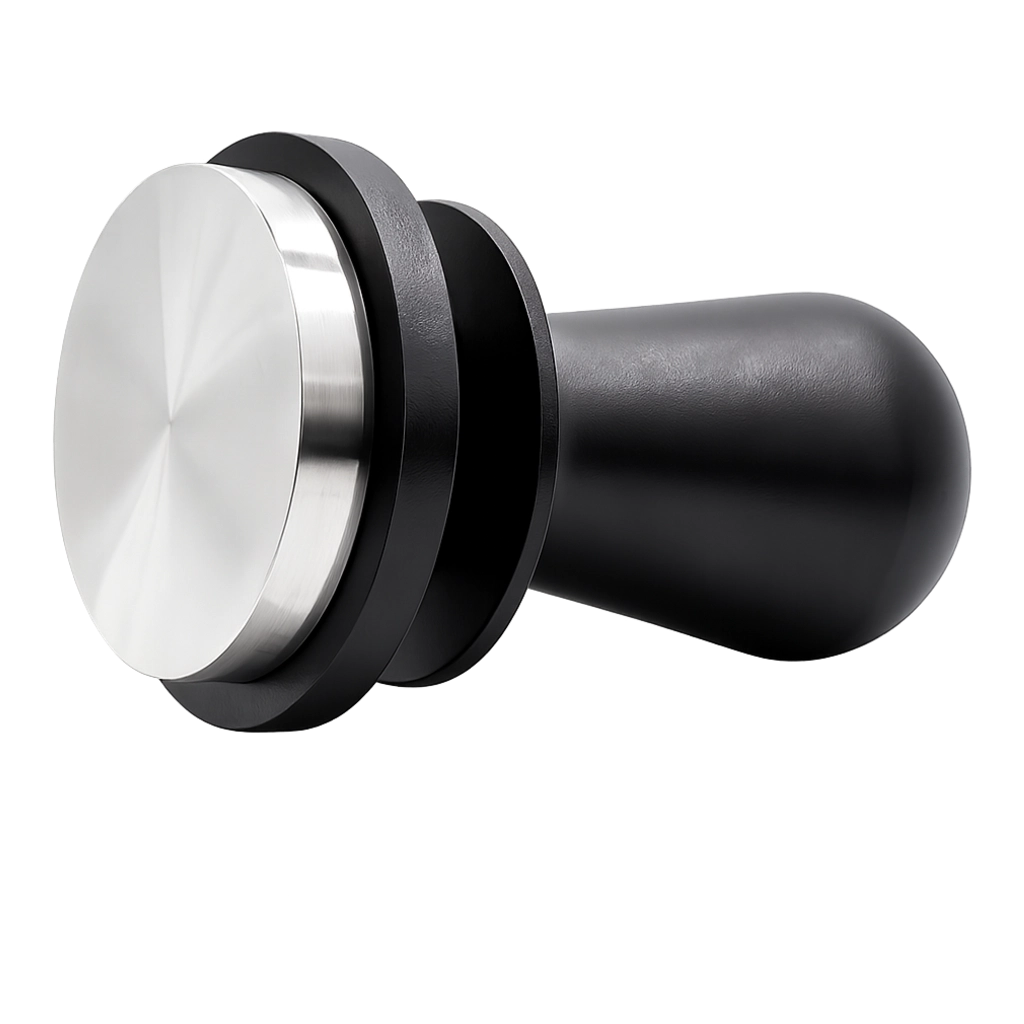
A word about the Oracle Jet's automatic tamper: the grounds are automatically tamped by the machine after grinding. You remove the portafilter and find a finished tamped coffee puck surface. Initially, we were skeptical – we have seen such solutions perform worse. But Sage did a good job: the pressure is consistent, the puck is densely compacted. Only a few loose crumbs remain at the edge sometimes, but you know that from manual tamping too (if the tamper is, e.g., minimally smaller than the filter basket diameter). You can ignore these crumbs – they do not noticeably affect the extraction. Important: the tamper pressure cannot be adjusted, but it is apparently preset in the optimal range. Overall, the auto-tamper saves work and functions reliably.
In short: automatic tamping is a fine thing, especially if several people operate the machine or if you want to work precisely but without much effort in the morning.

Operation and User Guidance
The Sage Oracle Jet presents itself as a "smart" portafilter machine – and that is noticeable in the operation. The central element is the large 5-inch touchscreen in the middle. We liked this display a lot: it is clear, color, and above all fast/responsive. Nothing is more frustrating than sluggish touchscreens – here, everything reacts well to touch.
User Interface and Menus
After switching on, the Oracle Jet greets the user with a start screen on which various drink options are available as icons for selection. By default, espresso, Americano, cappuccino, latte, flat white, etc., are listed there – essentially predefined programs. You can personalize this order: move your favorite drink to the front, hide rarely used ones (they then disappear from the first view but are not deleted). The drag-and-drop of the icons worked intuitively in the test.
If you tap a drink (e.g., espresso), you reach a submenu with specific setting options. Here, for example, the fill quantity can be set (i.e., how many ml/grams should run into the cup), and if required, the brew temperature and pre-infusion time (depending on the mode). For milk drinks, options for milk foam amount and milk temperature are added. For example, you can define for cappuccino: X ml espresso, foam level 5, milk temp 60 °C. These adjustments can be saved as a personal preference, so the machine uses these parameters directly the next time. Even the icon image of the drink can be adjusted – gimmicky, but nice.
In the menus, Sage tried to find a balance: as many setting options as possible, but still simple navigation. From our perspective, that has succeeded well. Sure, you might have to look at the instructions once at the beginning to understand all features – but we found our way around quickly. Those coming from fully automatic machines will be positively surprised by how much you can set. Those coming from manual machines might think "is all this necessary?" – but no worry: you can also simply operate the Oracle Jet like a classic machine (adjust grind and quantity manually and then start the pull) without constantly consulting menus. For shared households or beginners, however, the help is worth its weight in gold.

Barista Guide and Help
A special feature is the integrated "Barista Guide." That is basically a little helper that can give feedback after an espresso shot: was the shot under- or over-extracted? The machine recognizes this based on the flow time and quantity and then gives a tip in which direction you should change the grind size. Example: if your espresso ran through way too fast, the recommendation "set grind finer, e.g., from 30 to 27" appears after the pull. Or conversely, set it coarser for a very long pull accordingly. We found this feature useful – especially for people who just haven't had years of espresso experience. The Oracle Jet takes you by the hand and perhaps saves you one or two frustrating shots. Of course, that doesn't replace a barista course, but it ensures faster learning successes: you get a concrete action proposal directly instead of just stating "crap, ran too fast/slowly."
Another recommendation from us: definitely use the volumetric control of the machine, not the time-based one. You can namely set in the menu whether a pull should stop based on quantity (water volume) or time. The Oracle Jet has precise volumetrics: a flow meter ensures that, e.g., 45 ml of water flows through and then is stopped. We tested the consistency – the machine hits the quantity quite accurately (within 1–2 ml). Therefore, it gets 8/10 points in the "Volumetrics (consistency of output quantity)" category, a good value. Time-based stopping, on the other hand, we advise against: if you set a fixed 25 seconds, the cup might overflow once and be almost empty another time depending on the grind. The result would be inconsistent. So definitely work volumetrically! The quantities can be set in the profile after all. Unfortunately, the control here is not individualizable. Here, it follows the quantities specified by Sage, which are, however, sensibly related to the large amount of coffee used.
We rated the overall operability at 8.5/10 points. Despite its many features, the machine is intuitive. A large part of what sounds complex happens automatically or optionally. Example: Auto-Queue function – the Oracle Jet can optimize the sequence by, for example, automatically starting with milk frothing as soon as the espresso is finished extracting, without you having to press anything. So the espresso doesn't stand around unnecessarily long, but the milk is finished immediately afterward and you can combine both. That is well thought out and saves a few seconds – nice to have when you prepare cappuccino & co.
Cleaning and maintenance are also well supported: the machine reminds you of descaling, group head cleaning (backflush), and water filter change, each with an indicator in the menu. There are automated cleaning programs that you can start. All this ensures that even less experienced users can keep the machine in shape for a long time. Nevertheless, the important note: definitely use the included water filter (or fill in soft water)!
One more topic that caught our attention during operation: the double spout of the portafilter. Here we have a clear point of criticism: the two spouts are very close together at the bottom. Although they are far apart at the top of the portafilter, they run together conically on the inside so that the two espresso streams are only a few millimeters apart when flowing out. Why is that relevant? If you want to fill two espresso cups simultaneously, they have to stand really close together, otherwise, something goes to waste. We were annoyed a few times that a drop went next to the cup when splitting a two-cup shot because the spout is so narrowly centered. That is not the end of the world – you get used to it and position the cups accordingly – but it stood out to us negatively. With many other portafilters, the spouts are slightly further apart at the bottom, which makes it easier to pull two espressos. Alternatively, you could use a bottomless portafilter (available as an accessory), then you don't have this problem, but you have to split the shots manually.
In sum, the Oracle Jet is convincing in terms of usability. The mix of automation (for convenience) and manual control (for quality) is well met here. We would say: for someone coming from a fully automatic machine, much seems familiar ("press button, runs automatically, receives tips"), and at the same time, you gradually learn the important parameters of a portafilter machine (grind, ratio, temperature, etc.). Advanced home baristas can also find pleasure in it, because despite all the helpers, you can adjust enough yourself and the machine never "gets in the way" if you want to intervene manually. For example, you can grind and tamp manually at any time (the grinder also has a manual button, and the steam wand can be operated completely manually, see next section). In short: operation = successful.
Espresso Quality in the Taste Test
Ultimately, what comes out in the cup counts. How does the Oracle Jet perform in terms of taste? Here, of course, all previous aspects flow together: temperature, grinder, volumetrics – everything influences the espresso. Our test results were generally good, with certain limitations.
With the right bean (as mentioned, rather no ultra-light third-wave light roast, but something medium to darker profile), we were able to pull beautiful espressos. Crema, body, and aroma were at the level we expect from a good portafilter machine. Especially with our darker Compadre espresso (a roast in the Italian style we developed), we got a thick, hazelnut-brown crema, a full-bodied body with notes of cocoa and nuts, and the temperature problem was not sensorially noticeable – the espresso was sweet and strong, as it should be.
With lighter espressos (fruit-focused beans), however, we reached clear limits. Here we noticed that the machine does not quite achieve the optimal extraction that would be possible with a precise, temperature-stable espresso machine. The shots were very different, from drinkable to extremely sour; sometimes there was a lack of clarity, body, and balance. We attribute this primarily to the temperature curve – slight under-extraction in the first phase, which one senses as too much acidity or thin taste.
We call one of our evaluation categories espresso potential – i.e., how much quality can maximally be extracted from the device. We give the Oracle Jet 6/15 points here. It is primarily the temperature performance that severely limits the machine. Also, we are missing exact setting options for volume (water) and coffee (less than 20 grams, complicated setting with propeller). For the home barista who likes to experiment, this could be frustrating – but then again, exactly this target group is not primarily addressed with a partially automated machine.
In terms of reproducibility, the Oracle Jet performed well. Thanks to the volumetric control and consistent grinder, consecutive shots (with the same settings) were very similar. It is important, of course, to heat the machine up well and to keep in mind that sometimes the water begins to run with a 2–4 second delay.
With several espressos made in succession, the quality was constant. Here the electronics pay off: every double shot came out pretty much exactly with ~45 g in ~25–30 seconds as long as the grind was right.
Conclusion on espresso quality: For the daily enjoyment of strong espressos, cappuccino & co, the Oracle Jet without question delivers good results. You have to tinker a little into the machine (like with any new machine), but then you are rewarded with tasty shots. We were able to extract some of our favorite beans almost ideally. Only those who push to the limits (demanding light beans, experiments with brew profiles) hit limits here faster. In the context that this machine is intended to appeal to beginners, what is offered is satisfactory. Especially if you are switching from a fully automatic machine, you experience a taste upgrade: more intense aromas, denser crema, overall "more real" espresso.
Milk Frothing: Automatic vs. Manual Operation
For fans of cappuccino, latte macchiato & co, the Oracle Jet has another ace up its sleeve: an automatic steam wand with a milk foam program. Sage calls the system Auto MilQ™, and it enables barista-level milk foam at the push of a button – at least in theory. We have of course tested it extensively, both with cow's milk and oat drink, and always in comparison to milk foam frothed by hand ourselves.
Automatic Milk Foam
The Oracle Jet has a stainless steel steam wand equipped with sensors. You hang the wand into the pitcher (filled with milk), start the automatic program on the display, and can then watch the machine froth the milk. You set two things beforehand: target temperature of the milk (selectable between 40 °C and 75 °C) and foam texture (level 1–8). In the background, Sage has also stored profiles for different milk types – for example, there are specific settings for soy milk, almond milk, etc., which you can select so that the automatic system froths adapted to them. That is quite well thought out.
In practice, automatic frothing ran as follows: first, the wand hisses air into the milk (the phase in which coarser bubbles are created, baristas call this "stretching phase"). Then, after a while, the air blowing stops and it is only heated and swirled ("rolling phase"). The Oracle Jet does all this in a fixed sequence. Our impression: The result was "okay to good," but not perfect. Why? We noticed that the machine keeps the rolling phase relatively short and starts only late.
When milk frothing, we like to aim for temperatures just under 60 °C. Then milk is very sweet and tastes best in our view. The foaming structure of the Auto MilQ, however, is chosen in such a way that it still needs temperatures just above 60 °C to really homogeneously roll the milk. So a small compromise must be made here by anyone who wants to froth milk automatically.
We also noticed that the automatic system did not produce exactly the same amount of foam every time. Although we always filled to the same mark in the pitcher, there were slight differences in the foam height – nothing dramatic, but noticeable. It can be due to minimally different starting temperatures of the milk or the nozzle setting. In any case, the consistency of the auto-foam was "okay, with small fluctuations."
Manual Frothing
Fortunately, the Oracle Jet also lets you intervene manually. You can switch the steam wand to manual mode by tilting it forward – then the steam function starts and you control it yourself like with any classic machine (by opening/closing a valve or, in this case, by resetting). We of course also frothed manually to test the power of the steam wand. And behold: the power is absolutely sufficient to quickly bring 200 ml of milk up to temperature, and with some practice, you can produce excellent microfoam. The steam power is about at the level of good single-circuit machines or thermoblocks. Important: the Oracle Jet does not have a dual-heater system, i.e., when steaming, the ThermoJet element is heated to steam mode. But that takes hardly a few seconds. After the espresso pull, you can steam almost immediately (the machine indicates when ready). Conversely, after steaming, it must cool down again for the espresso pull – that happens automatically by flushing into the drip tray. Overall, the switching time is very low; we didn't find that disturbing.
Our comparison automatic vs. manual milk foam:
Automatic: delivers consistently good, but rarely perfect foam. For someone without practice, a better cappuccino probably succeeds with it than with a simple entry-level portafilter where you have to froth yourself. It is basically beginner-proof: no burning of the milk, no guessing games. You press start and the result is usable every time. That is a clear advantage over fully automatic machines, whose foam is often much coarser and cooler – here you get something that comes close to a cappuccino prepared by a barista. We would say the auto-foam of the Oracle Jet is better than 90 % of what fully automatic machines produce, but still somewhat removed from a top barista result.
Manual: enables experienced users to get the optimum out. We managed nicer foam manually than the automatic, simply because we could keep the rolling phase longer and dose the air more specifically. With the right pitcher position (tip: wand near the edge, almost touching the bottom, and let the milk swirl), we achieved fine, shiny microfoam, perfect for latte art. However – and one must be fair to say – that requires practice. A beginner will not immediately get perfect foam without guidance. Here, the advantage of the automatic system comes into play again: it offers everyone at least drinkable milk foam, without training.
Also practical: the steam wand cleans itself automatically. After every frothing process, it blows steam and water out briefly to flush milk residues out of the nozzle. You wipe it outside briefly with the included damp cloth – finished. The maintenance interval for a more thorough cleaning (flushing with cleaner) is indicated by the machine.
Cold Brew & Cold Drinks
A novelty with the Oracle Jet are special programs for cold coffee drinks. Sage noticed that cold brew and cold coffee are in trend and therefore gave the Oracle Jet a "Cold Extraction Enabled" stamp. This means: you can select "Cold Brew" or "Cold Espresso" in the menu, and the machine then tries to extract coffee with cold water.
Important beforehand: The Oracle Jet does not actively cool the water. It simply uses the water in your tank at room temperature. That means true cold brew temperatures (4–10 °C) are not reached with it – it is more "ambient brew." In our test, we had approx. 23 °C water temperature in the tank, which then – due to minimal heating in the tubes – came out of the portafilter at about 25–30 °C. So lukewarm.
What happens in cold brew mode? The machine grinds relatively fine (it even asks to adjust the grind size accordingly, a note pops up: "please grind finer for cold extraction"). Then it starts a very long pull with little pressure. The goal is to produce a kind of concentrate, which you can then put on ice. We were honestly skeptical – cold brew is normally made with coarse grind size over many hours in cold water. A 5-minute extract with espresso powder? Sounds wrong.
The result was surprising: it was drinkable and not as bad as expected. We tried a cold brew shot served on ice diluted with some water – it actually had less acidity and bitterness than a hot-brewed espresso on ice (which often has "shock-brew" effects).
Conclusion and Rating
The Sage Oracle Jet has left a ambivalent but overall positive impression in our test. It combines much of what we have always hoped for from a modern household espresso machine: very fast start, high energy efficiency, user-friendliness, and yet manual control (with limitations unfortunately) if desired. The integrated grinder proved to be better than expected – it grinds quietly, consistently, and sufficiently fine. Automatic tamping and the Barista Guide take the fear away from newcomers. At the same time, you can still live out the artisanal espresso feeling through volumetric programming, temperature selection, and even manual intervention.
The biggest weakness of the Oracle Jet is undoubtedly the temperature management during the pull. Here, one must make cutbacks – the device does not reach the performance of a good espresso machine. To get straight to the point: the machine brews the smaller part of the brewing time at target temperature. That severely restricts the beans suitable for the grinder. That it reaches 93 degrees at the end of the pull is positive. But what it brews over half of the brewing time provides one of the worst values in terms of standard deviation that we have measured so far.
A word on the target group: To whom would we recommend the Oracle Jet? Clearly to those who come from a fully automatic machine and finally want to make "real" espresso, but still appreciate a bit of comfort and automation. Exactly in this scenario, the Oracle Jet shines. It makes the transition immensely easier, delivers significantly better drinks than any fully automatic machine, but takes away much of the "annoying" part of espresso preparation (grinding, tamping, trying). The learning curve is gentle. Also for offices or families, where perhaps not everyone wants to act as a home barista, the Oracle Jet could be a good compromise – one person only presses "cappuccino" in the morning and is happy, the other stands there in the afternoon and refines the grind for the single origin shot.
It would not be the first choice for someone who already has a semi-professional machine and single grinder and wants 100% control. These people will see the limitations sooner (e.g., no simultaneous steam and brew output, temperature deviation, fixed integrated grinder). Speaking of the grinder: the problem with combo machines (grinder+brewer in one housing) is often: if one part is defective, one must send in the whole device, and upgrading is not possible. That of course applies here too. Long-term aspect: Sage devices are not necessarily known for still running after decades – there is a lot of electronics and complex mechanics (grinder, tamper motor, etc.) in a confined space. In our half-year test, everything ran flawlessly and we have not seen any failure reports from early users of the Oracle Jet so far. Sage seems to have learned from earlier Oracle models. Nevertheless, a certain skepticism remains: should something break in 3–4 years, you are dependent on the (hopefully accommodating) Sage service. Repairing it yourself is not an option with this abundance of technology (much is potted, screwed, installed – in case of doubt replacement instead of repair). But that is a general topic with modern household appliances.
Sage Oracle Jet
Rating converted to test protocol 2.3 (January 2026)In conclusion, we can say: The Sage Oracle Jet was quite fun in the test. Despite critical analysis of the measured values, we enjoyed many espresso and cappuccino moments with it in everyday life – and that's what it comes down to. It is a comfortable machine that doesn't keep the user waiting and takes a lot off your hands, while producing real espresso that can taste really good with a little fine-tuning.
For us, the target group fits: if you come from a fully automatic coffee machine, want real espresso, but still appreciate automation and comfort, then the Sage Oracle Jet can be the right machine for you.
Have you already had experience with the Sage Oracle Jet? Are you perhaps exactly the target group that wants to switch from a fully automatic machine? Let us know and write your opinion – whether praise or criticism – in the comments. We are curious about your impressions!
In this sense: Happy Brewing – whether hot or cold – and until the next test!