





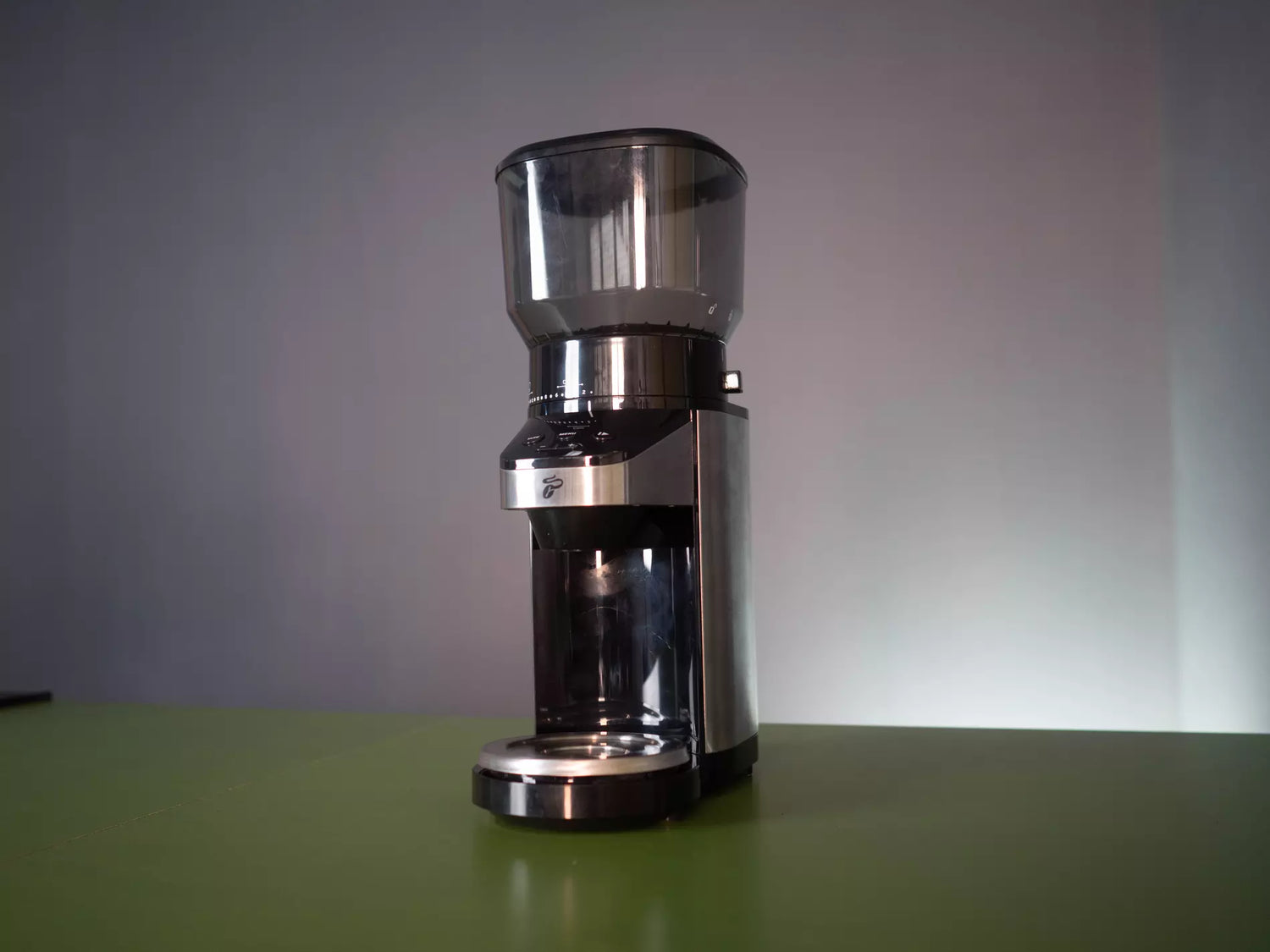

Tchibo's electric coffee grinder with an integrated scale manages to enter the competitive field of espresso grinders with a price tag of under 100 euros. We tested this small grinder from Tchibo and report our impressions and findings in this review and video.
A coffee grinder with a scale makes sense!
Tchibo has created something unique on the market with its electric coffee grinder. For under 100 euros, this grinder comes with a scale. That is quite something and is the exception even among much more expensive grinders. Of course, the question arises as to how well the scale works with the grinder. But before we answer that, a quick word on the functional principle and why it is actually ingenious.
Good coffee is very often a question of proportions. Too much coffee grounds result in the water not being able to extract the brew sufficiently. In terms of taste, this manifests as biting acidity. Too little coffee grounds in relation to water means that the coffee grounds are over-extracted. This often leads to unpleasantly bitter notes in terms of taste – and that isn't delicious either.
That is why proportions are so important. While we generally work with a ratio of 1:2 or 1:2.5 for espresso, i.e., e.g., dosing 18 grams of coffee into the portafilter and getting 36 grams of coffee as espresso in the cup, we brew filter coffee using a different ratio. A ratio of 60 grams of coffee per liter is recommended for preparing a good filter coffee.
A scale is therefore one of the most important tools when preparing coffee, primarily to correctly choose the brewing ratio. Only secondly are the grind size, temperature, and pressure further important parameters.
The fact that Tchibo is now equipping a grinder in the entry-level price range with a scale is absolutely sensible. The importance of the scale is highlighted and it is supplied directly. The crucial factor, of course, is whether the scale actually works.
How the scale works
The desired coffee quantity in grams or the desired number of cups can be programmed on the grinder. The Tchibo grinder calculates 7 grams of coffee per cup. We place the grounds container on the scale, which is integrated into the grinder's base plate. The grinder tares the grounds container and starts grinding. It is nice that the grounds container can also be replaced with a smaller cup, e.g., our Kaffeemacher measuring cup (in the CH shop, in the DE/EU shop).
Let's move on to accuracy, and this is unfortunately where the good idea evaporates. Tchibo itself specifies the accuracy at +/- 3 grams. In our measurement, we arrived at a deviation of "only" 1.1 grams over ten grind cycles. So that is better than Tchibo's own assessment. In relation to other grinders and in the assessment in our comparative test, we have rated values over one gram as "poor".
Particularly in the area of espresso brewing, fluctuations of 1 gram of coffee and more do not provide the reliability needed to prepare good espressos.

Size and exterior of the Tchibo coffee grinder
The electric coffee grinder from Tchibo is small and compact. With a width of 14 cm, a height of 35 cm including the bean hopper, and a depth of 23 cm, the grinder weighs around 2.1 kg. The bean hopper holds up to 450 grams of coffee and is removable.
The grinder is made of plastic and polished aluminum on the outside. The installed conical burr grinder strongly resembles other conical burr grinders in the low price range. 26 different grind size settings can be selected.
In addition to dosing by cup quantity and coffee weight, a timer function is also provided. In this mode, the grinder grinds for as long as desired.
The ability to remove the bean hopper is really cleverly solved. Professional barista Michel Aeschbacher expresses his joy in the test video that the container can be released at the push of a button. With one handle, the top part can be removed, and only 9.4 grams of coffee remain in unground form. That is an absolute best value in our comparison.
Also positive is that the bean hopper can subsequently be screwed back on without hitting annoying beans. With many coffee and espresso grinders, you first have to remove the remaining beans to attach the bean hopper. Not so with the electric coffee grinder from Tchibo. We really liked that.

How does the espresso taste?
An espresso can only be good if it exists. Sounds logical, but unfortunately that is not always the case with cheap and so-called espresso grinders. Many coffee grinders simply do not grind finely enough.
With the Tchibo grinder, too, we set it to the finest grind level in our test to obtain a grind distribution that is fine enough. The grind is fine enough when it builds up sufficient resistance to slow down the brewing water to approximately 25 seconds during the espresso extraction. Put another way: the espresso should run through in the desired amount in approx. 25 seconds. That is a basic setting, which is then adjusted +/- 5 seconds depending on the coffee.
With the Tchibo coffee grinder, we achieved brew times of 22+ seconds. Depending on the coffee and the espresso machine, extractions of 25 seconds were also possible. Basically, a corresponding grind fineness is therefore possible.

The scale of the electric Tchibo grinder is located in the area for the grounds container.
However, we are then already in the finest range and there is no room for adjustment downwards. Especially with coffees that may already be a bit older, the grind level will then not be able to be set fine enough.
The espressos we tasted could be sensory clearly characterized as espresso drinks. They exhibited the typical thick, syrupy texture and had a certain weight on the tongue.
With the second and third sip, however, a clearly bitter note appeared, which led to a dry, astringent aftertaste. Such a flavor profile can also be well explained by the measured particle distribution of the grinder.
Particle distribution of the Tchibo coffee grinder

The particle distribution shows a relatively narrow main peak compared to espresso grinders in the same price range. However, the proportion of fine particles is relatively high. This can explain why an espresso setting was possible, but the dryness of the espresso predominated, especially in the aftertaste.
The best and highest-quality espresso grinders have a very high and sharp main peak above all else. However, the Tchibo coffee grinder does not stand out either positively or negatively from its competitors in the same price range here.
In terms of speed, the Tchibo grinder was one of the slowest grinders in the field. In 10 seconds, the grinder was able to grind 19.2 grams of coffee at an espresso grind level.
The rise in the temperature of the grounds over 6 extractions was also tested. The Tchibo grinder reached an average temperature of 35.7 degrees Celsius and rose by 1.8°C from the first to the sixth grind. This was among the higher values, but should not yet lead to a change in the taste of the coffee due to the grinding temperature.

As can be seen from the grinding curves of tests 2, 4, 5, 7, the particle distribution changes relatively strongly at times. The graph shown above essentially shows the same recipe 4 times. Effectively, the fine particle content in particular jumped in part from, for example, 21 to 23%. These fluctuations provide an explanation for why the results also kept fluctuating in terms of taste.
Conclusion on the Tchibo coffee grinder
Compared with the other espresso grinders in price category 6 (up to 150 euros), the electric coffee grinder from Tchibo scores in a few points. We give the grinder a star for the idea of the scale. We deduct it again for the implementation of the scale. The usability is nevertheless better overall than that of its competitors. The controls are understandable, and the solution for removing the bean hopper is unparalleled, even among more expensive grinders.
At 81 decibels, the grinder is of average loudness, but it takes a very long time to grind the desired amount of coffee. The retention is lower at 3.2 grams of coffee than with the Graef CM800 but larger than with the Delonghi KG21 as well as the Rommelsbacher EKM300.

The grinder grinds espresso-fine with some coffees, but is then already at the finest grind setting. With many coffees, especially older coffees, the grinder does not grind espresso-fine.
We cannot recommend the Tchibo coffee grinder for espresso with a clear conscience. Especially if the grinder is intended to pave the way into the fascination of espresso preparation, we see too many arguments against it here. Above all, we fear that the grinder will unsettle beginners when they are trying to find the correct grind setting. Therefore, we recommend that you rather spend a little more money if possible, or take a look at the manual grinders under 100 euros that we have tested.
Tip: Our esteemed colleague Arne from Coffeeness has also taken a look at the Tchibo coffee grinder.