
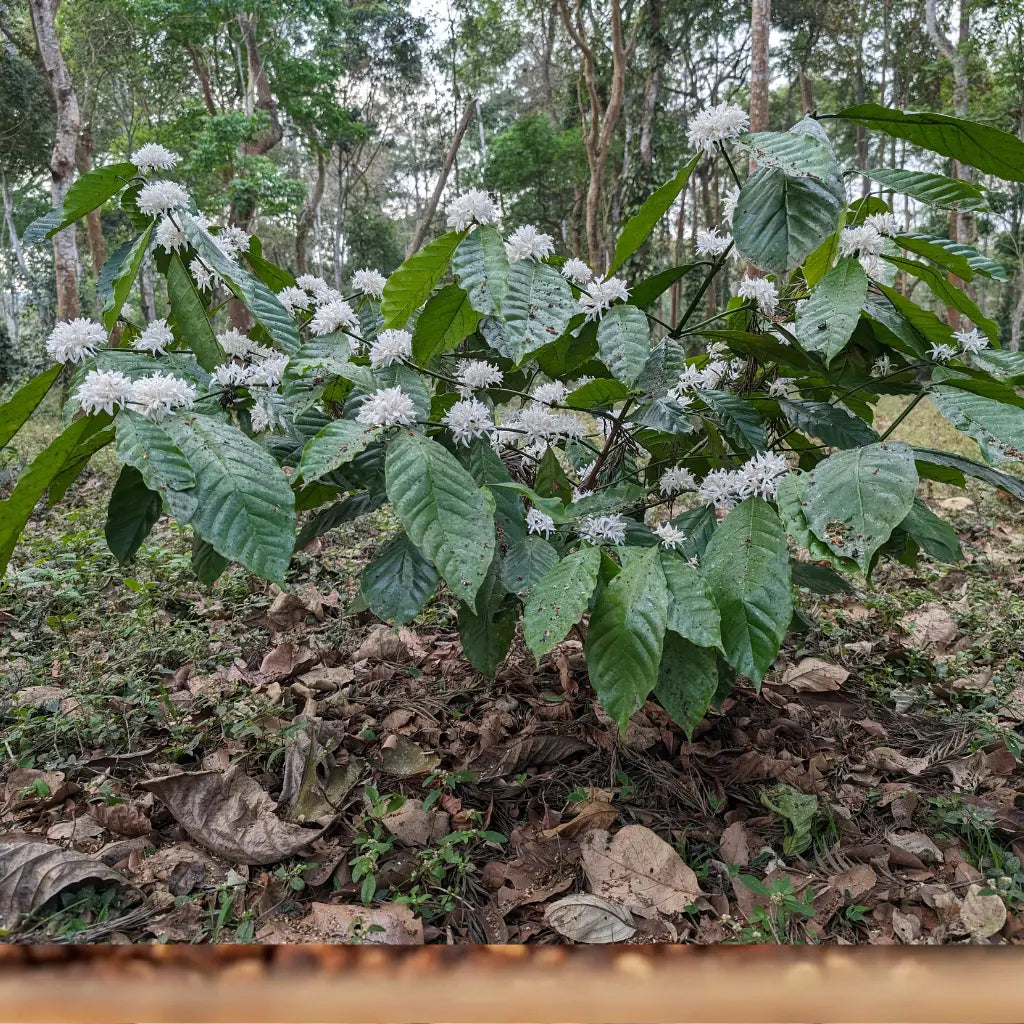






57% of the coffee consumed worldwide comes from the Arabica plant. Arabica coffee is often mentioned as the counterpart to Robusta and is therefore always being compared. It is time to focus solely on Arabica and go on a search for clues.
Where does Arabica coffee come from?
Today, Arabica coffee is grown in approximately 60 countries. The plant originally comes from the Boma region, located in the far east of South Sudan, on the border with Ethiopia (Open Street Map)

Modern-day Ethiopia and former Abyssinia were long considered the region of origin for the Arabica plant. The high plateaus reach 1,300 to 2,000m above sea level. In 2021, scientists led by Aaron Davies discovered which region the first Arabica plants originated from by researching the plant's genetics.
The high genetic diversity extends hundreds of kilometers westward to the Congo Basin. Coffee originally comes from forests and is accustomed to the proximity of trees - to this day.
It was only later, when coffee was planted for economic use, that cultivation shifted to intensive farming in densely planted plots.
The conversion from mixed to monoculture encouraged the spread of plant diseases, such as the notorious coffee leaf rust, or roya.
Many myths surround the discovery of coffee - whether it was goats that first ate coffee cherries and then danced, or whether it was a monk, a prophet, or someone else, will never be definitively proven.
Why is it called Arabica coffee?
Arabica coffee gets its name because the Swedish naturalist Carl Linnaeus fell victim to a mistake. He was the first researcher to botanically classify "Arabica" coffee, thus creating the foundation for modern botanical and zoological taxonomy.
He named the beans "Arabica" coffee because in Central Europe in the early 1700s, there was a strong association between coffee and the Arab world.
The Ottomans conquered the Yemeni highlands in 1530 and began coffee production in 1570. Coffee then reached the European metropolises of Amsterdam and London via the port of Mocha (al-Muchaa). The port of Mocha held a monopoly on the global coffee trade, and at that time, most of the coffee produced came from the Yemeni highlands.
"Mocha" was therefore the name for the coffee drunk in European cities. The first European traders appeared in Mocha around 1610 and brought the coffee of the same name "from the Arabs" - Carl Linnaeus could not have known any better, and he linked the coffee to its Arab background and henceforth called it coffea arabica.
(Sources: Ted Fisher, "Making Better Coffee" and Stuart McCook, "Coffee is not forever")
Where does Arabica coffee grow today?
Today, coffee is grown in approximately 60 countries, all of which are located in the so-called Coffee Belt around the equator. Between 23° north and 25° south of the equator, semi-stable weather patterns - at least for now - prevail, which favor coffee cultivation. We discuss what it will be like in 2050 here.
The Coffee Belt includes coffee-growing countries such as the Ivory Coast, Australia, Cape Verde, and China - who would have thought of them first? In terms of volume, these countries, with the exception of China, are of little significance on a global scale, but they sometimes play a major role in the local economy and tradition. In Burundi, for example, coffee was long responsible for 80% of foreign exchange inflows .

Brazil was, is, and remains by far the largest producer of Arabica coffee, producing almost four times as much coffee as Colombia in the 2023/24 season. Coffee production is growing in Honduras, making the country the largest producer of Arabica coffee in Central America.
Peru and Mexico primarily produce a great deal of double-certified Fairtrade-Organic coffee, while volumes in Nicaragua have been shrinking for several years. China is now appearing among the top ten, following growth of up to 15% annually since 2015.
What is the share of Arabica coffee in the global coffee volume?
There is still a widespread opinion that Arabica accounts for 70% of global coffee production, and that Canephora (Robusta) plays a minor role with 30%. This is incorrect.
In the 2023/24 season, 102.2 million 60kg bags of Arabica coffee will likely be produced compared to 75.8 million bags of Robusta coffee. This is a ratio of 57.4% to 42.6% out of a total of 178 million 60kg bags of coffee produced, Arabica and Robusta combined.
57.4% of the global coffee supply in the 2023/24 season is Arabica, 42.6% is Robusta.
33.2% of the globally produced coffee - Arabica and Robusta combined - is accounted for by dry-processed Naturals from Brazil. Brazil therefore produces almost as much Arabica coffee as places 2-10 combined (see table above).
What does Arabica coffee taste like?
The taste of Arabica coffee is always viewed somewhat "traditionally" in relation to Robusta coffee - but does that even make sense? Both are types of coffee, but red wine is not compared to white wine, nor are apples compared to pears or plums to apricots.
The species alone barely justifies a sensory comparison. Furthermore, depending on the post-harvest process or processing, Arabica coffees undergo such a strong taste transformation that they can hardly be assigned to a specific region sensorially.
Admittedly, there are certain similarities in country and region profiles that suggest the origin of the coffee, but here too, the rule applies: there is no rule without an exception.
We discuss how coffee flavor is influenced by fermentation in this video.
In general, however, it can be said about Arabica coffees that they can be extremely diverse in taste, which is also reflected in the common flavor wheel.
From chocolatey-nutty coffee from Brazil, to citric-balanced washed coffees from Central America, to floral-fruity coffees from Ethiopia, through to nutty-citrusy coffees in India and the tart, heavy coffees in Indonesia - as rough as this classification may sound, it often holds up to reality, even if we are surprised again and again by how little uniform such flavor concepts are.
What is needed for high-quality Arabica coffee?
Arabica coffee is not in itself a guarantee of good taste, although this is often implied to this day ("100% Arabica"). Nor is it an indication of how the coffee will taste, as it depends on the following five criteria: care, processing, temperatures, variety, and growing conditions.


The basis for quality Arabica, as well as Robusta coffee, is care. The "terroir," which is difficult to define and mystifies more than it explains, is just as little responsible for this as a microclimate that is not naturally present.
Good coffee is a human-made product and not a whim of nature or a result of higher powers.
The pyramid shows how important care and processing are and form a basis for what makes the coffee seem good to very good in the first place. The factors of temperature, variety, and microclimate/growing conditions then separate the very good coffees from the good ones.
100% Arabica coffee: what is the deal?
Even today, coffee packaging is labeled with "100% Arabica," which firstly does not do justice to the complexity of the product, secondly offers no added value in terms of information, and thirdly leaves coffee drinkers in ignorance.
Furthermore, distinguishing purely by species is no longer contemporary. The coffee plant is subject to climate change, and we should therefore expand our vocabulary in order to be able to understand and describe the coffee of the future. Varieties and new breeds are becoming increasingly important, so in the future, we should talk more and more about varieties rather than species.
Researchers have been intensively working for years to bring new hybrids from the laboratory into the field and scale them. The reduced distinction between Arabica and non-Arabica (e.g., Robusta) falls far too short here.