







Reading time: 4 minutes. This article is a short blog post. You can find the full blog article here.
Since your coffee drink consists of over 90% water and less than 2% dissolved coffee particles, it is worth taking a closer look at the water. Even if it tastes good as drinking water in a glass, there are several criteria that make your tap water a good starting point for your coffee drink.
What should good coffee water be like?
In principle, coffee water should be soft, usually softer than what comes out of the tap. There are two values here:
- Total hardness = magnesium Mg+2 and calcium Ca2+
- Alkalinity = hydrogen carbonate = bicarbonate = HCO3-
For filter coffee, the best values are:
- Total hardness: 2 – 3 °dH
- Alkalinity: 1 – 2 °dH
For espresso, the best values are:
- Total hardness: 3 – 6 °dH
- Alkalinity: 2 – 4 °dH
Alkalinity is also often referred to as carbonate hardness, which is not strictly correct, but the term carbonate hardness has become established.
That sounds very complicated. We explain how you can achieve such good values here, as it is very unlikely you will get such soft water directly from your tap.
How good is my water at home?
There are several ways to measure water hardness. A conductivity meter, a ppm meter, and a drop test kit (the simplest option). In the latter case, 10ml of your water is filled into a tube and a few drops of test liquid are added. You count the drops, and as soon as the color changes, you know the water hardness. Alternatively, you can contact your local water supplier or visit their website.
How and what does a table water filter filter?
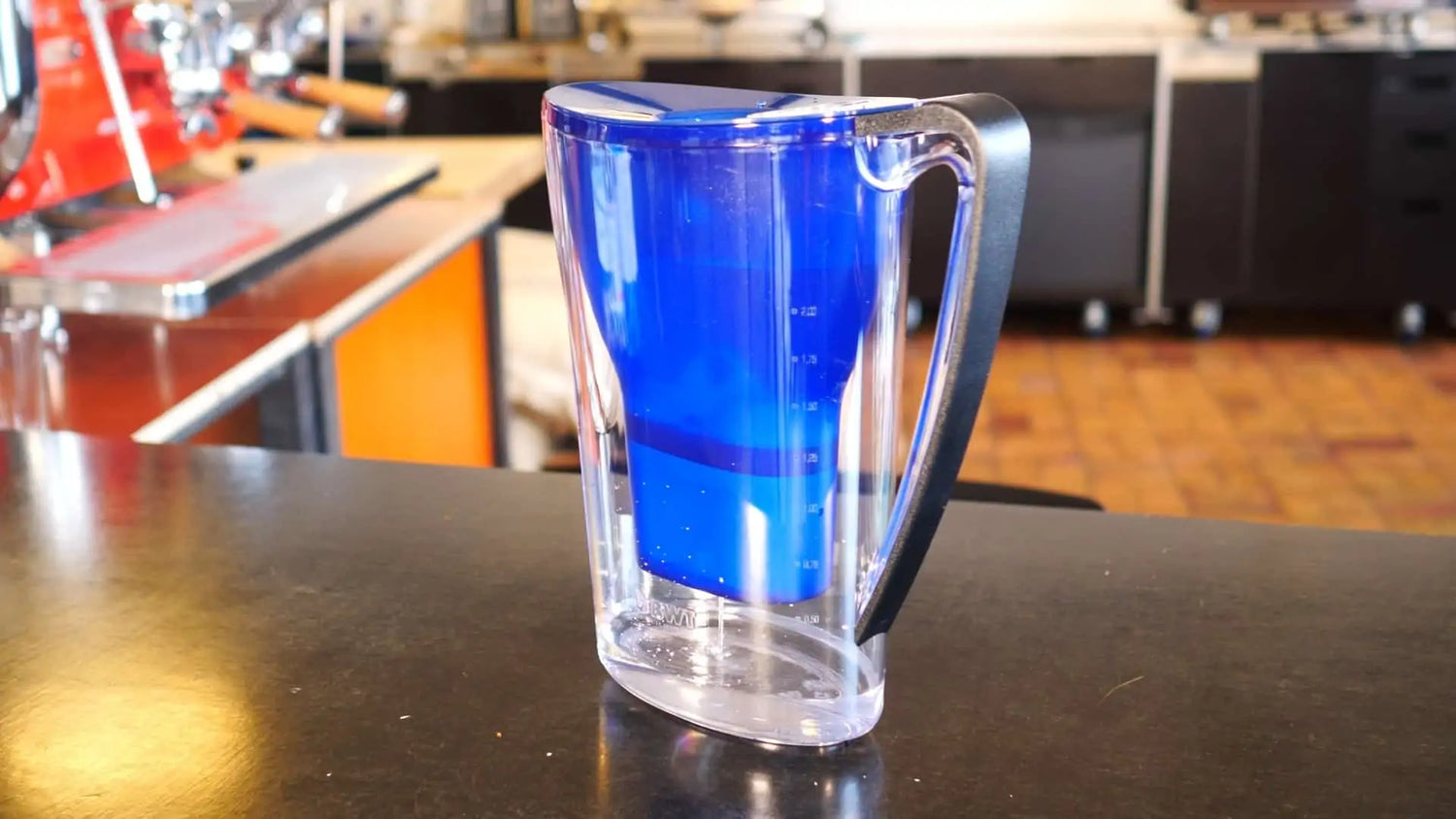
Tabletop filter devices are inexpensive and widespread. Water is poured in, and a maximum of 50% of the water is decarbonized. The other 50% simply runs through the device's activated carbon filter.
A quick calculation example: From the tap, we have drinking water with 16°dH total hardness and 12° dH alkalinity. After one pass through the water filter, the alkalinity is halved to 6° dH, but the total hardness only drops to 10° dH. Since this is still far from the perfect coffee water, we need a second pass.
After the second pass, the alkalinity is at 3°dH and the total hardness is at 7°dH. That is already good, but we only reach the perfect range with the third filtration (1.5° dH alkalinity and 5.5° dH total hardness).
In some cases, 3 or even more passes are necessary with tabletop filter devices. Quite elaborate!
The water filter with a fixed water connection
A luxury is a water filter with a fixed water connection, i.e., a permanently connected under-counter filter. It has a higher and more constant filter performance and filters the water directly to the desired value. Decarbonization takes place through ion exchange, which in turn changes the pH value of the water.
But is this luxury necessary? If you have hard water and prepare a lot of coffee, the purchase is worth it. 90% of machine defects are caused by water that is too hard. Considering the high purchase price of a good espresso machine, which you certainly want to use for a long time, you should think about such a filter system. It is generally cheaper to get an under-counter filter than to send your portafilter machine in for service once. In many cases, installation is simple, but it can also be carried out by professionals.
Another advantage is the reduced limescale content of the water, which you will also notice immediately in your kitchen, as white deposits will barely be found anymore.
Softening systems are not an alternative!
In some houses, the drinking water system is connected to a water softener. This softens the water through ion exchange (calcium and magnesium are replaced by sodium), but the alkalinity remains. This imbalance leads to the coffee tasting bland and boring during preparation, as the interplay of balanced acids and bitter notes does not work. One way out here is to go to the garden, as the garden hoses are usually not connected to the softener.
Concrete procedure on the way to your suitable coffee water
We are happy to help you achieve the right water hardness. This is how you proceed:
- Measure your current water hardness with a drop test kit or ask your water supplier.
- Estimate the amount of water you need per day.
- Send the total hardness and alkalinity (carbonate hardness) along with the amount of water and your coffee beverage type to support@kaffeemacher.de
- We will get back to you as soon as possible with a concrete recommendation on how you can achieve your target values.

Vielen Dank für euer tolles Video (auch wenn ich dann doch irgendwann nach der Mitte ausgestiegen bin ;-)
Ich muss allerdings beim Thema Volvic widersprechen. Habe meine Lelit Mara nun 3 Jahre mit Volvic betrieben. Nun war der Sensor des Wasserfüllstandalarms defekt. Also ab in die Werkstatt.
Nun der Schock. Starke Ablagerungen innen. Zusammen mit neuen Dichtungen etc läuft der Kostenvoranschlag auf 860€. Damit Totalschaden.
In der Werkstatt wurde mir gesagt, dass dies am Volvic liegt, das zwar weich ist aber trotzdem viele Mineralien enthält, die sich absetzen. Plose oder Lauretana wäre besser geeignet.
Mal sehen ob ich das bei einer neuen Maschine so mache oder mich doch nochmal tiefer in die Materie einlese und mein Wasser selbst filter....
Liebe Grüße
Tom

Ich werde demnächst meine ECM Technika IV verkaufen, hättest du Interesse?
Gruß aus München,
Philipp

ich bin aktuell etwas ratlos: Mein Vermieter hat eine Entsalzungsanlage im Haus, die folgende Werte aus dem Hahn lässt: GH dH = 5 und KH dH = 20.
Wie kriege ich die hohe KH am besten in den Zielbereich für Espresso, oder zumindest in die Nähe davon?
Da ich eine Synchronika II von ECM besitze, dachte ich über den Einbaufilter von ECM/Brita für den Wassertank, da dieser anscheinend v.a. die KH senkt. Habe aber nirgendwo gefunden, um wieviel.
Würde mich über eine Einschätzung von euch sehr freuen.
Beste Grüße
Luis

wir haben ein Haus in Neufahrn gekauft und nun möchte ich auf eine Maschine mit Festwasseranschluss umsteigen.
Ich sehe nun theoretisch 3 Möglichkeiten:
1. Ich versuche eine Filteranlage zu finden, die das ganze Wasser im Haus "Espressofähig" filtert - bislang habe ich keine gefunden
2. Ich verbaue für das Haus eine Entsalzungsanlage und für die Kaffeemaschine einen Entkarbonisiere - funktioniert das in Reihe? Oder muss ich dann im Keller vor dem Filter n bypass legen, den ich dann in die Küche führe?
Wie macht Ihr dass denn in eurem Kaffeestudio?
Vielen Dank

Am einfachsten ist eine Entsalzungsanlage fürs Haus und dort wo du sie anschliesst, zweigst du ungefiltertes Rohwasser ab und schliesst da separat einen Filter an (Brita beispielsweise). Dann muss man halt ab und an im Keller Wasser holen gehen, das ist aber die einfachste und kostengünstigste Lösung.
Grüsse
Andrea

erstmal vielen vielen Dank für die Informativen Blog-Posts und Videos! Ich hätte eine Frage zu meinem Wasser, da ich mir wirklich nicht mehr zu helfen weiß:
Ich wohne in Witten und habe hier mein Leitungswasser einmal mittels Brita Testlit aus eurem Shop gemessen. Ich kam hier auf folgende Werte:
Leitungswasser:
Gesamthärte: 7 °dh
Karbonathärte: 5 °dh
Ich habe einen Brita Tischwasserfilter mit "Maxtra Pro" Filter gekauft, da ich dachte, dass mich das auf die gewünschten Werte für Espresso bringt. Ich habe nun ca. 20 Liter durchlaufenlassen, da sich die Werte zu Beginn ja meist stark ändern. Hier sind die Werte, welche ich bei dem aktuellen gefilterten Wasser messe:
Gefiltertes Wasser:
Gesamthärte: 3° dh
Karbonathärte: kleiner als 0,5. bereits beim ersten Tropfen schlägt die Farbe auf Gelb um.
Ich hatte die Hoffnung, dass der filter die Karbonathärte halbiert und ich bei 2,5 lande, aber dies scheint nicht der Fall zu sein.
Ich frage mich nun, was der sinnvollste nächste Schritt ist. Macht es evtl. sinn reines Natriumhydrogencarbonat in entsprechendem Verhältnis hinzuzufügen? Oder doch eher einen anderen Filter verwenden? Ich habe auch noch eine Osmoseanlage (Osmofresh Quella Pro), diese macht allerdings ja noch viel weicheres Wasser. Ich dachte nur ich erwähne es an dieser Stelle, falls ich irgendwine Möglichkeit nicht bedacht habe).
Ich habe auch gelesen, dass diese Tests teilweise nicht so sensibel anschlagen bei so weichem Wasser, bzw. bei relativ neuen Filtern. Habe ich evtl. einfach falsche Messwerte?
Ich habe mir eine Lelit Bianca V3 gekauft und möchte nun natürlich sicherstellen, dass das Wasser möglichst optimal ist, um der Maschiene ein langes, glückliches leben zu ermöglichen ;) Ich verwende die Maschiene aufgrund der aktuellen Wohnsituation (Studentenwohnung) nur im Tankbetrieb, das Wasser kommt also mit der Luft in berührung.
Vielen Herzlichen Dank!!
Linus

Ich würde grundsätzlich immer eine Filtermethode empfehlen, sobald Leitungswasser im Spiel ist. Ich hatte schon Kursteilnehmende, die in ihren Maschinen Sand- oder andere Mineralien-Ablagen hatten. Es kann immer einmal passieren, dass im Leitungswasser versehentlich was drin ist, was deine Maschine "verstopft".
Grüsse
Andrea

Es ist grossartig, endlich einen Blog zu finden, der sich so umfassend mit dem Thema Wasser und Kaffee beschäftigt.
Dafür ein grosses Lob für euere Arbeit.
Als neuer stolzer Besitzer einer Siebträgermaschine habe ich mich natürlich intensiv mit dem Thema Wasser für meinen Kaffee auseinandergesetzt.
Einerseits, um meine Maschine zu schützen, andererseits, um einen ausgezeichneten Espresso zu geniessen. :)
Da das Leitungswasser an meinem Wohnort etwa 19°dH aufweist, habe ich von Anfang an auf Mineralwasser zurückgegriffen.
Derzeit befülle ich mein Wassertank mit einen Verschnitt aus 50 % Laurentana und 50 % Evian.
Laut meinen Berechnungen mit euren Hilfestellungen liege ich jedoch nicht im optimalen Bereich (Gesamthärte 5°dH / Alkalinität 4,73°dH).
Wenn ich es richtig verstanden habe, würde ein Mischverhältnis von ca. 80 % Laurentana und ca. 20 % Evian (Zielwert in Gesamthärte und Alkalinität 3,6°dH) das Optimum aus beiden Wassersorten herausholen.
Hier noch die Werte der beiden Wasser (abgelesen vom Ettikett).
Laurentan:
HCO3: 5.2mg/l
Ca: 1.7mg/l
Mg: 0.44mg/l
Evian:
HCO3: 360mg/l
Ca: 80mg/l
Mg: 26mg/l
Ich freue mich auf euer Feedback und danke euch für die wertvollen Infos.
Danke für deine tollen Worte :)
Genau. Ich würde einfach der Verschnitt ändern. Ein wenig mehr Lauretana als Evian. Mit deinen aktuellen Werten bist du nur knapp über unserer Empfehlung, also schon fasst im "leckeren" Bereich.
Grüsse
Andrea

vielen Dank für den aufschlussreichen Beitrag! Ihr seid super und habt mir schon oft geholfen!
Ich suche aktuell das ideale Wasser Set-Up für meinen Siebträger und habe destilliertes Wasser + Third Wave Water ausprobiert (Espresso Maschine Profil), komme jedoch beim Messen auf eine Gesamthärte von 10 °dH. Ich habe ein halbes Päckchen aus einem Tütchen von Third Wave Water für 1 Gallon auf 2 Liter destilliertes Wasser gemischt. Nun bin ich sehr verwundert, da man für Siebträgermaschinen 4-6°dH Gesamthärte nutzen soll. Ich habe mich somit nicht getraut, die Mischung in meine Maschine zu machen und bin wieder auf Volvic umgestiegen.
Könnt ihr mir helfen? Habt ihr hier Erfahrungswerte? Kann ich das Wasser nutzen oder ratet ihr von Third Wave Water ab?
Ich messe hiermit: https://amzn.eu/d/faTE99D
Vielen Dank vorab für eure Hilfe!
Beste Grüße, Valerie

erstmal vielen Dank für die spannenden Blogbeiträge – ich lese sie immer wieder gerne!
Wir haben zuhause eine Entkalkungsanlage von Evodrop, die mit Apfelsäure arbeitet und dadurch die Kalkbildung verhindert, ohne die Mineralien aus dem Wasser zu entfernen. Mich würde interessieren, ob ihr mit dieser Art der Wasserenthärtung bereits Erfahrungen gemacht habt und beurteilen könnt, wie sich das auf Maschinen auswirkt.
Wenn ich die Wasserhärte mit einem Titriertest messe, bleibt sie natürlich hoch, weshalb ich das Wasser zusätzlich mit einem Tischwasserfilter aufbereite. Dennoch frage ich mich, ob es Langzeiterfahrungen oder Erkenntnisse dazu gibt.
Ich freue mich auf eure Einschätzungen und Erfahrungen!
Viele Grüße
Raphael
Dazu haben wir aktuell keine vergleichbaren Testergebnisse. Ich an deiner Stelle würde einfach darauf schauen, dass die von uns angegeben Wasserwerte erreicht werden.
Grüsse
Andrea


Arbeitet ihr mit einer Waage? Misst ihr die Extraktionszeit? Hier ein Video von unseren beiden Jungs, vielleicht hilft euch dies:
https://www.youtube.com/watch?v=SIl1txYpLIo&t=1s
Grüsse
Andrea

ich habe aktuell ein Wasser mit folgenden Werten:
CA:29,2
MG: 3,1
Hydrogencarbonat von 32,1.
Wenn ich das richtig verstehe, ergibt sich eine Härte von 4,8°dH. Das ist recht gut. Was ich noch nicht einzuschätzen weiß ist der Vergleich zum Hydrogencarbonat. FALLS ich das richtig berechnet habe, ist es eine Alkalinität von 1,18°dH. Ist das zu wenig? Bzw nimmt die Maschine hier Schaden? Geschmacklich ist es gut.
Danke für eure Einschätzung.

Das klingt sehr gut. Da musst du dir überhaupt keine Gedanken machen :)
Lieben Dank!

Neben dem Aldi Wasser, kannst du auch das stille Volvic-Wasser verwenden.
Lieben Gruss Eric


Ich verwende für meine Siebträger Maschine Volvic. Kürzlich habe ich gehört, dass Volvic aufgrund des Siliziumgehaltes (Kieselsäure) 32mg/l ungeeignet ist, weil das zu Ablagerungen im inneren der Maschine, führen kann, die sich sehr schwer lösen lassen, bzw. mit klassischem Entkalker nicht entfernen lassen. Habt ihr eventuell Info dazu, ob das stimmt, oder ob es sich hierbei um ein Gerücht handelt? Vielen Dank
Kerstin
Da bei Leitungswasser auch Kieselsäure drin ist, welche wir beim Filtern nicht reduzieren, gehe ich da nicht von einem Problem aus. Ich hatte schon einige Maschinen, die seit Jahren mit Volvic laufen im Kurs und noch nie kam eine negative Rückmeldung

Sollte dieses Wasser mit einem härteren Wasser gemischt werden, pur ist es wohl sauer?

lange Rede, kurzer Sinn:
Was spricht dagegen, Leitungswasser mit käuflichem destillierten Wasser zu verschneiden.....wenn ich dadurch Gesamthärte und Alkalinität ins Zielfenster bringe?
Vielen Dank schon mal
Andy
Grundsätzlich nichts:) Einfach auf die Zielmineralisierung achten

erst Mal sorry, dass ich mich so spät "einmische". Ich beschäftige mich erst seit kurzem mit diesem Thema durch den Kauf eines Siebträgers. Habe deine Frage zum Mischen mit destillierten Wasser gesehen. Dazu kann ich auf keinen Fall raten.
Erstens ist dieses Wasser aus den Supermärkten niemals echtes destilliertes Wasser (das wäre viel zu teuer), sondern immer demineralisiertes Wasser (siehe die zahlreichen Beiträge hier zu Entsalzungsanlagen).
Zweitens ist dieses Wasser nicht für Lebensmittelzwecke freigegeben, sondern für technische Zwecke, und wird zumindest nach anderen Gesichtspunkten überprüft, wenn überhaupt. Nicht zu vernachlässigen ist dabei die Art der Verpackung und Lagerung. Keiner weiß, z.B. wieviel Weichmacher in diesem Wasser gelöst ist. Nicht wirklich appetitlich. Falls man solches gelegentlich zu sich nimmt, vergiftet man sich wohl nicht gleich, aber dauerhaft würde ich das nicht konsumieren wollen.

Ich wohne in Berlin und habe mir den Wassertest mit eurem Testkit durchgeführt. Gesamthärte ist 21 dh und Alkalinität 11 dh. Also ist auch ne ordentlich Nummer hier das Wasser in Berlin


Ich komme aus Heilbronn in Deutschland und habe eine Umkehrosmoseanlage in Betrieb. Da sollte das Kaffeewasser dann mit Leitungswasser verschnitten werden?
Grüße aus D

Ich schätze eure Arbeit sehr, und habe schon viele eurer Videos geschaut und dabei viel Neues lernen dürfen. Ich bin selber Kaffeeliebhaber, wenngleich ich zu Hause ausschließlich mit einem Kaffeevollautomaten meine Kaffees zubereite. Asche über mein Haupt! *g*
Mit dem Thema Wasser beschäftige ich mich vorrangig aus gesundheitlichen Gründen, und finde es als "aufgeklärter Mitmensch" hierzu meine Pflicht, diesen - aus meiner Sicht - wichtigsten Aspekt von Wasser nicht unerwähnt zu lassen.
Wasser ist DAS wichtigste LEBENSmittel! Auch wenn wir im Vergleich zu anderen Ländern, zB. Ländern aus Afrika, besseres Leitungswasser beziehen können, ist es tatsächlich so, dass die Trinkwasserqualität in unseren Breitengraden seit Ende der 1970er-Jahre zunehmend schlechter bzw. schlecht geworden ist. Mittlerweile ist es so, dass neben Kalk, Calcium und anderen Mineralien, enorm viele andere unliebsame und ungesunde Stoffe mitgeliefert werden. Dazu zählen zB. Hormone, Medikamentenrückstände, Spritzmittel wie Gyphosat, Nitrat, Mikroplastik, PFAS, usw. und so fort. Insgesamt zählen wir über 2.000 gesundheitsgefährdende Stoffe die im Trinkwasser, wie auch in abgefüllten Mineralwässern enthalten sein können. Nur wenige davon werden überhaupt erst geprüft bzw. monitorisiert. Wir sprechen hier von nur ca. 4% aller gesundheitsrelevanten Stoffe. Mineralwässer werden übrigens noch weniger streng kontrolliert als Leitungswasser.
Mir ist bewusst, dass das Hauptaugenmerk in eurem Bestreben beim Thema Wasser vor allem auf der geschmacklichen Qualität des daraus produzierten Kaffees liegt, dennoch erachte ich es im Zuge dieser Diskussion wichtig diese Informationen zu teilen. Wem das Thema Gesundheit wichtig ist, dem steht es frei sich selbstständig weiterführend mit dem Thema Wasser als Lebens- und Heilmittel zu beschäftigen. Ich kann es jedem aus tiefstem Herzen nur dringend empfehlen.
In diesem Sinne weiterhin viel Freude und Erfolg mit eurem Wirken rund um das schwarze Gold des Gaumengenusses
Karl
Danke für deinen Kommentar. Ich verstehe deinen "Einwand", möchte dich aber dazu animieren die Informationen, die dir fehlen gerne selber zu besorgen. Ich hege weder den Anspruch es allen recht machen zu wollen bzw. zu müssen, noch bin ich der Erklärbär der Nationen. Wie erwähnt habe ich in den vielen Jahren mit denen ich mich intensiv mit dem Thema Wasser (Trinkwasser) beschäftige nicht nur viel "Wissen" angesammelt, sondern auch Versuche gemacht, und tatsächliche Erfahrungen gesammelt. Ich kann mir vorstellen, dass Du mir recht gibst, dass es am Ende des Tages eben entscheidender ist welche Erfahrungen man gemacht hat, und nicht wieviel Wissen man angehäuft hat. Ich kann folgendem Spruch durchaus seine Berechtigung bestätigen: "Wissenschaft ist und bleibt, was der eine ab vom anderen schreibt." Das ist selbstverständlich keine allumfassende Weisheit, aber es steckt sehr viel Wirklichkeit dahinter.
In diesem Sinne viel Freude beim Recherchieren, wälzen von Studien, finden von Informationen, stöbern durch Gesetzestexte (alte sowie aktuell gültige) und sammeln von Erfahrungen.
Beste Grüße
Karl

Im Moment eher für Filterkaffee. Ich muss mir da nochmals Zeit nehmen und das ganz genau für geschlossene Systeme anschauen. Kommt aber sicher noch.
Michel

am Wochenende war ich endlich beim Barista 1 und habe festgestellt, dass der Apas zuhause ganz anders (leider nicht besser) als bei euch schmeckt (trotz gleicher Maschine und Mühle- die hatte ich dabei). Sprich es muss das Wasser sein (zumindest fällt mir sonst nichts ein).
Mein Wasserversorger gibt folgendes an:
Ca 44mg/l
Mg 6,7mg/l
HCO3 192mg/l
Gesamthärte 7,7°dH
Carbonathärte 7,7°dH
Mit eurem Rechner komme ich auf 6,2°dH und 8,81°dH Alkalinität. Nicht ganz gleich aber ich denke hauptsächlich die Alkalinität ist das Problem. Habt ihr eine Idee, warum euer Rechner leicht andere Werte ausgibt?
Ich begebe mich erstmal auf die Suche nach Flaschenwasser...
Viele Grüsse,
Marco
PS: Danke für nen tollen Kurs- freue mich schon auf die nächsten!
Danke dir vielmals für deinen Besuch und die Frage. Es gibt leichte Abweichungen bei den Berechnungen. Die sind aber eher nach dem Komma:) Wobei der Unterschied mit 1°dH nicht riesig ist. Ich gehe aber davon aus, dass genau das den Geschmack massiv beeinflusst hat. Du könntest auch einfach dein Wasser einmal filtern mit deinem Tischwasser Filter. Dann wärst du optimal. Im übrigen kann eine Angabe des Wasserversorges nicht stimmen, weil die Alkalinität niemals höher ist als die Gesamthärte.
Liebe Grüsse aus dem Haus des Kaffees
Michel


Ein paar Beobachtungen nun:
- Der Wasserdruck ist merklich reduziert... damit hatte ich nicht gerechnet. Ist das normal?
- Der Filter macht bei Wasserbezug ordentlich Geräusch... damit hatte ich nicht gerechnet. Ist das normal?
- Das gefilterte Wasser ist im Glas zunächst ziemlich trüb. Es dauert einige Sekunden, bis sich das Wasser klärt... damit hatte ich nicht gerechnet. Ist das normal?
- Das Wasser "schmeckt" deutlich anders, sehr "weich" und ganz leicht salzig... Das nehme ich mal an war zu erwarten ;)
Meine Messungen:
- Gesamthärte 2 -> Etwas zu weich, oder? Sollte ja für Espresso laut Blogeintrag eher bei 3-6 liegen
- Karbonathärte 21 -> Schock! Was ist denn hier passiert??
Help me, ihr Obi-Wan Kenobis, you are my only hope...
Chris


Quelle Löhningen mit Volvic 50-50 gemischt ergibt:
DH => 4.18°dH / Alkaniliät: 2.43 °d Alk

vorweg: VIELEN DANK für eure tolle Arbeit! Ich bin ein großer Fan!
Ich wohne in Berlin und habe sehr hartes Wasser (GH: 15dh, KH: 11dh)
Demnach müsste ich das Wasser mehrfach durch einen Tischfilter laufen lassen, um die Maschine zu schonen.
Dieses Problem könnte ich aus meiner Sicht mit Flaschenwasser von Spreequell lösen (GH: 3,1dh, KH:0,6dh)
Die Werte für Calcium (17mg/l) , Magnesium (3,3mg/l) sind aus meiner Sicht ok und ergeben 3,1dh GH.
Allerdings hat dieses Wasser nur sehr wenig Hydrogencarbonat (13,2mg/l), wodurch die KH bei nur 0,6dh liegt.
Frage: Kann ich das Wasser ohne Bedenken einsetzen oder gefährde ich meine Maschine? (Korrosion)
Oder kann ich das Problem lösen, indem ich es mit dem Leitungswasser verschneide (86% zu 14%)?
Vielen Dank vorab und LG
Anna


vielen Dank für den informativen Blog und das Video. Mir war zuvor nicht klar, dass das Thema Wasser für Kaffee so komplex sein kann. Beim Kauf meiner Maschine vor ein paar Wochen war ich noch optimistisch, da mein Wasser eine Gesamthärte von 4 °dH aufweist. Super! Aber eben leider doch nicht ganz. Denn mein Wasser kommt aus einer Entsalzungsanlage und hat eine Karbonathärte/Alkalinität von 14 °dH.
Da ich meine neue Maschine schützen möchte, bin ich erst mal auf Flaschenwasser umgestiegen und habe zunächst Black Forest Wasser ausprobiert (Calcium 6,7 mg, Magnesium 2,6 mg, Bikarbonat 30,5 mg). Dieses Wasser war jedoch etwas zu weich, sodass ich es mit Leitungswasser gemischt habe. Um den Prozess zu vereinfachen, habe ich nach Alternativen in Glasflaschen gesucht.
Dabei bin ich auf Aqua Panna gestoßen, das folgende Werte aufweist:
• Calcium: 31,5 mg
• Magnesium: 6,5 mg
• Bikarbonat: 106 mg
Laut Rechner ergibt sich damit eine Gesamthärte von 5,93 °dH und eine Alkalinität von 4,86 °dH.
Kann man aus Sicht des Maschinenschutzes und des Geschmacks die Verwendung von Aqua Panna ungefiltert und unverschnitten empfehlen?
Viele Grüße,
Andy

ich habe bei mir vom Wasserversorger eine Gesamthärte von 6,5 (+-1 übers Jahr) und Karbonathärte von 4,9 (+-1 übers Jahr) mitgeteilt bekommen. Ich bereite Espressi zu und nutze dieses Leitungswasser ungefiltert. Sollte ich filtern? An Hand der Werte sieht es ja gut aus, aber ich glaube es ist recht kalkhaltig. Jetzt frage ich mich was ich machen soll?
Gruß aus Essen in Deutschland.
Grüsse Pascal

Ergebnis Gesamthärte: 27 und Karbonathärte: 16
Was würdet ihr mir den empfehlen. Damit ich auf ein Gutes Espresso Wasser komme?

Ich filtere mein Leitungswasser insgesamt 3 x hintereinander mit dem Tischfilter. Damit bekommt man die beiden Werte praktisch auf 0 (bzw. 1, da die Verfärbung beim ersten Tropfen eintritt). Anschließend fügst du wieder eine kleine Menge des Leitungswassers dazu. Ich erhalte mit dieser Prozedur perfekte Werte (4 GH / 3 KH) mit ca. 1 l triple-gefiltertem Wasser gemischt mit 150 ml Leitungswasser. Bei dir dürfte dieses Mischverhältnis vermutlich ebenfalls sehr nahe kommen.

Lg, Antonia
Grüsse Pascal

danke für den Input, wir gehen da nochmals nach. Da ist, glaub wirklich was vertauscht. Michel schaut sich das an. Grüsse Pascal
Hallo zusammen, danke für die ausführlichen und super nützlichen Infos! Kurz Verständnisfrage zum Mischungsrechner: Sind da die Zeilen 12 und 20 evtl. vertauscht? Z.B. gebe ich doch in den Zeilen 15/16 die *Alkalinität* als meinen Zielwert ein, nicht die *Gesamthärte*... Oder verstehe ich da etwas falsch?

Erstmal danke für eure Mühe! Wir haben eine Entsalzungsanlage im Haus und im Garten "normales" Wasser (18°dH, 22° Alkalinität). Nun habe ich mir diverse Tröpfchentests und einen Brita-Filter zugelegt. Im Haus (nach der Entsalzungsanlage) haben wir 7°dH und 12° Alkalinität. Nun bin ich etwas verwirrt, ich dachte die Alkalinität sinkt bei Entsalzungsanlagen nicht? Nach 1x Filtern mit der Brita habe ich noch 3°dH und 12° Alkaliniät, nach einer zweiten Filterung ca. 2°dH und 6-7° Alkalinität. Welches Wasser würdet Ihr verwenden bzw. gibt es eine Möglichkeit nur die Alkalinität zu senken?
Danke und LG
Berni
In deinem Fall würde ich offen gesagt zu Flaschenwasser empfehlen. Dies schont eure Maschine und ist geschmacklich sicherlich besser. Grüsse Pascal

Ich habe ebenfalls eine Entsalzungsanlage im Haus, aber ohne seperaten Zugang zu ungefiltertem Wasser. Je nach Jahreszeit und Wassermischung (See- u/o Quellwasser) habe ich eine leicht andere Zusammensetzung, aber im Schnitt bin ich bei 6° GH und 12° KH. Ich filtriere dieses Wasser dreifach mit einem BWT-Filter und erhalte nach dem ersten Durchgang 0°/6°, nach dem zweiten 0°/3° und nach dem dritten 0°/1.5°. Dieses Wasser mische ich 2:1 mit (entkalktem) Leitungswasser. Die fertige "Lösung" hat in etwa die Werte von 2.5° GH und 6° KH. Mit diesem Wasser kann ich gut leben, auch wenn es für Espresso nicht optimal. Aber Kosten und Aufwand für Flaschenwasser finde ich irwie auch übertrieben.
Gruss, Hitsch

Selbst gemessen habe ich in der Wohnung eine Gesamthärte von 8° dH und einer Carbonathärte von 17,0° dH. Selbst im Garten habe ich ausschließlich das enthärtete Wasser.
An meiner Kaffeemasachine habe ich eine Versorgungseinheit mit einer Pumpe, die aus einem Kanister einen Festwasseranschluss simuliert (mit einem FlowJet) und einem Brita Filter Purity C Quell Filter. An dem Filter kann man einen Verschnitt einstellen.
Meine Frage ist, kann ich mit dem Wasser bei uns in der Wohnung etwas anfangen, oder muss ich zukaufen?
Wenn ich zukaufen muss, kann ich Wasser aus der Wohnung zumischen um nicht so viel kaufen zu müssen?
Wenn ich zukaufen muss, wäre es gut, wenn ich teilweise

Volvic kommt aus offensichtlich Gründen für mich nicht in Frage...
Das beste was ich jetzt in lokalen Supermärkten finden konnte ist das Netto Wasser Naturalis (Clara Quelle) mit den folgenden Werten.
Calcium 32mg
Magnesium 4mg
Hydrogencarbonat 125mg
Die daraus resultierende Gesamthärte ist mit 5,4 dH noch im empfohlenen Bereich, die Alkalinität mit 5,7 dH allerdings etwas zu hoch.
Meine Frage wäre jetzt ob ich das guten Gewissens nehmen kann?
Würdet ihr mir hier empfehlen den Sage Filter im Wassertank weiterzuverwenden?
Den Sagefilter haben wir auch getestet: https://www.kaffeemacher.ch/blog/wasserfilterpatronen/
Würde dir aber mit dem Flaschenwasser keinen Filter mehr empfehlen, sonst ist es dann zu weich.
Hoffe, das hilft dir weiter.
Gruss
Pascal

Ich hätte noch eine Frage zum Thema Wasser und Filterung.
Und zwar stellt sich unser Leitungswasser auf einen Wert von 7 Gesamthärte dH und eine Alkalinität von 5 dH ein. Hier war meine Vorgehensweise , es einmal mit einem Tischfilter zu filtern. Allerdings komme ich hier durch die Überfilterung auf 0 dH in beiden Werten.
Sensorisch werde ich das definitiv mischen allerdings liest man des öfteren das durch zu weiches Wasser die Maschine schaden nehmen kann. In eurem Video verstehe ich das so, das das nur zu einem Problem führen kann bei Festwasseranschlüssen durch die Kohlensäure.
Kann/konnte hier die Maschine schon einen Schaden nehmen?
( Ich habe jetzt für ca ein halbes Jahr direkt ausschließlich aus der Filterkanne in die Maschine eingefüllt.)
Vielen Dank für eure Hilfe und die vielen tollen Videos und Informationen!
Gruß Michael


Wenn ich das richtig verstanden habe, kann ich mein Trinkwasser für die Espressomaschine nicht verwenden. Ich habe eine Wasserhärte von 6,9 und eine Alkalinität von 1,2.
Ich müsste das Wasser mit dem Tischfilter dreimal filtern um bei der Wasserhärte einen Wert unter 6 zu bekommen. Und die Alkalinität würde dann bei 0,15 liegen, was auch viel zu niedrig ist.
Habe ich das richtig verstanden?
LG
Wie so viele hier habe ich mich nie gross mit dem Thema Wasser beschäftigt - bis zu eurem Beitrag hier.
Ich wohne in der Region Schaffhausen und wir haben folgende Situation (alle Werte mit eurem Tropfset getestet):
Leitungswasser: GH 26 / KH 15
Da das wirklich sehr hartes Wasser ist, haben wir eine fest installierte Entsalzungsanlage im Keller. Resultat danach: GH 4 / KH 14
Beides also nicht zu gebrauchen. Daraufhin habe ich mir den Aarke Wasserfilter gekauft (das Auge isst mit :-)). Nach einem Mal filtern bin ich immer noch zu hoch (GH immer noch bei ca. 8) aber nach zwei Mal filtern dann bei GH 2 / KH 0. Nun muss ich also das zwei Mal gefilterte Wasser wieder mischen. Wenn ich es nun aber mit dem Leitungswasser mische, dann springt die GH hoch und die KH bleibt etwas zu tief. Wenn ich es mit dem entsalzten Wasser mische, dann steigt die KH hoch aber die GH bleibt zu tief. nach einigen Tests habe ich dann folgendes Rezept gefunden:
1 Liter doppelt gefiltertes Wasser (Aarke)
ca. 50 ml Leitungswasser
ca. 80 ml entsalztes Wasser
Tönt jetzt ein bisschen kompliziert, ist aber nach ein paar Anwendungen gar nicht mehr so aufwendig (wobei mir hier meine Frau widersprechen würde :-)). Resultat ist dann eine ideale Wasserhärte von 5 GH / 3 KH.
Und der Kaffee schmeckt wunderbar!
Herzlichen Dank an euch für all eure interessanten Beiträge! Ich habe schon wahnsinnig viel gelernt und freue mich mittlerweile noch mehr aufs Wochenende, da ich dann nicht den grausligen Kaffee im Büro trinken muss.

Wie komme ich auf diesen Wert?
Wie haben eine Salz-Enthärtungsanlage welche das Ortswasser auf ca. 3-5 dH enthärtet - das nütze ich zurzeit für den Kaffee, bin neugierig wie der Vergleich morgen zum Third Wave Water ausfällt.
Die "Karbonathärte" beträgt bei unserem Ortswasser 13,9°dH, die Gesamthärte 16,9°dH.
Wie gesagt Enthärten wir das Wasser mittels einer Salzanlage auf ca. 4°dH - wenn ich das richtig verstehe betrifft das aber nur die Gesamthärte oder? Die Karbonathärte (= Alkalinität??) bleibt aber bei 16,9°dH und damit viel zu hoch oder?
Habe eine ESE-Pad Maschine und verschiedene Sorten nun mit meinem enthärteten und dem Third Wave Water (in selbst destillierten Wasser gemischt) verglichen: Je Stärker die Sorte desto mehr viel auf das der Geschmack "runder" wurde.
Einfach gesagt: Es war KEIN enormer Unterschied was Geruch oder Geschmack ansich betrifft, aber jener Espresso mit dem enthärteten Wasser hatte auf der Zunge einen viel stärkeren bitteren Geschmack.
Mit dem Third Wave Water war dies auch vorhanden, aber bei weitem nicht so stark...das witzige ist nun das mir (speziell bei den leichteren Kaffeesorten) dieses Bittere zusagt bzw. "schmeckt" und ich daher überlege mir den Aufwand antue das Wasser zu destillieren (wenn dann mache ich es selbst mittels einen Kessel ;) )


Wenn die Gesamthärte in dem Bereich von 3-7 dGH und die Alkalinität zwischen 2-4 dKH liegt ist die starke Reduktion kein Problem, wenn die Werte unter dem Bereich liegen, kann der Espresso etwas fade schmecken. Magnesium bringt oftmals etwas mehr Süsse, deshalb gibt BWT bei manchen Filtern noch Magnesium hinzu. Gruss Thomas

Ich habe euren Artikel gefunden, da ich letzte Woche in Napoli war. Einerseits wollte ich die Stadt am Vesuv schon lange einmal besuchen und erleben, andererseits natürlich auch den Kaffee, für welchen doch Italien bekannt ist verkosten.
Obwohl ich auch etwas skeptisch war, ob mir der Kaffee in Napoli schmeckt. Denn meistens haben mir die italienischen Röstungen, welche ich in der Schweiz trinken konnte, gar nicht geschmeckt. Bzw. waren sie für meinen Gaumen einfach zu intensiv und stark. In Napoli war dies doch ein wenig anders. Die Kaffees hatten doch ihre Intesizität und auch ihre Stärke, doch waren sie viel weicher, runder und hatten gar etwas süssliches. Sehr zu meiner Verwunderung. So einen Kaffee oder bei uns Espresso, hatte ich noch nie getrunken. Ich fragte mich, ob dies mit dem sehr mineralhaltigen Wasser, welches im Land des Vesuvs eine ganz eigenen Geschmack hat (auch das Trinkwasser aus der Flasche), den Kaffee auf eine positive Art beeinflusst.
Wart ihr auch schon einmal in Napoli?
Würde mich interessieren, was ihr dazu für eine Meinung habt.
Liebe Grüsse
Simon

Zuvor habe ich noch nie richtig über das Wasser nachgedacht. Dann fand ich diesen Beitrag und war voll drin. Mega spannend.
Natürlich habe ich auch ein Testkit gekauft um den Tröpfchentest durchzuführen. Die Werte waren leicht anders als von IB Murten angegeben. Allerdings war ich dann überrascht, dass die Alkalinität höher liegt als die Gesamthärte.
Gesamthärte: 11° d GH
Alkalinität (Karbonatshärte): 17-18° d KH
Gut das Video nochmals geschaut und den Beitrag durchgelesen. Dabei festgestellt, dass dies sein kann weil Enthärtungsanlagen oder Entsalzungsanlagen verwendet werden. Auch im Testkit von BWT spricht dies an und macht auch auf Produkte wie BWT water+more bettaste aufmerksam. Von Entsalzung wird da jedoch nicht gesprochen.
wenn ich das richtig verstanden habe, dann würde ich mit einmal filtern, folgende Werte erzielen können:
Gesamthärte: 2° d GH
Alkalinität (Karbonatshärte): 9° d KH
Damit wäre ich also schon an der Schmerzgrenze was die Gesamthärte betrifft und würde bei erneutem Filtern eher eine Korrosion in Kauf nehmen...
Was nun? Ich habe keinen Garten und daher auch keinen Anschluss. Muss ich nun doch Wasser kaufen?
Ich hätte auch eine Umkerhosmose "Anlage" zu Hause. Und könnte damit etwa in 1 Stunde mal 20 Liter basteln^^ Das würde ich sonst mal noch testen. Wäre zwar aufwendig aber immernoch ökologischer....
Diese Werte habe ich dann beide in der Rechner mit 2 Wasser eingegeben. Obschon es war erst sehr verwirrend diesen zu verstehen. Aber mit ein wenig rumprobieren habe ich es dann gecheckt.
So wusste ich, dass ich ein Verschnitt im Verhältnis von 1 zu 4 oder 20% Hahnenwasser unbehandelt zu 80% Osmosewasser brauche. Das sollte mir dann einen Wert von 3° d GH zu 4° d KH geben.
Ich habe dies natürlich nachkontrolliert und so war es dann auch. .
Vielen Dank für die Hilfe
Grüsse
Florian

Ich habe Wasser gefunden aus einer Harzer Quelle (Fels Quelle )
Wasserhärte : 2,67 °dH
Alkanilität 4,95 °dH
Somit wäre die Alkalinität leicht drüber.
Kein Kaffee nur Espresso.
Besitze einen 2 Kreiser, Serviceboiler aus Edelstahl.
Kann das Wasser so direkt genommen werden? Oder da ein Tipp ..? Bei einer so geringen Abweichung
Viele Grüße

Könnt Ihr zu den versch. Ansätzen (z. B. Scott Rao, Barista Hustle & Co.) und den Ergebnissen in der Tasse mal was veröffentlichen? Gerne auch was zu DIY-Wasser für Pour Over / Handfilter.
Vielen Dank & weiter so!


unser Leitungswasser in Leipzig hat eine Alkalinität von 3-4°dH aber eine Gesamthärte von 12-17°dH.
Wenn ich das Ganze mit Osmosewasser verschneide bekomme ich natürlich nie das Verhältnis von GH : KH hin was ideal wäre. Auf was sollte man denn optimieren, auf GH oder KH, was ist wichtiger? Ich bin jetzt nicht unbedingt der Fan von saurem Kaffe. Oder dann Natriumhydrogencarbonat zugeben?
LG
Sascha Danny

Danke

Unser Wasserversorger ist so nett und gibt ganz viele Werte.
Unter anderem auch die Säurekapazität. Falls ich dies im Netz richtig verstanden habe, kann man daraus die Karbonathärte errechnen (Säurekapazität x 2,8 = Karbonathärte (°dH)).
Säurekapazität von 5,95 * 2,8 = 17,16 Karbonathärte in °dH.
Gesamthärte = 17°dH laut Analyse der Versorger. (Mit Tropfen nachgemessen Stimmt)
Also Gesamthärte runterziehen und alles ist gut?
Danke und Grüße

Ich weiß nicht ob ich den Link posten darf, aber bezüglich Wasser für Siebträgermaschinen recht interessant finde ich.
https://wasserdatenbank.de/


Mein Leitungswasser hat eine GH: 14dH und eine KH: 7,5dH. Ich habe mit eurem Brita Test getestet.
Ich habe Eine BWT Filterkartusche für meinen Festwasseranschluss. Kartusche: Bestmax premium.
Nach vielem experimentieren, komme nach der Filterung auf die Werte GH: 9,5 und KH: 4dH (Verschnitt 0 und 25 Liter durchlaufen lassen)
Kann es sein, dass durch die Zugabe von Magnesium ins Filtrat und Filterung von Calcium die Gesamthärte immernoch hoch ausfällt, aber meine Maschine nicht zwingend verkalkt?
Sonst kann ich mir die Werte trotz Bestmax premium nicht erklären?!
Herzliche Grüße


Wir sind gerade nach Spanien gezogen und haben jetzt leider kein passendes Leitungswasser mehr :(
Ich habe jetzt gem. Der Exeltabell ein Flaschenwasser gefunden mit einer Gesamthärte von dh 1.68 und Alkanilität von 8,7 dh .
Die Werte sind Calcium 7,2 Magnesium 3,4
Und Hydrogencarbonat von 190
Kann das sein?
Besteht durch die hohe Alkalinität das Risiko meine Maschine zu schädigen?

Erstmal ein Kompliment für den sehr ausführlichen und informativen Bericht.
Wir haben bei uns weiches Wasser, so zwischen 3° und 4,5° dH.
Trotzdem wollte ich mal einen Test machen, das Kit bei euch bestellt, kam heute an
und gleich mal einen Test durchgeführt.
Und das Ergebnis:
4 Trofen Gesamthärte = 4°dH
11 Tropfen Karbonathärte = 11°dH Alkalinität
Hier ist die Alkalinität höher als die Gesamthärte. ?!?
Was hat das zu bedeuten und was kann ich hier tun?
Viele Grüße aus Oberfranken
Olaf
Ich würde dir empfehlen mal den Geschmackstest zu machen und eine Flasche Volvicwasser kaufen und sehen ob du einen Geschmacksunterschied feststellst oder nicht. Wen nicht kannst du gut dein Leitungswasser verwenden.
Gruss Pascal

Gruss Pascal

Vielen Dank für den tollen Bericht :-))
Frage: ich habe hier ein Mineralwasser (Quelle: Metzeral in Frankreich) mit folgenden Werten:
Calcium: 4,2 mg/l; Magnesium: 1,2 mg/l; Hydrogencarbonat: 18,9 mg/l
Das ergibt: DH 0,864°; A: 0,867°
Kann man das so im Siebträger verwenden (wenn nein: warum?) oder würdet ihr raten das zu mischen?
Oder anders gefragt: kann ein Mineralwasser auch zu weich sein? (da gibt es je noch einige weiter z.B. Plose, Blck Forest still,...)
Beste Grüße und weiter so
Carsten

ich rechne seit Stunden, aber komm zu keinem Ergebnis. Ich hab mir ein Destilliergerät und die Third Wave Water Sticks gekauft für annähernd perfektes Espressowasser. Ich besitze ein pH Messgerät und eins für ppm. pH ist bei mir 6,8, dass passt, aber ich komm über die ppm nicht auf die Gesamthärte und Alkalität. Egal welche Zahlen ich nehm. Ich habe 108 ppm. Lt. der Berechnungstabelle ist die Alkalität immer doppelt so hoch wie die Gesamthärte. Wie komm ich so auf die Idealwerte, wenn Gesamtwerte ca. doppelt so hoch sein sollen wie die Alkalität?
Besten Dank für die Hilfe im Voraus 😅

In unserer neuen Küche möchte ich gerne einen Inline Filter von BWT installieren um damit gutes Wasser für Espresso zu filtern.
Leider bin ich mir bei der Vielfalt der angebotenen Filter von BWT nicht sicher, was sinnvoll ist, der normale BWT Bestmax oder der Bestmax Premium mit Magnesium-Anreicherung, könnt Ihr mir da helfen?
Wie ich das gesehen habe, nutzt Ihr in euren Schulungsräumen auch BWT-Filterpatronen, welche nutzt Ihr?
Ich wohne in Hannover und habe ähnlich wie Ihr 13° dH Gesamthärte und 6-7° dH Karbonathärte…
Vielen Dank schon mal!
LG, Max

wir haben bei uns sehr hartes Wasser ca. 19.5 GH mit einer Alkalinität von nur 9.9. Wenn ich es richtig verstehe, ist es mit Tischwasserfiltern nicht möglich in den Espresso Zielbereich zu kommen, da die Differenz von GH zu KH ja immer gleich bleibt.
Meine Idee dazu:
Die Alkalinität auf den gewünschten Zielbereich mit Tischwasserfilter filtern und dann mit einem Entsalzer (wie zB der Lelit Filter) die GH komplett reduzieren. Dann hätte ich doch einen sensorischen Effekt, da Alkalinität im Zielbereich und würde die Maschine schonen, da GH --> 0. Würde das so funktionieren oder ändert sich auch die Alkalinität beim entsalzen?
Grüße aus Hamburg

wie verhält es sich mit Wasser aus einer Osmosefilteranlage?
Mit freundlichen Grüßen
Jens
wie bekomme ich bei einer Umkehrosmoseanlage die Alkalinität nach der Filterung wieder angehoben ?
Gesamthärte funktioniert ohne Probleme mit ionisiertem Magnesium, aber die Alkalinität bleibt quasi bei 0
auch durch Zugabe von Calcium verändert sich nichts.
Ich ihr könnt mir viell helfen ?
Mit freundlichen Grüßen
Jens


das Wasser „Bad Brückenauer Naturell“ passt von den Werten für die Espressozubereitung.
Calcium 15,0 / Magnesium 4,0 / HydrogenCarbonat 66,0
Die Werte liegen nach Berechnung der Formel im unteren Bereich
Alkalinität 3,02
Gesamthärte 3,03
Öko Test hat das Wasser im Jahr 2021 mit sehr gut bewertet.
Viele Grüße
Andrea
das Wasser „Erbeskopfquelle, ohne Kohlensäure“ zu bekommen. Es passt wohl von den Werten für die Espressozubereitung ganz gut (?).
Calcium 12,7/ Magnesium 7,80 / HydrogenCarbonat 67,0
Die Werte liegen nach Berechnung der Formel im unteren Bereich
Würdet ihr empfehlen, das Wasser mit Leitungswasser zu mischen?
Hier in Darmstadt „sehr hart“ (Ich messe gleich mal mit einem Brita Stäbchen).
Die Formel zum mischen hier verstehe ich leider überhaupt nicht, weiß nicht, wo ich was eingeben soll.
Viele Grüße
Oliver
PS: die Karte zur Wasser Härte in Deutschland ist wohl nicht mehr aktuell (1997?), hier in Darmstadt ist das Wasser locker 17-21 Grad dH.


Ich habe eine Gesamthärte von 24 und eine Carbonathärte von 16. Aktuell filtere ich mit einem BWT Bestmax Premium, weil meine Maschine am Festwasser hängt und ich diesen Komfort sehr schätze.
Sollte ich doch wieder auf Flaschenwasser umstellen oder vielleicht alle 6 Monate entkalken?
Gruss Pascal
ich habe irgendwo gelesen, dass das Messen nach Enthärtung mit Tröpfchentest nicht mehr zuverlässig möglich ist.
Ich sehe allerdings leichte Kalkspuren an einer undichten Verschraubung innerhalb meiner Maschine. Daher befürchte ich, dass das Wasser noch relativ hart ist.
Wie kann ich denn den Härtegrad alternativ bestimmen?

Wenn man die Standards der SCA anschaut und den DIY Rezepten von Barista Hustle folgt, kommen weitaus höhere Grad deutscher Härten raus.
Im SCA Water for Brewing Standards ist 68 mg/L Calcium Hardness angegeben. Was in einer Deutschen Wassserhärte von 10 resultiert.
Habe ich hier einen Denkfehler und habt ihr mal Blindverkostungen gemacht? Mir schmeckt Volvic V60 nicht. Zu lasch, zu wenig. Eventuell wegen der sehr niedrigen Dichte an Ca und Mg.
LG Paul
Bei dem Rezept mit 68 mg/L Magnesium wären wir bei dH von 15 aufwärts.

leider wird die kleine Excel nicht mehr angezeigt, mit der man die Wasserhärte und Alkalität von Mineralwasser berechnen konnte.
Könnt Ihr die vllt als Downlad bereitstellen oder wieder sichtbarmachen hier auf der Seite?
Vielen Dank.

danke für das spannende Video. Mir stellt sich die Frage, ob nicht einfaches abkochen des Wassers auch funktionieren würde. Ggf. mehrere Durchläufe. Nach meiner Überlegung habe ich ja dann schon beim Abkochen Kalk ausgefällt, der sich dann nicht mehr in der Maschine absetzen kann. Im Netz habe ich hierzu leider nichts belastbares gefunden.
Grüße Julian


Dann noch mit einen Bwt Tischfilter gefiltert.
Jetzt habe ich mir das Volvic Wasser geholt und bin komplett geflasht wie anders der Kaffee schmeckt.
Zuvor hatte er immer eine bittere Note die ist jetzt komplett verschwunden.
Viele Dank für das Tolle Video
Anregung: Entwickelt doch eine App für Smartphones, mit der man den Strichcode auf dem Etikett des Mineralwassers einscannt. Der Scan wird übertragen und auf dem Server ausgewertet.
Auf dem Server befindet sich eine Datenbank, in der alle Mineralwasserprodukte (Volvic etc.) gespeichert sind (Gehalt Kalzium, Gehalt Natrium etc.).
Auf dem Server befindet sich auch eine Applikation, die GH und KH berechnet und an die Handy-App zurückliefert.
Wie kommen die Werte der einzelnen Mineralwasserprodukte in die Datenbank? — Durch die Nutzer. Der Appbenutzer scannt den Strichcode des unbekannten Mineralwassers und trägt selbst die Werte (Gehalt Kalzium, Gehalt Natrium etc.) ein. Die werden auf den Server übertragen und in der Datenbank gespeichert.
Vorbild: Die Weightwatchers-App.
Vielleicht befinden sich Entwickler unter den Espresso-Aficionados. Wenn ihr diese App auf die Beine stellt, könnte das eine interessante Marketing-Idee für die Kaffeemacher sein.
Von den Kosten, sowas auf die Beine zu stellen, habe ich allerdings keine Ahnung. => Nur mal laut gedacht.


Die Suche eines passendes Wasser war jedoch nicht leicht. So gut wie alle Wasser kommen aufgrund der GH oder KH nicht in Frage. Volvic will ich auch nicht (Herkunft & Preis). Nachdem ich in unzähligen Läden war, bin ich auf die Lösung Saskia Wasser (Quelle Kirkel) aus Lidl gekommen. Das Wasser ist zu weich und hat zu wenig KH. Aber das lässt sich mit einem anderen Flaschenwasser leicht verschneiden.
Kosten Saskia Quelle Kirkel => 6x1.5 - 1.70; Herkunft ist auch OK da nicht allzuweit weg.
Und das wichtigste wie schmeckt der Kaffee? Wesentlich besser und lebendiger als mit dem Vollentsalzten Wasser. Wurde mir auch bei einer Blindverkostung von anderen Bestätigt.

Ich stehe vor dem selben Problem.
Hier im Haus ist eine Entsalzungsanlage verbaut sodass ich auf Flaschenwasser umsteigen muss.
Ich möchte auch Saskia verwenden, aber womit verschneidest du es ?
Danke dir

Bei der Entsalzung gibt es zwei Varianten, Teilentsalzung wären Anlagen die Hydrogencarbobarsalze von Magnesium und Calzium vollständig entfernen (nicht ersetzen). Vollentsalzung wären Analgen die alle gelösten Salze entfernen.
Entsalzung ist zb. im Heizungswasserbreich ein Thema oder in der Industrie. In Häusern stehen soweit ich weiss Enthärtungsanlagen auf Ionentauscher Basis. Erkennt man daran ob man Salztabletten nachfüllen muss ;-)
Noch ein Hinweis/Frage zum Absatz "Der Wasserfilter mit Festwasseranschluss". Der letzte Satz heisst dort "Der pH-Wert steigt dadurch, je stärker wir filtern". Müsste es nicht umgehrt sein? Also der PH Wert sinkt, wie stärker man filtert?

Es scheint für Trinkwasser keine Rolle zu spielen, oder kann man es herleiten bzw. heißt es ggf. anders?


der Tip mit "gut & günstig" Marke von Edeka ist aber nur eingeschränkt gültig. Grund: Dies ist ein Handelsname, dahinter stecken deutschlandweit zig verschiedene Mineralquellen und damit Wasserhärten.
Siehe https://wasserdatenbank.de: Suche nach "gut" unter Name, und "Edeka" unter Händler. Je nach Quelle gibt es hier ziemlich breite Schwankungen.

Ich habe mitlerweile alle Versionen getestet. Ich wahr mit dem tischwasserfilter wie auch mit verschiedenen Mineralwassern nicht wirklich zufrieden und habe mir die BWT Anlage von eich gekauft. Der unterschied ist echt extrem. Ich hätte nie gedacht dass das so einen Eingluss auf den geschmack haben würde. Ich danke euch für den Beitrag ohne euch hätte ich mir darüber wohl nie so viel gedanken gemacht.

Ich liebe eure wissenschaftliche Herangehensweise an die Themen.
Nur ein Bereich zum Thema Kaffeewasser fehlt mir noch: die im Wassertank der Maschine eingebauten Filterkartuschen.
Was haltet ihr davon?
Liebe Grüße aus Nürnberg
Gunther

- Wie sieht es mit Filterkartuschen am Ansaugschlauch im Wassertank einer Espressomaschine aus - Das ist ja wohl so ein Mittelding zwischen Tischfilter und Filteranlage in der Wasserleitung. Das Wasser tropft nicht bloss durch, sondern wird von der Pumpe 'durchgesogen'.
- Ich habe mit Euern Tropfen folgendes gemessen:
ungefiltert ab Wasserhahn (Basel-Stadt, 4055): GH 11, KH 8
gefiltert (Maschine noch kalt, Leerbezug an BZ10 ab Brühgruppe ohne Siebträger): GH 0 bis 1, KH unverändert bei 7 bis 8
Filterkartusche im Wassertank der Maschine. Maschine wird wöchentlich rückgespühlt nach Eurer Anleitung ;-)
Das passt irgendwie nicht zur Aussage, dass GH und KH beim Filtern um den selben Wert abnehmen.
Eine Klärung wäre hilfreich...
Herzlichen Gruss
HN
PS:
Sozusagen mein ganzes Kaffeewissen kommt von Euren Videos und Eurer Homepage - herzlichen Dank an dieser Stelle!

danke für den gut gemachten Beitrag!
Ich überlege nun, mir einen Wasserfilter für den Festwasser Anschluss zuzulegen.
Einen Tischfilter habe ich schon lange, aber mehrfaches Filtern und mischen ist mir zu kompliziert.
Dazu habe ich mich auf den Seiten von bwt mal schlau gemacht.
Dort wird überraschenderweise das gefilterte Wasser mit Magnesium angereichert.
Und das ausdrücklich aus sensorischen Gründen!
Laut eurer Berechnung würde das Magnesium die Gesamthärte aber wieder steigern.
Nun bin ich etwas verwirrt.
Könnt ihr noch mal auflösen, was das mit der Magnesiumanreicherung auf sich hat?
Oder habe ich da im Video etwas überhört?
Im Text steht dazu beim Kapitel Wasserfilter jedenfalls nichts.

ich habe eine Untertischfilteranlage im Einsatz teilweise mit den Kartuschen die angeblich Magnesium zusetzen. Welche Auswirkungen haben die?
liebe Grüße aus Wien,
Martin

ein toller Beitrag, allerdings stimmt die Aussage zum Tischfilter nicht: Michel sagt, dass nach dem Filtern nur die Hälfte gefiltert wird. Das kann man so pauschal nicht sagen, da die Ergebnisse sehr stark schwanken, abhängig von gefilterten Wassermenge und Hersteller. Es gibt dazu einen älteren Test von Stiftung Warentest:
https://www.test.de/Wasserfilter-im-Test-Gut-filtert-keiner-4840828-0/
Ich filtere mein Wasser mit einer modifizierten Filterkanne, bei der das Wasser ganz langsam durchfließt und wechsle das Granulat in der nachfüllbaren Filterpatrone wöchentlich. So hat das Wasser immer ca. 1 dH und verschneide es dann mit Leitungswasser.
Schöne Grüsse aus Augsburg
Peter

Gemäss eurer Erläuterung sollte ich also, ausgehend vom Basler Leitungswasser, mit dem Brita-Filter eine Gesamthärte von 5.5 °dH und einer Alkalinität von 3.8 °dH erreichen. Das ist doch perfekt für meine Espressomaschine :)
Mich würden noch zwei Punkte interessieren:
1. Habt ihr untersucht, wie sich die Wasserqualität vom gefilterten Wasser über die Lebensdauer vom Filter verändert? (Die Filterleistung wird sich vermutlich reduzieren, aber ab wann wird es kritisch...)
2. Was ist eure Meinung zu Kalkschutz-Pads?
Besten Dank, weiter so!

Liebe Grüße
Stephan

Könnt ihr denn was zu den Filterkissen sagen? Meines Wissens funktionieren die ja etwas anders ( fragt mich nicht wie :s). LG

Tolles Thema, danke
Ich denke das muss ich mir noch 1-2 reinziehen, dass ich alles verstanden Haben ;-)
Dennoch ich "nur" 87x das Wort Wasser gezählt
Beste grüsse
Macht weiter so!
Stephan

zunächst vielen Dank für die vielen hilfreichen Infos auf Eurer Seite. Seit einiger Zeit kann ich in Eurem Wasserrechner keine Werte mehr eingeben. Vorher hat alles prima geklappt.
Viele Grüße
George