






The Eureka Specialità is a legend. It has been grinding in home kitchens and small cafés for years; its 55 mm flat burrs are considered a standard in the mid-price segment, and many manufacturers have based their designs on them. Now Eureka has followed up: The Specialità Smart aims to combine proven performance with digital intelligence. Grind size display, brewing assistant, recipe storage – all for 599 euros. We have tested the grinder extensively. The central question: Does the 'smartness' make the Specialità better – or are you just buying yourself more problems than solutions? As always, we bought this test grinder ourselves.
Design and build quality
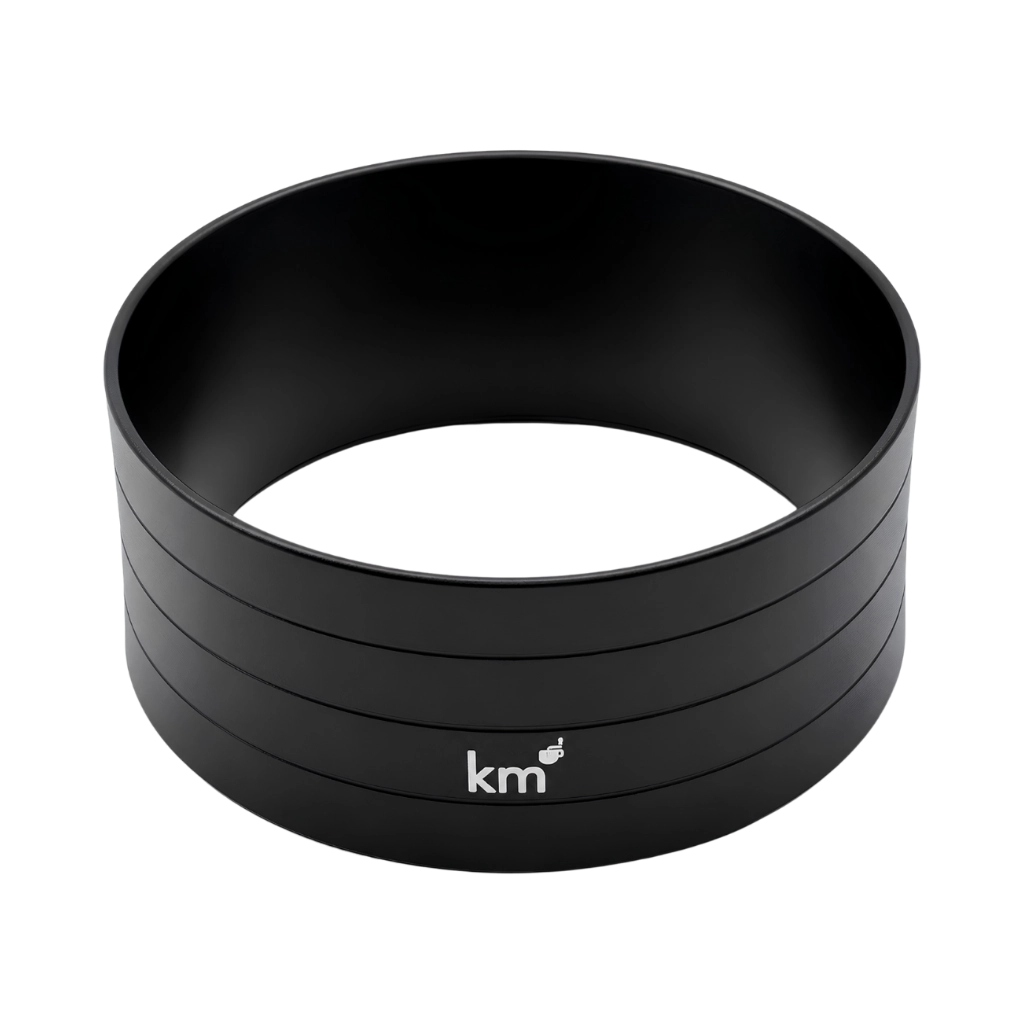
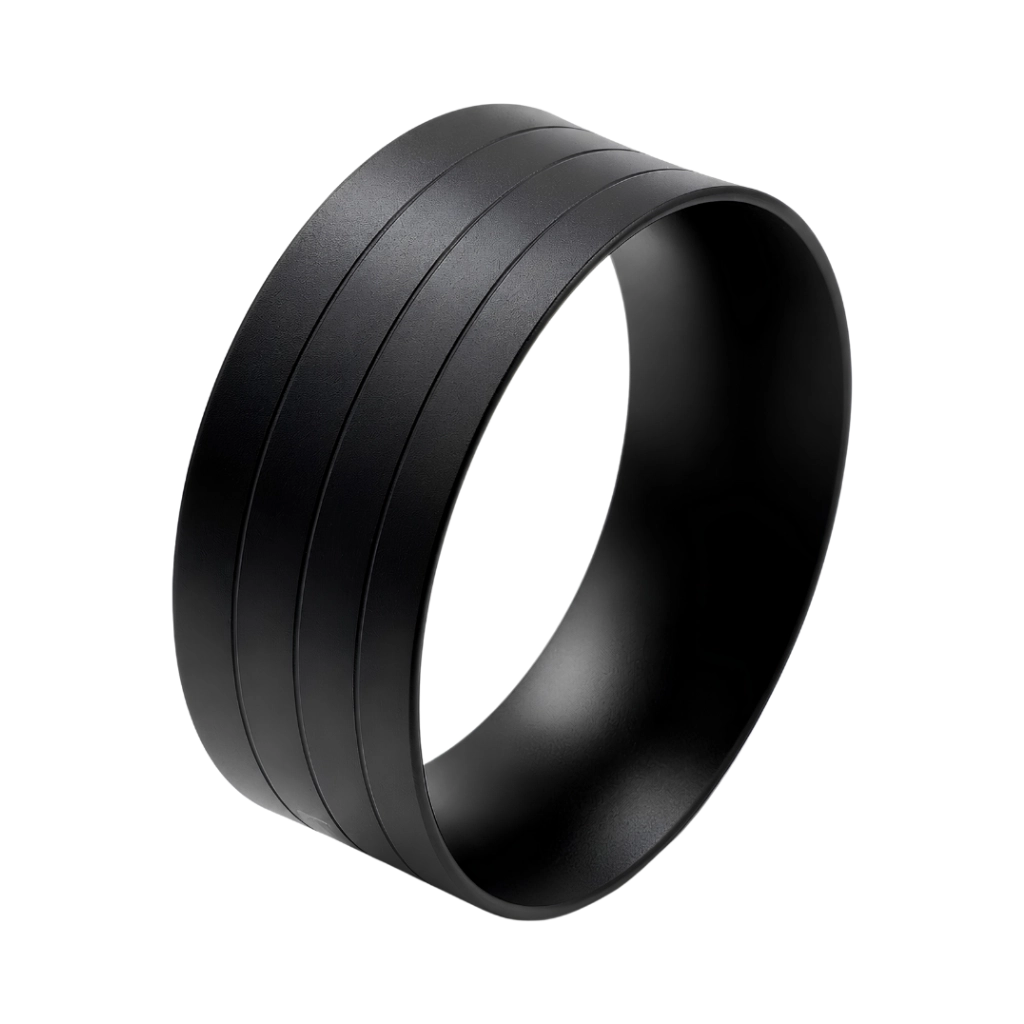
Little has changed in the basic shape. The Specialità Smart is compact, light enough at 5.6 kg to be moved if necessary, and sits firmly on the counter. You attach the included dosing ring magnetically to the portafilter; it has a cutout for the ejection side. In practice, coffee grounds occasionally fall off the side when grinding without the ring. With the ring, the grinder doses cleanly into the portafilter.
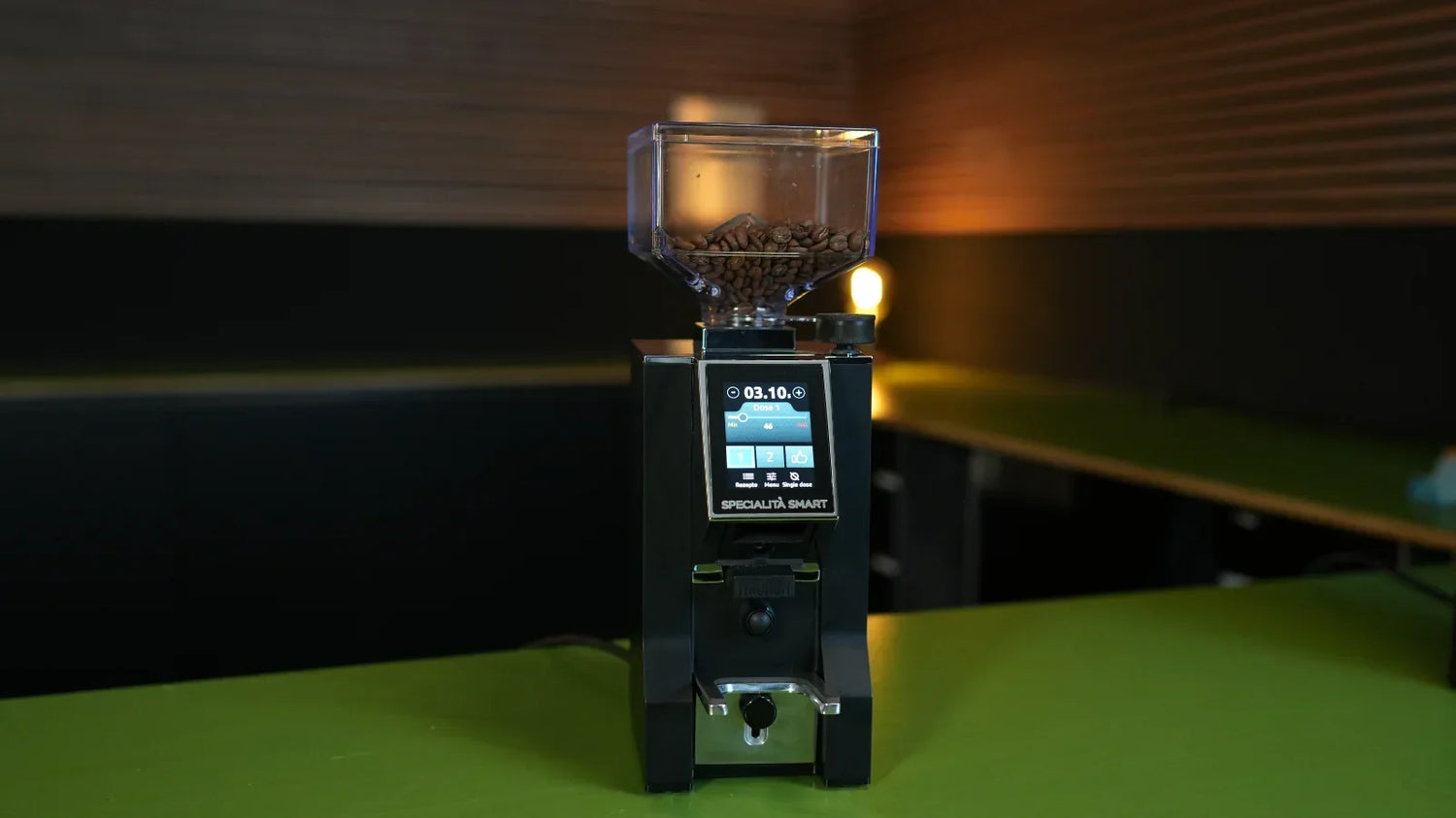
The most striking new design element is the display. By default, it shows the current grind size as a number and expands to a digital grind size indicator at the touch of a finger or automatically when you turn the grind adjustment dial quickly. The Smart interface with a thumbs-up button, recipe recall, and timer is integrated into the display. In terms of feel, the grinder remains at the level of its predecessor: solidly crafted plastic, nothing surprising in either direction.
Burrs and Smart features
At its core, it features the same heart as the classic Specialità: 55 mm flat burrs made of hardened steel with stepless grind adjustment. No RPM control, no single dosing as a primary operating mode – the Smart is designed as a dosing grinder with a timer and direct grinding into the portafilter.
What is new are the assistance functions. And here we have to be clear.
The digital grind size indicator. The sensor measures the distance between the burrs each time it is switched on and outputs it as a number. Sounds like progress. The problem: The measurement varies. After switching it off and on again, the grinder suddenly shows 1, 2, or 3 numbers off – without you even touching the grind adjustment. And it doesn't stop when switching on: during operation, between two shots, the display can jump from 17 to 14. Just like that. You turn it finer, finer, finer – nothing happens. Then the display makes a jump from 17 to 16, you go to the portafilter, come back: 14. This is not an isolated case. We had two Smart Specialitàs with us – and the errors occurred repeatedly.
This is not a minor issue. The grind size indicator is the cornerstone of the entire Smart system. Saving recipes, reproducing settings, trusting the assistant – all of this only works if you know what grind size you are actually at. If the display suddenly drifts after a break, saved recipes lose their value. You can still note down your setting – but then the display is just a decoration.
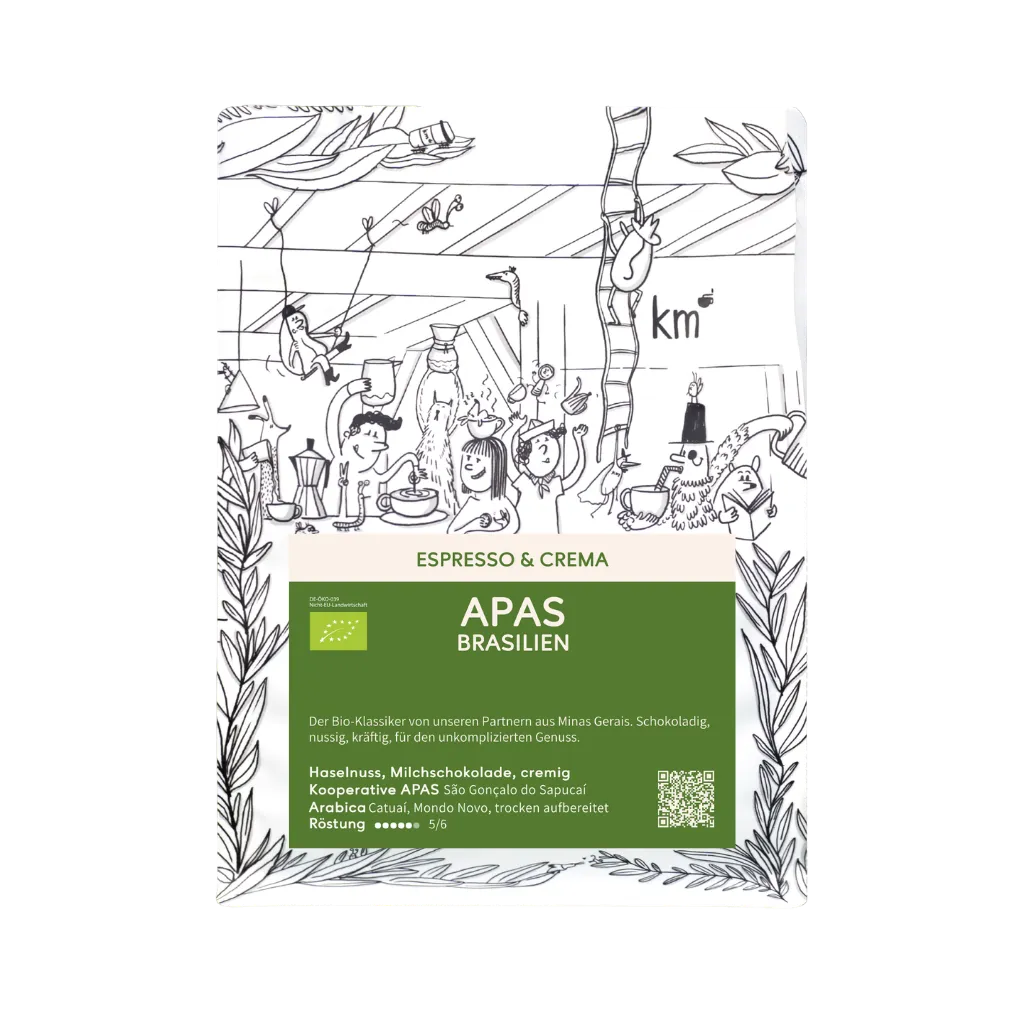
The brewing assistant. The thumbs-up/down function learns from your extraction time and suggests the next grind size change. The concept is good. The implementation is – depending on the coffee – half-baked. With medium roasts like the Apas, it works: after the third or fourth shot, you end up at the target time. With lighter, complex coffee like the Mano Blend, the assistance goes haywire. Recommendation: from 17 to 23. Really. The coffee then ran through in 21 seconds – we had aimed for 27. The assistant simply had difficulty finding the right grind size time and again. And this even when it wasn't interpreting a different grind size itself. If a display drift occurred during the adjustment process, we were completely lost in the grind adjustment process.
The automatic quantity compensation. The grinder recognizes when you adjust the grind size and increases or decreases the timer time so that the correct amount of coffee is produced anyway. The idea is great – because anyone grinding finer must automatically grind longer to reach the correct amount. The execution was heading in the right direction, but was never accurate enough for us to really want to trust the automatic adjustment. You can see it in the test video: We aim for 19 g, change the grind size, and follow the recommendation to grind longer. 18.3 g is the result of the following grind. Being 0.7 g off is not a strength for a function that promises automatic precision.
In total, we have to conclude: The grinder is the opposite of smart. The Smart system does not deliver what it promises. The supposed smartness creates more uncertainty than it provides support.
Usability
A grinder that is called "Smart" must be measured against its core promise: Does it support you – or does it complicate your morning?
The Specialità Smart does both. And unfortunately, the latter outweighs the former.
The recipe system is the core of the grinder: You save your grind size, the grinder remembers it, and for the next coffee, you recall the recipe. Sounds good. But the grind size indicator makes reliable use of the recipes impossible. If the grinder suddenly shows a different value after switching on than when switching off, the following happens: It detects the deviation from the saved recipe – and recommends that you adjust the grind size. You adjust it. The espresso does not run as desired. You adjust it again. All the while, the mechanical setting was correct the whole time. The grinder re-measured itself, displayed the wrong number – and then led you astray based on this wrong number.
This is the opposite of ease of use. With a classic grinder with a mechanical adjustment dial, you note down your grind size, come back the next morning, and the setting is where you left it. Not here. Here, the guessing game begins all over again – supported by a machine that thinks it knows better.
If you ignore the Smart functions and use the grinder purely as a time-controlled dosing grinder, it grinds reliably. Better to save your grind size on a sticky note on the device than in the recipe memory – that is more reliable. Alternatively, you can also simply take a look at the "old" Eureka Mignon Specialità.
Speed and noise
20 g in 10 seconds – this is at the lower end of the mid-range, but perfectly sufficient for a 55 mm dosing grinder in home use. It takes 11 seconds for 18 g. Anyone who makes 2–3 espressos a day will never experience this as a bottleneck.
At 77 dB(A), it is pleasantly quiet. Below 80 dB, no roaring hum, no annoying scratching. The sound quality fits a compact kitchen or living room – wherever the espresso grinder is placed.
Grinding temperature
The first sample is at 33.1 °C – still in the solid range. After five consecutive grinds with 20 seconds of pause each, this rises to 37.3 °C; the average value is 34.98 °C. That is warm, but not critical. Those who pull their two shots in the morning are in the green zone. Anyone testing round after round or grinding frequently in succession should be aware of the temperature rise. The grinder is not made for continuous grinding.
retention
The retention is 5.7 g absolute – of which 3.5 g is temporary, 2.2 g permanent. That is a lot. For comparison: We measured the classic Specialità again with our current protocol and came to 5.0 g absolute. There is therefore no significant improvement between the predecessor and the successor.
What does this mean in everyday life? 3.5 g temporary retention means that 3.5 g of coffee from the last portion is carried over with every grind. With regular daily use, this is justifiable – the coffee is then at most one shot old. However, anyone changing coffee bean varieties or leaving the grinder for days at a time will brew about 3.5 g of old coffee without purging. When adjusting, the rule applies: After every grind size change, you should grind out at least these 3.5 g of coffee from the temporary retention before the new setting really takes effect.
Given the small burrs, the retention of 5.7 g is surprisingly large.
Dosing accuracy
As a dosing grinder in timer mode, the Specialità Smart is reliable in its core area. With a carefully set timer, the output quantity lands within 0.1–0.2 g of the target quantity – that is good for a time-controlled grinder. Prerequisite: You measure afterwards and do not rely on the automatic quantity compensation.
The Smart dosing, which automatically corrects after grind size changes, should be viewed as a rough guide, not as a replacement for the scale.
The consistency of the grinder is solid: 0.1 g standard deviation over 15 portions. That is sufficiently precise for everyday use; we do not note any significant outliers in normal operation. Once well-adjusted, the grinder grinds consistently.
Cleaning
As with all Eureka grinders: remove the lid at the back, loosen the screws, then you can access the grinding disc. That is a bit laborious – but because you do not change the mechanical grind size while doing so, you have no calibration problem afterwards. By far not as comfortable as with some modern grinders, but absolutely solid in handling. We recommend regular cleaning as with any 55 mm burr grinder with corresponding retention.
Particle distribution
We analyze the particle distribution in cooperation with the ZHAW using the Retsch Camsizer X2.
In the adjustment test – Ristretto (GS 22), Lungo (GS 43), back to Espresso – the PVM analysis shows an x50 deviation of 31.76 µm between the initial setting (T4: 135.09 µm) and return (T7: 166.85 µm). That is a measurable difference. Whether it is exclusively attributable to mechanical inaccuracy or partly to the erratic grind size display cannot be completely separated – the return to the initial position is only as precise as the display you follow.
The main peak width changes moderately from T4 to T7 (206.15 to 218.78 µm). The grind profile remains similar, but it is not identical.
Espresso setting (T4): x50: 135.09 µm · Fines (Qf < 100 µm): 46.51 % · 60 % main peak width: 206.15 µm
With 46.51 % fines, the Specialità Smart is at the upper end of the scale. Many fines mean more body, more extraction resistance – and the need to grind coarser than one would intuitively think. In the cup, this works well for medium and dark roasts: dense texture, body-rich espresso. For light, complex roasts, the high proportion of fines can make extraction harder to control and cause the espresso to lack clarity.
The main peak width of 206 µm is narrow. The curves of T4 and T5 (Ristretto) are close together, which indicates a consistent grind profile in fine settings. T6 (Lungo) shows, as expected, a significantly broader distribution (main peak 254.62 µm) and lower fines content (36.48 %).
In short: The Specialità Smart grinds as one expects from Eureka 55 mm burrs. Good for classic, body-rich espressos with medium to dark roasts. For light specialty roasts, the grind profile is less ideal – which is primarily due to the high proportion of fines.
Conclusion
The Eureka Specialità Smart is in a dilemma it cannot resolve.
The grinder itself – that is, the part that grinds – is good. Solid particle distribution, decent temperature control, quiet in operation, proven 55 mm grinding mechanism. We know all this from Eureka, and it works here too.
The Smart system, on the other hand, is a step backward. The digital grind size indicator keeps jumping after switching on. It drifts during operation, making saved recipes largely worthless. The brewing assistant works reasonably well with simpler roasts; with complex coffees, it gives recommendations you are better off ignoring. The automatic quantity compensation shows the direction, but does not hit the target amount.
Strengths: Proven grinding performance at the level of the classic Specialità · Quiet (77 dB), compact, solid build quality · Good dosing accuracy in carefully set timer operation
Weaknesses: Grind size indicator is unreliable – this undermines the entire Smart concept · Medium retention (5.7 g absolute), no progress compared to the predecessor · Brewing assistant fails regularly with light coffees, but also with medium and dark coffees when the grind size indicator jumps again
For whom? Those who know the classic Specialità, are happy with it, and are looking for a dosing grinder with a timer will find a proven grinding mechanism here. If you ignore the Smart functions and simply use the grinder as a time-controlled 55 mm dosing grinder, it reliably grinds good coffee for medium to dark roasts.
For whom not? Anyone buying the smartness in the hope of less adjustment work will be disappointed. Anyone who changes beans frequently or relies on precise recipes will have to struggle with the unreliable display daily. Anyone wanting single dosing is buying the wrong grinder.
Price-performance: 599 EUR for a solid 55 mm grinding mechanism with a timer – that is justifiable if you view the Smart functions as an accessory and ignore them from the start. However, if you buy the digital intelligence because you hope for less effort, you get the opposite.
Eureka can build grinders. That is indisputable. But putting 'Smart' on the box and delivering 'Smart' – those are two different things here. As the grinder currently works, the supposed smartness holds the greatest potential for frustration – especially for beginners who hope to be quickly guided to their first good espresso.
Eureka Specialità Smart – Test result
Kaffeemacher test protocol · Measurement with Retsch Camsizer X2 (ZHAW) · Apas espresso as reference coffee
Rating scale: very good good medium poor very poor
Technical specifications at a glance
| Feature | Value |
|---|---|
| Price | 599 EUR / 599 CHF (RRP, as of 2026) |
| Burr size | 55 mm |
| Burr type | Flat burrs (hardened steel) |
| Operating mode | Dosing grinder with timer, direct grinding into portafilter |
| Grind speed | 20 g / 10 sec. (hopper) · 11 sec. for 18 g |
| Volume | 77 dB(A) |
| Grind temperature | 33.1–37.3 °C (first to last sample, average: 34.98 °C) |
| retention absolute | 5.7 g (thereof 3.5 g temporary, 2.2 g permanent) |
| Consistency (std. dev.) | 0.1 g |
| x50 (Espresso T4) | 135.09 µm |
| Fines Qf < 100 µm | 46.51 % |
| 60 % main peak width | 206.15 µm |
| RPM control | No |
| Bean hopper | 300 g (plastic) |
| Weight | 5.6 kg |
| Dimensions (W × H × D) | 120 × 348 × 191 mm |
| Special features | Digital grind size indicator, brewing assistant, recipe storage, hands-free operation, stepless adjustment |
* Prices incl. VAT, as of 2026.
We bought the Eureka Specialità Smart for 599 EUR ourselves. This test was not requested or paid for by Eureka.