




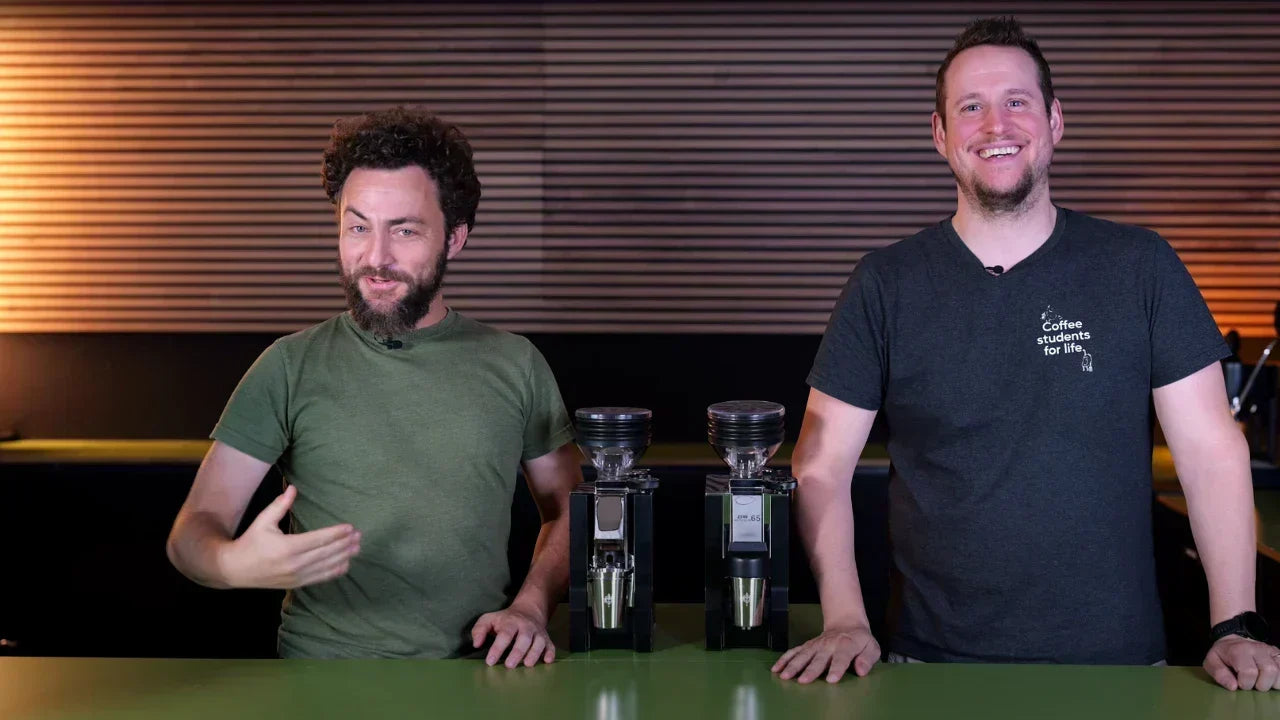

The Eureka Mignon Zero 65 AP (All Purpose) is a new model with a larger 65 mm burr set, going up against the well-established Eureka Mignon Zero (55 mm). We tested both espresso grinders extensively and independently. What stands out right away: both Zero models are among the most affordable grinders in Eureka's lineup, at around 370 euros (classic Zero) and 419 euros (Zero 65 AP). That made it all the more interesting to see what Eureka actually delivers here, especially since the name "Zero" is meant to suggest "Zero Retention," i.e. zero retention. As we'll show, neither grinder is entirely free of leftover grounds.
The test also had a surprise in store: the Zero 65 AP behaves quite differently from the older model in several respects. Sensorially, the two could hardly be more different, making them almost two extremes for espresso. In the meantime, an updated entry-level model, the Zero 55 S, has also arrived, and we're including it here as well. Further down you'll find the particle distribution, all our measurements, and our take on all three Zeros.
The Zero line is the most affordable way in. All other models are covered in our Eureka comparison.


What does "Zero" mean at Eureka?
You might assume "Zero" refers to the missing display. What's actually meant is "Zero Retention," i.e. as close to zero retention as possible. Historically, the Zero was one of the first Eureka models with a bellows. The market was moving toward single dosing, and Eureka took one of its compact Mignon grinders, added a bellows on top, and dropped the display. That brought the grinder closer to single dosing, but not quite to zero.
Because retention remains. By that we mean the coffee that stays behind in the grinder after grinding, ages there, and partly ends up in the next shot. We distinguish three values: temporary retention, which gets flushed out with every grind; permanent retention, which sticks in crevices and gaps for good; and absolute retention, the sum of both. These are exactly the values we look at for every grinder.
Three Zeros, one name
The name causes some confusion, since three grinders now carry it. A quick breakdown:
- Zero (classic, 55 mm): the original model with the small original grind-adjustment dial and a 45-gram single-dose hopper. Around 370 euros.
- Zero 55 S: the revised entry-level version. A King Size grind-adjustment dial and a front-start lever come fitted from the factory, along with a larger container. Around 229 euros, making it cheaper than the older model.
- Zero 65 All Purpose: the larger 65 mm model with All Purpose burrs, a King Size dial with a rotation counter, and a top burr that's screwed in from behind. Around 419 euros.
According to Eureka, all three weigh 5.6 kg and come with a ten-year motor warranty.
A quick note on origin, since we're asked often: the classic Zero and the Zero 65 All Purpose are manufactured by Eureka in Italy. The new Zero 55 S, on the other hand, comes out of Eureka's factory in China. We don't see a quality difference in our measurements, but it's good to know.
Measurements compared
| Model | Burr set | Noise level | 18 g in | Absolute retention | Grinding temperature | Price |
|---|---|---|---|---|---|---|
| Zero (classic) | 55 mm, standard | 83.5 dB | 12 s | 1.9 g* | 34.6 °C | ~€370 |
| Zero 55 S | 55 mm, standard | 83.1 dB | 10.5 s | 2.7 g** | 28.9 °C | ~€229 |
| Zero 65 All Purpose | 65 mm, All Purpose (screwed in from behind) | 79.2 dB | 17 s | 1.8 g* | 34.5 °C | ~€419 |
* Measured in 2025. ** Measured in early 2026. Our retention protocol has gotten stricter over the years, so the 55 S's 2.7 g isn't directly comparable to the older figures. Eureka states noise levels considerably lower (factory figures between 51 and 64.5 dB); measured with coffee, we land at the values above.
One pattern runs through all three: each has the retention typical of the Zero line, in the range of about two grams, with a larger temporary portion and a smaller permanent one. Grinding speed is solid across the board, though the 65 All Purpose is noticeably slower at 17 seconds for 18 grams, because the All Purpose burrs deliberately grind more slowly. Heat buildup isn't an issue for any of them; the 55 S actually runs strikingly cool at 28.9 degrees. Consistency is good across all three — for the 55 S we measured a standard deviation of 0.05 grams over five grinds.
Two burr sets, two espresso worlds
The most interesting difference isn't in the numbers, it's in the cup. And that's where the standard 55s and the All Purpose 65 clearly part ways.
The 55s (classic Zero and 55 S) carry the same 55 mm burrs as the Specialità and Magnifico. That's a familiar, proven cup profile: full-bodied and dense, cocoa-forward, with the marzipan-in-dark-almond note typical of our Apas, plus a nice sweetness and a light, pleasant dryness in the finish. Good for medium and darker roasts, and workable, with some compromises, for lighter ones too. A solid, all-round profile.
"This is a safe bet. We know the particle distribution, we know the espresso is good. With this grinder, you're not experimenting."
The Zero 65 All Purpose is a different animal. The top burr is blind, meaning it's screwed in from behind, so the entire surface is used for grinding. That pushes the particle distribution from good to very good, with an unusually narrow main peak around 155 µm, the kind you'd otherwise expect from expensive SSP burrs. In the cup, that translates to less heaviness, more clarity, acidity, and fruitiness — a body that's more juicy than deep and dark.
The catch is extraction behavior. Because of the many similarly sized particles and the elevated fines content, resistance in the puck is very high at the start and then drops off quickly. The first drops come late — on a machine with a rotary pump, often only after 11 or 12 seconds — and the shot is done at around 28 seconds. That's unusual and feels a bit like a very light roast. This grinder plays to its strengths when your machine can do pressure profiling or flow control, and struggles more when it's stuck with a flat 9 bar.
The Zero 65 All Purpose isn't a grinder for beginners. You'll need some experience with coffee and with the grinder itself to dial it in and understand how it behaves. If you bring that, or want to learn it, you get an excellent particle distribution for a price that's very low for this class in return. As a bonus, it also works well for really good filter coffee.
Handling and retention in practice
The grind-adjustment dial is where the progress shows most clearly. The classic Zero still has the small original dial, which jumps in steps that are too large. That's why we sell the larger King Size dial separately as an upgrade. On the 55 S and the 65 All Purpose, the King Size dial comes fitted from the factory — on the 65, even with a rotation counter, which makes switching between espresso and filter much more pleasant. The 55 S also has a lever that lets you start grinding from the front, handy if your counter is deep or you work sitting down.
You can noticeably reduce retention on all three. A simple tilt using a base (there are plenty of 3D-printed kits out there) angles the grinder forward and nearly halves the exchangeable portion. If you also grind through three or four beans before your actual dose to clear the grinder, you effectively get a single-dose grinder for under 400 euros. And since permanent retention builds up over time and coffee oils turn rancid, it's worth cleaning the grinder every one to two weeks and opening it up to brush it out roughly once a month.
Which Zero is right for you?
A solid, affordable way into single dosing. The Zero 55 S. For around 229 euros you get the proven 55 mm cup profile, the King Size dial and front lever from the factory, and a grinder that runs cool and consistent. If you're working in the mid espresso spectrum with the occasional lighter roast, this is a very good value proposition.
The classic Zero (55 mm). Still technically sound, but overtaken by the 55 S on price and handling. Still worth a look if you can get it cheap or want a specific color. Otherwise you'd need to retrofit the King Size dial to match the same level of handling comfort.
Clarity, acidity, and filter for advanced users. The Zero 65 All Purpose. Not a beginner's grinder, but a surprisingly capable one for anyone with a suitable machine who wants to work with the distinctive character of the All Purpose burrs. If you were already eyeing SSP burrs, this one's worth a look.
And the Zero 65 Speedy?
Beyond the three models we tested, there's a fourth Zero that's often confused with the 65 All Purpose: the Zero 65 Speedy. We haven't had it on our test bench ourselves yet, so here's just a quick placement based on the manufacturer's specs.
The name says it all. The Speedy also has 65 mm hardened-steel burrs, but with an espresso-specific geometry instead of the All Purpose burrs, and a faster motor running at 1650 rather than 1350 rpm. That lets it grind at around 2.3 to 2.8 grams per second, noticeably quicker than the deliberately slow 65 All Purpose. In exchange, it skips the King Size dial with rotation counter and is clearly built for espresso rather than switching over to filter.
In short: if you want fast, pure espresso single dosing with 65 mm burrs, take a look at the Speedy. If you want clarity, filter capability, and the distinctive All Purpose character, stick with the 65 All Purpose. Once we've tested the Speedy ourselves, we'll add our measurements here.
Conclusion
The Zero line remains an insider tip at the entry level, both in price and performance. For most home users, the new Zero 55 S is the well-rounded recommendation: affordable, easy to handle, runs cool, and delivers the proven 55 mm espresso profile. The classic Zero still does everything right, but gets outpaced by the S. And the Zero 65 All Purpose is the most exciting but also the most demanding of the three — a clear choice for advanced users after clarity, acidity, and filter coffee. None of the three hits zero retention exactly, but with a tilt and a few tweaks, you get close.