






What we can extract from coffee, what we should extract, and how that influences the strength of the coffee beverage.
“A bit over-extracted and bitter,” the barista murmurs while adjusting the espresso grinder. Moments later, with a few steps coarser grind setting, the coffee flows smoothly, and the extraction is just right. The result is a perfect cup containing all the flavor potential dormant in the coffee bean—potential established by coffee producers in the country of origin as well as by the roasting process.
Brewing coffee is nothing more than accessing or solubilizing this potential. “Solubilizing” is the key term. Grinding breaks the cell structure of the coffee beans, increasing the coffee's surface area and making it accessible to water. The solids become gaseous and liquid, forming the flavor components we perceive sensorially in the coffee beverage: taste, aroma, body, and the brown-red color. What we taste are chemical compounds with varying solubilities that, depending on the extraction and intensity, lead to very different results in the cup.
Two perspectives make it easier to understand the brewing process. What we dissolve from the coffee bean is called “extraction.” The dissolved particles in the cup are called the “strength” of our beverage, referring to the concentration of the dissolved coffee.
Strength and concentration of dissolved coffee particles
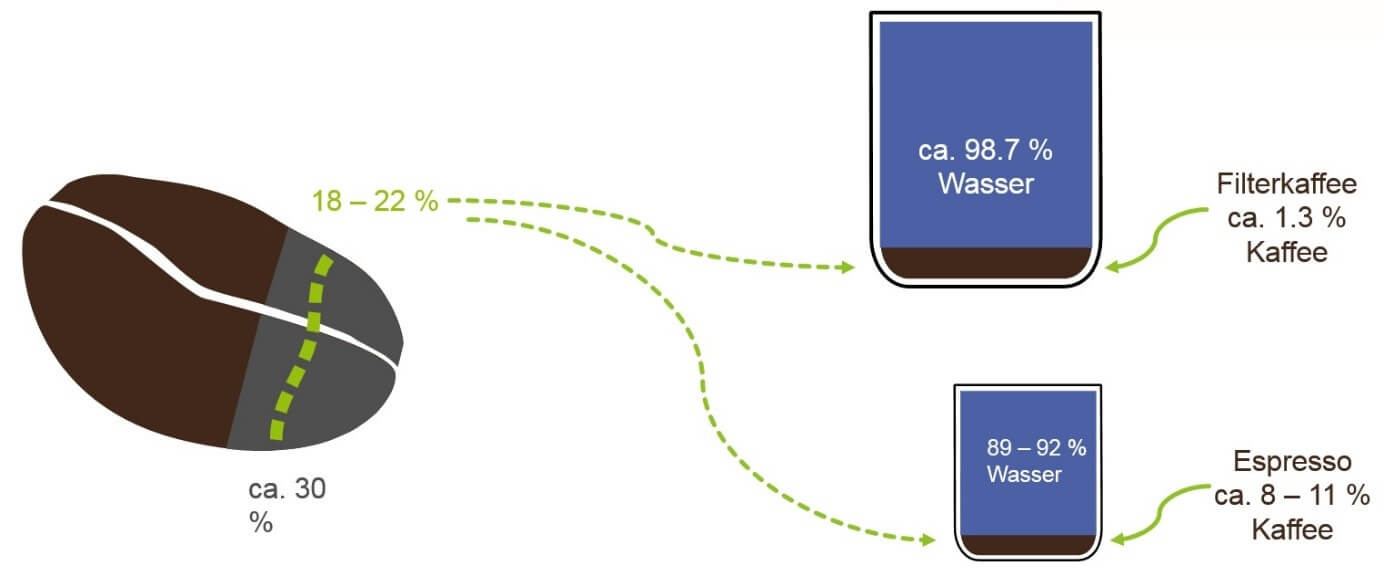
Every coffee beverage is ultimately water in relation to a certain amount of coffee particles, i.e., strength. A filter coffee, for example, consists of about 98.5% water and 1.5% dissolved coffee particles. An espresso, which is perceived as much “stronger” and more intense in terms of taste, consists of about 90–92% water and accordingly 8–10% dissolved coffee particles. When we speak of strength, we mean the concentration of coffee in relation to water. These dissolved coffee particles are called Total Dissolved Solids in English, abbreviated as TDS. The concentration of TDS can be measured with a refractometer.
Coffee extraction – what we take from the bean
Approximately 30% can be extracted from every coffee bean. Everything else is cellular material, oil, and protein, which is not soluble by normal and easily accessible means. But not everything we can extract from a coffee bean tastes good. It is a fine line between too much and too little extraction, which we perceive sensorially in every cup of coffee.
Over-extraction – too much extracted
If a coffee tastes more bitter than we are used to, we have likely extracted too much. A common reason for this is a grind that is too fine. A fine grind offers more resistance to the water, forcing it to extract more on its way into the cup—in the case of over-extraction, more than is actually good. The result is a coffee that tastes bitter, astringent, and unbalanced. In terms of taste, this sensation occurs when we dissolve an average of more than 22% from a coffee bean.
Under-extraction – too little extracted
On the other side of the line lies the danger of under-extraction. If we dissolve less from a coffee bean than its potential, we not only fail to access the bean's potential but also get a sour, grassy, and, depending on the strength, aggressive cup. We are only dissolving the most soluble particles and have likely extracted less than 18% from the coffee bean.
The sweet spot and the perfect coffee
The art of brewing a perfect coffee lies in navigating this fine line between over- and under-extraction while simultaneously bringing the dissolved particles into the desired strength ratio with the water. A successful extraction unlocks the potential in the bean. The strength defines what kind of drink we have brewed.
Strength of coffee beverages
The concentration of dissolved coffee particles is defined for every coffee beverage:
Filter coffee: 1.2 – 1.5% TDS
Café crème: 1.8 – 3% TDS
Americano: 3 – 4.5% TDS
Espresso: 6 – 10% TDS
These are approximate values that provide a good guideline for the strength of coffee beverages. It is important to note that the remaining content of the cup is water. In the case of filter coffee, for example, more than 98% water.