



The French Press or plunger pot delivers great coffee like no other brewing method, and plenty of it. In this article, Swiss filter coffee master and German coffee taster of the year 2017 Benjamin Hohlmann brings together his two favorite French Press recipes. This guide walks you through the preparation step by step. We answer the most important questions, explain how much Kaffeemacher for which amount of water is needed, and how to find the right brewing temperature.
French Press, Plunger Pot, or Coffee Press
More important than the name of the coffee maker is the functional principle. First, coffee is added to a round glass or metal vessel. Hot water is poured in at a ratio of 1:15 to 1:16. This corresponds to 60 to 70 grams of coffee per liter of water, depending on taste. The water has a brewing temperature of about 95 degrees. After a brewing time of 3 to 5 minutes, a central rod pushes down a screen, mesh, or paper plunger. The plunger separates most of the coffee particles from the brewing water. The plunger thus ends the brewing and gives the French Press its name.
This French Press is so simple and so practical. And this simple principle is one reason why the plunger pot is so popular. Anyone can make good coffee at home with a French Press. The following two recipes are simple and emphasize two different flavor profiles.

French Press Instructions: Recipe No. 1, Classic, Strong, Good
The procedure already described in the introduction is the classic French Press basic recipe. Here it is again, step by step.
Since water with coffee is still sitting in the plunger pot, extraction continues in principle. After pressing down, there is little movement, which greatly limits extraction. For the best results, I serve the coffee immediately after the four minutes or pour it into another pot.
French Press Recipe No. 2: Elegant, Nuanced, and Championship-Worthy
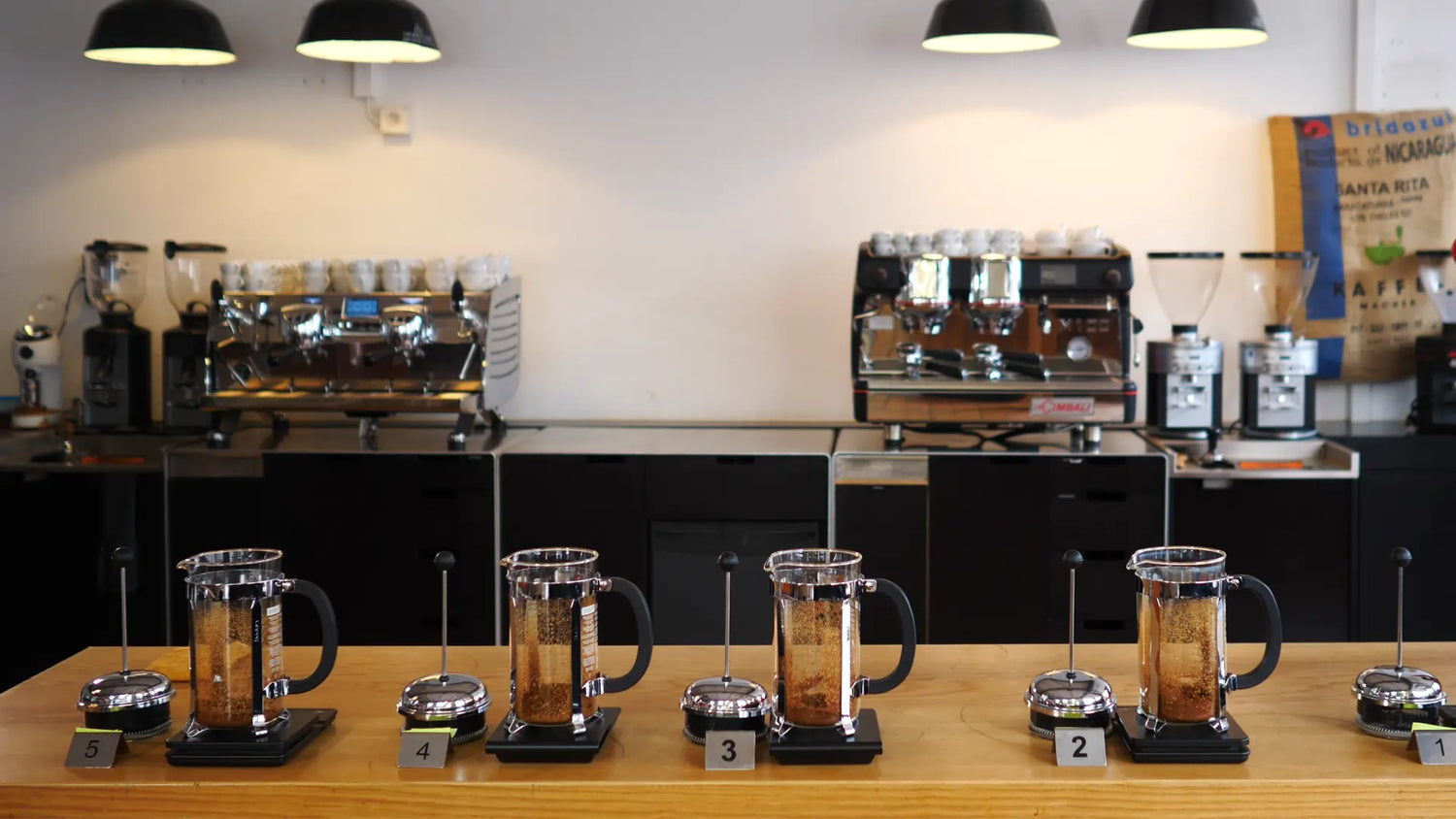
For even better results with the French Press, a recipe that is based on professional coffee tasting is suitable. This type of preparation is called cupping. Cupping or cup tasting is used in quality control by green coffee traders and roasteries.
In this method, the ground coffee is placed directly in a cup and poured over with approximately 94-degree hot water. After four minutes, the crust is broken and skimmed off. After another four minutes, tasting begins with a spoon from above. This avoids stirring up the coffee that has sunk to the bottom again.
Sensorially, this way the coffee tastes "clearer" and "cleaner" than the sensory results of brewing from plunger pot recipe 1. The mouthfeel is also "softer" and "more elegant".
This taste result can also be achieved with the plunger pot. Steps 1 through 4 of Recipe 1 are performed in the same way.

The Ratio of Coffee Amount to Water in the Coffee Press
The use of 60 to 70 grams of coffee leads to the best taste result, which suits most Central European palates well. The exact choice of amount can be made depending on preference.
In general, using more ground coffee, for example 7 grams of coffee per 100 ml or 70 grams per liter, results in a "stronger" coffee. When more powder is used, the water also has more extraction potential available. It is often overlooked that the coffee beverage becomes "more acidic" at the same time.
Using more coffee makes the beverage stronger. However, the same amount of water can no longer extract substances from the coffee used equally effectively. This tends to result in under-extraction, which tastes generally more acidic.
If the coffee result should become stronger without increasing the acidity, a finer grind often gives a better result. However, it should be noted that a finer grind triggers higher extraction of the ground coffee. This tends to taste more bitter.
When the ratio of ground coffee to water settles at 60 to 70 grams of coffee, the brewing is usually balanced and delicious.

What Temperature for the French Press?
The right brewing temperature is quickly explained: We pour at about 95 degrees. If you have a kettle with temperature control, set it to 95 to 96 degrees. Everyone else boils the water and then waits about two minutes, then it's in approximately the right range.
It shouldn't be much hotter, otherwise the brewing quickly emphasizes bitter notes. If the water is too cool, the coffee remains thin and flat. With very light roasted filter coffees, you can go to the upper end; with somewhat darker roasts, you might prefer a degree or two less. Unlike the hand filter, the French Press is forgiving here: a few degrees off is easily tolerated.
If your coffee with rather dark roasting tastes too bitter, brew "cooler" next time, e.g. with 92 - 94 degrees.
Which Coffee Is Suitable for the French Press?
The French Press or plunger pot belongs to the alternative brewing methods and is part of the "immersion brewer" family. Immersion means that water and coffee are in contact for most of the brewing—the coffee is submerged in water. In contrast are percolator systems like traditional filter coffee, where water flows through coffee.
Another immersion method is the AeroPress, which works with shorter retention and some pressure. If you're looking for the difference from the classic hand filter: With the French Press, the coffee sits in the water the whole time; with the filter, the water flows through it. This makes the plunger pot stronger and less complicated, while the filter is clearer in the cup.
"The French Press is a very honest brewing tool. It shows the coffee as it is. Without filtering anything out. I like that."
Benjamin Hohlmann, German Cup Tasting Master and Swiss Brewers Cup MasterThe choice of coffee largely depends on the strength of the final beverage. This is roughly the same for both immersion and percolator systems. Strength is the concentration of dissolved coffee particles in relation to water. The best taste results are achieved when a coffee prepared with the plunger pot contains approximately 1.2 to 1.5% dissolved coffee particles. In technical terms, we call this "total dissolved solids", abbreviated TDS in percent.
To put this in perspective: the remaining 98.5 to 98.2% of the coffee beverage is water! A reminder of the importance of the water used.
Which Coffee Is Suitable for the Plunger Pot?
For preparing a plunger pot, filter coffees are best suited. Due to the lighter roast, flavor nuances and the coffee's own positive acidity are present, which balance very well with the water amount (+98%).
We offer our filter coffees in Switzerland and also in Germany and the EU.
For preparing espresso, darker roasted coffee is used. This is also partly due to the ratio to water. Since here only 90 – 93% water in the espresso final beverage provides balance, the darker roast reduces the intensity of the acidity.
Important: the acidity mentioned here is especially important for the taste of the coffee. As with wines, it helps make it balanced. Acidity, sweetness, and bitterness are in balance in good coffees.

Which Water Should Be Used for the French Press?
As with all coffee beverages, with the French Press too, coffee tastes best when "soft" water is used, which itself is free from off-flavors. Soft indicates lower hardness, meaning fewer minerals like magnesium or calcium in the water.
"Hard" water buffers the acidity of the coffee and thus removes an important factor for taste. Without acidity, a coffee becomes "dull", one-dimensional, and the flavor notes cannot develop well.
For brewing methods like the plunger pot or traditional filter, water with a hardness of 2 to 5 German hardness degrees and appropriate carbonate hardness is best suited. With a table filter by BWT or Brita, the water's hardness can be reduced. Mineral waters such as Lauretana, Black Forest, or Volvic are also very soft.
Who Is the French Press Suitable For?
The plunger pot is the simplest brewing method for making good coffee easily. It forgives more mistakes than the hand filter, the Moka pot, or espresso. Even if the grind size isn't quite right, the French Press achieves good results. A good, everyday-friendly pot for beginners is, for example, the Timemore U French Press from our shop.
We always recommend grinding coffee fresh. However, if the coffee is not ground fresh and the grind size cannot be adjusted, the plunger pot still achieves the best results. It's a brewing method that forgives. This is largely because the coffee sits in water. No movement or wrong movement affects the result. If, when preparing filter coffee, water doesn't flow through because the grind is too fine, the result is always poor. Not so with the coffee press or plunger pot.
The plunger pot also brews larger amounts of coffee without problems. The 1-liter version of the Bodum Chambord plunger pot, for example, is suitable for preparing up to 800 ml of coffee. The results don't get worse with larger amounts of coffee, they remain consistent. This makes the plunger pot excellent for brewing coffee for larger groups. It also speaks in its favor that it requires little "attention". And even if step 5 of either recipe isn't performed to the minute, the plunger pot forgives this in terms of taste.

The Bestargot titanium coffee press* is one of the most interesting coffee brewing methods for outdoor use. In our article about coffee methods on the go, the plunger pot, weighing only 216 g, therefore achieved a top spot.
How Much Ground Coffee per Cup for How Many People?
An average coffee cup holds 150 ml. To brew one full cup of coffee for four people, at least 600 ml of coffee should be brewed.
If you pour 600 ml of water over 36 grams of coffee, you won't prepare enough coffee (remember: about 6 to 7 grams of coffee per 100 ml of water, see above). For each gram of coffee used, 2 to 2.5 grams of water remain in the coffee grounds, so in our example at least 72 grams. From the 600 ml, we only get about 530 ml of coffee, or somewhat less if we consistently don't pour everything out. This leads to better flavor.
That's why with the plunger pot it makes sense to always brew a bit more than 150 ml per cup. The brewing method conveniently makes it easy for us to brew larger volumes deliciously. We've published a separate article on the perfect amount of ground coffee per cup.

Freshly Ground Is Half Brewed!
For the coffee press too, freshly ground coffee tastes best. Grinding the coffee breaks the coffee's natural protective shell. It then begins to react with the oxygen in the air and light. Volatile flavor components escape and the coffee's oils begin to oxidize. The coffee loses its complexity and becomes rancid at the same time.
We tested 14 hand grinders under 100 euros and almost all of them are good for grinding coffee for filter coffee and also for the plunger pot. Higher-priced and very good models from Comandante we've included in our shop ourselves. One of the test winner hand grinders from the test series in the newest version, we now also offer with the Timemore C5 ESP PRO hand grinder in our shop.

Which Grind Size for the French Press?
The grind size is only slightly coarser than for filter coffee. The company Kruve has developed a good reference guide. While we don't agree with all the particle sizes they recommend for the different methods, the grind size reference is helpful.
A particle size of 700 – 1000 is perfect for preparing the recipes we've shown for the plunger pot.
Cleaning the French Press
After the coffee, wet grounds remain in the pot. You best knock them into the compost bin or compost, not down the drain, or the pipe will clog over time. Then rinse the glass and plunger with warm water, with a little dish soap if needed.
Once a week, it's worth taking a closer look at the plunger. The metal screen can be unscrewed on most models. Coffee oils accumulate there over time, and if they become rancid, you'll taste it in your next coffee. So separate the individual discs occasionally and clean thoroughly. Most plunger pots are also dishwasher-safe, but a quick look at the manufacturer's instructions doesn't hurt.
Cold Brew with the French Press
The plunger pot is also excellent for preparing cold brew. To do this, aim for a brewing ratio of 1:10, for example 30 grams of coffee with a liter of good water for 18 - 24 hours cold in the refrigerator. Then filter and enjoy. You'll find more tips for making cold brew here.