






Melitta's new flagship filter coffee machine is called Melitta EPOS. EPOS as in "electric Pour Over System". Or Epos as in epic? We'll explore that in this in-depth review. The Melitta EPOS is a filter coffee machine with an integrated coffee grinder.
First things first – the rotating brewing water output of the Melitta EPOS has set a milestone in terms of distributing coffee water. No other filter coffee machine distributes the brewing water better than the Melitta EPOS. With this, Melitta has made an enormous development step exactly where the biggest problem in this coffee machine segment lies. The machine brews with high precision. The extractions are very consistent, and the taste is correspondingly good.
For that, I tip my hat as a filter coffee enthusiast. To truly understand the Melitta EPOS technology, I conducted my most extensive coffee machine test to date. 20 hours and over 100 extractions flowed through the filter.
Unfortunately, the Melitta EPOS doesn't perform as well everywhere as it does with brewing water distribution. This really annoyed me during the test. If they had worked as consistently on the grinder and controls as they did on water distribution, the Melitta EPOS would be the best filter coffee machine on the market. Instead, it's a first-class brewer with an average grinder and insufficient control options.
But read for yourself and watch the first test video if you want to learn more. An even more detailed video will be released next week. Enjoy.
Brewing Water Distribution – The Showpiece
The Melitta Epos consistently distributes brewing water evenly over the entire coffee bed throughout the brewing process. This is the most important task when brewing filter coffee and coffee in general. This allows the brewing water to dissolve roughly the same amount from all coffee particles.
With this, the Melitta Epos achieves something that no other filter coffee machine has done so well before. The vast majority of filter coffee machines drip into the center of the coffee bed. At this point, enormous turbulence occurs, and a large portion of what is soluble is extracted from the surrounding coffee particles. However, it's important to note that not everything soluble in coffee is delicious. If too much is extracted from the coffee grounds, the coffee drink tastes bitter. In this case, we speak of over-extraction.
In the case of coffee machines that always drip onto the same spot, we simultaneously have under-extraction. This occurs at the edges of the coffee filter, where the coffee powder is not sufficiently enveloped by water. There is a lack of flow and turbulence. Too little extraction leads to a sour, sometimes aggressive and unpleasant taste.

The result in the cup is unbalanced, bitter and sour to a high degree, which overshadows the positive taste of the coffee. It is almost absurd that the vast majority of old and new filter coffee machines still feature such technology.
At the same time, this is why hand-brewed coffee almost always tastes better. The brewer can then control how they pour the water.
Like Hand-Brewed – EPOS as "electric Pour Over System"
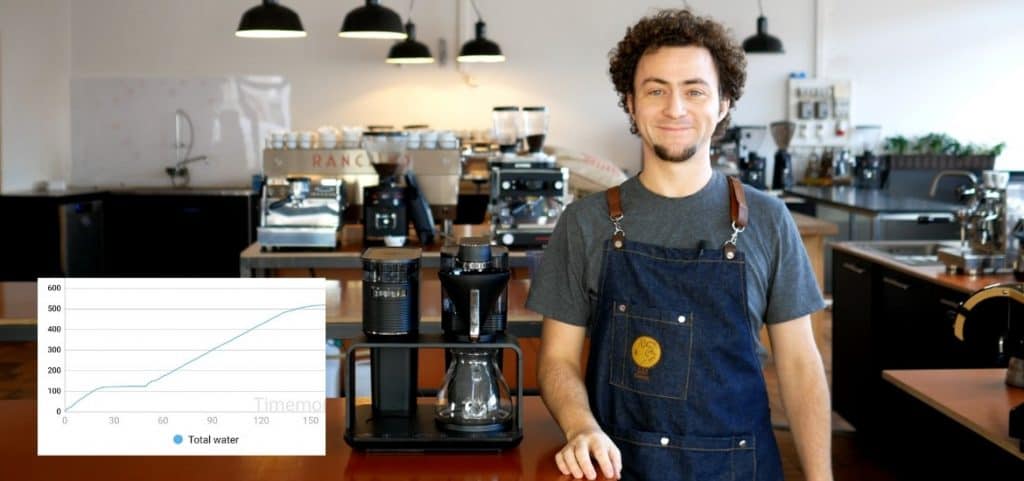
After brewing starts, it takes 5 to 15 seconds for the brewing arm to begin rotating and distributing the brewing water over the coffee. Three holes dispense the water offset at a distance of 1.5 cm. The fact that Melitta calls the rotating water distribution "electric Pour Over System" is quite amusing, given that Melitta Bentz once brewed by hand. "Melitta - electric brewing like Melitta" would have sounded strange, though. At the same time, the name of the machine also references the trendy hand-brewing scene that likes to throw around Anglicisms. Filter coffee is hip and young. EPOS also sounds good like epic, which in many computer games is the highest item category.
And indeed. The Pour Over System brews almost like by hand, and even better. The machine brews consistently and controls the water quantity. Furthermore, it brews alternately with single and triple water pours. And the triple pour is something no hand brewer can achieve.
The coffee grounds are wetted very evenly. The triple stream creates significant turbulence in the brewer, ensuring that all coffee grounds are extracted uniformly. A hand brewer achieves this by stirring the coffee. The triple stream in conjunction with the even application provides equivalent service here.
Brewing – Consistent as Clockwork
Overall, I made about 100 brews with the Melitta EPOS. The consistency is truly impressive! The EPOS rotates like clockwork. This is also clearly visible in the test video. To test the brewing unit on its own, and not be limited by the built-in grinder, I brewed weighed coffee portions of 30 grams of coffee with 500 ml using an external professional grinder. The measured strength of the coffee particles (TDS % = total dissolved solids) is remarkably consistent. In 20 brews, I measured a marginal deviation of 0.02 TDS. I don't know any professional hand brewer who delivers better results.
| Coffee/Water | TDS | Water Cycle | Drip Cycle | Output Quantity | Extraction |
| 30g/500g | 1.36% | 02:24 | 03:08 | 425 | 19.27% |
| 30g/500g | 1.37% | 02:21 | 03:07 | 425 | 19.41% |
| 30g/500g | 1.37% | 02:20 | 03:07 | 422 | 19.27% |
| 30g/500g | 1.38% | 02:22 | 03:09 | 422 | 19.39% |
| 30g/500g | 1.36% | 02:21 | 03:08 | 422 | 19.13% |
Conclusion on Water Distribution
The water distribution over the coffee grounds is the best I have ever tested in a filter coffee machine. This is truly delightful, and the brews are extremely consistent.

For me, there's only one deduction here. Although the machine's description states that it brews with individual brewing profiles, this is only partially true. The EPOS delivers precise results, rotates consistently, and controls all three brewing water outlets relatively evenly across all brewing profiles. While it brews the smallest coffee quantity of 2 cups or 250 ml of water with a slightly shorter pre-infusion of 90 milliliters and 45 seconds, this is still long and unfortunately cannot be programmed differently. All other pour quantities are pre-infused with 120 milliliters of water for 50 seconds.
Also, the outermost water outlet is activated with water very early on. This means that for smaller coffee quantities (2 cups) at the beginning of brewing, the outermost brewing water output doesn't wet the coffee grounds, but rather the filter paper. However, the goal is to extract coffee, not paper, and there's a risk of the water bypassing the coffee.

Nevertheless, the distribution of the brewing water is impressive and earns 9 out of 10 possible points!
Flow Rate
Another important criterion for a good brewer is the flow rate. If water is added too quickly, it sits on the coffee bed and there is a lack of turbulence. In this case, the extraction is too low, meaning not enough is extracted from the coffee bean.
If coffee is added too slowly and repeatedly in bursts, impact turbulence occurs repeatedly over a very long period, leading to a very high dissolution of coffee particles. The coffee then remains in contact with water for too long overall.
The Melitta EPOS strikes a good balance. It dispenses a little too much water during the pre-infusion, but this ensures that all the coffee is wetted. It then brews very consistently, dispensing about 100 milliliters of water every 20 seconds. This is a good value. The ultimate would be if this water quantity could also be controlled, especially so that the pre-infusion could run differently.
Why a pre-infusion or so-called blooming?
First of all, it's very positive that the Melitta EPOS has a pre-infusion function. Instead of continuously pouring from the start, this is activated by default when the pre-infusion button lights up. A pre-infusion is particularly useful when coffee is fresh. Good coffee is always fresh, and with a built-in grinder, it's also freshly ground.
In this case, the coffee grounds still retain a significant amount of CO2 from roasting. A pre-infusion at high temperature allows the CO2 to escape and thus not be present in the coffee. This makes sense because CO2 gives the coffee drink a carbonic acid aftertaste. Furthermore, the escaping CO2 creates turbulence in the coffee bed. This leads to irregular extraction and should be avoided. Therefore, a pre-infusion is particularly useful for fresh and darker roasted coffees with more CO2. The pre-infusion is called blooming because the coffee literally opens up like a blossoming flower.
A pre-infusion is present, a plus compared to many conventional filter coffee machines. The flow rate is good. Since neither of these can be controlled, there are 2 points deducted but still a very good score of 8 out of 10 for the flow rate.
Melitta EPOS Brewing Temperature
The set brewing temperature is at the upper limit. At the water outlet, I measured relatively continuous temperatures of 98 degrees. In the coffee bed, the brewing temperature was consistently 94 – 95 degrees. These high temperatures are only a major problem if a coffee is darker roasted.
With darker roasted coffees, a lot of bitterness is already present. High temperatures further intensify this impression. For high-quality, lighter roasts, high temperatures are not a problem.
If there were a temperature setting option, the brewer could make certain adjustments themselves and adapt the temperature to the coffees used. Unfortunately, this is not the case. Hardly any filter coffee machine has this option. But with its price of around €300, the Melitta EPOS also enters the highest price segment. So the desire for such a function does not seem out of place. And if you want to develop a brewer for all coffees and customer groups, then adjusting the brewing temperature is almost necessary.
Therefore, the Melitta EPOS performs rather averagely here. 6 out of 10 points are awarded for temperature assessment.
Does the coffee taste good?
Ultimately, a coffee machine should primarily make good coffee. The Melitta EPOS achieves this with flying colors in some respects. Especially with high-quality coffees directly from the roaster, which were ground to the desired grind size not with the built-in grinder but with an external one, the results were excellent. I have drunk some of the best coffees I have ever had from a filter coffee machine.
The machine truly excels with higher brewing volumes. Especially at 750 ml, the machine performs magnificently. In this case, coffee quantities of around 46 grams should be used. With such a large amount of coffee, the outer opening of the brewing arm only briefly wets the paper. The machine creates significant turbulence with its continuous rotation. It operates with great precision. That's a joy!
It performs less well with smaller coffee quantities. I would especially advise against 250 ml/2 cups. It's better to brew by hand in that case. I also cannot recommend the use of dark coffee roasts. The bitterness in the cup at high brewing temperatures was not pleasant. Or to put it differently: the machine could not show its strengths here. I provide some filter coffee recommendations from roasteries in Germany, Switzerland, and Austria in my article on coffee selection.
Overall, the filter coffee machine makes good coffee, and 8 out of 10 points go to the Melitta EPOS. I cannot avoid the deductions, as the setting options are too limited to exploit the machine's capabilities in terms of temperature and with smaller water quantities.
Texture and Appearance
The wide shape, the filter holder on the U-shaped arch, it makes an impression. The Melitta EPOS breaks away from the typical tall and narrow shape of filter coffee machines and looks more like a fully automatic coffee machine. The EPOS is available in silver-black and gold-black. It's meant to be elegant.
Unfortunately, the materiality does not match the appearance. At the latest when the machine is in front of you, it becomes clear: it is completely made of plastic. And that doesn't really look high-quality. The plastic units give way when you press them slightly. The machine doesn't feel really stable. Plastic can be used, but here expectation and reality collide. For the price, the online presentation, filter coffee bags that no longer come in bulk but in elegant envelopes – I would then wish for a stronger expression of that in the machine itself.
In addition, there are major structural defects and problematic controls - regardless of the fact that not much can be controlled.

Where brewing happens, water flows and drips. Both in the grinder and the brewer, the crevices at the base are designed in such a way that water can penetrate from above. You wouldn't give a plumber who works like that in the wet area of a bathroom any more jobs. I haven't found a way to dry the moisture out again.
The buttons provide no haptic feedback, but light up when activated. They trigger very quickly, which has led to me accidentally activating the grind button several times and the grinder eagerly starting to grind.
The plastic lid of the beautiful glass carafe fell into the opening several times, and I had to fish it out of the pot. It doesn't happen when it's on the carafe, but when placing it, it can easily fall in. This could certainly have been prevented with a slightly different shape.
The water tank is removable and can thus be filled directly from the tap. The markings are very precise and allow for accurate filling.
Overall, the impression remains that the Melitta EPOS cannot keep up with its first-class brewing unit in terms of material quality. In addition to the subjective impression, structural difficulties (crevices) are significant. The limited control, which we will discuss when reviewing the grinder, also falls short. 5 out of 10 points must also be seen here in the context of the very high RRP of €299.
Melitta EPOS Price-Performance
Of course, 299 Euros is a lot of money. On the other hand, you also get a coffee machine and a coffee grinder. As a consumer, however, the decision is taken away from me whether I even want that.
Personally, I would buy the Melitta EPOS without a grinder for 180 Euros and would find the price reasonable. For control options, temperature control, and saving profiles, I would have paid 300 Euros – without a grinder.
Nevertheless, one has to say that you get a lot of performance for your money here. And anyone who adheres to our brewing recipes will also brew very good coffee with the Melitta EPOS.
Our impression: 6 out of 10 points.
Bonus Points for Special Features?
If there are things I particularly like about a filter coffee machine that didn't fit into the preceding text, they will be discussed here. This includes the fact that the heating plate of the Melitta EPOS can be switched off after brewing by pressing and holding the "Brew" button. Coffee kept warm doesn't taste good, and Melitta also states this in the operating instructions. The fact that this is also pointed out and that an automatic shut-off occurs after 40 minutes is positive.
Incidentally, there is a "manual extraction control." Anyone who wants to brew themselves is, of course, better served with a pour-over filter and a pouring kettle. But the fact that the function is available is still nice. The rotation direction of the brewing arm can be adjusted manually, but not the control of the holes. It is also not possible to save the manual brewing.
An option with a thermos and without a warming plate was not available at the time of purchase. I would have rated that positively, because a thermos keeps the coffee flavor better over a period of 45 minutes than a warming plate.
For the option to switch off the warming plate and the manual extraction control, the Melitta receives two extra points.
Conclusion on the evaluation of the Melitta EPOS filter coffee machine
The Melitta EPOS operates on two playing fields. It is, on the one hand, a filter coffee machine, and on the other, a coffee grinder. I have decided to evaluate them separately and will maintain this principle for further tests of filter coffee machines with grinders. This allows for a better assessment of the machine's performance in both areas.

Integrated Coffee Grinder of the Melitta EPOS
On its own, the Melitta EPOS grinder performs respectably. A good grinder is characterized by a uniform particle size distribution. For example, if you choose a medium grind setting, as many coffee particles as possible should correspond to this grind size or desired particle size. Smaller particles are extracted much more intensely (over-extraction). Larger particles are extracted less intensely (under-extraction). We performed a manual check with micron sieves and obtained satisfactory results. A sample of ground coffee was sent for analysis, and we are still awaiting the results.
The grinder allows for a total of 3 ½ control options.

1. Grind quantity by selecting the number of cups.
For example, choosing 4 cups will grind a quantity of slightly more than 30 grams. The quantity depends on the condition (density, moisture, roast, age) of the ground coffee. Therefore, at least a slight adjustment of the grind quantity is almost always necessary.
2. "Strength" beans
By selecting one, two, or three beans, the grind quantity can be slightly altered. Increasing to two or three beans uses more coffee grounds than with "one bean".
3. Grind size adjustment
The grind size can be adjusted in three stages: fine, medium, and coarse. No further adjustment options are indicated in the operating manual.
Additionally, the total grind quantity can be increased or decreased by 10%. The controls are so cumbersome that even the proofreaders of the operating manual probably missed an error. Section 3.5, under Grind Quantity Fine Adjustment, states that when LED 2 lights up, the grind quantity is reduced. LED 1 would be correct. I pointed this out to Melitta in an email, and it was confirmed.
Why this can be quite problematic
If your coffee tastes good, then everything is fine! If your grinder dispenses the correct amount of coffee at the appropriate grind size for the coffee you are using, then you can skip this chapter. Unfortunately, that would be a lucky coincidence, and the very next day, with a different coffee, you might face the following challenge.
I brewed with the setting of 4 cups, bean strength 2, and medium grind. To control the results, I weighed the amount of coffee after grinding and precisely added the amount of water each time.
| Cup | Bean | GS | Coffee amount | TDS | Water cycle | Drip cycle | Output amount | Extraction | Brew ratio | |
| 4 | 2 | medium | 33 | 1.46% | 02:25 | 03:24 | 408.1 | 18.06% | 15.15 | |
| 4 | 2 | medium | 34.2 | 1.55% | 02:12 | 03:20 | 404.2 | 18.32% | 14.62 | |
| 4 | 2 | medium | 33 | 1.52% | 02:22 | 03:30 | 409.3 | 18.85% | 15.15 | |
| 4 | 2 | medium | 34.8 | 1.56% | 02:12 | 03:24 | 402.3 | 18.03% | 14.37 | |
| 4 | 2 | medium | 34.4 | 1.58% | 02:11 | 03:17 | 406.1 | 18.65% | 14.53 | |
| 4 | 2 | medium | 34.4 | 1.54% | 02:10 | 03:10 | 405 | 18.13% | 14.53 | |
| 4 | 2 | medium | 31.7 | 1.53% | 02:25 | 03:35 | 408.8 | 19.73% | 15.77 | |
| 4 | 2 | medium | 33 | 1.58% | 02:18 | 03:30 | 407 | 19.49% | 15.15 | |
| 4 | 2 | medium | 32.2 | 1.54% | 02:18 | 03:28 | 406.1 | 19.42% | 15.53 | |
| 4 | 2 | medium | 31.7 | 1.52% | 02:19 | 03:32 | 408.1 | 19.57% | 15.77 |
The brewer showed astonishing consistency. Both in taste and in the measurement with the refractometer, the coffee was quite strong. In the measurement, this can be explained by the high TDS. TDS stands for "total dissolved solids" and thus for the concentration of dissolved coffee particles. Typically, filter coffee has a strength of about 1.2 to 1.5%. Depending on the coffee used, this can be stronger or weaker. In our case, the coffee was very strong, and the acidity was slightly unpleasant.
To reduce the strength, we can do two things: either set the grind size coarser or use less coffee. You should never do both at once, as the results will not be easily reproducible.
So I used less coffee powder. This was also supported by the fact that the coffee powder used above was extracted at the lower limit (18.83% on average). Extraction is what we dissolve from the bean. A value between 18 – 22% is good for filter coffee. In the lower range and below 18%, the acidity of the coffee is emphasized. In the upper range and above 22%, the coffee tastes more bitter.
| Cup | Bean | GS | Coffee amount | TDS | Water cycle | Drip cycle | Output amount | Extraction | ratio | |
| 4 | 1 | medium | 30 | 1.47% | 02:23 | 03:30 | 425 | 20.83% | 16.67 | |
| 4 | 1 | medium | 30 | 1.42% | 02:22 | 03:22 | 426 | 20.16% | 16.67 | |
| 4 | 1 | medium | 30 | 1.42% | 02:30 | 03:30 | 428.7 | 20.29% | 16.67 | |
| 4 | 1 | medium | 30.5 | 1.44% | 02:22 | 03:25 | 426.4 | 20.13% | 16.39 | |
| 4 | 1 | medium | 30 | 1.45% | 02:24 | 03:28 | 429.5 | 20.76% | 16.67 |
The subsequent grinds were impressively consistent. The grinder repeatedly ground 30 grams very precisely. This is remarkable, as hardly any professional grinder achieves such precision.
The coffee tasted significantly better. It was balanced and sweet, and acidity and bitterness were well-balanced. However, I wanted to refine it further, also to test the limits of the grinder.
Since the grind amount was perfect, the option of coarser grinding remained. So I set the grinder to coarse.
| Cup | Bean | GS | Coffee amount | TDS | Water cycle | Drip cycle | Output amount | Extraction | ratio | |
| 4 | 1 | coarse | 32.8 | 1.42% | 02:25 | 03:30 | 414 | 17.92% | 15.24 | |
| 4 | 1 | coarse | 33.4 | 1.43% | 02:02 | 03:20 | 400 | 17.13% | 14.97 | |
| 4 | 1 | coarse | 32.8 | 1.42% | 02:21 | 03:18 | 411.7 | 17.82% | 15.24 | |
| 4 | 1 | coarse | 34.3 | 1.43% | 02:24 | 03:19 | 422.4 | 17.61% | 14.58 | |
| 4 | 1 | coarse | 34.1 | 1.51% | 02:26 | 03:21 | 407.8 | 18.06% | 14.66 |
As a result, the grind quantity also increased again. Instead of 30 grams, the grinder dispensed an average of 33.48 grams. This no longer corresponds to my desired coffee quantity of approx. 60 grams per liter. Accordingly, the brewing water used could no longer adequately extract from the particles. It was too little for the amount of coffee and also too coarse. The coffee tasted sour.
The amount of coffee could no longer be changed using the "strength" buttons. By reprogramming the strength buttons with a 10% reduction, the approx. 30 grams were achieved again. However, the grind size was still not coarse enough.
And now I had reached the limits of the grinder's capabilities. A coarser grind size cannot be set. 3 levels for adjusting the grind size are very, very few. Modern grinders offer 30 levels or are even stepless.
Forgot to co-develop the grinder
The grinder's adjustability strongly resembles the Melitta Aroma Fresh – also a filter coffee machine with an integrated grinder.
There, too, the adjustment options are too limited. However, there is another significant and important difference to the Melitta EPOS.
The Melitta EPOS brews with its brewing arm with much more turbulence. This means that much more is extracted due to the swirling. For this reason, the coarser range of the grinder is much more in demand than is the case with brewing with a "classic filter coffee machine."
And this is where it gets frustrating. The grinder is good in terms of consistency. But it cannot keep up with its more advanced neighbor, the brewing unit. It does not provide the right grind size to flexibly handle the brewer. The adjustment options are limited. 10% more or less grind time is not a sufficient range to set the desired grind quantity.
Good brewing is not just about "Pour Over" but about the interplay of precise grind size, coffee quantity, and pouring.

Final Conclusion on the Melitta EPOS
It is genuinely difficult to provide a nuanced conclusion about the Melitta EPOS. That's why this article has become so long. When evaluating a football team, ultimately, it's the team's performance that counts. Even if one player scores goals, if the defense doesn't pull its weight, it achieves little.
I feel somewhat similarly about the Melitta EPOS. The consistent further development of the brewing arm has been truly successful. Never before have I enjoyed such consistent and high-quality water distribution. Bravo!
Unfortunately, the grinder cannot match this performance. In many respects, it is a solid grinder. But it is not the right counterpart to support the brewer's performance. Nevertheless, a grinder is a hundred times better than no grinder, because freshly ground coffee is a prerequisite for good coffee. I am grateful to Melitta for this signal to the market.
The machine's adjustment options are limited. This means the Melitta EPOS misses further opportunities to become the best filter coffee machine on the market. This is tragic because it was absolutely within reach.
Wishlist for Melitta for the EPOS 2.0
I wish for:
- PID temperature control
- Display with grind time indicator
- Stepless adjustment of the grinder
- Thermal carafe and no hot plate
- (Less plastic)