









For decades, one figure has been circulating: 140 liters of water consumed per cup of coffee. It is copied, cited, and even written into laws, yet barely ever critically questioned. The image of coffee that this creates is one of a water-guzzling pollutant. However, this figure is inaccurate. For some of our producers, the actual consumption is close to zero. Water problems in coffee production do exist, but they are different from the ones being discussed.
Whether or not coffee production is environmentally friendly is a topic that comes up repeatedly in sometimes sensationalist debates. Too much water consumption, too much monoculture, too much fertilizer use. Some of this is true, but there are, of course, many counter-examples of how coffee can be produced otherwise. Just as varied and colorful as the brands and names created by coffee roasters, so too is the way coffee is produced. In full sun, in full shade. In monoculture, in polyculture. Wet-processed, dry-processed, or something in between.
It is obvious that these are different approaches and that varying amounts of water are required. But the figure of 140 liters of water per cup of coffee persists stubbornly and is often repeated uncritically.
So, I would like to take a differentiated look at this 140-liter water consumption per cup of coffee and understand the calculation behind it. Our coffee partners have shared their numbers with me, and to give away the punchline: the 140 liters are not correct. The sum is as individual as coffee can possibly be.
Where does the figure come from?
The frequently cited figure of 140 liters of water per cup of coffee is technically correct but deeply misleading. Around 96% of these 140 liters is rainwater that falls on the coffee plant and evaporates. This is water that would have fallen on the same ground and been evaporated by natural vegetation even without coffee cultivation. According to Revolve, only about 1.4 liters per cup would actually come from irrigation (groundwater or surface water). About four liters correspond to the theoretical dilution requirement for fertilizer residues.
I am always amazed at how uncritically these 140 liters are copied without being questioned. I see nothing more than sensationalism in this. In this sense, it is not surprising to find that the figure stems from a 2003 calculation based on climate data from capital city weather stations, which makes no regional differentiation and equates rainwater with irrigation water.
In 2003, Dutch scientists Hoekstra and Chapagain calculated the 140 liters of water per cup of coffee in their widely cited report, "the water needed to have the Dutch drink coffee." For their calculations, they used climate data from the FAO (CLIMWAT). However, as they themselves write, there is a catch: they use climate data from the capitals of coffee-producing countries, not the coffee-growing regions.
From my own many years of experience: when the climate data from Managua, the capital of Nicaragua, is compared with that of Finca Santa Rita in northern Nicaragua, the difference is enormous. Managua is on average about 10 degrees hotter than Santa Rita, there is no tree canopy in the capital, and it is significantly drier.
We admit that this is a crude assumption, because the climate near the capital is not necessarily representative for the climate in the areas in the country where coffee is grown, but global data on exact locations of coffee plantations are not easily obtainable.
It was not easy to obtain exact coordinates of coffee farms in 2003. Geolocation was not yet a widespread topic in smallholder agriculture.
“Virtual water”
Their globally weighted average resulted in 20,400 liters of virtual water per kilogram of roasted coffee. Virtual water is a concept that dates back to Tony Allan (1993). The idea: every product carries an invisible amount of water within it – the water that was used for its production. If Switzerland imports wheat instead of growing it itself, it also “imports” the water that would have been necessary for cultivation. Virtual water is therefore not water physically contained in the product, but a purely mathematical consideration. The aforementioned Dutch scientist Hoekstra developed the “Water Footprint” concept from this.
How do you get to 140 liters? How did the authors calculate it?
Step 1: How much water does a coffee plant need per year?
The authors use the CROPWAT model, which measures the evaporation value of a coffee plant. In Brazil, they arrive at 12,000–13,000 m3 of water per hectare per year. That would be roughly equivalent to having a soccer field covered in about 1.8m of water.
Step 2: How much coffee is harvested per hectare?
The authors used FAO average data from 1995–1999 from Brazil. They arrived at 1,100 kg of green coffee per hectare. Today, we would assume at least double that. The 13,000 m3 divided by the 1,100 kg of green coffee per hectare results in 11,800 liters of water per kilo of green coffee.
Step 3: From green coffee to roasted coffee
1 kg of green coffee results in about 0.84 kg of roasted coffee. The 11,800 l divided by 840 g of roasted coffee results in 14,000 l per kilogram. Globally weighted, it would be 20,400 l per kilogram, because in other countries, the yield per hectare is significantly lower.
Step 4: the 140 liters
These 20,400 l divided by 7 g = 143 l per cup. The 3l difference is negligible.
For a double espresso with 18g of coffee, it would then be 367l.
The core problem of the calculation
The first step in the calculation is the crucial one: the authors ask how much water a planted hectare with coffee plants evaporates per year and arrive at the value of 13,000 m3. This is physically correct. But, and here lies the problem that so many have simply jumped on: this figure does not distinguish where this water comes from.
The relevant question would be: how much additional, scarce water is claimed by coffee cultivation that would otherwise be available elsewhere?
Green, blue, and grey water
The Water Footprint concept distinguishes between three components, which have fundamentally different meanings for coffee.
Green water:
the rainwater that is stored in the soil and evaporated by the plant. For coffee, this should be over 95%, i.e., almost the entire 140 liters. This water falls as rain on the land, regardless of whether coffee grows there or not.
Blue water:
is water taken from bodies of water or groundwater. This is what we understand as “water consumption.” For coffee, this accounts for only about 1% of the water footprint (Revolve, 2023, based on Mekonnen and Hoekstra 2011). Today, it is likely more, as the proportion of farms that use artificial irrigation has increased.
Grey water:
is a theoretical construct. It designates the amount of water that would be necessary to dilute the pollution caused by fertilizers to permissible threshold levels. It is precisely here that one must look very closely. Studies from 2011 (Mekonnen and Hoekstra) and 2021 (Leal-Echeverri) arrive at a fivefold difference based solely on methodological assumptions.
The fundamental problem is that the three types of water are added together into one. More than just an apples-to-oranges comparison, this calculation is flawed because it also introduces a theoretical construct into the mix.
Criticism of the concept
There has been a lot of criticism from the scientific community and from several directions. Water footprints are not scientifically tested at all (Wichelns 2010, 2011), and water scarcity is not a global phenomenon. Especially with coffee, this really needs to be viewed critically: coffee is generally planted where it rains. Climate change is altering weather patterns, but coffee was never planted in arid areas because it simply wouldn't have grown there.
Since the water footprint was originally developed for irrigated arid regions and not for rain-fed agriculture in the humid tropics, i.e., where most coffee grows, the method appears very misleading (Batchelor 2022).
If we were to continue calculating with the mentioned method, we would arrive at enormous regional differences: the authors arrive at 49,000 liters per kilogram in Ghana, but only 6,000 in Vietnam. The reason lies in the yield per hectare: if more is produced on one hectare, then the water value is divided by the yield. Higher harvest, lower water consumption per kilo, according to the calculation.
The now much more widespread calculation of CO2 emissions per hectare also incorporates the yield per hectare. High yield, lower emissions, but always per unit, i.e., per kilo. We measured this ourselves at Apas.
Processing methods and agroforestry
Washed coffees require water during the process, as the cherries are guided through channels, then depulped and then sprayed with water (Ecopulper) or washed in channels. The water used is fresh water, ensuring it is as germ-free as possible and does not cause contamination.
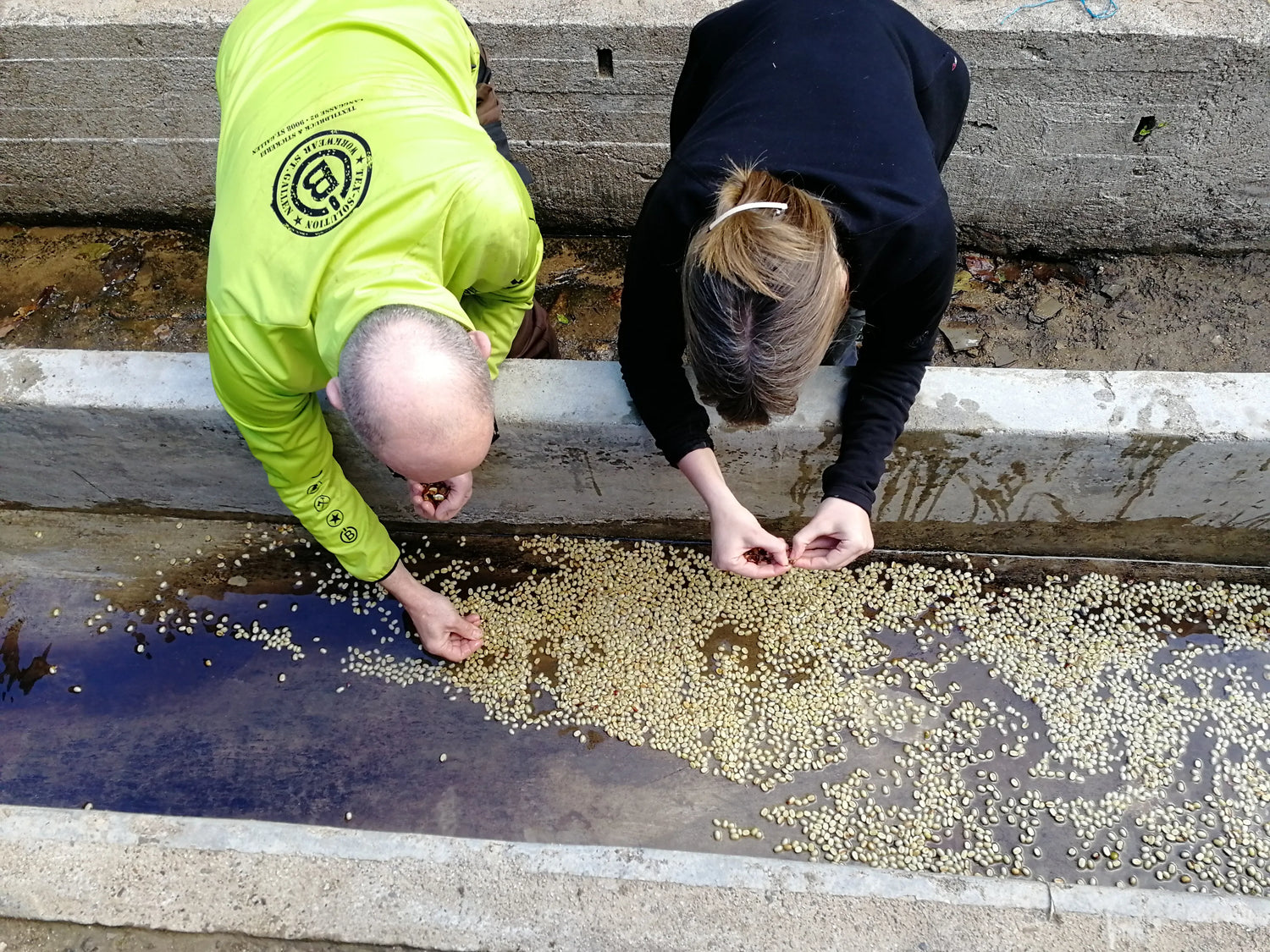
Dry-processed coffees only require fresh water if the cherries are floated in a water channel before drying – the cherries that float to the top are removed. They are less dense and could have a defect.
Likewise, it is hardly surprising that coffee grown in full sun requires more water because it is often artificially irrigated. This is in contrast to coffee production in partial shade or in an agroforestry system, where the coffee plants are surrounded by shade trees.
Realistic water consumption
In 2003, researchers had difficulty obtaining precise farm data. For this reason, they, and other scientists in the following years, relied on databases. This led much more to assumptions than to certainties. The 140 liters per cup of coffee naturally sound catchy and are effective in the media.
But:
how much water does it really take to produce coffee for a cup of coffee? I asked our friends at Apas (Brazil), Cima Coffee (Honduras), Chacra d'Dago (Peru), and Mount Sunzu (Zambia). In short: it is not 140 liters per cup of coffee.

Mount Sunzu – Zambia: 22 liters
Washed processed
Luca Costa from Mount Sunzu wrote to me:
«I have looked at our calculations for the dimensioning of our irrigation system. I think the most important comment right at the beginning: These are our numbers for our farm and our processing, i.e., an operational example and not a general value for coffee in general.»
He is right about that. That is exactly the point: to make specific calculations, to analyze, and to adjust as needed.
Cultivation/Irrigation: 568.5 liters per kg Cherry Processing: 0.9 liters per kg Cherry Green Coffee: 3,410 l per kg With a roasting loss of 20%, Luca arrives at 32 l of water per cup (7 g). That is 77% less than the study says. Luca calculates conservatively, meaning with rather high numbers. He assumes that the real water consumption in cultivation is 30% lower, and would then arrive at 22 l per cup (-84% compared to 140 l).

Yair Keidar, Cima Café, Honduras: < 1 liter
Washed processed
«Indeed, in Honduras very little if any coffee farms use irrigation, so this is not really a big factor in water usage.» Water for irrigation is hardly or not at all used in Honduras. However, for processing, the large majority of producers in Honduras use wet processing. There, efficiency depends on the existing equipment.
It is interesting that IHCAFE – the Honduran Coffee Institute – picks up the 140 liters again as a figure:
There is a «limit» of 140 liters of water per quintal (bag) that the IHCAFE supposedly enforces, and a producer risks a fine if they exceed this amount of water.
There are the 140 liters again. They are the vague and methodologically questionable basis for a law that could fine producers if they use more than 140 liters for the processing of 69 kg of green coffee.
At Finca San José in Santa Bárbara for example, total farm yield is about 80–120 bags (69 kg bags) and they are usually using around 130 liters per bag of washed coffee.
That would then be 1.9 l per kilo of green coffee. For 7 g of roasted coffee, it would consequently be 17 ml. For comparison: the espresso machine itself uses around 60–80 ml of brewing water for a double shot. The process water for the entire wet processing is therefore less than a quarter of the water you pour directly into the machine.

Chacra d'Dago, Peru: < 1 liter
Washed processed
Fresh water is used at Chacra d'Dago only for processing the cherries when coffee is wet-processed. The water in the floater tanks, where cherries are sorted, is cleaned and reused.
Based on our records and operational practices, water use can be estimated in a range of approximately 90,000 to 152,000 liters, which is about 0.8 liters of water per kg of cherry under an efficient water management system.
0.8 l of water per kg of cherries is then about 35 ml per 7 g of roasted coffee, 99% less than 140 l of water. The modern facility with a closed flotation circuit is very efficient and cleans the water, which would bring the value even lower.

Apas, Brazil: 0 liters
Dry processed
At Apas, the coffee plants are not artificially irrigated, and the cherries are dry-processed as naturals. Thus, they consume not a single liter of fresh water. What was not included in all calculations is the amount of fresh water for liquid fertilizer applied to the leaves. However, these would be minimal volumes and would not change the calculations.
For washed coffees from the region, according to Mauricio from Apas, 30 l per 60 kg of green coffee would be used for washing. Another 50 l for depulping. Combined, that would be 11.6 ml per cup, which is again 99.9% less than 140. That would then be 4.4 ml per cup of coffee.
What real water problems are
The 140-liter figure is no longer relevant today, but it still persists stubbornly. Yet we need to talk about other water problems that really have an impact and endanger local ecosystems.
Irrigation in water-scarce regions
It is necessary to look closely at which sources the water comes from when coffee is artificially irrigated. According to the Brazilian agricultural research agency EMBRAPA, 14% more coffee plantations in Brazil have been artificially irrigated from 2022 to 2024. Wherever high yields are to be achieved (e.g., also Vietnam), the water demand must be checked precisely.
Wastewater from wet processing
Coffee wastewater contains tannins, phenols, and alkaloids that inhibit biological degradation. Oxygen is depleted, and anaerobic conditions are created. Unpurified wastewater is highly organic, which has a deadly effect on river organisms and is not drinkable. I have visited farms that fed agua miel, the wastewater from washed production, unfiltered into the fields. I have also seen farms that had state-of-the-art water purification plants and actively addressed the problem.
Climate change and changing precipitation patterns
However, the biggest water problem for coffee is yet to come: Climate Central documents an average of 47 additional days per year with temperatures over 30°C in the 25 most important growing countries for 2026. This makes shade, water storage, and artificial irrigation increasingly important.