






Refractometers are scientific instruments that measure the refractive index of a liquid – put simply, how strongly light is bent in a medium. In the coffee world, the refractive index is directly related to the concentration of dissolved substances in the coffee beverage, known as Total Dissolved Solids (TDS). The TDS value indicates what percentage of the drink consists of dissolved coffee components – it is a measure of coffee strength. A stronger coffee has a higher TDS percentage, a weaker one correspondingly a lower one. By measuring TDS, baristas can objectively assess extraction during the brewing process and make it reproducible.
However, not every refractometer from laboratory supplies is suitable for coffee. A standard Brix meter measures sugar (1 °Bx = 1 g sucrose in 100 g solution). For coffee, you need a conversion factor: 10 °Bx equals approximately 8.5% TDS (factor ~0.85). Cheap hand-held Brix meters also have only coarse scales (resolution often 0.2 °Bx ≈ 0.1% TDS) – too imprecise for the fine differences in filter coffee (~1.3% TDS). Specialized coffee refractometers are precisely calibrated for coffee solutions and provide digital displays with two decimal places in seconds.
Percent dissolved coffee components (TDS) · typical reference values
Reference values · may vary depending on recipe and roast
TDS Says Nothing About Quality – In a Nutshell
The TDS value alone provides no information about the actual sensory quality of an extraction. Tasting is essential for quality assessment. Nevertheless, a refractometer helps in many ways:
- The strength or concentration of dissolved coffee particles can be measured.
- TDS is the prerequisite for calculating extraction. This gives us an indication of whether a coffee is under- or over-extracted.
- The values signal changes in materials (e.g., dulling burrs), water, pressure, coffee aging, or channeling.
- Different espresso machine types, baskets, tamping techniques, and fill amounts can be compared with their extraction analysis.
- Different coffees (origin, altitude, variety) can be newly discovered when they show very different extraction values under constant parameters.

VST refractometer in use
Overview of Common Coffee Refractometers
In specialty coffee, some digital refractometers have established themselves, varying in precision, features, and price. Here's an overview of the three most well-known models:
| Model | Accuracy | Price | Special Feature |
|---|---|---|---|
| VST LAB Coffee III | ±0.02 % (Filter) ±0.05 % (Espresso) |
~€1,000 | Gold standard, sapphire optics, software included |
| Atago PAL-COFFEE | ±0.15 % | ~€450 | Robust, waterproof, up to 100 °C |
| DiFluid R2 Extract | ±0.02 % | ~€250 | Bluetooth app, USB rechargeable, IP67 |
VST LAB Coffee III
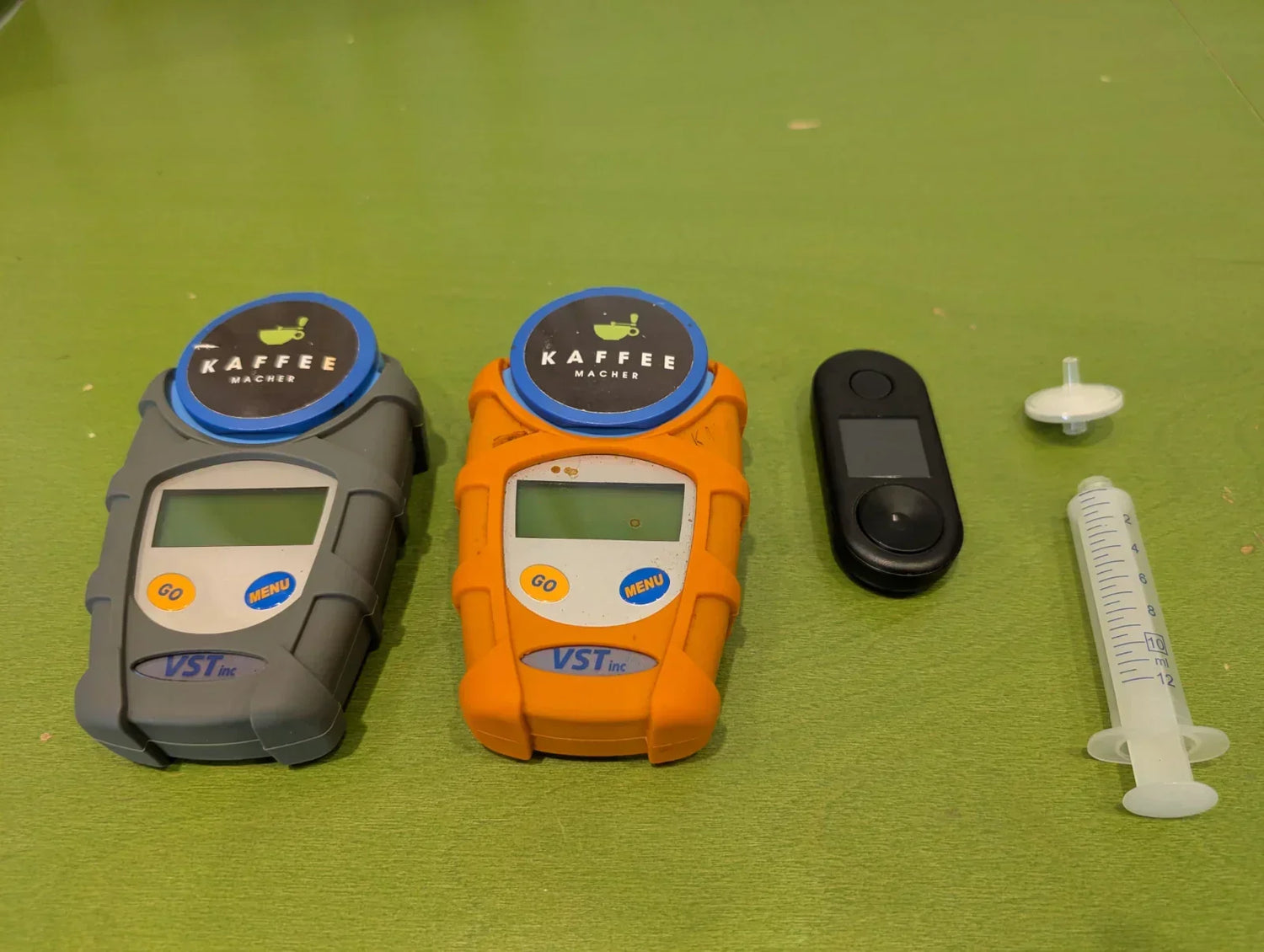
The Lab Coffee Refractometer from Voice Systems Technology (VST) is considered the industry gold standard. We have three units – and they've been serving us for over ten years.
The VST refractometer measures from 0.00% to approximately 20% TDS with an accuracy of ±0.02% (typical). Automatic temperature compensation in the range 15–40 °C, sapphire optics, and a 1024-pixel sensor array ensure reliable measurements. VST supplies CoffeeTools software directly – it has been used at world championships (Brewers Cup, Barista Championship) as the official tool for years. The price is in the four-digit range.
Atago PAL-COFFEE
The PAL-COFFEE from Japanese manufacturer Atago is a handy pocket refractometer. We've had a PAL-Coffee refractometer in use since 2018 – in brewing courses and at championships.
Measurement time ~3 seconds, automatic temperature compensation up to 100 °C, accuracy ±0.15% TDS. Sufficient for espresso, somewhat coarse for filter coffee. Its robust, waterproof design makes it ideal for the hectic café environment.
DiFluid R2 Extract
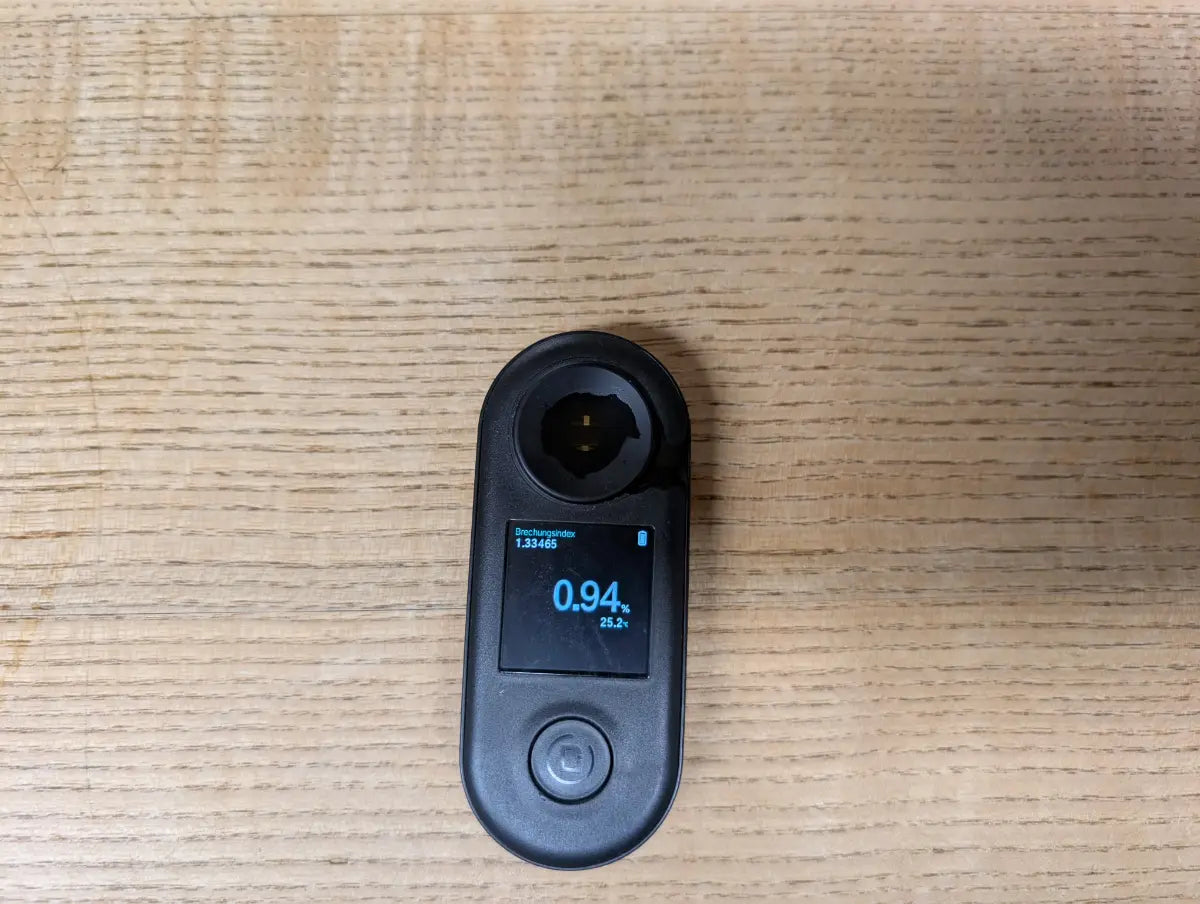
The DiFluid R2 Extract from China has been making waves since 2022 as a budget-friendly alternative. Despite its low price, it offers ±0.02% TDS accuracy, is USB rechargeable, and IP67 waterproof. So if an espresso spills on it, no problem.
Particularly practical: Via Bluetooth, the R2 connects to the DiFluid Café app, which stores measurements, creates statistics, and updates the device. An ideal tool for ambitious home baristas or as a second refractometer to take along.

They are often only designed for high Brix values, too imprecise in the low TDS range, and require manual reading. Anyone who wants to work seriously with coffee measurement will reach for the coffee-specific devices mentioned above.
Operating Principle and Correct Use
The refractometer sends a light beam through the sample onto a prism and measures the angle at which the light exits. The more concentrated the solution, the more strongly the light is bent. Beyond a certain angle of incidence, total reflection occurs – this critical angle depends directly on the refractive index of the liquid. The device calculates the TDS value from the critical angle.
Since coffee consists of hundreds of chemical compounds, the relationship between refractive index and TDS is not simply linear. VST analyzed thousands of samples during development – refractometrically and by drying – to develop their algorithms. Modern coffee refractometers contain these empirical curve formulas as a chip, so light refraction becomes reliable percentage readings.
Equally important is temperature compensation. Heat changes the density of a liquid and thus the refractive index. All high-quality devices have automatic temperature compensation (ATC), but the rule is: For the highest accuracy, let the sample cool to room temperature, especially for espresso.
Coffee solutions – especially espresso – always contain finest insoluble particles and emulsified oils that distort the refractive index. For precise measurements, use filter paper or syringe filters (e.g., 0.5 µm pore size). Filtered espresso samples typically show a slightly lower, but more reproducible TDS value.
Step by Step: How to Measure with a Refractometer
Understanding Coffee Strength (TDS) and Extraction Rate (EY)
Once you've determined the TDS value, the question arises: Is that good or bad? This is where extraction rate (Extraction Yield, EY) comes in. It indicates what percentage of the original coffee grounds passed into the solution. If you brew 20 g of coffee and end up with 4 g of it dissolved in the cup, you've extracted 20%. Under-extraction yields sour, thin taste; over-extraction leads to bitterness. Balance is traditionally found at 18–22% extraction.
Formula for determining Extraction Yield (EY)
17.8 % is slightly below the ideal range (18–22 %) – a bit more body would have been possible.
However, strength (TDS) itself also affects the sensory experience. An espresso with 10% TDS and 20% extraction tastes fundamentally different from filter coffee with 1.3% TDS at 20% extraction – despite identical extraction rate. The former is ten times more concentrated. For different brewing methods, typical TDS ranges have therefore established themselves: filter coffee approx. 1.2–1.5%, espresso approx. 8–12%, Moka pot approx. 3–5%, French press approx. 1.2–1.7%, cold brew typically 1.4–1.6%, cupping approx. 1.2–1.4%.
SCA Standard · Extraction vs. Strength (TDS)
SCA Golden Cup Standard · for filter coffee · kaffeemacher.de
Apps and Software as Helpers
Today no barista has to manually reach for a calculator and brewing diagram. There are apps designed specifically for this and often work seamlessly with the refractometers:
- VST CoffeeTools: The software developed by VST (PC/Mac) takes TDS, coffee amount, and beverage weight and calculates extraction and graphical analysis. Included with the purchase of a VST refractometer.
- MoJo To Go: A mobile app from VST – famous because it ran on iPod Touch from 2010 and first brought baristas an "extraction toy" in their back pocket. I only bought an iPhone back then because of this app. Today part of the CoffeeTools family.
- DiFluid Café App: Receives TDS live via Bluetooth, calculates extraction rate after entering dose and output, and shows your brew as a point in the SCA brewing chart. Values can also be integrated into Bean Conqueror.
- SmartRef Coffee Meister: App from Anton Paar for their SmartRef laboratory refractometer. Calculates TDS and extraction – more for roasters and laboratories.
Strength remains constant at 1.35% · Extraction varies from 14% to 28%
underdeveloped
Golden Cup Standard
dry finish
This is my absolute favorite recommendation as an exercise to improve your own sensory skills: Lock TDS to 1.35% and then work through all extraction values from 14 to 28%. The strength remains the same, but you notice very clearly how under- and over-extraction feel at identical intensity. No textbook conveys this as clearly as this direct comparison.
Critical Reflection: Accuracy, Sources of Error, and Usefulness
For all the enthusiasm about precise measurements: A refractometer is a tool, not a taste oracle.
- Absolute accuracy vs. practice: Manufacturers advertise ±0.02% TDS. In practice, real deviation can be higher, depending on calibration and careful handling. The Atago has ±0.15% – an actual TDS of 1.30% could thus be displayed as 1.15% or 1.45%. For comparative measurements (recipe A vs. B), all devices are sufficiently accurate. But: No palate in the world tastes the difference between 1.37% and 1.40% TDS.
- Sources of error: Residue from the last coffee on the prism, sample not properly mixed, not filtered, measured too hot – all of this distorts the value. Always mix well, pipette carefully, zero the device. Repeat measurements should differ by max. ±0.03%, otherwise there's a user error.
- Oils in espresso: Coffee oils are hydrophobic and as an emulsion can slightly affect the refractive index. Therefore: Always proceed the same way – either always filter or never filter. In competitions and labs, filtration is standard.
- TDS is not taste: The refractometer measures quantity, not quality. Two coffees can have identical TDS and EY and taste completely different. Numbers don't lie, but they don't tell the whole story. A high extraction value of 24% doesn't necessarily indicate over-extraction – if the coffee still tastes good, it isn't.
- Eyebrow raising in the community: There were comments like "If you don't know TDS and EY, you're not a competent barista." That caused understandable frustration. Today, the discussion is more objective. The refractometer demystifies some aspects of brewing but doesn't take away from creativity or sensory fine-tuning.
If the coffee tastes watery and the refractometer confirms 1.0% TDS (instead of 1.3%), you objectively know: too thin – next time more dosage or finer grind. This way you learn to connect cause and effect faster.
Scientific Context and New Insights
Full Immersion, Fixed Extraction
In 2021, a study (Liang et al., Scientific Reports) showed that in immersion brews, the extraction rate is fixed within a narrow range – a thermodynamic equilibrium. In cuppings between 80 °C and 99 °C, equilibrium extraction was always around ~20%, regardless of water amount. More water dilutes the coffee (TDS drops) but doesn't significantly increase extraction percentage.
TDS vs. Taste – Cold Brew vs. Hot Brew
In 2022, Batali et al. investigated the sensory difference between cold brew vs. hot-brewed coffee at identical TDS (~2%). Result: hot-brewed coffee tasted more bitter and sour, cold-brewed tasted sweeter and more floral. Brewing temperature thus influences which substances dissolve – even if the total amount is the same.

Grinding, Fines, and Extraction Dynamics
A 2024 paper (Smrke et al., Scientific Reports) investigated the impact of fines on espresso extraction. More fines → lower permeability, slower flow, higher extraction yield. But: Aroma compounds don't increase linearly with extraction. Beyond a certain point, volatile aromas dissipate during longer pulls. An espresso with 25% extraction might have less aroma in the cup than one with 22%. Learning: A uniform grind with moderate fines content promotes both flow and taste balance.
Conclusion on Refractometers
Refractometers have evolved from laboratory equipment to a secret weapon of modern coffee brewing. In my daily brewing practice, the refractometer rarely comes out – but for test series, championship preparation, and recipe setting in our cafés, it's a central tool.
Especially when preparing for national Brewers Cup championships – and also at the World Brewers Cup in Rimini 2024 – the refractometer helped me understand filter coffee and espresso brewing much better. It also helped improve my own sensory skills. Twelve years after buying my first refractometer, I still love the game of brewing, guessing TDS, and measuring – even when you're wrong, you learn something.
Models like the VST, Atago, or DiFluid offer the right tool for various needs. Combined with apps, dialing in recipes becomes data-driven fun. Nevertheless, the rule stands: The numbers serve the taste, not the other way around. A refractometer tells you what happened – whether the result is good, your tongue and nose decide.
Ultimately, refractometers are a valuable tool for ensuring consistency and supporting learning processes. When you bring both together – sensory expertise and measurement data – you can almost alchemically work toward coffee perfection. May your coffee be delicious and your TDS on point. ☕️